

Walmart Q2 Earnings: Revenue Beat and Guidance Raise Fail to Prevent Stock Drop on EPS Outlook Miss
2026/08/21 15:27:00
Introduction
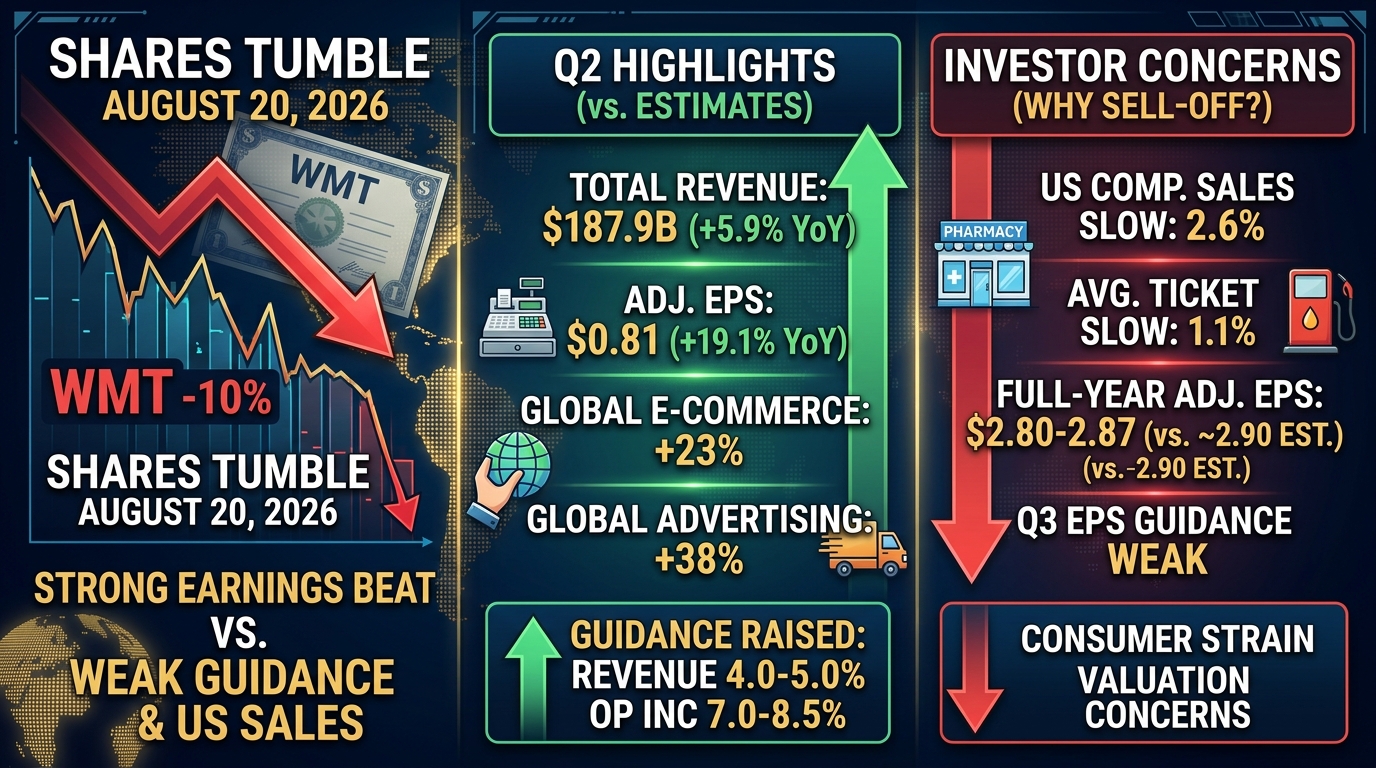
Walmart shares tumbled nearly 10% on August 20, 2026, even after the retailer delivered stronger-than-expected second-quarter results. According to Walmart’s official Q2 FY27 earnings release, total revenue reached $187.9 billion, up 5.9% year-over-year and above consensus estimates near $186.8 billion.
Adjusted earnings per share hit $0.81, rising 19.1% and beating forecasts around $0.74. Management raised full-year net sales and adjusted operating income guidance. Yet the full-year adjusted EPS outlook of $2.80–$2.87 fell short of Wall Street’s roughly $2.90 consensus, while U.S. comparable sales slowed to 2.6%. Investors focused on the guidance shortfall and softer consumer trends, driving the sharp sell-off.
What Were the Key Highlights of Walmart’s Q2 FY27 Earnings?
Walmart reported solid top-line growth and operational strength in its fiscal second quarter ended July 31, 2026. Revenue of $187.9 billion rose 5.9% year-over-year, or 5.1% on a constant-currency basis, exceeding market expectations of approximately $186.8 billion, based on data from the company’s August 20, 2026 earnings materials.
Global e-commerce sales surged 23%, accounting for a larger share of total net sales. Walmart U.S. e-commerce grew 24%, driven by store-fulfilled delivery and marketplace expansion. Global advertising revenue climbed 38%, with Walmart U.S. advertising also up 38%. Membership fee revenue increased 17% worldwide.
Operating income grew 28.8% to $9.383 billion, or 17.4% on an adjusted constant-currency basis. Gross margin expanded 96 basis points to 25.4%. Management noted that tariff refunds provided a temporary boost, partially offset by price investments. Excluding this net impact, underlying operating income growth sat at the high end of prior guidance.
GAAP net income fell 9.4% to $6.366 billion, and diluted EPS declined 9.1% to $0.80, primarily due to net losses on equity and other investments. Adjusted EPS of $0.81 better reflected core performance after excluding those items and a related tax benefit.
Why Did Walmart’s U.S. Comparable Sales Slow in Q2?
U.S. comparable sales growth decelerated to 2.6%, the slowest pace in more than six years and below analyst expectations of 3.5% to 3.8%, according to reports citing FactSet and LSEG data following the August 20 release. Transactions rose 1.5% while average ticket increased only 1.1%, a sharp slowdown from the prior year’s 3.1% ticket growth.
Pharmacy sales created an approximate 80-basis-point headwind after federal maximum fair price regulations took effect. Excluding health and wellness, comparable sales would have reached about 3.4%. Higher gasoline prices also pressured lower- and middle-income shoppers, prompting trade-offs in discretionary spending.
Sam’s Club U.S. performed more strongly, with comparable sales up 4.4% excluding fuel and net sales rising 8.8% to $25.7 billion. International sales grew 7.9% on a constant-currency basis, led by China and India. These segments helped offset the softer Walmart U.S. store trends.
How Did Walmart Raise Its Full-Year Guidance Despite the Challenges?
Walmart increased its fiscal 2027 outlook across key metrics, signaling confidence in its long-term growth drivers. Net sales growth guidance on a constant-currency basis rose to 4.0%–5.0% from the previous 3.5%–4.5% range. Adjusted operating income growth guidance moved to 7.0%–8.5% from 6.0%–8.0%. Adjusted EPS guidance increased to $2.80–$2.87 from $2.75–$2.85.
The raise reflected strength in e-commerce, advertising, and membership businesses, which deliver higher incremental margins. Management plans to continue investing tariff refunds into price reductions and customer experience to drive volume and share gains. Capital expenditures guidance also edged higher to approximately 4.0% of net sales.
For the third quarter, Walmart guided constant-currency net sales growth of 3.0%–3.75% and adjusted EPS of $0.62–$0.64. Adjusted operating income is expected to grow 2.0%–4.0%. The Q3 outlook incorporates a timing shift related to Flipkart’s Big Billion Days event and ongoing price investments.
Why Did Walmart Stock Drop After Beating Estimates?
Shares fell as much as 10% and closed down approximately 9% on August 20, 2026, wiping out tens of billions in market value. Investors reacted to two primary factors: the full-year adjusted EPS guidance midpoint remaining below consensus estimates near $2.90, and the softer-than-expected U.S. comparable sales that raised questions about consumer resilience.
The operating income surge included a sizable net benefit from tariff refunds. CFO John David Rainey emphasized that remaining refunds would be prioritized for price investments in the second half, advising investors to view Q2 and Q3 together for a clearer picture of underlying growth. Q3 EPS guidance also came in below many analyst forecasts, reinforcing near-term caution.
Valuation concerns played a role. Walmart had traded at a premium multiple reflecting its consistent execution and digital momentum. A quarter of essentially flat sequential earnings growth expectations challenged that premium. Broader market pressure from rising yields and inflation worries amplified the reaction.
What Role Did E-Commerce, Advertising, and Membership Play in the Results?
High-margin digital businesses provided the primary growth engines. Global e-commerce net sales rose 23% and represented roughly 24% of total net sales. Marketplace sales in the U.S. grew more than 50% in some reported metrics, while store-fulfilled delivery accelerated.
Advertising revenue expanded 38% globally, benefiting from increased scale and better targeting across channels. Membership income grew 17%, supported by higher penetration at Sam’s Club and Walmart+. These streams improved overall profitability and helped expand gross margin despite price investments in the core retail business.
Management highlighted multi-year consistency in e-commerce growth above 20% for Walmart U.S. as evidence of durable competitive advantages in speed, assortment, and convenience. These areas remain central to the raised full-year outlook.
KuCoin Offers A More Stable Option in A Volatile Market
If you worry about the frequent ups and downs in the market, and pursue a more stable option to earn money passively, KuCoin is the right place to come:
-
Simple Earn: Deposit and withdraw tokens anytime, earning stable returns.
-
Kucoin Earn: Earn stable profits with professional asset management.
-
Hold to Earn: Earn rewards by holding assets in Funding, Trading, Margin, Futures, Mining, and Unified Accounts.
-
Staking: Unlock the earning potential of on-chain assets.
-
Advanced Investments: Advanced Investments offer a variety of structured products to help your money grow in any market.
-
Shark Fin: Principal Protection and Guaranteed Gains
-
Dual Investment: Buy low and sell high with transparent return calculations.
-
Snowball: High yields, with price protection.
-
Discount Buy: Buy crypto at discount prices.
-
KCS Loyalty: Level up to enjoy exclusive perks by staking ≥ 1 KCS.
-
KuCoin Wealth: Discover future value and begin your smart investing journey.
-
KCS Benefits: Hold and stake KCS to access benefits across the platform.
-
KCS Staking 2.0: Participate in KCS on-chain governance to earn yield.

Conclusion
Walmart delivered a revenue and adjusted EPS beat in Q2 FY27 while raising full-year sales and operating income guidance, driven by 23% global e-commerce growth, 38% advertising expansion, and resilient membership trends. U.S. comparable sales slowed to 2.6% amid pharmacy headwinds and higher fuel costs, and the adjusted EPS outlook of $2.80–$2.87 missed higher consensus expectations. These factors triggered a roughly 9–10% stock decline on August 20, 2026, according to market reports following the earnings release.
Core operations remained healthy, with underlying profitability supported by digital high-margin businesses and planned price investments from tariff refunds. The results underscore Walmart’s ability to gain share even in a pressured consumer environment, yet they also highlight near-term sensitivity to guidance details and economic signals. Investors will watch Q3 execution closely for evidence that volume growth offsets the planned investments. Overall, the quarter reinforced the durability of Walmart’s multi-channel model while reminding markets that premium valuations leave little room for perceived shortfalls.
FAQs
What caused Walmart’s GAAP net income to decline in Q2?
Net losses on equity and other investments drove the 9.4% drop in GAAP net income to $6.366 billion, rather than weakness in core retail operations.
How much did Walmart’s global e-commerce sales grow?
Global e-commerce sales increased 23% year-over-year, with Walmart U.S. e-commerce up 24%.
What is Walmart’s updated full-year adjusted EPS guidance?
The company now expects adjusted EPS of $2.80 to $2.87 for fiscal 2027, up from the prior $2.75 to $2.85 range.
Why did U.S. comparable sales miss expectations?
Pharmacy pricing changes from federal regulations created an approximate 80-basis-point headwind, while higher gasoline prices led to more cautious consumer spending.