

Vitalik Buterin: AI Won’t Destroy Cybersecurity—Why He Still Holds 90% of His Wealth in Crypto
Vitalik Buterin Argues AI Could Strengthen Cybersecurity Through Formal Verification
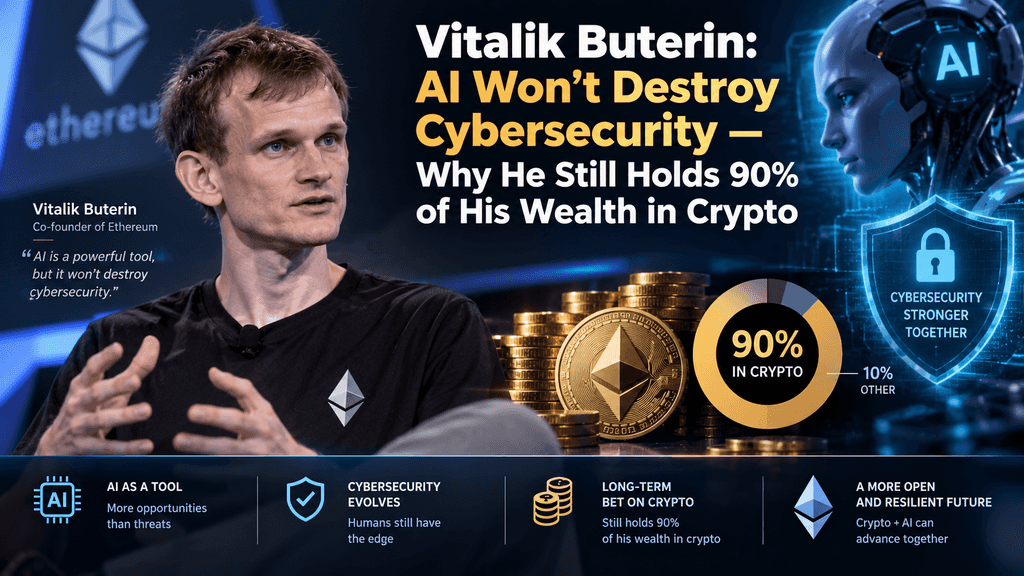
Ethereum co-founder Vitalik Buterin has publicly rejected the growing view that advanced artificial intelligence will render cybersecurity unwinnable. In a detailed post on X dated September 16, 2026, he stated that cybersecurity remains fundamentally defense-favoring once rigorous methods are applied and that continued cryptocurrency holdings represent an implicit bet on this outcome. He noted that cryptocurrency accounts for approximately 90 percent of his own net worth. The comments arrived amid broader discussions of AI-powered attacks on digital infrastructure and followed an earlier exchange in which he dismissed predictions of a sharp Bitcoin price decline driven by security failures.
Buterin’s position centers on the potential of AI-assisted formal verification to prove that complex software satisfies precisely defined security properties, shifting the balance from reactive bug hunting toward proactive mathematical assurance. This stance carries particular weight for Ethereum, where scalability and privacy upgrades demand higher confidence in underlying code. Vitalik Buterin’s September 2026 statements establish that AI will ultimately favor defenders through formal verification of software security properties, a conviction reinforced by his continued allocation of roughly 90 percent of personal net worth to cryptocurrency assets.
Vitalik’s Direct Pushback Against Claims That AI Hacking Dooms Cybersecurity
In his September 16, 2026, X post, Vitalik Buterin addressed what he described as an increasingly common take that AI-driven hacking will make cybersecurity doomed. He disagreed, asserting that cybersecurity is naturally defense-favoring once participants apply disciplined methods. He explicitly linked this assessment to cryptocurrency ownership, writing that anyone who continues to hold cryptocurrency, including himself, with roughly 90 percent of his net worth, is implicitly betting on the viability of secure digital systems. Buterin framed the issue not as an inevitable offensive advantage for attackers but as a transition problem that rigorous engineering can solve.
He positioned formal verification as the practical pathway, arguing that sufficiently capable AI systems capable of proving difficult mathematical results could also establish that a given program meets its security specification. The post arrived against a backdrop of industry concern about automated vulnerability discovery, yet Buterin maintained that the same capability that accelerates attacks can accelerate the construction of proofs that close those attack surfaces permanently. This framing elevates personal capital allocation from a simple portfolio choice to a public signal of technological conviction.
Formal Verification as the Mathematical Path to Proving Programs Secure
Buterin’s core technical claim rests on formal verification, the practice of using mathematical specifications and proofs to demonstrate that software behaves according to predefined properties across all relevant states rather than merely testing selected scenarios. He argued that if AI can prove results such as the Navier-Stokes equations or Fermat’s Last Theorem, the same reasoning power can prove the statement that a given program is secure, even when the program itself is complicated. Formal verification has long been applied in high-assurance domains such as aerospace and cryptography; the novelty in Buterin’s view is that AI lowers the cost and expands the feasible scope of these proofs.
Once a proof is machine-checked and accepted, it remains permanent, whereas an attacker discovering a previously unknown vulnerability is a one-time event. This asymmetry underpins the claim that cybersecurity favors defense over the long term. The method does not eliminate the need for careful specification writing; it amplifies the effectiveness of well-crafted specifications. By treating security claims as mathematical theorems, developers move from probabilistic confidence based on testing coverage to deterministic assurance within the boundaries of the chosen model. This move is especially relevant for blockchain systems where a single subtle flaw can affect large volumes of value. The argument therefore reframes AI from a pure threat into a dual-use tool whose defensive application can dominate once the industry invests in the necessary tooling and discipline.
Defining Security Across Keys, Servers, Operating Systems, and Full Stacks
A critical caveat in Buterin’s reasoning is that the meaning of “secure” must itself be defined with sufficient breadth. Security definitions can exceed one thousand lines of formal specification because they must address key management, server compromise, operating-system integrity, databases, network layers, caches, side-channel leakage, and supply-chain risks. Mathematical proofs only confirm the properties that are explicitly included; risks outside the model remain unaddressed. Buterin therefore emphasized that AI can assist not only in generating proofs but also in examining specifications for incompleteness and strengthening them before deployment.
The practical implication is that teams cannot limit verification efforts to isolated security-critical components; they must eventually cover the interactions among components. This full-stack perspective raises the engineering bar but also raises the confidence ceiling. For systems that combine high scalability with privacy features, incomplete definitions leave residual attack surfaces that automated tools can exploit. By insisting on comprehensive definitions, Buterin redirects attention from headline-grabbing attack successes toward the quieter work of specification quality. The result is a more realistic assessment of both the power and the limits of formal methods in complex production environments.
Ethereum’s Multi-Year Direction Toward AI-Enabled Full-Stack Verification
Buterin stated that Ethereum’s development over the coming years will advance along the formal-verification path he outlined. Blockchain systems that pursue both scalability and privacy features particularly require this foundation; without stronger software security guarantees, those features risk expanding rather than contracting the attack surface. Ethereum Foundation research has already treated formal verification as cross-cutting tooling across several long-term protocol tracks. Security teams have begun using AI agents to inspect protocol code and independently reproduce vulnerabilities, according to September 17 reporting from crypto.news. Researchers are working toward architectures in which validators verify succinct execution proofs rather than re-executing every block.
Additional efforts combine AI agents with machine-checked proofs for client implementations, protocol compliance, and zero-knowledge virtual-machine infrastructure. These initiatives align with the broader technical roadmap that places formal verification alongside privacy, zero-knowledge proofs, and post-quantum protection. The direction reflects recognition that conventional testing and human review alone will not scale to the complexity of next-generation protocol upgrades. By embedding verification into the research agenda, Ethereum positions itself to absorb AI capabilities as a defensive multiplier rather than merely reacting to offensive advances. The multi-year horizon underscores that the transition Buterin described is an engineering program, not an overnight switch.
Existing Projects Demonstrating Formally Verified Cryptographic Building Blocks
Concrete projects already illustrate the approach. Arklib is developing a formally verified implementation of STARKs, a major family of zero-knowledge proof systems, inside the Lean theorem prover. Every component from polynomial arithmetic through the FRI protocol and Merkle commitments is intended to carry machine-checked proofs of correctness. A related effort, evm-asm, constructs an Ethereum Virtual Machine abstraction designed for formal analysis. Additional work covers Rust-to-Lean verification pipelines that extract production cryptographic code, generate specifications, and close proof obligations with AI provers while retaining kernel-checked soundness.
Reports from mid-2026 and September updates confirm active formalization of sum-check protocols, Spartan, Merkle trees, FRI-related coding theory, and other primitives. These efforts demonstrate that end-to-end verification of critical cryptographic infrastructure is progressing from a research prototype toward a reusable library. The existence of such projects supplies empirical grounding for Buterin’s claim that the necessary tooling is emerging. Developers can examine the public repositories and release notes to assess the current coverage and remaining gaps. Progress in these libraries reduces the marginal cost of applying formal methods to new protocol components and supplies reusable verified building blocks for higher-level systems.
Personal Wealth Allocation as an Explicit Bet on Defensive Technology
Buterin repeatedly connected his technical outlook to personal capital allocation. By stating that roughly 90 percent of his net worth remains in cryptocurrency, he presented continued ownership as an implicit wager that highly secure digital systems can be constructed despite stronger automated attackers. The figure appeared both in the September 16 cybersecurity post and in the earlier September 7 response to predictions of a major Bitcoin price decline. Contemporaneous coverage clarified that the statement does not imply a pure Bitcoin position; the bulk of known holdings are in ether and related assets, so the exposure is best understood as a broad commitment to the resilience of decentralized systems.
Market data on September 17 placed Bitcoin near 76,000 dollars and ether near 2,400–2,460 dollars, illustrating the scale of value tied to these security assumptions. The disclosure functions as a high-signal data point because it is voluntarily offered by a principal figure whose technical judgments have historically influenced protocol direction. Readers can cross-reference the wealth statement with on-chain transparency reports and prior foundation-related comments to form an independent view of consistency. The linkage of capital and conviction supplies a practical example of how long-term security optimism can be expressed outside pure research papers.
Earlier September Exchange on AI Risk to Bitcoin’s Core Security
On September 7, 2026, Buterin responded to an assessment by investor Liron Shapira that assigned a 50 percent probability to Bitcoin falling more than 50 percent within two years because artificial intelligence could undermine security assumptions. Buterin took the opposite side, stating that he remains optimistic about cybersecurity over the long term and views the primary difficulty as managing the transition. He expected Bitcoin to handle issues that do not require broad social consensus, such as client or mining-pool adjustments, and placed an extremely low probability on fundamental breaks in hashing functions or proof-of-work.
He noted that his existing holdings already constituted the equivalent of a large bet against the crash scenario, again citing the approximate 90 percent net-worth figure. The earlier comments establish continuity: the later formal-verification post is not an isolated reaction but an elaboration of a consistent security thesis. Together, the two statements form a coherent public position spanning both short-term price-risk narratives and longer-term architectural strategy.
Results for Scalability and Privacy Upgrades on Blockchain Networks
Systems that simultaneously pursue high throughput and strong privacy properties expand the surface that must be secured. Zero-knowledge proofs, recursive proof systems, and complex state-transition logic introduce subtle correctness requirements that conventional testing struggles to exhaust. Formal verification offers a path to higher assurance precisely because the security claims can be stated mathematically and checked mechanically. Buterin’s argument implies that without progress on verification tooling, ambitious scalability and privacy roadmaps face elevated residual risk. Conversely, successful application of AI-assisted proofs can unlock those features with greater confidence.
Ethereum’s research tracks already treat verification as enabling infrastructure for these goals. The practical consequence is that protocol teams must allocate engineering effort to specification quality and proof infrastructure in parallel with performance work. Market participants evaluating long-term protocol health can therefore monitor the maturity of verification libraries and the integration of verified components into production clients as leading indicators of defensive readiness. This perspective shifts attention from purely quantitative metrics such as transactions per second toward qualitative measures of assurance depth.
Balancing Accelerated Offensive Capabilities with Defensive Tooling Gains
Frontier AI systems can accelerate vulnerability discovery and attack design, as acknowledged by multiple research organizations. Anthropic and other labs have reported models identifying large numbers of flaws. Buterin does not deny this offensive progress; he contends that the identical advances in machine reasoning can lower the cost of constructing formal proofs and of refining security specifications. The decisive variable becomes institutional and engineering discipline rather than raw model capability. Once proofs exist and are machine-checked, they persist; individual exploits remain discrete events.
This asymmetry supports the claim that defense can regain and maintain the advantage provided teams invest in the necessary methods. Industry observers can track the ratio of verified critical components to total critical surface area as a concrete metric of progress. The September statements therefore serve as both a technical forecast and a call for the industry to organize around verification rather than solely around detection and response.
Space Context for High-Assurance Methods in Value-Critical Code
Formal methods have historically been reserved for domains in which failure costs are extreme. Cryptographic libraries, consensus-critical code, and zero-knowledge circuits now fall into that category because of the financial and systemic value they secure. The emergence of reusable verified libraries such as Arklib and supporting verification pipelines indicates that the barrier to entry is falling. AI assistance further reduces the specialist labor required for many proof obligations while preserving soundness through kernel checking.
Ethereum’s decision to treat formal verification as cross-cutting tooling reflects recognition of this shift. Other blockchain ecosystems and traditional financial infrastructure operators face analogous pressures as automated attack tools improve. The September 2026 discussion therefore contributes to a broader conversation about the appropriate assurance level for software that underpins digital asset systems. Practitioners can examine the public progress of Lean-based cryptographic formalizations and Rust-to-Lean extraction pipelines to gauge the current state of the art and remaining engineering gaps.
Practical Considerations for Teams Building Verifiable Systems
Teams seeking to apply the approach must begin with precise security definitions that encompass the relevant threat model, then select tooling capable of machine-checked proofs. Existing projects demonstrate that Lean 4, specialized cryptographic libraries, and AI-assisted provers can already handle non-trivial components. Integration into continuous development pipelines remains an active engineering challenge, as does the verification of interactions across full stacks. Documentation of assumptions and residual risks outside the verified model is essential for honest communication with users and auditors.
Monitoring of Ethereum Foundation research updates and independent verification efforts supplies ongoing visibility into tooling maturity. The path described by Buterin is incremental and multi-year; early adoption of verified libraries and participation in specification-refinement work can compound advantages over time. Organizations that treat verification as a first-class engineering objective rather than a post-hoc audit activity are better positioned to absorb both the risks and the opportunities created by advancing AI capabilities.
Ecosystem Signals from Sustained Founder-Level Crypto Exposure
Public confirmation that a principal protocol figure maintains the large majority of personal wealth in cryptocurrency assets supplies a durable signal of confidence in the underlying security trajectory. Combined with active research investment in formal verification, the disclosure suggests that key decision-makers view the defensive transition as achievable within relevant time horizons. Market prices on September 17, 2026, reflected ongoing valuation of these systems under prevailing macroeconomic conditions.
Observers can track subsequent research publications, library releases, and client integrations as empirical tests of the thesis. The overall picture that emerges is one of measured technological optimism grounded in specific engineering methods rather than vague assurances. Continued progress on verified cryptographic primitives and full-stack specifications will determine whether the defense-favoring outcome materializes at the scale required by global digital-asset infrastructure.
🔥 Beyond the Headlines: What KuCoin 5.0 Means for You
Market news moves fast — but where you act on it matters just as much. This October, KuCoin launches KuCoin 5.0, transforming KuCoin into a rebuilt platform. Here's what actually changes for you:
-
One account for everything. Older platforms split your money across separate "spot," "margin," and "futures" accounts and expected you to understand why. KuCoin 5.0's unified account removes that entirely — deposit once, and everything is simply there.
-
Stocks, indices, and commodities. KuCoin 5.0 expands beyond crypto into global markets. When crypto chops sideways and equities rally (or the reverse), you rotate in minutes instead of opening a brokerage account and waiting days for fiat rails.
-
Real-world assets (RWA). Tokenized exposure to traditional assets like commodities, right inside your crypto account. One of the fastest-growing segments in global finance is no longer reserved for institutions — you access it from the same balance you trade with.
-
Earn while you learn. Not ready to trade? KCUSD lets your stablecoins earn daily, auto-compounding interest. The lowest-stress way to put your idle deposit to work for 4% yield.
-
An AI assistant in plain language. Ask questions, get market context, understand what you're looking at — built into the platform, no jargon required.
-
An app that doesn't overwhelm. Faster, cleaner, and consistent — intuitive from the first tap, not after a tutorial.
-
Safety you can check, not just trust. A MiCAR-licensed EU entity, Proof of Reserves you can verify yourself, and internationally certified security (SOC 2 Type II, ISO 27001:2022).
Create your account in minutes — and start on the platform built for where crypto is going, not where it's been.
FAQs
What exactly did Vitalik Buterin say about AI and cybersecurity in September 2026?
Vitalik Buterin stated on X that the increasingly common view that AI hacking means cybersecurity is doomed is incorrect. He argued that cybersecurity is naturally defense-favoring once people apply rigorous methods and that anyone continuing to hold cryptocurrency is implicitly betting on that outcome. He confirmed that cryptocurrency represents roughly 90 percent of his own net worth. The comments emphasized formal verification as the mechanism that can turn AI advances into a defensive advantage by proving software security properties as mathematical theorems.
How does formal verification differ from conventional security testing?
Conventional testing examines program behavior under selected inputs and scenarios, providing probabilistic confidence limited by coverage. Formal verification uses mathematical specifications and proofs to establish that defined security properties hold across the relevant state space. Once a proof is machine-checked, it provides deterministic assurance within the model. AI can assist in generating and checking these proofs, potentially making the method practical for larger and more complex codebases than previously feasible.
Why does Buterin emphasize comprehensive security definitions?
Security definitions must cover keys, servers, operating systems, databases, networks, caches, and related risks. Incomplete definitions leave residual attack surfaces outside the verified model. AI can help identify missing assumptions and strengthen specifications, but the quality of the initial definition remains foundational. Broad definitions raise the engineering effort yet increase the value of the resulting proofs.
What role does formal verification play in Ethereum’s current research?
Ethereum researchers treat formal verification as cross-cutting tooling across long-term protocol tracks. Teams already use AI agents for code inspection and vulnerability reproduction. Work continues on succinct execution proofs, client verification against specifications, zero-knowledge virtual-machine infrastructure, and related efforts. The direction supports upcoming scalability and privacy features that require higher assurance.
Are there concrete projects already producing verified components?
Yes. Arklib is building a formally verified STARK implementation in Lean. Related efforts address EVM abstractions, Rust-to-Lean extraction pipelines, and formalizations of sum-check, Merkle trees, and other cryptographic primitives. These projects demonstrate that machine-checked proofs of critical infrastructure components are progressing and becoming reusable.
Does the 90 percent net-worth figure refer only to Bitcoin?
No. The statement reflects broad cryptocurrency exposure, primarily ether and related assets according to available reporting. The point is that the majority of personal wealth is positioned in systems whose security assumptions would be stressed by the failure scenarios under discussion.
Disclaimer: This content is for informational purposes only and does not constitute investment advice. Cryptocurrency investments carry risk. Please do your own research (DYOR).