

US Treasury Doubles Long-Term Bond Buybacks: Why Bitcoin Surged While Stocks Barely Moved
Introduction
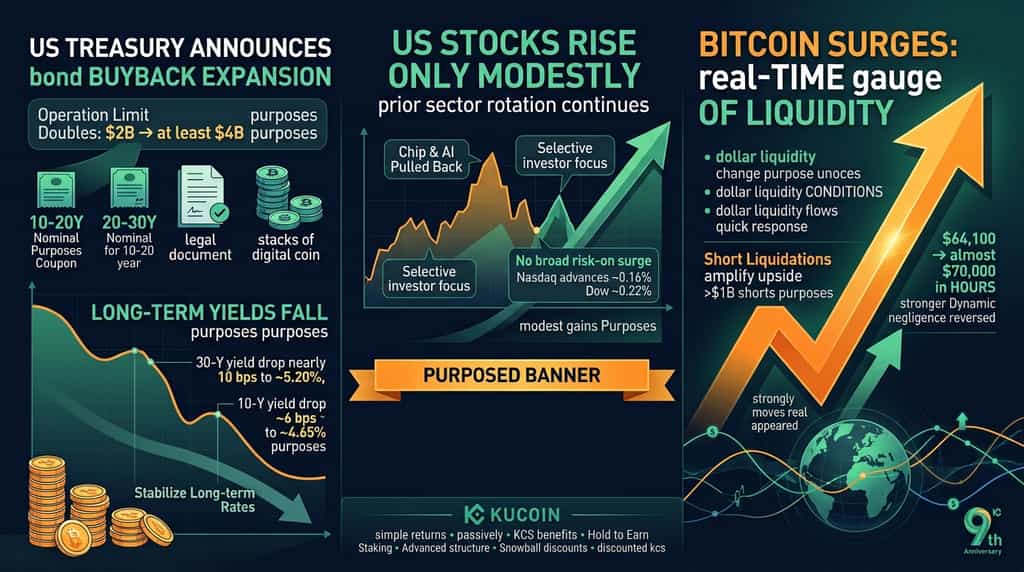
High US Treasury yields have pressured equity markets in recent weeks, with chip and AI-related stocks leading the pullback. On August 19, 2026, the US Department of the Treasury announced it would at least double the maximum size of its liquidity-support buyback operations for longer-dated nominal coupon securities. According to the official Treasury statement, the limit rises from $2 billion to at least $4 billion per operation for the 10-to-20-year and 20-to-30-year sectors, effective September 9 through November 4, 2026.
Long-term yields fell sharply after the news. The 30-year Treasury yield dropped nearly 10 basis points from its multi-year high near 5.34%, settling around 5.19–5.20%, while the 10-year yield declined about 6 basis points to roughly 4.65%, based on market data reported that day. US stocks rose only modestly. The real market signal appeared in Bitcoin, which climbed from near $64,000 to almost $70,000 in a matter of hours.
What Did the US Treasury Announce About Bond Buybacks?
The Treasury is expanding liquidity-support buybacks of longer-dated Treasuries to improve market functioning at the long end of the curve. Effective September 9, 2026, the maximum size for operations in the 10-to-20-year and 20-to-30-year nominal coupon sectors will rise from $2 billion to at least $4 billion per operation and remain in place through November 4, 2026.
Treasury officials stated the increase reflects strong sponsorship from market participants, shown by the large volume of high-quality offers routinely received in these operations. The program does not reduce overall outstanding debt. It simply removes older, less-liquid securities from the market and injects cash into the hands of sellers.
Market participants view the step as a targeted effort to stabilize long-term rates after yields reached levels not seen in nearly two decades. The previous day’s scheduled $2 billion operation in the 20-to-30-year sector had already drawn nearly $20 billion in offers, yet yields continued higher until the larger-size announcement arrived. The expanded capacity adds at least $14 billion of additional buyback room in the current quarter on top of previously planned operations.
Why Did Long-Term Treasury Yields Fall After the Announcement?
Long-term yields declined because the market interpreted the larger buybacks as direct demand support for the long end of the curve. The 30-year yield fell almost 10 basis points and the 10-year yield dropped about 6 basis points on August 19, 2026, according to contemporaneous market reports.
Higher long-term rates had reflected concerns over rising government debt near $40 trillion, elevated AI-related corporate borrowing, and sticky inflation risks. By committing to buy more long-dated paper, the Treasury signaled willingness to absorb supply and improve liquidity precisely where sponsorship remains strong. The immediate price response showed traders pricing in lower term premiums and reduced risk of further disorderly moves higher in yields.
Why Did US Stocks Only Rise Modestly Despite the Positive News?
US equities posted only modest gains because investors remained selective and prior sector rotation continued. On August 19, 2026, the S&P 500 rose approximately 0.21%, the Dow Jones Industrial Average gained about 0.22%, and the Nasdaq Composite advanced roughly 0.16%, ending a short losing streak but falling well short of a broad risk-on surge.
Chipmakers and storage-related names continued to face pressure. Shares of companies tied to memory, storage, and optical modules declined on the day even as broader indexes edged higher. The divergence reflected ongoing questions about the sustainability of elevated AI infrastructure spending and a rotation out of the most crowded growth names. While lower long-term yields normally support equities by reducing discount rates and improving financial conditions, the market required clearer evidence that liquidity would broaden beyond the initial bond-market relief.
How Did Bitcoin React and Why Was Its Move More Pronounced?
Bitcoin surged far more aggressively than stocks, climbing from an intraday low near $64,100 to highs approaching $70,000 before settling in the high $68,000s. The move represented a gain of roughly 6–9% on the day and marked its strongest level in about 11 weeks.
Bitcoin functions as a sensitive barometer of dollar liquidity conditions. When the Treasury injects cash by purchasing long-dated bonds, that liquidity can flow into risk assets that respond quickly to changes in funding availability. In the preceding period, much of the available risk capital had concentrated in AI-related equities, leaving Bitcoin relatively neglected. The sudden liquidity signal reversed that dynamic. Short positions were liquidated in size, with reports of more than $1 billion in crypto shorts forced closed in a short window, amplifying the upside.
Why Does Bitcoin Serve as a Liquidity Barometer for Broader Markets?
Bitcoin often leads broader risk-asset responses to changes in dollar liquidity because it trades 24/7, carries no cash-flow valuation anchor, and attracts highly leveraged participants. Historical patterns show Bitcoin prices tend to strengthen when global or US liquidity conditions ease and weaken when liquidity tightens.
In the recent environment, AI narratives had absorbed the majority of incremental risk capital while dollar liquidity remained relatively constrained. The Treasury’s decision to expand long-end buybacks delivered a clear, if modest, positive liquidity impulse. Bitcoin’s rapid response indicated that market participants recognized the signal before it fully filtered into equity sectors still digesting earlier excesses. Over time, improved liquidity conditions tend to support a wider range of risk assets, including US equities once rotation and positioning normalize.
KuCoin Offers A More Stable Option in A Volatile Market
If you worry about the frequent ups and downs in the market, and pursue a more stable option to earn money passively, KuCoin is the right place to come:
-
Simple Earn: Deposit and withdraw tokens anytime, earning stable returns.
-
Kucoin Earn: Earn stable profits with professional asset management.
-
Hold to Earn: Earn rewards by holding assets in Funding, Trading, Margin, Futures, Mining, and Unified Accounts.
-
Staking: Unlock the earning potential of on-chain assets.
-
Advanced Investments: Advanced Investments offer a variety of structured products to help your money grow in any market.
-
Shark Fin: Principal Protection and Guaranteed Gains
-
Dual Investment: Buy low and sell high with transparent return calculations.
-
Snowball: High yields, with price protection.
-
Discount Buy: Buy crypto at discount prices.
-
KCS Loyalty: Level up to enjoy exclusive perks by staking ≥ 1 KCS.
-
KuCoin Wealth: Discover future value and begin your smart investing journey.
-
KCS Benefits: Hold and stake KCS to access benefits across the platform.
-
KCS Staking 2.0: Participate in KCS on-chain governance to earn yield.

Conclusion
The US Treasury’s decision to at least double long-end buyback sizes from $2 billion to $4 billion per operation provided targeted support for longer-dated Treasuries and produced an immediate decline in yields. Stocks responded with only modest gains and continued sector divergence, particularly in chip and storage names. Bitcoin, by contrast, delivered a sharp rally from the mid-$60,000s toward $70,000, underscoring its role as a real-time gauge of dollar liquidity.
The episode illustrates that policy actions aimed at bond-market liquidity can register first in the most sensitive risk assets. While the absolute size of the expanded buybacks remains modest relative to the overall Treasury market, the directional signal proved powerful enough to reverse near-term pressure on long yields and to reawaken interest in Bitcoin. Broader equity markets may eventually benefit as improved liquidity conditions filter through, but the clearest near-term message emerged in the cryptocurrency’s price action. Investors and traders monitoring dollar funding dynamics will continue watching both Treasury operations and Bitcoin for confirmation of sustained liquidity support.
FAQs
What is the difference between Treasury buybacks and Federal Reserve quantitative easing?
Treasury buybacks recycle existing cash by purchasing outstanding securities without expanding the central-bank balance sheet, whereas quantitative easing involves the Fed creating new reserves to buy assets.
How large is the increase in buyback capacity for the current quarter?
The higher per-operation limit is expected to add at least $14 billion of additional long-end buyback capacity through November 4, 2026, on top of previously announced totals.
Why did storage and optical-module stocks continue to decline after the announcement?
These sectors remained under pressure from ongoing rotation out of crowded AI-related names and questions about the pace of infrastructure spending, outweighing the broader yield relief on the day.