

US Federal Debt Tops $40 Trillion as Borrowing Accelerates: What It Means for Bitcoin and Crypto Markets
2026/08/21 16:59:00
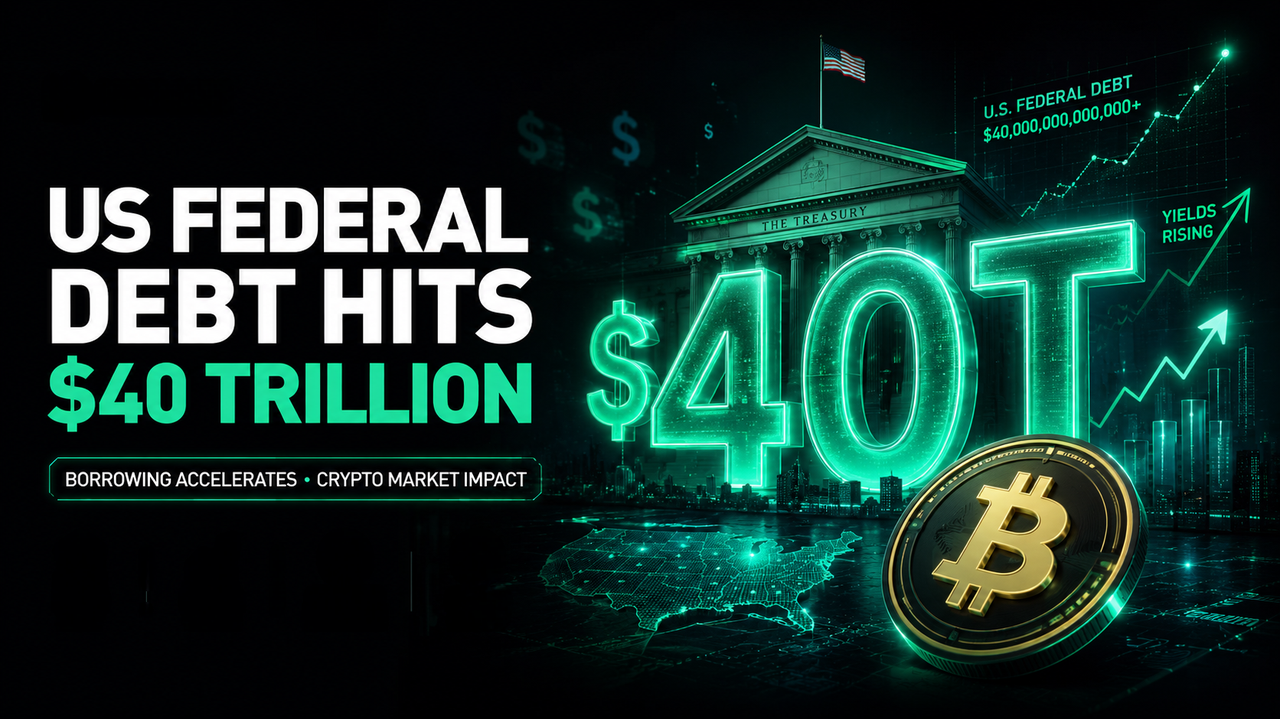
The US federal debt has crossed $40 trillion for the first time, putting renewed attention on government borrowing, Treasury yields and the broader financial conditions shaping global markets in 2026. The milestone comes as persistent fiscal deficits, elevated refinancing requirements and rising interest costs continue to increase the government's funding needs. For investors, however, the significance of the $40 trillion figure goes beyond the size of the debt itself. What matters increasingly is how Treasury issuance is absorbed, what investors demand in return for holding government bonds and whether those developments tighten or loosen financial conditions across equities, currencies and crypto market conditions.
For Bitcoin and the broader crypto market, the relationship is particularly complex. Rising federal debt can reinforce Bitcoin's fixed-supply and alternative-monetary-asset narrative, but heavy Treasury borrowing can also keep yields elevated and make lower-risk assets more competitive for capital. At the same time, dollar liquidity, Federal Reserve expectations, Treasury-market stability and growing stablecoin demand for government securities are creating deeper links between traditional finance and crypto. Understanding what the $40 trillion US debt milestone means for crypto therefore requires looking at borrowing trends, interest costs, bond-market conditions and the flow of liquidity rather than assuming that higher government debt is automatically bullish or bearish for Bitcoin.
How US Federal Debt Reached $40 Trillion as Borrowing and Interest Costs Accelerated
The US federal debt crossed $40 trillion for the first time in August 2026, marking another major milestone in the country's rapidly expanding borrowing burden. The increase reflects more than one year of heavy Treasury issuance. Persistent budget deficits, elevated government spending, refinancing needs and rising interest expenses have all contributed to the faster accumulation of debt. For financial and crypto markets, the important issue is not simply the headline number, but how continued borrowing affects Treasury yields, government financing costs and broader liquidity conditions.
-
Persistent Budget Deficits Pushed Federal Debt Above $40 Trillion
The United States continues to spend substantially more than it collects in revenue, requiring the Treasury to finance the difference through additional borrowing. The Congressional Budget Office projects a fiscal 2026 deficit of roughly $1.9 trillion, keeping the annual funding gap well above its long-term historical average. As these deficits accumulate, the government must issue additional Treasury bills, notes and bonds, increasing the overall stock of federal debt even during periods of solid economic growth.
The $40 trillion figure refers to gross federal debt, which includes both debt held by outside investors and obligations held within government accounts. Debt held by the public remains the most closely watched measure for financial markets because it represents securities held by households, banks, investment funds, foreign governments, the Federal Reserve and other investors.
Several structural pressures are keeping deficits elevated:
-
Higher mandatory spending on programmes such as Social Security and Medicare is increasing as the US population ages.
-
Federal revenues have not consistently grown fast enough to match the expansion in overall government spending.
-
Refinancing previously issued debt at higher interest rates is adding costs even when no new programme is introduced.
-
Large annual deficits mean the Treasury must continually attract domestic and international investors to absorb additional government securities.
These forces help explain why the $40 trillion milestone represents a longer-term fiscal trend rather than a sudden one-time increase in borrowing.
-
Treasury Borrowing Requirements Remain High in the Second Half of 2026
The scale of current financing needs is visible in the Treasury's latest borrowing projections. For the July-September 2026 quarter, the department estimated $739 billion in privately held net marketable borrowing, an increase from its earlier projection. Treasury also expects another $628 billion of net borrowing during the October-December quarter. Those figures show that substantial government financing requirements are likely to continue even after the debt has already crossed $40 trillion.
Not all Treasury issuance represents completely new debt. A significant portion of government securities is issued to refinance bills, notes and bonds that are reaching maturity. However, persistent fiscal deficits mean the government must raise additional net financing on top of those refinancing needs. This makes Treasury auction demand, maturity composition and investor appetite increasingly important for broader financial conditions.
Key factors investors are watching include:
-
Treasury auction demand, particularly whether investors require higher yields to absorb growing issuance.
-
The balance between short-term Treasury bills and longer-dated bonds, which can influence different parts of the yield curve.
-
Foreign demand for US government securities, which remains important because overseas investors hold a meaningful share of Treasury debt.
-
Treasury cash-balance management, which can temporarily affect money-market liquidity and the amount of cash circulating through financial markets.
For crypto investors, these details matter because large changes in Treasury financing can influence yields, the US dollar and available market liquidity, all of which can affect risk appetite toward Bitcoin and other digital assets.
-
Rising Interest Costs Are Making the US Debt Burden More Expensive
Borrowing volume is only part of the challenge because the cost of servicing existing debt has also increased. The CBO projects net federal interest spending of around $1 trillion in fiscal 2026, reflecting both the larger debt balance and the higher rates attached to newly issued or refinanced securities. When older low-yield government debt matures, replacing it at higher prevailing rates can raise federal interest expenses even without a dramatic change in total borrowing. This creates a difficult fiscal feedback loop: larger debt produces higher interest payments, those payments add to government spending, wider deficits require additional borrowing, and new borrowing can further increase future interest costs. For markets, that dynamic makes Treasury yields and fiscal policy increasingly relevant because sustained pressure on government financing costs can influence bond markets, the dollar, monetary-policy expectations and ultimately the liquidity environment in which Bitcoin and the broader crypto market trade.
How $40 Trillion US Debt, Treasury Yields and Liquidity Could Affect Bitcoin and Crypto
The $40 trillion US debt milestone matters to crypto investors less because of the headline itself and more because of what it can mean for Treasury yields, the dollar, financial conditions and market liquidity. Bitcoin and other digital assets are increasingly connected to the same macro forces that influence equities and bonds, so changes in US government financing conditions can affect crypto through several different channels. Importantly, those effects are not automatically bullish or bearish: the direction can change depending on whether rising debt is accompanied by higher yields, a weaker dollar, easier monetary conditions or tighter liquidity.
-
Higher Treasury Yields Can Raise the Opportunity Cost of Holding Bitcoin
One of the most direct links between US fiscal pressure and crypto markets runs through Treasury yields. The 30-year US Treasury yield reached about 5.33% on August 18, 2026, its highest level since 2007, as investors reacted to inflation concerns, heavy bond supply and broader fiscal uncertainty. When government securities offer higher returns, investors can earn comparatively attractive yields from assets considered much lower risk than Bitcoin, potentially reducing the appeal of speculative positions and increasing the cost of leverage across financial markets. Investors tracking these macro-driven moves can compare them with the Bitcoin price and market overview as financial conditions change. IMF research has also found that tighter US monetary conditions tend to weaken the broader crypto cycle through a risk-taking channel, with institutional participation making digital assets more sensitive to changes in financial conditions. This means that if fiscal concerns keep long-term yields elevated, Bitcoin and altcoins could face periods of valuation pressure even while the long-term debt narrative appears supportive of scarce digital assets.
-
Dollar Liquidity May Matter More Than the Debt Headline for Crypto Prices
Crypto markets are heavily dollar-linked, making changes in US dollar liquidity especially important when assessing the effect of rising federal debt. Bitcoin, Ether and most major cryptocurrencies are quoted primarily against dollars or dollar-backed stablecoins, while much of crypto lending and collateral activity also depends on dollar-denominated liquidity. When financial conditions tighten, funding becomes more expensive and investors may reduce leverage or exposure to higher-risk assets; when liquidity improves and yields ease, the environment can become more supportive for crypto risk-taking. Recent market action illustrates that sensitivity: after Treasury measures aimed at improving long-dated bond-market liquidity pushed yields lower on August 19, the dollar weakened and Bitcoin rose alongside other risk assets, although such short-term reactions do not establish a permanent relationship between government debt and crypto prices. For investors, indicators such as real yields, the US dollar, Fed policy and broader financial liquidity may therefore provide more useful signals than simply watching the national debt total move from one milestone to another.
-
Fiscal Concerns Could Strengthen Bitcoin's Scarcity Narrative Without Guaranteeing Higher Prices
A different channel operates through Bitcoin's monetary design. Persistent increases in government debt can renew debate over fiscal sustainability, inflation and the long-term purchasing power of fiat currencies, which may strengthen interest in Bitcoin because its maximum supply is limited to 21 million coins. That scarcity narrative can become particularly relevant when investors expect monetary easing, declining real yields or a weaker dollar. However, describing Bitcoin as an automatic hedge against US debt would be misleading. Historical research shows that crypto has frequently traded like a risk asset during periods of tighter monetary policy, and the growing presence of institutional investors has increased its connection with broader financial cycles. The more useful distinction for crypto investors is therefore between the long-term investment narrative created by fiscal expansion and the shorter-term market conditions that determine whether capital is actually moving into Bitcoin.
-
Stablecoins Are Creating a Two-Way Link Between Crypto and US Treasuries
The relationship between government debt and crypto is also becoming more complex because stablecoin issuers themselves can be significant buyers of short-term US government securities. The Federal Reserve reported in May 2026 that stablecoin assets stood at approximately $320 billion, with reserve portfolios commonly including Treasury bills and other short-term instruments, an important feature of how stablecoins work within the digital-asset ecosystem. As regulated dollar-backed stablecoins expand, demand for safe and liquid reserve assets could deepen the connection between the crypto ecosystem and the Treasury market. At the same time, changes in short-term interest rates influence the income generated by Treasury-backed stablecoin reserves, while growth or contraction in stablecoin supply can affect the amount of dollar liquidity available for trading, DeFi and settlement. This creates an increasingly important SEO and investment theme: US debt can influence crypto markets through yields and liquidity, while crypto's expanding stablecoin sector can itself become a source of Treasury demand, making the relationship between traditional government finance and digital assets more interconnected than it was during earlier Bitcoin market cycles.
What Happens Next for US Debt and Crypto Markets as Treasury Borrowing Stays High
With US federal debt above $40 trillion, the next phase for markets will depend on whether the Treasury can continue financing heavy borrowing without pushing long-term yields significantly higher. Treasury's August 2026 refunding plan keeps most nominal coupon auction sizes broadly stable for the next several quarters, while short-term bills can be adjusted as funding needs change. For Bitcoin and crypto investors, the most important signals are now Treasury auction demand, bond yields, debt maturity structure and dollar liquidity because these factors can directly influence funding costs, risk appetite and capital flows across digital assets.
-
Treasury auction demand: Weak bid-to-cover ratios or larger auction tails could signal softer investor demand and put upward pressure on yields.
-
10-year and 30-year Treasury yields: Persistently high long-term yields can make government bonds more attractive relative to volatile assets such as Bitcoin and altcoins.
-
Foreign investor participation: Strong demand from overseas institutions and central banks can help absorb Treasury supply and limit pressure on borrowing costs.
-
Debt maturity mix: Greater reliance on short-term bills can reduce immediate pressure on long-duration bonds but increases refinancing exposure if interest rates remain elevated.
-
Treasury General Account liquidity: Large changes in government cash balances can affect short-term dollar liquidity, which is closely watched by crypto traders.
-
Bitcoin versus altcoins: Bitcoin may react differently from smaller tokens because of its deeper liquidity, institutional participation and fixed-supply narrative.
-
Risk of tighter financial conditions: Higher yields and expensive leverage could weigh more heavily on speculative altcoins, DeFi activity and leveraged crypto positions.
-
Potential relief from stabilising yields: If Treasury auctions remain orderly and bond yields ease, broader financial conditions could become more supportive for crypto market liquidity.
-
Fiscal uncertainty: Persistent concerns over US debt and deficits may strengthen interest in Bitcoin as a scarce digital asset, although this does not guarantee higher prices.
-
Key 2026 market focus: The main issue for crypto is not simply how fast US debt rises, but whether continued Treasury borrowing changes the cost and availability of global capital.
Conclusion
The United States crossing $40 trillion in federal debt is an important fiscal milestone, but its significance for Bitcoin and crypto markets depends on what happens around the debt rather than the headline number alone. Continued Treasury borrowing, elevated refinancing needs and rising interest expenses could keep pressure on longer-term yields and financial conditions, while strong auction demand and stable bond-market functioning could reduce the risk of more disruptive moves. For crypto investors, the interaction between Treasury supply, real yields, the US dollar and liquidity is therefore likely to be more informative than the national debt counter itself. The longer-term picture is equally nuanced. Persistent fiscal imbalances may strengthen Bitcoin's scarcity and alternative monetary asset narrative, yet higher risk-free yields can still limit demand for volatile assets when liquidity is tight. Stablecoins are adding another dimension by connecting digital-asset markets more directly with US Treasury securities. As borrowing remains elevated through the rest of 2026, investors may benefit from watching Treasury auctions, bond yields, Fed expectations, dollar liquidity and stablecoin growth together rather than treating rising US debt as a simple bullish or bearish signal for crypto.
FAQs
Can Weak US Treasury Auctions Affect the Crypto Market?
Potentially. A weaker-than-expected Treasury auction can lead to higher bond yields if investors demand more compensation to absorb new debt. If that move spreads across financial markets, borrowing costs and discount rates can rise, while investors may reduce exposure to higher-volatility assets. Crypto prices do not respond mechanically to every auction, but repeated signs of weak demand could become more important.
Why Should Crypto Investors Watch the Treasury General Account?
The Treasury General Account (TGA) is the US government's primary cash account at the Federal Reserve. Large changes in the TGA can move liquidity between the government and the private financial system. A rapid increase in the Treasury's cash balance can temporarily absorb liquidity, while government spending can return some of that cash to the banking system, making TGA movements useful for investors tracking short-term market liquidity.
Does a Weaker US Dollar Always Help Bitcoin?
No. Bitcoin has sometimes performed well during periods of dollar weakness because a softer dollar can coincide with easier global financial conditions and greater demand for alternative assets. However, the relationship is not consistent. Bitcoin can fall alongside the dollar during periods of severe risk aversion, so investors should also consider real yields, liquidity, volatility and broader market sentiment.
Could Rising Federal Debt Increase Demand for Tokenized Treasuries?
It could contribute to a larger supply of Treasury securities available for use in digital markets, but growth in tokenized US Treasuries depends more directly on regulation, institutional adoption, blockchain infrastructure and investor demand. Tokenized Treasury products have become increasingly important in crypto because they allow eligible investors to access yield-bearing government securities through blockchain-based platforms.
What Macro Indicators Should Crypto Investors Monitor Alongside US Federal Debt?
The debt total alone offers limited information about short-term crypto direction. Investors can gain more context by monitoring 10-year and 30-year Treasury yields, real yields, the US Dollar Index, Treasury auction results, Fed policy expectations, stablecoin supply, credit spreads and broader market liquidity. Watching these indicators together can provide a clearer picture of whether fiscal developments are tightening or easing financial conditions for Bitcoin and the wider crypto market.
KuCoin Offers A More Stable Option in A Volatile Market
If you worry about the frequent ups and downs in the market, and pursue a more stable option to earn money passively, KuCoin is the right place to come:
Simple Earn: Deposit and withdraw tokens anytime, earning stable returns.
Kucoin Earn: Earn stable profits with professional asset management.
Hold to Earn: Earn rewards by holding assets in Funding, Trading, Margin, Futures, Mining, and Unified Accounts.
Staking: Unlock the earning potential of on-chain assets.
Advanced Investments: Advanced Investments offer a variety of structured products to help your money grow in any market.
Shark Fin: Principal Protection and Guaranteed Gains
Dual Investment: Buy low and sell high with transparent return calculations.
Snowball: High yields, with price protection.
Discount Buy: Buy crypto at discount prices.
KCS Loyalty: Level up to enjoy exclusive perks by staking ≥ 1 KCS.
KuCoin Wealth: Discover future value and begin your smart investing journey.
KCS Benefits: Hold and stake KCS to access benefits across the platform.
KCS Staking 2.0: Participate in KCS on-chain governance to earn yield.

Disclaimer
The information provided on this page may originate from third-party sources and does not necessarily represent the views or opinions of KuCoin. This content is intended solely for general informational purposes and should not be considered financial, investment, or professional advice. KuCoin does not guarantee the accuracy, completeness, or reliability of the information, and is not responsible for any errors, omissions, or outcomes resulting from its use. Investing in digital assets carries inherent risks. Please carefully evaluate your risk tolerance and financial situation before making any investment decisions. For further details, please consult KuCoin’s Terms of Use and Risk Disclosure.