

TRON Q2 2026 Report: $2.08T Stablecoin Settlements, 1.1B Transactions, and Record $89B Supply
Introduction
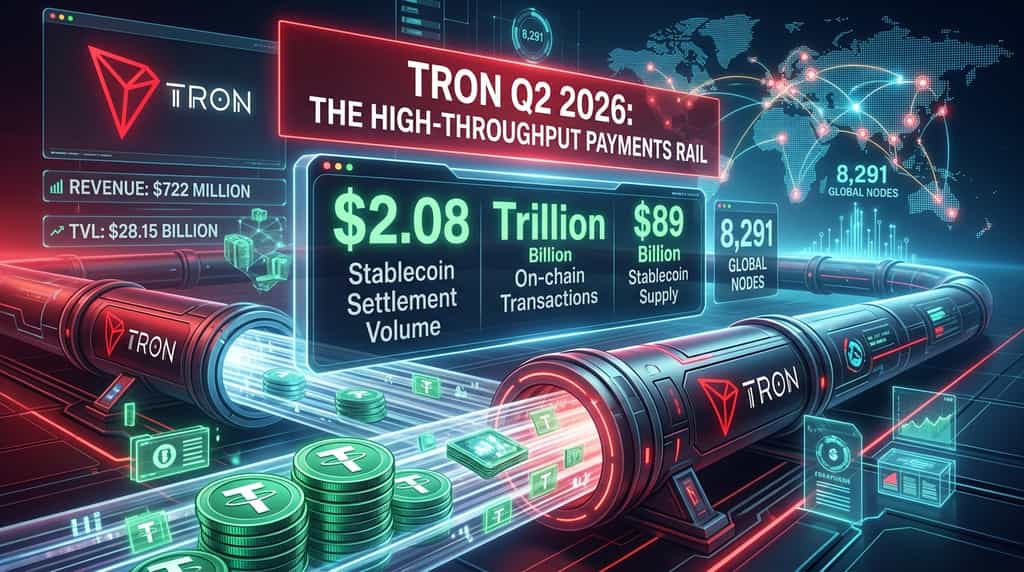
Can a single Layer 1 process more than two trillion dollars in stablecoin value in one quarter and still add millions of users? TRON did exactly that in Q2 2026. According to TRON DAO’s Q2 2026 Quarterly Report, the network recorded $2.08 trillion in stablecoin settlement volume, 1.1 billion on-chain transactions, and a record $89 billion stablecoin supply.
Those three figures define TRON’s position as a high-throughput payments and USDT settlement chain. Protocol revenue reached $722 million, TVL rose to $28.15 billion, and node count expanded to 8,291. After the quarter closed, total accounts crossed 400 million and USDT circulating on TRON moved above $94 billion, according to TRON DAO updates and Token Terminal data.
This article breaks down the Q2 2026 numbers, what they mean for payments and DeFi, and how traders can access TRX and TRON-based assets on KuCoin.
What Did TRON’s Q2 2026 Network Activity Show?
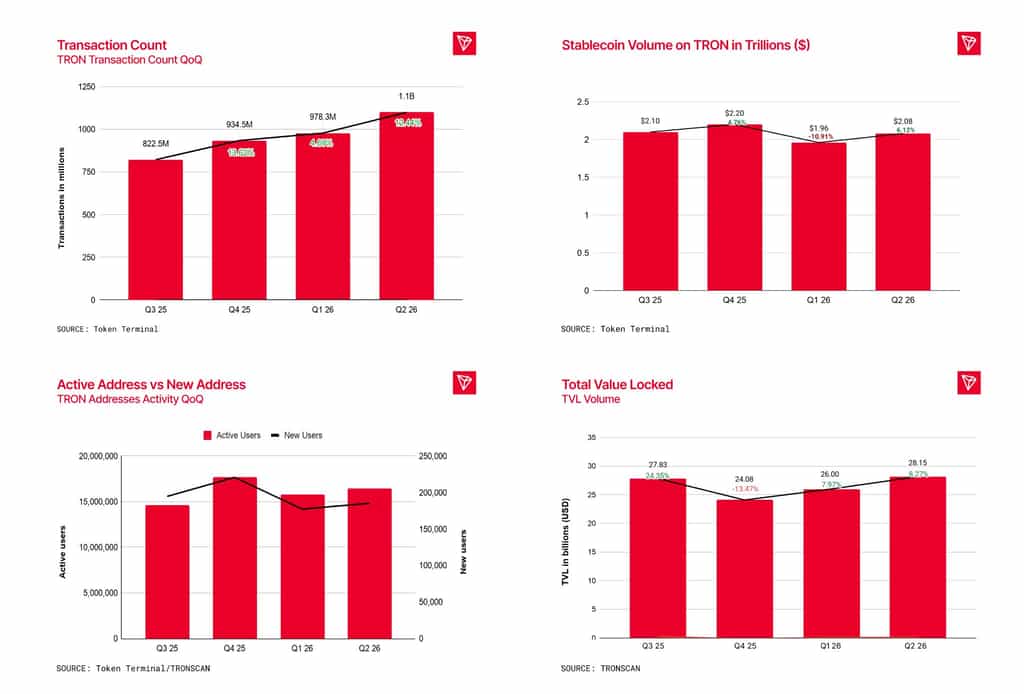
TRON processed 1.1 billion transactions in Q2 2026, up 12% quarter over quarter and the first quarter above the one-billion mark.
According to Token Terminal’s TRON Q2 2026 metrics, the prior quarter totaled 978.3 million transactions. Year over year, volume rose 37.2% from 784.4 million in Q2 2025. Average throughput reached 137 transactions per second, up 8.7% from 126 TPS in Q1 and 37.3% from 99.76 TPS a year earlier.
Active usage scaled with throughput. TRON DAO reported 16.4 million active addresses in the quarter, with a Q2 average of more than 4.2 million daily active addresses. Roughly 190,000 new addresses were added each day. Token Terminal listed monthly active users at 16.4 million, up 4.5% quarter over quarter and 13.9% year over year.
Infrastructure kept pace. Node count rose 18% quarter over quarter to 8,291, according to the on-chain snapshot circulated with the quarterly figures. More nodes improve connectivity and reduce single-point operational risk as daily transaction load stays in the tens of millions.
Protocol revenue confirmed that activity was not empty throughput. TRON DAO reported $722 million in protocol revenue for the quarter. Token Terminal recorded $715.4 million, up 17.3% quarter over quarter. The two figures sit in the same range and both show a rebound after earlier fee-parameter changes.
Fully diluted market cap stood at $31.6 billion at quarter-end, according to Token Terminal, up 13.5% quarter over quarter and 27.7% year over year. Circulating TRX supply was 94.80 billion, a 0.03% increase from 94.77 billion in Q1, according to TRON DAO. Supply growth stayed modest relative to usage growth.
After Q2, TRON DAO stated that total accounts surpassed 400 million. Cumulative lifetime transactions had already moved past 15 billion earlier in the summer on TRONSCAN-linked updates from the foundation. That scale is why payments desks and stablecoin issuers treat TRON as a settlement rail rather than a niche smart-contract experiment.
How Large Were TRON Stablecoin Settlements and Supply in Q2 2026?
TRON settled $2.08 trillion in stablecoins in Q2 2026 and ended the quarter with about $89 billion in on-chain stablecoin supply.
TRON DAO’s quarterly report lists both figures directly and cites Token Terminal as the source for supply and settlement charts. Settlement volume rose 6.12% quarter over quarter. The report framed the print as a recovery after an industry cooldown, with demand still concentrated in cross-border value transfer, low fees, and high throughput.
Messari’s State of TRON Q2 2026 report puts the USDT transfer total at $2.1 trillion for the quarter. Average daily USDT transfer volume rose 4.3% to $22.8 billion after a Q1 pullback. Stablecoin velocity — daily transfer volume divided by circulating supply — held at 0.26, unchanged from Q1 and stable for several quarters.
Supply composition remained lopsided toward USDT. Messari reported a record $89.2 billion stablecoin market cap on TRON, with USDT at 98.5% share and $87.9 billion circulating at quarter-end. That placed TRON ahead of Ethereum’s $78.7 billion circulating USDT and gave TRON 47.6% of tracked USDT supply. Token Terminal’s average Q2 supply reading was $88.6 billion, up 4.7% from $84.5 billion in Q1 and 19.4% from $74.2 billion in Q2 2025.
Token Terminal also listed USDD at about $1.1 billion and TUSD at $169.6 million as of June 30. USDD later printed a new high near $1.3 billion in the first half of July. Holder counts matter as much as balances. TRON averaged 74.8 million monthly stablecoin holders in Q2, more than Ethereum (23.3 million), Celo (19.5 million), Base (11.4 million), and Solana (10.4 million) combined, according to Token Terminal.
TRON DAO later stated that Q2 stablecoin supply of $89.2 billion represented 28.7% of the global stablecoin market. After the quarter, USDT circulating on TRON surpassed $90 billion on July 9, according to TRON Network’s official milestones page, and subsequent ecosystem updates put circulating USDT above $94 billion.
Early Q3 settlement already points to continuity rather than a one-off spike. On-chain monitors tracking the same settlement series reported about $1.63 trillion settled in Q3 to date as of mid-September 2026. That run-rate is consistent with a multi-trillion quarterly pace if activity holds.
A common misconception is that large transfer totals equal speculative wash volume. Velocity near 0.26 and a holder base of tens of millions argue for repeated payments and treasury movements, not only looped market-making. Another misconception is that Ethereum still hosts the most circulating USDT. Messari’s quarter-end snapshot put TRON first on circulating USDT hosted on-chain, even as issuance-origin statistics can differ by methodology.
How Fast Did TRON Developer and Node Infrastructure Grow?
Developer activity accelerated faster than transaction count. TRON recorded 561 code commits in Q2, up 82% quarter over quarter, and 10,200 unique contract deployers.
Those figures come from the Q2 growth snapshot aligned with TRON DAO’s report. Commit growth at that pace usually reflects tooling, protocol clients, and application repositories moving together rather than a single repo spike.
Official 2026 milestones list several infrastructure releases in the same half-year. B.AI, TRON’s AI agent stack for payments, settlements, identity, and collaboration, launched on April 15, 2026. Developer tooling upgrades covered TronGrid MCP, TronWeb API security, and TronBox EVM workflows. BitTorrent launched BTT InferGrid on June 17, 2026, extending compute-related work across the wider TRON-BitTorrent stack.
Node growth supports that build-out. An 18% quarter-over-quarter rise to 8,291 nodes is a capacity signal. Payments networks lose usefulness if block propagation or API access thins out while TPS rises. Expanding the node set while holding 137 average TPS reduces that risk.
Institutional access continued in parallel. TRON remains one of the chains selected by the U.S. Department of Commerce in 2025 to publish official GDP data hashes, according to TRON Network’s milestone record. Nasdaq-listed Tron Inc. adopted a TRX treasury reserve strategy in 2025. Those items are not Q2 volume drivers by themselves, but they explain why custody, index, and reporting teams keep TRON on coverage lists.
The misconception to drop is that TRON is “only USDT transfers and nothing else.” Transfer volume is the headline. Commits, deployers, AI agent rails, and node expansion are the supporting layer that keeps those transfers cheap and available.
What Do the Q2 2026 Figures Mean for TRX and On-Chain Payments?
Q2 data shows TRON functioning as a dollar-settlement network first and a smart-contract platform second.
Payments fit that ranking. Low fees and high TPS keep small transfers viable. Token Terminal’s holder data — 74.8 million monthly stablecoin holders — is hard to reconcile with a purely institutional OTC story. Retail-sized transfers and peer-to-peer flows are a large part of the mix in other TRON research packs from the same quarter, including high peer-to-peer share of stablecoin transfers.
TRX value capture is indirect. Users pay energy and bandwidth in TRX or via staking. Protocol revenue near $715–722 million shows that usage still produces cash flow after the 2025 fee-parameter cut. Circulating supply rose only 0.03% in the quarter, so issuance did not swamp the activity print.
Price is not the same as throughput. Token Terminal’s fully diluted market cap of $31.6 billion can rise or fall while settlement volume stays in the trillions. Traders who treat TPS as a short-term price signal usually overfit. The cleaner use of the report is positioning: TRON remains a core venue for USDT movement, TRX is the fee and staking asset, and DeFi yield sits mainly in lending and staking rather than high-turnover DEX books.
Risks stay real. Stablecoin supply is concentrated in USDT. Regulatory treatment of dollar tokens can change issuer behavior. Velocity could fall if off-chain rails take share. DEX volume already cooled in Messari’s cut of the data. None of those risks erase the Q2 settlement total. They explain why position sizing still requires a thesis beyond “transactions went up.”
Q3-to-date settlement of about $1.63 trillion, according to the same on-chain series used after the quarterly report, suggests the payments rail did not shut off when Q2 ended. That is the continuity test investors should watch next.
Beyond the Headlines: What KuCoin 5.0 Means for You
Market news moves fast — but where you act on it matters just as much. This October, KuCoin launches KuCoin 5.0, transforming KuCoin into a rebuilt platform. Here's what actually changes for you:
-
One account for everything. Older platforms split your money across separate "spot," "margin," and "futures" accounts and expected you to understand why. KuCoin 5.0's unified account removes that entirely — deposit once, and everything is simply there.
-
Stocks, indices, and commodities. KuCoin 5.0 expands beyond crypto into global markets. When crypto chops sideways and equities rally (or the reverse), you rotate in minutes instead of opening a brokerage account and waiting days for fiat rails.
-
Real-world assets (RWA). Tokenized exposure to traditional assets like commodities, right inside your crypto account. One of the fastest-growing segments in global finance is no longer reserved for institutions — you access it from the same balance you trade with.
-
Earn while you learn. Not ready to trade? KCUSD lets your stablecoins earn daily, auto-compounding interest. The lowest-stress way to put your idle deposit to work for 4% yield.
-
An AI assistant in plain language. Ask questions, get market context, understand what you're looking at — built into the platform, no jargon required.
-
An app that doesn't overwhelm. Faster, cleaner, and consistent — intuitive from the first tap, not after a tutorial.
-
Safety you can check, not just trust. A MiCAR-licensed EU entity, Proof of Reserves you can verify yourself, and internationally certified security (SOC 2 Type II, ISO 27001:2022).
Create your account in minutes — and start on the platform built for where crypto is going, not where it's been.
Conclusion
TRON’s Q2 2026 report is a settlement story backed by usage, not a single vanity metric. The network processed $2.08 trillion in stablecoin settlements, 1.1 billion transactions, and held about $89 billion in stablecoin supply, according to TRON DAO and Token Terminal. Active addresses reached 16.4 million, daily actives averaged above 4.2 million, and nodes rose 18% to 8,291.
Messari’s parallel cut showed $2.1 trillion in USDT transfers, $87.9 billion circulating USDT on TRON, and a $89.2 billion stablecoin market cap. TVL at the ecosystem level rose to $28.15 billion. Protocol revenue printed near $715–722 million. Developer commits jumped 82% to 561, with 10,200 unique deployers.
After the quarter, accounts crossed 400 million and USDT on TRON moved through $90 billion and later above $94 billion on official milestone and ecosystem updates. Early Q3 settlement near $1.63 trillion points to persistence. Concentration in USDT, cooler DEX volumes, and policy risk still apply. The report’s core claim stands: TRON remains one of the largest live rails for dollar stablecoin movement.
FAQs
Is TRON the largest chain for circulating USDT after Q2 2026?
Yes, on Messari’s quarter-end snapshot. TRON hosted $87.9 billion circulating USDT versus $78.7 billion on Ethereum and held 47.6% of tracked USDT supply.
Did TRON really pass one billion transactions in a single quarter?
Yes. Token Terminal recorded 1.1 billion Q2 transactions, up from 978.3 million in Q1, the first quarter above one billion.
How much of TRON’s stablecoin market is USDT?
About 98.5% at Q2-end, according to Messari, with USDD and TUSD making up the remainder.
Is TRON TVL the same as DeFi TVL?
No. TRON DAO’s $28.15 billion figure includes broader ecosystem liquidity such as staking. Messari’s DeFi-only TVL was $4.4 billion in Q2.
Has USDT on TRON kept growing after Q2?
Yes. TRON Network’s official milestones show circulating USDT above $90 billion on July 9, 2026, and later ecosystem updates placed the figure above $94 billion.
Disclaimer: This article is for informational purposes only and does not constitute financial, legal, or investment advice. Always conduct your own research before interacting with digital assets.