

Tesla Stock Keeps Declining After SpaceX IPO as Investors Shift to SpaceX’s Growth Story
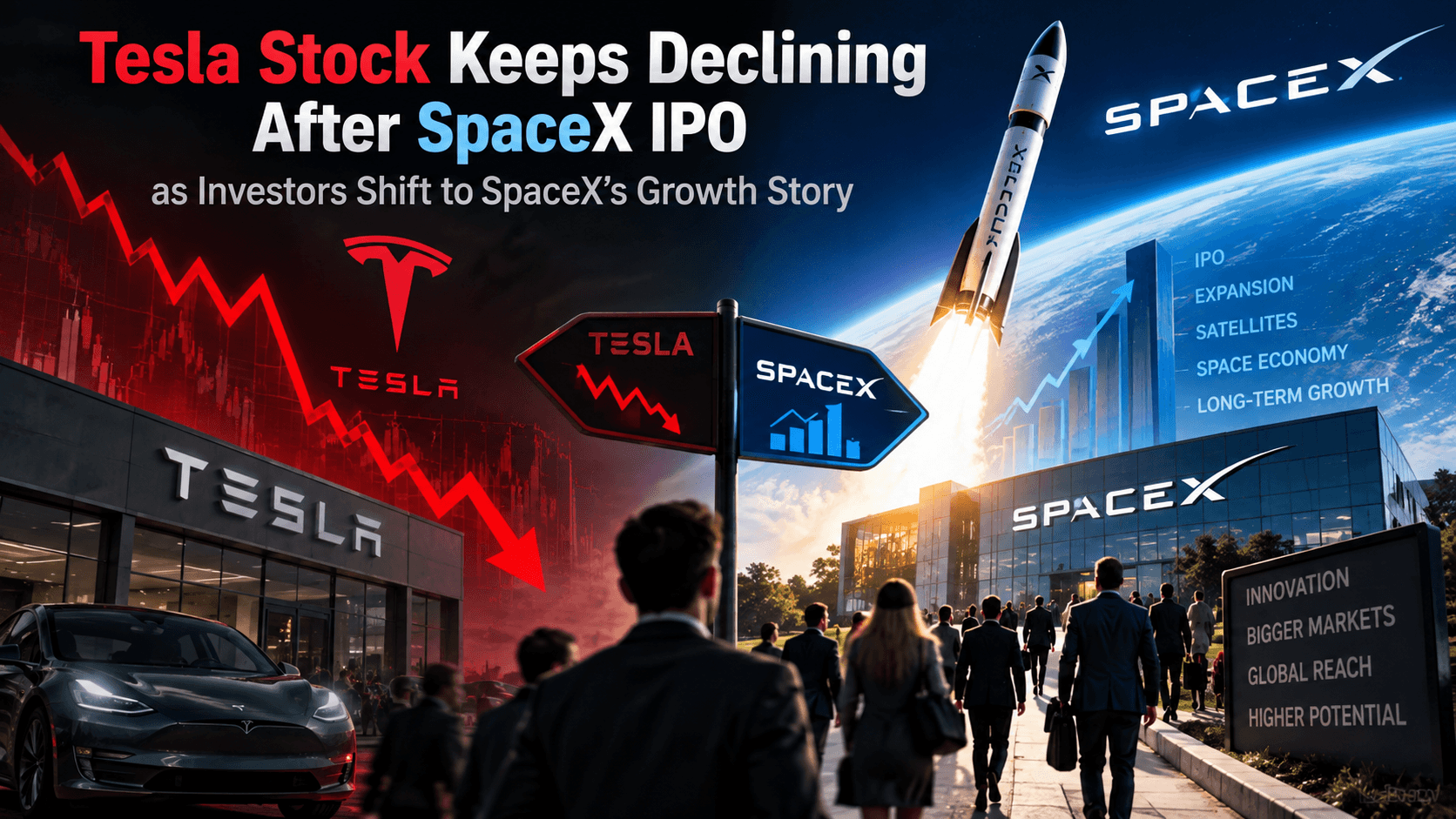
SpaceX IPO Shifts Investor Attention Away From Tesla
Tesla shares have underperformed the broader market in the months following SpaceX’s record initial public offering in mid-June 2026. Space Exploration Technologies Corp. priced shares at $135 and raised approximately $75 billion in what became the largest IPO on record, briefly propelling the company’s valuation near $3 trillion before settling lower. Tesla, long the primary public vehicle for exposure to Elon Musk’s ventures, has seen its stock decline roughly 8.9 percent in the three months after the debut, while the S&P 500 advanced about 2.7 percent and SpaceX shares traded roughly 9.8 percent above the offer price as of early September reporting.
Retail and institutional capital has rotated toward SpaceX’s launch, satellite, and artificial-intelligence infrastructure story, leaving Tesla to contend with thinner margins, elevated capital spending, and questions about the pace of its own autonomy and robotics programs. The central thesis is that SpaceX’s public listing has diluted the exclusive “Musk premium” once attached almost solely to Tesla, prompting a measurable reallocation of investor attention and capital toward a business perceived as offering clearer growth in space infrastructure and AI compute while Tesla navigates near-term execution and profitability pressures.
Retail Capital Rotation Intensifies After Record SpaceX Bookbuild
SpaceX’s IPO attracted more than $250 billion in demand against the roughly $75 billion of shares offered, creating an oversubscription estimated at 3.5 to 4 times. A substantial retail allocation, initially targeted near 30 percent of the deal before being trimmed, drew orders exceeding $100 billion in some reports. Data from trading platforms and flow trackers showed net retail buying of SpaceX reaching approximately $1.25 billion across millions of trades in the second quarter, while Tesla recorded the largest net selling among individual stocks in the same period. Analysts, including Gary Black, noted that many retail holders reduced Tesla positions to free cash for SpaceX subscriptions, a dynamic visible in the days surrounding pricing when Tesla shares fell about 4 percent to the low $380s. The concentration of demand left hundreds of billions of dollars of unfilled interest that had to be deployed elsewhere or held in cash, amplifying the near-term pressure on Tesla as the most liquid prior proxy for Musk-related upside.
This rotation did not reverse quickly. Subsequent flow data continued to show SpaceX as a preferred retail destination while Tesla experienced sustained net outflows in the weeks after the listing. The mechanical effect of funding a new multi-trillion-dollar opportunity from an existing large holding created a temporary but observable supply overhang in Tesla shares. Institutional participation in the IPO further crowded the narrative, with early trading volumes reflecting both the lock-up structure and the novelty of a pure-play public space and AI platform. Market participants who previously viewed Tesla as the sole liquid expression of Musk’s broader ambitions now had a direct alternative, reducing the scarcity value that had supported Tesla’s valuation premium for more than a decade.
SpaceX Valuation Peaks Then Stabilizes Near IPO Levels
SpaceX shares opened near $150 on June 12 and climbed as high as $225.64 within days, briefly valuing the company above $2.5 trillion and making Musk the first dollar trillionaire on paper. The rally reversed sharply, with the stock shedding more than 30 percent from the peak in a matter of sessions and trading as low as the mid-$140s before recovering toward the $148–$151 range by mid-September. At those levels, the shares stood roughly 10 percent above the $135 IPO price, still reflecting substantial gains for IPO participants yet well below the euphoria of the first week. Analysts highlighted the limited public float of approximately 4 percent of shares outstanding and a schedule of lock-up releases that could expand tradable supply meaningfully over subsequent months.
The early volatility underscored the challenge of pricing a company whose largest growth segments, particularly AI infrastructure and Starship development, still generate significant operating losses even as Starlink contributes the bulk of profitable revenue. First post-IPO earnings later revealed elevated capital expenditure, especially in AI, that exceeded some forecasts and contributed to further price swings. Despite the pullback, the shares retained a valuation that embeds aggressive assumptions about future satellite constellations, launch cadence, and space-based compute capacity. The contrast with Tesla’s more mature but margin-compressed automotive business became a recurring theme in investor commentary throughout the summer.
Tesla’s Three-Month Relative Underperformance Against Benchmarks
From the June 12 close through early September, Tesla shares declined 8.9 percent while the S&P 500 rose 2.7 percent. The lag occurred against a backdrop of record vehicle deliveries in the second quarter and revenue that exceeded consensus, yet operating margins compressed sharply and free cash flow turned negative amid heavy investment in AI, robotics, and manufacturing. Tesla closed near $365 in mid-September after trading in a wide range that included a 52-week low near $297 and highs above $498 earlier in the prior year. The stock’s sensitivity to Musk-related news remained high, but the presence of a second large public company under the same leadership diluted the unique status Tesla had long enjoyed.
Market strategists observed that the valuation gap between the two companies reflected differing growth narratives. SpaceX was framed as an infrastructure and AI pure play with multi-decade optionality in launch and connectivity, while Tesla was viewed as a transformation story still dependent on scaling robotaxi and Optimus programs that had yet to deliver material revenue. Earnings reports and product events after the IPO, including a Cybercab demonstration that left some investors seeking more concrete pricing and deployment details, reinforced the relative caution toward Tesla. The result was a sustained period of underperformance that measured in both absolute price and versus broader equity indices.
Tesla’s SpaceX Equity Stake Adds Earnings Volatility
Tesla converted an earlier investment into a less-than-1-percent stake in SpaceX Class A shares in March 2026, carrying the position at fair value. In the second quarter, the company recorded an unrealized mark-to-market gain of approximately $1 billion on that holding, which boosted reported GAAP net income even as operating income declined. Non-GAAP figures excluded the gain, revealing thinner underlying profitability. The stake introduces ongoing earnings volatility because quarterly revaluations flow through the income statement as SpaceX’s share price moves. Restrictions on selling the shares were scheduled to ease later in 2026, creating a future liquidity event that could influence both companies’ floating supply.
Related-party commercial activity also continued. SpaceX purchased hundreds of millions of dollars of Tesla Megapack energy-storage systems to support AI data center power needs, generating ordinary-course revenue for Tesla while underscoring operational linkages. These transactions, disclosed in filings, illustrate the interconnectedness of the two businesses without constituting a formal combination. Investors monitoring Tesla’s results now must parse the contribution of the SpaceX mark-to-market item separately from core automotive, energy, and software performance, adding complexity to valuation models that previously focused primarily on vehicle deliveries and autonomy progress.
Analyst Commentary Frames SpaceX as Cleaner Growth Exposure
Equity strategists and fund managers described SpaceX as offering a more direct expression of high-growth themes in orbital infrastructure and AI compute compared with Tesla’s multi-segment profile. Comments from market participants after the IPO noted that the rocket company’s story centered on Starlink profitability, Starship scalability, and space-based data centers, while Tesla remained subject to automotive cycle risks, regulatory credit fluctuations, and the uncertain timeline for unsupervised robotaxi economics. One global market strategist highlighted that investors increasingly viewed SpaceX as the purer growth vehicle and Tesla as a higher-risk transformation bet.
Price targets issued after the quiet period for SpaceX spanned a wide range, with median estimates near $225 according to some compilations, though independent models such as Morningstar’s discounted-cash-flow analysis placed fair value substantially lower. The divergence in analyst frameworks reflected uncertainty over the pace at which SpaceX’s loss-making AI and launch segments would reach scale. For Tesla, the same period produced mixed reactions to delivery records that failed to translate into margin expansion, reinforcing the narrative that capital preferred the newer public growth story.
SpaceX’s public float began at a low single-digit percentage of total shares. Subsequent unlock schedules tied to earnings, price triggers, and time-based releases were projected to increase the tradable supply by a large multiple over the ensuing months. Some estimates suggested that up to 44 percent of insider shares could become eligible by early September, representing a potential multi-fold expansion of the float. The prospect of additional supply contributed to the post-IPO price consolidation as early holders and employees gained liquidity.
The mechanical increase in available shares tested demand absorption capacity. Institutional coverage expanded after the quiet period, bringing more formal valuation models and index-inclusion speculation into the discussion. Index funds and systematic strategies that might eventually absorb the larger float require time to adjust weightings. Until that process advanced, the combination of elevated capital spending disclosed in earnings and the expanding supply of shares kept a lid on the share price relative to the early peak.
Tesla Delivery Records Fail to Offset Margin Compression
Tesla reported second-quarter 2026 revenue of $28.24 billion, up more than 25 percent year over year and above consensus, supported by a record 480,126 vehicle deliveries. Automotive gross margin, however, declined, and operating income fell to $398 million, producing an operating margin of just 1.4 percent. Free cash flow turned negative by roughly $1.09 billion as capital expenditures rose to support AI, battery, and manufacturing initiatives. Adjusted earnings per share missed expectations, even after the SpaceX mark-to-market contribution.
The divergence between top-line strength and bottom-line pressure became a focal point for investors evaluating Tesla against SpaceX. Higher research-and-development spending, stock-based compensation, and investments in autonomy and robotics weighed on profitability at a time when the market was rewarding clearer growth narratives elsewhere. Energy-storage deployments reached new highs, yet the automotive segment still dominated results and remained sensitive to average selling prices and regulatory-credit revenue. The quarter illustrated the execution challenges of simultaneously scaling existing products while funding future platforms.
Commercial Linkages Between Tesla and SpaceX Grow
Filings revealed ongoing purchases of Tesla Megapack systems by SpaceX and related entities to power AI infrastructure campuses. One period in early 2026 alone accounted for hundreds of millions of dollars in such orders, building on prior-year totals that approached $1 billion cumulatively. These transactions occur in the ordinary course under related-party policies and generate revenue for Tesla while supporting SpaceX’s energy needs for data centers.
The commercial relationship reinforces operational synergies without implying an imminent combination. Tesla’s energy business benefits from a large, growing customer that requires reliable high-capacity storage, while SpaceX gains access to proven battery technology. Investors tracking both stocks must account for the reciprocal flows when assessing independent valuation. The scale of the purchases also demonstrates the capital intensity of AI infrastructure build-outs that both companies are pursuing in parallel.
Merger Speculation Persists Without Concrete Timelines
Market commentary after the IPO frequently returned to the possibility of a future combination of Tesla and SpaceX. Some analysts assigned high probabilities to a deal within one to two years, citing potential operational synergies and the logic of consolidating Musk-controlled assets. Betting markets and investor surveys showed varying probabilities, with near-term odds remaining modest. Tesla holders in particular expressed interest in a merger as a means of recapturing growth exposure that had shifted to the newly public company.
No formal proposal or timeline has been announced. Structural, regulatory, and valuation considerations would need resolution before any transaction could proceed. SpaceX’s higher growth multiple relative to Tesla’s compressed margins creates a valuation gap that complicates exchange ratios. Until concrete steps emerge, the speculation itself influences sentiment by keeping the possibility of a larger combined entity in investors’ minds while the two stocks trade independently.
AI Capital Intensity Differentiates the Two Companies
SpaceX’s first post-IPO earnings highlighted AI-related capital expenditure of $15.8 billion in one quarter, exceeding some analyst forecasts even as total revenue beat expectations. The AI segment posted rapid sequential revenue growth alongside continued operating losses, underscoring the heavy front-loaded investment required for space-based compute and related infrastructure. Tesla simultaneously increased its own AI and robotics spending, contributing to margin pressure in its automotive results.
The difference in investor reception reflected perceptions of pure-play exposure. SpaceX’s AI spending was viewed as foundational to a long-term orbital data center strategy, while Tesla’s comparable outlays competed with near-term vehicle profitability metrics. Both companies face the same industry-wide challenge of funding large-scale AI infrastructure, yet the market currently assigns a higher growth premium to the space-oriented platform.
Index Inclusion and Institutional Coverage Expand for SpaceX
As SpaceX’s float increases and analyst coverage broadens, the stock has begun to attract more systematic and institutional capital. Speculation about eventual inclusion in major indices such as the Nasdaq-100 has circulated, with estimates of potential passive inflows in the tens of billions of dollars if weightings rise. Banks published target prices after the quiet period ended, establishing a formal research framework that was previously limited to private-market valuations.
The shift from scarcity-driven trading in the first days after the IPO toward a more conventional institutional ownership base is underway. Tesla already enjoys deep liquidity and broad index membership; SpaceX is in the process of acquiring similar structural support. The transition may reduce extreme volatility over time while subjecting the shares to the same macro and sector rotation forces that affect other large technology names.
Cybercab and Autonomy Progress Face Heightened Scrutiny
Tesla’s Cybercab demonstration in early September drew mixed reactions after limited details on pricing, fleet scale, and revenue models were provided. Shares declined from intraday highs amid the muted reception and a regulatory inquiry into the vehicle’s design without traditional controls. The event occurred against the backdrop of the ongoing capital rotation to SpaceX, amplifying the sense that Tesla needed clearer near-term catalysts to regain relative momentum.
Autonomy and robotics remain central to Tesla’s long-term valuation case. Progress on Full Self-Driving subscriptions and Optimus development continues, yet the market has grown more demanding about concrete commercialization timelines. The presence of SpaceX as an alternative growth story raises the bar for Tesla to demonstrate that its physical AI initiatives can deliver returns comparable to orbital infrastructure investments.
Valuation Multiples Reflect Divergent Growth Expectations
Tesla’s forward multiples have compressed relative to historical peaks as margin pressure and capital intensity weigh on near-term earnings power. SpaceX continues to trade at elevated multiples of revenue that embed aggressive assumptions about Starlink expansion, Starship flight rates, and AI infrastructure utilization. Independent fair-value estimates for SpaceX vary widely, with some models suggesting the shares remain above intrinsic value under base-case cash-flow assumptions.
Investors allocating between the two names must weigh Tesla’s established production scale and cash-generation potential against SpaceX’s earlier-stage but higher-optionality profile. The post-IPO period has clarified that the market currently prefers the latter narrative, resulting in the observed relative performance gap. Future shifts will depend on execution milestones at both companies rather than the simple existence of dual public vehicles under common leadership.
🔥 Beyond the Headlines: What KuCoin 5.0 Means for You
Market news moves fast — but where you act on it matters just as much. This October, KuCoin launches KuCoin 5.0, transforming KuCoin into a rebuilt platform. Here's what actually changes for you:
-
One account for everything. Older platforms split your money across separate "spot," "margin," and "futures" accounts and expected you to understand why. KuCoin 5.0's unified account removes that entirely — deposit once, and everything is simply there.
-
Stocks, indices, and commodities. KuCoin 5.0 expands beyond crypto into global markets. When crypto chops sideways and equities rally (or the reverse), you rotate in minutes instead of opening a brokerage account and waiting days for fiat rails.
-
Real-world assets (RWA). Tokenized exposure to traditional assets like commodities, right inside your crypto account. One of the fastest-growing segments in global finance is no longer reserved for institutions — you access it from the same balance you trade with.
-
An AI assistant in plain language. Ask questions, get market context, understand what you're looking at — built into the platform, no jargon required.
-
An app that doesn't overwhelm. Faster, cleaner, and consistent — intuitive from the first tap, not after a tutorial.
-
Safety you can check, not just trust. A MiCAR-licensed EU entity, Proof of Reserves you can verify yourself, and internationally certified security (SOC 2 Type II, ISO 27001:2022).
Create your account in minutes — and start on the platform built for where crypto is going, not where it's been.
FAQs
How much has Tesla stock declined since the SpaceX IPO?
Tesla shares fell approximately 8.9 percent in the three months following SpaceX’s June 2026 debut, underperforming the S&P 500’s 2.7 percent gain over the same window. The decline occurred while SpaceX shares remained roughly 9.8 percent above their $135 IPO price. Absolute levels placed Tesla near the mid-$360s by mid-September after trading as low as the high $290s earlier in the summer. The relative underperformance reflected both capital rotation and company-specific margin pressure rather than a broad market downturn.
What was the size and valuation of the SpaceX IPO?
SpaceX priced 555.6 million shares at $135 each, raising about $75 billion and valuing the company near $1.8 trillion at the offer price. Demand exceeded $250 billion, making the offering several times oversubscribed. The deal ranked as the largest IPO on record by proceeds. Early trading pushed the market capitalization above $2 trillion before a subsequent consolidation.
Did retail investors sell Tesla to buy SpaceX?
Flow data and analyst observations indicated that retail investors generated substantial net buying of SpaceX, estimated at $1.25 billion in the second quarter, while Tesla experienced the largest net selling among individual names. Comments from market participants noted that many holders reduced Tesla positions to fund SpaceX allocations, particularly given the large retail slice of the IPO. The pattern contributed to near-term selling pressure around the listing date.
How does Tesla’s ownership stake in SpaceX affect its earnings?
Tesla holds a less-than-1-percent stake in SpaceX Class A shares acquired through conversion of an earlier investment. The position is marked to market each quarter. In the second quarter of 2026, the company recorded an unrealized gain of roughly $1 billion that boosted GAAP net income. Non-GAAP results exclude the item, revealing the contribution of the equity holding separately from core operations. Future share-price moves at SpaceX will continue to create earnings volatility for Tesla.
Are there commercial ties between Tesla and SpaceX beyond the equity stake?
Yes. SpaceX has purchased significant volumes of Tesla Megapack energy-storage systems to support AI data center power requirements. Disclosures show hundreds of millions of dollars in such orders in early 2026 alone, building on prior totals approaching $1 billion cumulatively. The transactions occur in the ordinary course and generate revenue for Tesla’s energy segment while meeting SpaceX’s infrastructure needs.
What do analysts say about a possible Tesla-SpaceX merger?
Some strategists and fund managers have assigned elevated probabilities to a combination within one to two years, citing potential synergies and the logic of consolidating related assets. Near-term odds remain more modest according to prediction markets. No formal proposal has been announced, and valuation differences, regulatory considerations, and structural issues would need resolution. Speculation continues to influence sentiment without a concrete timeline.
Disclaimer: This content is for informational purposes only and does not constitute investment advice. Investments carry risk. Please do your own research (DYOR).