

Super Inu Pumps After Trump Calls AI ‘Super Intelligence’ in UN Speech
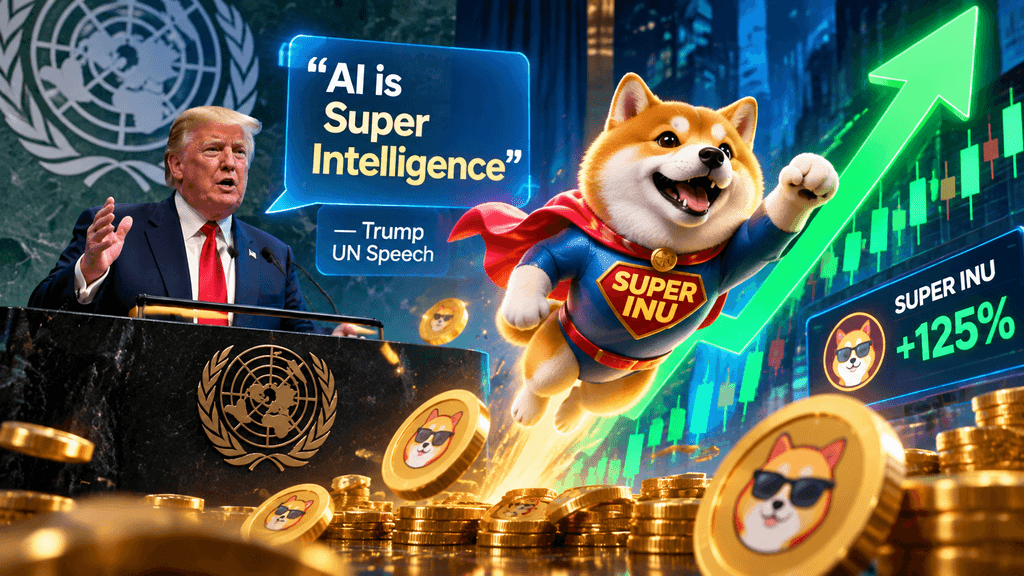
Trump’s “Super Intelligence” Remark Sparks Super Inu Meme Coin Rally
President Donald Trump used his September 22, 2026, address to the United Nations General Assembly to declare that U.S. government documents would henceforth refer to artificial intelligence as “super intelligence,” or SI. He argued that the word “artificial” made the technology sound fake, insisting the term “super” better captured its capabilities while rejecting any “globalist scheme” to control its development. Within hours, a Solana-based meme coin named Super Inu, ticker SI, recorded gains exceeding 300 percent according to market data from GMGN and on-chain trackers. The token, launched on the Stonk platform and paired with tokenized NVIDIA shares under the NVDAX ticker, saw its market capitalization climb into the low millions of dollars amid heavy short-term trading volume.
Similar tokens carrying the Super Inu name appeared on other chains and posted comparable percentage moves, underscoring how quickly narrative-driven assets respond to high-profile political statements. The quick price action in Super Inu demonstrates the tight linkage between political rhetoric on emerging technologies and speculative activity in low-liquidity meme tokens, where a single speech can generate outsized short-term returns for early participants while exposing later buyers to elevated volatility and selling pressure.
Trump’s UN Remarks Recast Artificial Intelligence Terminology Overnight
In his September 22 speech before the United Nations General Assembly, President Trump stated that all U.S. documents would switch from “artificial intelligence” to “super intelligence.” He explained that the original phrasing made the technology appear inauthentic and that “super” provided a more accurate description. The president paired the rebranding with a clear policy stance: the United States would encourage the technology rather than constrain it, rejecting international frameworks he described as globalist efforts to limit progress. He claimed the United States already held a substantial lead over China and other nations, framing leadership in the field as decisive for future economic and strategic outcomes. Officials close to the administration quickly adopted the new language on social platforms, reinforcing the message that the change would take effect in federal communications. The speech also dismissed certain safety concerns by comparing them to earlier warnings on climate change that, in his view, had not materialized as predicted. Coverage from multiple outlets, including Breaking Defense, The Verge, and Reuters, confirmed the exact wording and the broader context of technological competition.
The timing of the remarks amplified their market impact. Trump had tested alternative names on social media in the preceding days, with “super intelligence” emerging as the preferred option after informal polls. When the phrase entered the formal UN address, traders monitoring political developments for crypto catalysts moved quickly. The combination of a high-visibility global platform and a simple, memorable rebrand created an immediate narrative hook that meme-coin communities could adopt. Data showed trading volume in related tokens rising sharply in the hours following the speech, consistent with patterns observed in previous instances where presidential comments triggered short-term speculative flows. The episode illustrates how language from senior political figures can function as an exogenous shock in markets characterized by thin liquidity and high sensitivity to news.
Super Inu Token Records Triple-Digit Gains on Solana Within Hours
Market data tracked by GMGN indicated that the Solana Super Inu token, contract address DEW9dSN6QpWyNthphCpMmAbZP1Q4cEKR9xQXAri98WDP, advanced more than 300 percent in a short window after the speech. At one point, its market capitalization reached approximately $7.23 million before fluctuating. Later snapshots from Solscan and Birdeye placed the figure in the $3 million to $4 million range as prices consolidated, with 24-hour trading volumes reported in the millions of dollars. The token had been created shortly before the speech and listed on the Stonk platform, which specializes in pairs involving tokenized equities. Holders numbered in the low thousands, with top wallets controlling a notable share of circulating supply. Early participants who acquired the token near launch realized substantial mark-to-market gains as liquidity and attention increased.
Price action remained highly volatile throughout the session. Rapid upward moves were followed by profit-taking, producing wide intraday ranges. Analytics accounts noted that bottom holders had already secured large profits, raising the probability of near-term selling pressure. Liquidity depth, while improved relative to launch levels, stayed modest relative to the volume traded, increasing the risk of slippage for larger orders. The pattern matches classic meme-coin dynamics in which a catalyst produces a sharp initial spike, early capital extracts gains, and subsequent price discovery becomes more uncertain. Traders monitoring the token on decentralized exchanges observed elevated transaction counts and frequent small-to-medium-sized transfers consistent with retail participation.
Cross-Chain Super Inu Variants Mirror the Solana Move
Parallel tokens carrying the Super Inu name launched or gained traction on additional networks. On the Robinhood chain, one version briefly surpassed a $2 million market capitalization, with hourly gains exceeding 400 percent. A BSC counterpart recorded even larger percentage advances from a smaller base, reaching roughly $350,000 in market value amid extreme short-term volatility. These concurrent moves suggest coordinated attention rather than isolated organic growth. Blockchain explorers and aggregation sites listed the respective contracts, allowing traders to verify authenticity and liquidity pools. The simultaneous activity across chains reduced the chance that the Solana token alone captured the full narrative premium.
The multi-chain response shows the speed at which meme narratives propagate in 2026 crypto markets. Once a phrase from a major political figure enters public discourse, automated tools and social monitoring systems surface matching tickers almost immediately. Liquidity providers and speculative capital then migrate toward the highest-visibility pools. In this instance, the shared branding of “Super Inu” and the SI ticker created a recognizable cluster, amplifying overall volume even as individual tokens remained relatively small. Risk remained elevated across all versions because none possessed independent utility or audited tokenomics beyond the meme concept itself.
Super Inu launched on StonkFun, a Solana-based platform that pairs new tokens with tokenized equities rather than native SOL or stablecoins. The SI token trades against NVDAX, a tokenized representation of NVIDIA stock issued under the xStocks framework. This structure means that trading activity in the meme coin interacts with exposure to a major semiconductor and AI-related equity. Platform documentation and pool data confirm the pairing, with fees and liquidity mechanics designed around the equity token. The arrangement appeals to traders seeking thematic alignment between AI narratives and actual technology-sector equities.
The design carries both advantages and constraints. On the positive side, the equity pairing can attract capital interested in on-chain exposure to NVIDIA’s performance without leaving the Solana ecosystem. On the risk side, the tokenized stock itself is subject to issuer terms, redemption limitations, and regional eligibility rules. Holders of Super Inu gain no direct claim on the underlying NVIDIA shares or any vault that may accumulate related tokens. Liquidity in the SI/NVDAX pool, while sufficient for retail-sized trades during the pump, remains vulnerable to sudden withdrawals. The structure therefore embeds an additional layer of complexity that pure meme tokens lack, requiring participants to understand both the meme dynamics and the characteristics of the paired equity token.
Early Holders Capture Substantial Profits as Selling Pressure Builds
On-chain analysis showed that wallets acquiring Super Inu near its creation recorded large percentage gains once the Trump speech catalyzed broader interest. Some early positions multiplied several times within hours. As prices rose, a portion of those holders began realizing profits, contributing to observed selling pressure. Analytics platforms flagged elevated concentrations among top addresses and noted that a meaningful share of supply had already changed hands at elevated levels. Later entrants therefore faced a market in which a cohort of prior buyers held unrealized or realized gains and possessed an incentive to exit.
This distribution pattern is characteristic of narrative-driven tokens. Initial liquidity often concentrates among a small set of participants who monitor political and social catalysts closely. When a high-profile event occurs, their positions appreciate rapidly. Subsequent waves of buyers encounter thinner effective liquidity and the risk that early capital will distribute into strength. Market observers advised caution precisely because the small overall capitalization and high realized profits among early holders increased the probability of corrective moves. Volume remained elevated even as prices consolidated, indicating continued interest mixed with profit-taking activity.
Political Rhetoric Continues to Function as a Primary Catalyst for Meme Tokens
The Super Inu episode fits a broader pattern in which statements by senior political figures trigger measurable flows into related crypto assets. Previous Trump-linked tokens have responded to speeches, social media posts, and policy announcements with sharp, short-lived advances. In each case, the mechanism appears similar: the speech supplies a ready-made narrative, traders search for tickers that match key phrases, and capital migrates toward the most liquid or most visible pools. The speed of reaction has increased as monitoring tools and social channels have become more efficient at surface-matching content.
The absence of any official endorsement or contractual link between the token and the political figure does not diminish the market response. Speculators treat the rhetorical association itself as sufficient justification for short-term positioning. This dynamic places a premium on rapid information processing and equally rapid risk management. Tokens that fail to sustain attention after the initial catalyst typically experience rapid mean reversion. Super Inu’s price trajectory after the initial spike will therefore depend on whether secondary narratives or continued political commentary can maintain interest beyond the first 24 to 48 hours.
Liquidity Conditions and Slippage Risks Remain Elevated
Despite the surge in volume, Super Inu’s liquidity pools stayed relatively shallow compared with larger meme assets. Order-book depth and pool reserves indicated that sizeable market orders could move prices substantially. During peak activity, reported 24-hour volumes on some trackers reached several million dollars against liquidity measured in the low hundreds of thousands. This imbalance creates conditions in which both entry and exit costs can exceed nominal spreads. Traders relying on automated market makers faced variable slippage depending on trade size and timing.
The risk is compounded by the token’s recent creation. Newer contracts often lack the deep, multi-pool liquidity that develops over longer periods. Concentration among early wallets further reduces the free float available for orderly trading. Participants who treat the token as a pure momentum vehicle must therefore size positions accordingly and monitor real-time pool metrics. Failure to account for these constraints has historically produced larger-than-expected losses when sentiment reverses.
Tokenomics and Holder Distribution Point to Speculative Character
Available data show a total supply near one billion SI tokens, nearly all of which circulate. Holder counts rose into the low thousands within the first day of elevated activity. Top-ten addresses controlled roughly 20 percent of supply in some snapshots, a level typical of many meme launches. No formal utility, staking mechanism, or revenue-sharing design has been documented beyond the meme narrative and the NVDAX pairing. The absence of these features confirms that price discovery rests almost entirely on attention and narrative strength.
Such tokenomics place Super Inu firmly in the speculative category. Value depends on continued social engagement and the persistence of the “super intelligence” association. When attention migrates, the lack of fundamental anchors leaves the token exposed to rapid declines. Investors evaluating similar assets typically examine holder concentration, mint authority status, and liquidity lock details before committing capital. In this case, the combination of a recent launch, political catalyst, and equity pairing creates a distinct risk-reward profile that rewards speed and punishes delay.
How AI-Driven Narratives Influence Speculative Crypto Trading
The episode reinforces the close coupling between mainstream AI discourse and crypto speculation. As artificial intelligence remains a dominant theme in both technology and policy discussions, tokens that successfully attach themselves to high-visibility statements capture temporary premiums. The Super Inu case shows that even a terminological shift announced on a global stage can serve as a sufficient catalyst. Market participants increasingly treat political speeches as scheduled volatility events for narrative assets.
This coupling carries systemic implications for risk management. Portfolios containing exposure to meme tokens linked to political or technological themes must account for discontinuous jumps driven by external commentary. Traditional valuation frameworks offer limited guidance; instead, attention metrics, social volume, and on-chain flow become primary signals. The speed with which Super Inu responded suggests that automated detection of keyword matches has become an operational advantage for certain trading strategies.
Potential Risks for Narrative-Driven Tokens Linked to Equities
Beyond ordinary meme-coin risks, Super Inu introduces exposure to the mechanics of tokenized equities. NVDAX represents economic exposure to NVIDIA but does not convey ownership rights, voting power, or automatic redemption into physical shares under all conditions. Issuer terms, custody arrangements, and jurisdictional restrictions apply. Any disruption in the tokenized equity layer, whether operational, regulatory, or liquidity-related, could affect the paired meme token independently of its own narrative.
Participants must therefore monitor both the political narrative and the underlying equity-token infrastructure. Changes in NVIDIA’s equity price, shifts in tokenized stock premiums or discounts, or alterations to the Stonk platform’s fee and vault mechanics could all influence SI price action. The dual-layer structure multiplies the number of variables that can drive volatility.
Historical Parallels with Previous Political Meme Reactions
Earlier Trump-associated tokens displayed comparable short-term reactions to speeches and social media activity. Gains of tens of percent within hours, followed by partial retracements, have occurred repeatedly. The Super Inu move extends that pattern into the AI terminology domain. Each episode reinforces the observation that low-float, high-attention assets function as pure expression vehicles for political and cultural signals.
The magnitude of the Super Inu response, exceeding 300 percent in places, places it among the more pronounced recent examples. Consistency across episodes allows market participants to develop playbooks: monitor high-visibility political calendars, pre-position in or near matching narratives when possible, and define strict exit criteria once the initial catalyst fades. The Super Inu case supplies additional data points for calibrating those approaches.
Market Structure Lessons from the Super Inu Episode
The quick cross-chain proliferation of similarly named tokens demonstrates both the efficiency and the fragility of current meme markets. Information travels quickly, capital follows, and liquidity fragments across multiple contracts. Price discovery therefore occurs in parallel rather than in a single dominant pool. Aggregation tools and real-time analytics have become essential for navigating the resulting complexity. Traders who limited themselves to one chain missed part of the move; those who chased every variant faced elevated execution and monitoring costs.
The episode also shows the continuing importance of contract verification. Multiple Super Inu tokens existed simultaneously, requiring participants to confirm addresses against trusted explorers and pool data. Mistakes in this step can produce total loss of capital. The combination of speed, fragmentation, and verification requirements defines the operational environment in which narrative tokens now trade.
Outlook for Attention-Driven Tokens After High-Profile Catalysts
Once the immediate news cycle around the UN speech recedes, Super Inu and similar tokens will depend on secondary catalysts to retain value. Continued political commentary on AI, further adoption of the “super intelligence” phrasing in official documents, or broader market risk-on conditions could provide support. In the absence of such factors, historical patterns suggest mean reversion toward levels consistent with residual community interest.
The token’s equity pairing may offer a modest structural distinction relative to pure meme assets, yet that distinction remains secondary to attention dynamics. Market observers will watch holder retention rates, liquidity trends, and social-volume metrics in the coming sessions. Sustained trading activity above a few million dollars in daily volume would indicate that the narrative has achieved longer durability. Declining volume and rising concentration among remaining holders would signal the more typical post-catalyst fade.
🔥 Beyond the Headlines: What KuCoin 5.0 Means for You
Market news moves fast — but where you act on it matters just as much. This October, KuCoin launches KuCoin 5.0, transforming KuCoin into a rebuilt platform. Here's what actually changes for you:
-
One account for everything. Older platforms split your money across separate "spot," "margin," and "futures" accounts and expected you to understand why. KuCoin 5.0's unified account removes that entirely — deposit once, and everything is simply there (only available to VIPs for now).
-
Stocks, indices, and commodities. KuCoin 5.0 expands beyond crypto into global markets. When crypto chops sideways and equities rally (or the reverse), you rotate in minutes instead of opening a brokerage account and waiting days for fiat rails.
-
Real-world assets (RWA). Tokenized exposure to traditional assets like commodities, right inside your crypto account. One of the fastest-growing segments in global finance is no longer reserved for institutions — you access it from the same balance you trade with.
-
Earn while you learn. Not ready to trade? KCUSD lets your stablecoins earn daily, auto-compounding interest. The lowest-stress way to put your idle deposit to work for 4% yield.
-
An AI assistant in plain language. Ask questions, get market context, understand what you're looking at — built into the platform, no jargon required.
-
An app that doesn't overwhelm. Faster, cleaner, and consistent — intuitive from the first tap, not after a tutorial.
-
Safety you can check, not just trust. A MiCAR-licensed EU entity, Proof of Reserves you can verify yourself, and internationally certified security (SOC 2 Type II, ISO 27001:2022).
Create your account in minutes — and start on the platform built for where crypto is going, not where it's been.
FAQs
What exactly did President Trump say about artificial intelligence at the United Nations?
During the September 22, 2026, General Assembly address, President Trump stated that U.S. government documents would use the term “super intelligence” instead of artificial intelligence. He argued that “artificial” made the technology sound fake and that “super” was more accurate. He simultaneously rejected international regulatory frameworks and affirmed that the United States would encourage rather than restrict development of the technology. Multiple independent transcripts and news reports confirm the wording and context.
How large was the price movement in Super Inu?
According to GMGN and other on-chain data providers, the primary Solana Super Inu token advanced more than 300 percent in a short period after the speech, with market capitalization reaching approximately $7.23 million at one point before consolidating lower. Parallel tokens on other chains recorded comparable or larger percentage gains from smaller bases. Volume spiked into the millions of dollars within the first day.
Is Super Inu officially connected to the Trump administration or any government entity?
No verified connection exists. The token was launched by independent creators on the Stonk platform and draws its narrative inspiration from the speech. It carries no endorsement, contractual relationship, or official affiliation with any political office or campaign.
What is the significance of the NVDAX pairing?
Super Inu trades against NVDAX, a tokenized representation of NVIDIA stock available on Solana. The pairing links meme-coin trading activity to exposure to a major AI and semiconductor equity. Holders of Super Inu do not receive ownership rights in NVIDIA shares or automatic claims on any related vault.
What are the primary risks associated with Super Inu?
Key risks include extreme price volatility, relatively thin liquidity, concentration among early holders who may sell into strength, and the absence of independent utility. Additional risks arise from the tokenized-equity layer, including issuer terms and potential liquidity constraints in NVDAX itself.
Disclaimer: This content is for informational purposes only and does not constitute investment advice. Cryptocurrency investments carry risk. Please do your own research (DYOR).