

Why Are S&P 500 and Nasdaq Futures Falling? Iran Sanctions, Trade Risks, and Market Uncertainty Explained
2026/08/25 17:11:00
Key Takeaways
-
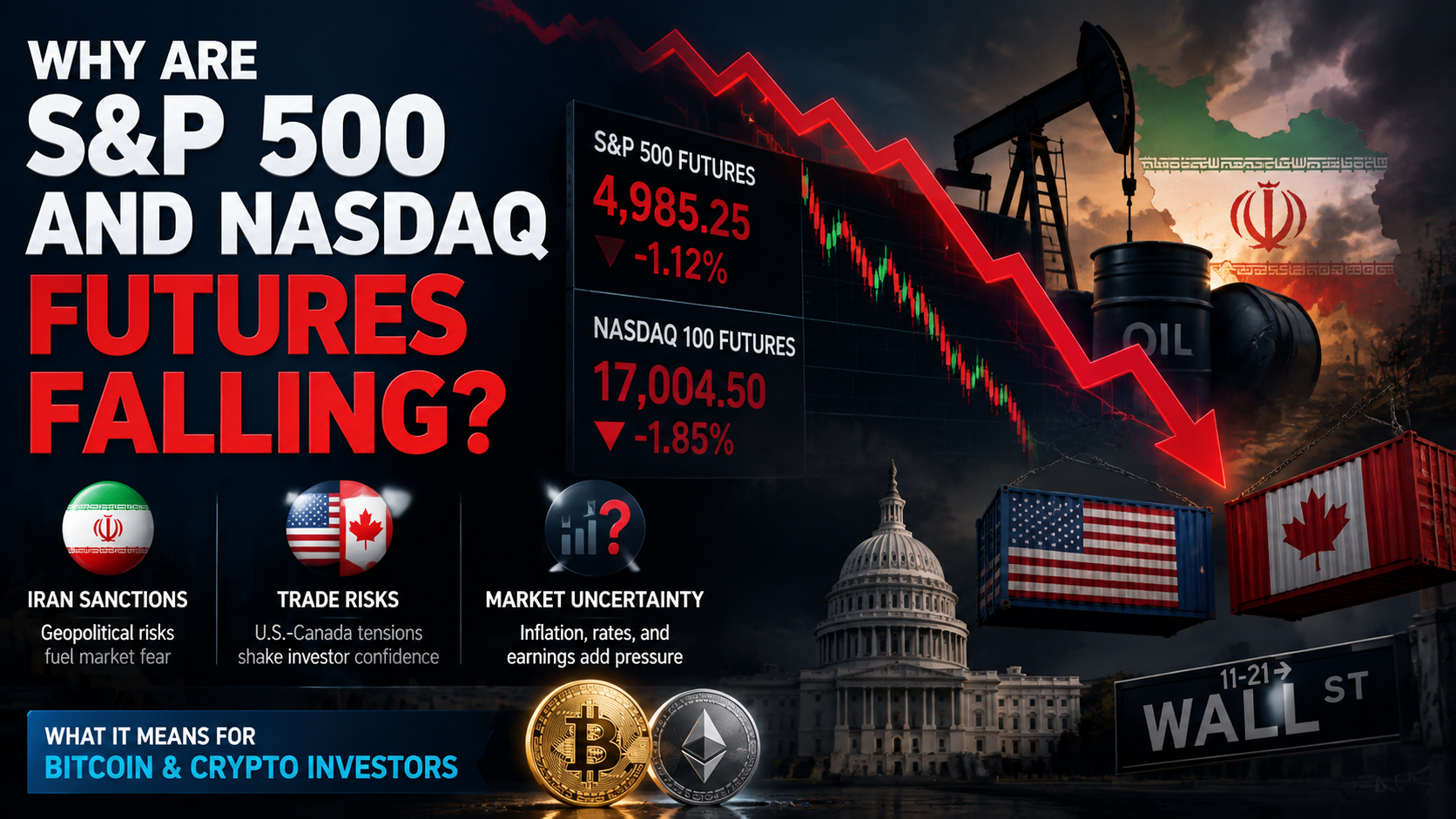
S&P 500 and Nasdaq futures declined as investors reacted to rising geopolitical risks, potential Iran sanctions, and renewed trade tensions.
-
Market uncertainty increased as investors evaluated the impact of energy prices, inflation risks, and Federal Reserve policy expectations.
-
Technology stocks faced additional pressure due to concerns surrounding AI valuations and upcoming earnings reports.
-
Risk-off sentiment across traditional markets can deeply influence Bitcoin and cryptocurrency prices through changes in liquidity and global investor appetite.
-
Understanding macro drivers is becoming increasingly important for crypto investors as digital assets become tightly connected with global financial markets.
U.S. stock futures recently declined, sending a wave of caution across global financial markets. Both S&P 500 and Nasdaq futures came under immediate pressure before the opening bell, as investors reacted to multiple layers of macroeconomic and geopolitical uncertainties. This was not a localized market event driven by a single bad earnings report. Instead, it was a culmination of several macro factors colliding at once: concerns over potential U.S. sanctions on Iran, escalating U.S.-Canada trade tensions, lingering Federal Reserve policy uncertainty, and mounting pressure on the high-flying technology sector.
For years, the cryptocurrency ecosystem was often viewed as a decentralized island, largely independent of traditional financial market swings. However, that narrative has shifted dramatically. Today, Bitcoin, Ethereum, and the broader digital asset market are increasingly sensitive to global liquidity conditions and traditional risk appetite.
When Wall Street gets nervous, the crypto market feels the tremors. This article explains exactly why traditional equities are facing downward pressure, how geopolitical and trade risks influence broader market sentiment, and what this shifting macroeconomic landscape ultimately means for Bitcoin and crypto investors.
What Happened to S&P 500 and Nasdaq Futures?
To understand how global risks are currently shaping investor portfolios, it is essential to look at the immediate price action in the futures market.
U.S. Stock Futures Declined Before the Market Open
Stock futures act as a barometer for market sentiment before regular trading hours begin. Recently, S&P 500 futures fell steadily, but Nasdaq futures experienced a much sharper decline. The technology-heavy Nasdaq index faced significantly stronger selling pressure compared to the broader market.
This divergence is largely because technology companies, semiconductor stocks, and AI-related firms carry premium valuations. When macroeconomic uncertainty rises, these high-growth stocks become highly sensitive to changes in market sentiment. Adding fuel to the fire, the market has been on edge awaiting pivotal earnings reports from industry giants like Nvidia. As AI-related stocks experience increased volatility, the entire technology sector feels the downward pull.
Multiple Risks Created a Risk-Off Environment
The sudden drop in futures was not triggered by a single headline. Financial markets are currently navigating a complex web of overlapping risks, creating what analysts call a "risk-off" environment. Investors are simultaneously digesting several major concerns:
| Risk Factor | Market Concern |
| Iran sanctions | Energy supply disruptions and geopolitical instability |
| U.S.-Canada trade tensions | Higher corporate costs and supply chain pressure |
| Fed policy uncertainty | Shifting interest rate and inflation expectations |
| AI valuation concerns | Technology stock volatility and earnings sustainability |
Why Investors Reacted Before Any Major Economic Damage Appeared
A common question among new investors is why markets drop before a geopolitical event actually damages the economy. The answer lies in the fundamental nature of financial markets: they trade on forward-looking expectations, not just current realities.
Investors proactively adjust their portfolio exposure, equity positions, and overall risk allocation the moment the probability of a negative event increases. Therefore, even if proposed tariffs or sanctions have not yet caused immediate economic loss, the mere perception of heightened risk forces asset prices to adjust downward instantly.
Why Are Iran Sanctions Increasing Market Concerns?
Geopolitics are currently taking center stage in the financial world, with potential sanctions on Iran serving as a primary catalyst for market anxiety.
Geopolitical Risks Can Quickly Spread Across Global Markets
The suggestion of the U.S. expanding economic pressure and sanctions on Iran does not just affect the Middle East; it creates a domino effect across global markets. The primary impact is concentrated in energy markets, specifically regarding oil supply expectations and global risk sentiment.
The market logic is straightforward: escalating tensions involving Iran raise the threat of energy supply disruptions. This energy uncertainty leads directly to oil price volatility. If oil prices spike, it inevitably feeds into broader inflation concerns, which ultimately puts risk assets—ranging from equities to crypto—under severe pressure.
Why Oil Prices Matter for Stocks and Crypto
Crypto investors might wonder why the price of a barrel of oil matters to a decentralized digital currency. The connection lies in inflation and central bank policy.
Rising oil prices increase global inflationary pressures. When inflation rises (or refuses to fall), the Federal Reserve is forced to keep interest rates higher for longer to cool the economy. High interest rates reduce global market liquidity, making it more expensive to borrow money. For speculative, high-growth risk assets like technology stocks and cryptocurrencies, tighter liquidity is a massive headwind. A hawkish Fed essentially drains the capital that typically flows into Bitcoin and altcoins.
How Geopolitical Events Change Investor Behavior
When geopolitical risk escalates, investor psychology shifts rapidly from wealth generation to wealth preservation. Capital typically flees high-risk investments and flows into traditional safe-haven assets.
During these periods, we see increased demand for the U.S. dollar, Treasury bonds, and physical gold. Conversely, institutions rapidly reduce their exposure to stocks, speculative assets, and cryptocurrencies. While some crypto enthusiasts argue that Bitcoin is a digital safe haven, its actual market behavior during geopolitical shocks often mirrors that of a risk-on tech stock. The ongoing debate over whether Bitcoin is a decentralized safe haven or a liquidity-sensitive risk asset is put to the test during these exact geopolitical flashpoints.
How Do Trade Tensions Affect Market Sentiment?
While the Middle East commands attention on the energy front, trade disputes in North America are creating headaches for corporate supply chains.
U.S.-Canada Trade Disputes Raise Economic Uncertainty
Recent breakdowns in U.S.-Canada trade negotiations have introduced another layer of macroeconomic friction. The threat of sweeping tariffs has reignited tariff concerns, supply chain risks, and corporate cost pressures. Because the U.S. and Canada share one of the most integrated supply chains in the world—particularly in the automotive and industrial sectors—any disruption here sends immediate shockwaves through the manufacturing economy.
Why Tariffs Matter for Businesses
Tariffs are essentially a tax on imported goods, and they have a direct impact on corporate fundamentals. When tariffs are implemented, they increase production costs for businesses. Companies are then faced with a difficult choice: absorb the costs and accept lower profit margins, or pass the costs onto consumers through higher pricing strategies.
For the financial markets, this creates a dangerous sequence of events: higher corporate costs lead to higher consumer inflation, which leaves the Federal Reserve with less room to execute interest rate cuts. When rate cuts are delayed, equity valuations are immediately pressured downward.
Why Crypto Investors Should Pay Attention
Crypto is not a traditional corporate asset producing physical goods, so it doesn't pay tariffs. However, it is heavily reliant on global market conditions. Crypto thrives on abundant liquidity, low interest rates, and a strong global risk appetite. If trade conflicts drive up inflation and force central banks to keep liquidity tight, the macroeconomic environment becomes hostile for digital assets. Trade conflicts ultimately influence the macro channels that dictate BTC and ETH price action.
Why Is Nasdaq More Vulnerable Than the Broader Market?
During this recent futures selloff, the Nasdaq took a much harder hit than the S&P 500 or the Dow Jones. This vulnerability is deeply tied to the specific composition of the index.
Technology Stocks Depend on Growth Expectations
The Nasdaq is heavily weighted toward AI companies, semiconductor firms, and high-growth technology companies. These are long-duration assets, meaning their current high valuations are justified by massive future earnings expectations. To achieve these future earnings, tech companies benefit greatly from low interest rates and stable economic conditions. When inflation threats rise (via oil or tariffs), the discount rate applied to those future earnings increases, causing their present valuations to plummet faster than traditional value stocks.
AI Market Concerns Add Extra Pressure
Beyond macroeconomics, the tech sector is dealing with its own internal anxieties. The market is hyper-focused on Nvidia earnings, the long-term sustainability of AI infrastructure investment, and stretched semiconductor valuations. The Nasdaq is currently facing a double whammy: external macroeconomic risks (geopolitics and trade) combined with internal sector valuation adjustments. When both strike simultaneously, tech futures drop aggressively.
What Does This Mean for Bitcoin and Crypto Markets?
For the crypto investor, the crucial question is how this traditional financial turbulence translates to the blockchain ecosystem.
Crypto Markets Are Increasingly Connected to Macro Conditions
In previous market cycles, crypto was largely driven by retail speculation, internal crypto narratives (like block size debates or DeFi summers), and Bitcoin halving cycles. Today, the landscape is entirely different.
With the approval of spot ETFs and the entry of Wall Street giants, Bitcoin and Ethereum are heavily influenced by Fed policy, dollar liquidity, and institutional capital flows. The same macro hedge funds trading Nasdaq futures are also managing crypto exposure. Therefore, crypto is now tethered to the same macroeconomic forces that dictate traditional equity movements.
Risk-Off Sentiment Can Pressure Crypto Prices
When institutional investors decide to reduce risk in their portfolios due to geopolitical or trade fears, they do not just sell stocks; they sell across the board. In a risk-off environment, capital is pulled from equities, technology assets, and cryptocurrencies alike. Because crypto markets operate 24/7 and have thinner liquidity than the U.S. Treasury market, this risk-off liquidation can cause sharp, sudden price drops in Bitcoin and altcoins, especially in the short term.
Could Bitcoin Benefit From Geopolitical Uncertainty?
Despite the short-term correlation with risk assets, there remains an ongoing debate about Bitcoin's behavior during macro crises.
One viewpoint argues that Bitcoin, as a decentralized asset and alternative store of value outside the traditional banking system, should attract capital during times of sovereign uncertainty. If trade wars and sanctions weaponize fiat currencies, a neutral digital asset becomes highly attractive.
The opposing viewpoint highlights that, in reality, Bitcoin still trades like a high-volatility, liquidity-sensitive asset. Historical data from the last few years shows that during sudden geopolitical shocks, Bitcoin tends to sell off alongside stocks initially. Therefore, crypto investors cannot blindly assume that geopolitical risk is an automatic catalyst for a Bitcoin rally.
What Should Crypto Investors Watch Next?
To navigate this complex environment, crypto investors must broaden their focus beyond the blockchain and monitor traditional macroeconomic indicators.
Federal Reserve Policy Signals
The Fed remains the most powerful force in global finance. Crypto investors should closely monitor upcoming inflation data (CPI/PCE), speeches by Fed officials, and shifting interest rate expectations. Any signal that the Fed might cut rates will inject liquidity into the system, generally benefiting digital assets.
Energy Prices and Geopolitical Developments
The situation in the Middle East and its impact on the oil market must be watched carefully. If the Iran situation escalates and oil spikes, inflation fears will return, which could pressure global risk appetite and stall crypto momentum.
Institutional Market Positioning
Finally, follow the institutional money. Monitor the daily and weekly flows into U.S. spot Bitcoin and Ethereum ETFs. Observing how institutions adjust their crypto demand during traditional market selloffs will provide the clearest signal of whether Wall Street views digital assets as long-term holdings or highly liquid assets to be dumped at the first sign of macro trouble.
Conclusion
The recent decline in S&P 500 and Nasdaq futures serves as a stark reminder that markets are highly sensitive to overlapping macroeconomic threats. Investors pulled back as they reacted to multiple uncertainties, with Iran sanctions concerns and North American trade tensions significantly increasing global risk aversion.
For the digital asset ecosystem, these developments are critical. These traditional market factors matter deeply for crypto because Bitcoin and Ethereum are now thoroughly integrated with global liquidity conditions. Crypto investors can no longer afford to ignore traditional finance; understanding macroeconomic drivers, geopolitical shifts, and central bank policies is now a mandatory requirement for successfully navigating the cryptocurrency markets.
FAQs
Why do stock futures move before the market opens?
Stock futures trade nearly 24 hours a day, allowing investors to react to overnight news, geopolitical events, and economic data releases. They reflect forward-looking expectations, serving as an early indicator of how the regular stock market is likely to behave once the opening bell rings.
Are geopolitical risks always negative for Bitcoin?
Not necessarily, but they are complex. While the "digital gold" narrative suggests Bitcoin should act as a safe haven during crises, its high volatility often causes it to sell off initially alongside risk assets like tech stocks when investors rush to cash. Its long-term reaction depends heavily on how the crisis affects global fiat liquidity.
How does the Federal Reserve affect crypto markets?
The Federal Reserve controls the U.S. money supply and interest rates. When the Fed lowers rates, borrowing is cheap, liquidity expands, and investors seek higher returns in riskier assets like crypto. Conversely, when the Fed raises rates, liquidity tightens, often driving capital out of the crypto market and into safer, yield-bearing assets.
Why does Nasdaq react strongly to interest rate changes?
The Nasdaq is heavily composed of technology and growth companies. The valuations of these companies are based on expected profits far in the future. When interest rates rise, the present value of those future profits decreases significantly, causing a sharper selloff in tech stocks compared to stable, dividend-paying value stocks.
What indicators should crypto investors monitor during market uncertainty?
During macro uncertainty, crypto investors should monitor the U.S. Dollar Index (DXY), as a strong dollar typically pressures crypto. Additionally, tracking U.S. Treasury yields, the VIX (Volatility Index) for market fear, and institutional capital flows into Bitcoin and Ethereum ETFs will provide a clearer picture of market direction.
🔥 KuCoin Offers A More Stable Option in A Volatile Market
If you worry about the frequent ups and downs in the market, and pursue a more stable option to earn money passively, KuCoin is the right place to come:
Simple Earn: Deposit and withdraw tokens anytime, earning stable returns.
Kucoin Earn: Earn stable profits with professional asset management.
Hold to Earn: Earn rewards by holding assets in Funding, Trading, Margin, Futures, Mining, and Unified Accounts.
Staking: Unlock the earning potential of on-chain assets.
Advanced Investments: Advanced Investments offer a variety of structured products to help your money grow in any market.
Shark Fin: Principal Protection and Guaranteed Gains
Dual Investment: Buy low and sell high with transparent return calculations.
Snowball: High yields, with price protection.
Discount Buy: Buy crypto at discount prices.
KCS Loyalty: Level up to enjoy exclusive perks by staking ≥ 1 KCS.
KuCoin Wealth: Discover future value and begin your smart investing journey.
KCS Benefits: Hold and stake KCS to access benefits across the platform.
KCS Staking 2.0: Participate in KCS on-chain governance to earn yield.
Disclaimer: This content is for informational purposes only and does not constitute investment advice. Cryptocurrency investments carry risk. Please do your own research (DYOR).