

September 2026 FOMC: Fed Hikes 25bp, Hawkish Dot Plot, and Is This a New Hiking Cycle?
Introduction
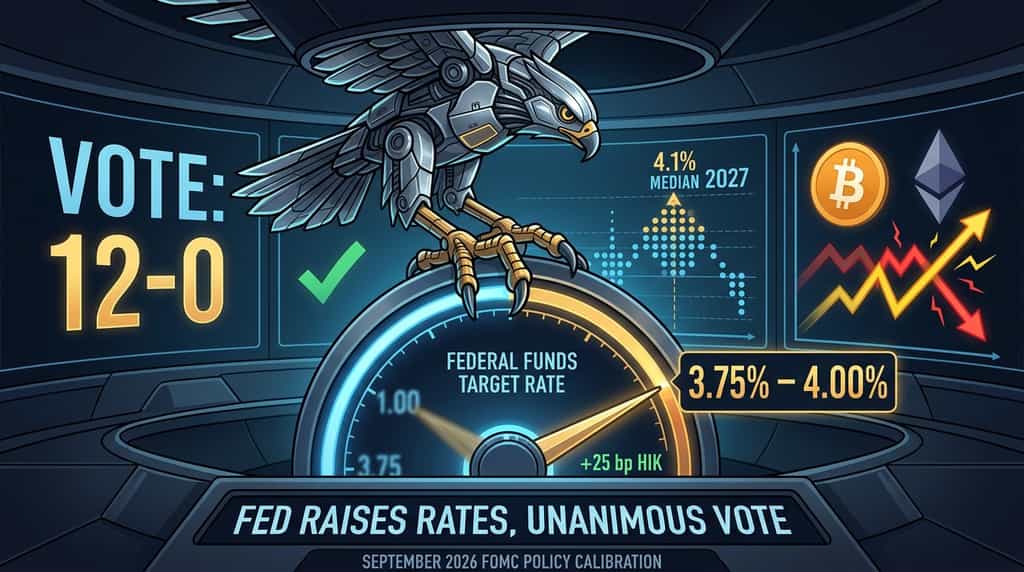
Did the Federal Reserve just restart a hiking cycle — or only recalibrate policy after a long pause? On September 16, 2026, the Federal Open Market Committee voted 12-0 to raise the federal funds target range by 25 basis points to 3.75%–4.00%, according to the official FOMC statement released by the Federal Reserve Board. The same release said inflation remains elevated and that the hike is intended to support a timelier return to the 2% goal.
The accompanying Summary of Economic Projections is more hawkish than June. The median federal funds rate for year-end 2026 is 4.1%, which implies one additional 25bp increase after this meeting. Medians stay at 4.1% for 2027, then ease only modestly to 3.9% in 2028 and 3.6% in 2029. The longer-run rate ticked up to 3.2% from 3.1%, based on the official September 16, 2026 projection tables.
This article explains what the decision actually changed, how the dot plot is distributed, whether the move is a new multi-year hiking cycle, and how rate-sensitive crypto markets typically respond.
What Did the September 2026 FOMC Decide?
The Committee raised the federal funds target range by one-quarter point to 3.75%–4.00% and did so unanimously.
That is the first increase since July 2023. The implementation note issued the same day set interest on reserve balances at 3.90% and the primary credit rate at 4.00%, both effective September 17, 2026. Standing overnight repo and reverse-repo rates were adjusted to keep the funds rate inside the new band. The Committee also restated its policy of maintaining ample reserves rather than restarting a large balance-sheet runoff.
The statement itself is short. It described economic activity as expanding at a solid pace, domestic spending as resilient, productivity growth as strong, and capital investment as robust. Job gains have kept pace with the workforce, and the unemployment rate has changed little. Inflation “remains elevated.” The policy action, officials wrote, will support a timelier return to the 2% goal, and “the Committee will deliver price stability.”
Those words matter more than their brevity suggests. Compared with earlier 2026 holds, the Committee dropped language that had tied elevated inflation partly to supply shocks. The new framing treats sticky prices as a policy problem that requires tighter settings now, not only patience while shocks fade.
How Hawkish Is the September 2026 Dot Plot?
The median path is one more hike in 2026, then a hold through 2027.
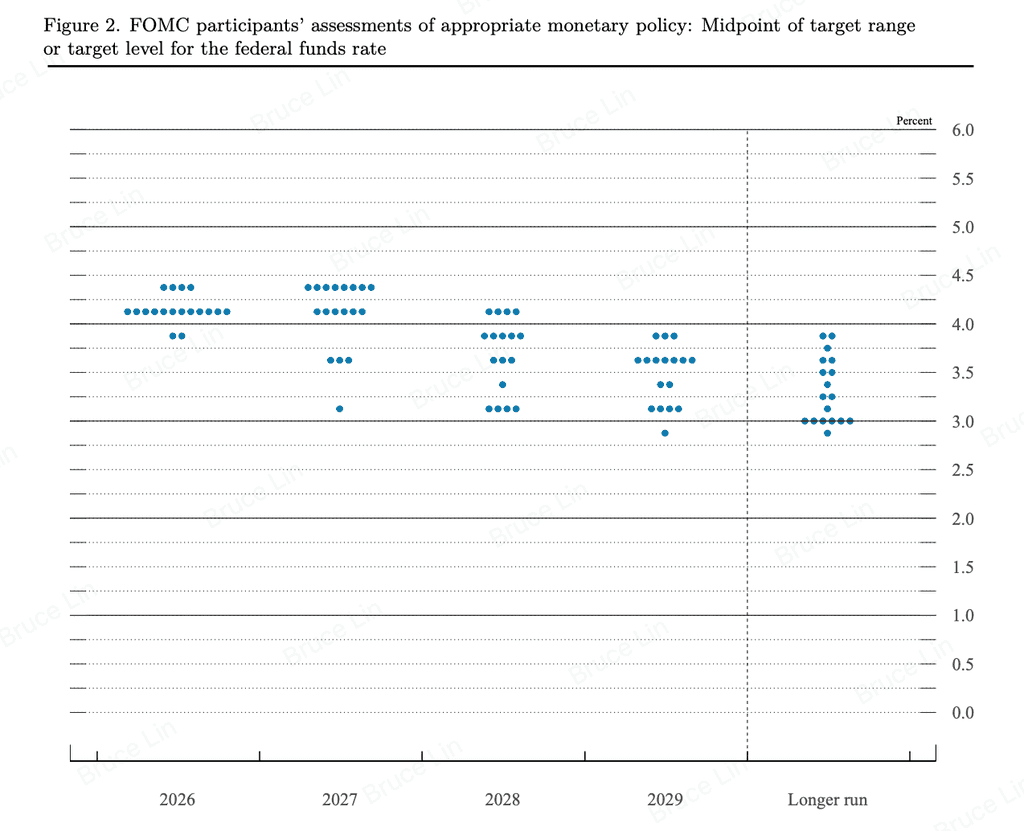
According to the official September 16, 2026 Summary of Economic Projections, 18 participants submitted rate dots. Twelve placed the 2026 year-end midpoint at 4.125%, four at 4.375%, and two at 3.875%. That distribution is why the median is 4.1% — one additional quarter-point move from the new 3.75%–4.00% range.
The 2027 median is also 4.1%. Eight participants still sit at 4.375% for 2027, which keeps a hawkish tail in the plot even though the median does not rise further. For 2028 the median falls to 3.9%, and for 2029 to 3.6%. The longer-run rate is 3.2%.
Growth and labor forecasts moved in a direction that supports tighter policy. Median real GDP growth for 2026 is 2.3%, up from 2.2% in June. The unemployment rate is 4.1% for 2026–2028, versus 4.3% in the June projection for 2026. Core PCE inflation is 3.4% for 2026, 2.5% for 2027, 2.2% for 2028, and 2.0% for 2029. Headline PCE for 2026 is also higher than in June, consistent with energy and tariff pass-through still in the forecast.
The plot is therefore hawkish in three ways at once: the near-term median rose, more officials cluster at two total 2026 hikes than markets had assumed, and the longer-run rate moved up. It is not hawkish in the 2022–2023 sense. The Committee is not projecting a string of 50bp or 75bp moves, and the 2027 median is a hold, not another full tightening year.
Is This the Start of a New Hiking Cycle?
This is better described as a limited recalibration than as a new multi-year hiking cycle.
A classic hiking cycle — 2022–2023 is the recent template — features rapid, repeated increases because demand and the labor market are overheating and inflation is accelerating. The September 2026 SEP does not describe that economy. Growth is solid, not runaway. Unemployment is little changed near 4.1%. Core inflation is still well above 2%, but the Committee’s own path has it declining through 2029, not re-accelerating.
Three policy motives fit the data better than “cycle restart.”
First, the hike is preventive. Inflation has been above target for more than five years. Officials want medium-term inflation expectations to stay anchored. A 25bp move after a long pause is a signal that the Committee will not wait for a full upside breakout before acting.
Second, the hike is a calibration toward a higher estimate of neutral. The longer-run rate at 3.2% is still below the new target range, so policy is mildly restrictive on the Committee’s own map. Several participants clearly believe financial conditions are not restrictive enough for inflation to fall at “sufficient speed.” A small increase tests that view without committing to 150–200bp of extra tightening.
Third, the hike partially reverses last year’s insurance cuts. Those cuts were made when labor-market risk looked larger than inflation risk. Official 2026 projections now show a steadier labor market and higher near-term inflation. The risk balance has shifted back toward prices.
What would turn this into a true cycle? The SEP implies a high bar. Officials would need evidence that the labor market is moving from stable to overheated and that services inflation is turning up with wages, not merely falling slowly. The current forecast does not contain that combination. A path of two to three 25bp moves — this hike plus one more in 2026, and at most one later if data deteriorate on inflation — is the configuration the median dots describe.
Why Did the Fed Tighten If Growth Is Still Solid?
The Committee tightened because inflation is still too high and the economy can, in its view, absorb a modestly higher rate.
The official statement pairs “solid” activity with “elevated” inflation. That pairing is the dual-mandate logic in one paragraph. When employment is not deteriorating, price stability gets more weight. Productivity and capital investment being described as strong also reduces the fear that a 25bp hike will stall the expansion.
Geopolitical uncertainty remains in the statement, including energy-market risk. The Committee no longer treats those shocks as a reason to stay on hold. Instead, it uses them as a reason to make sure policy does not fall behind if price pressures persist.
This is also why the vote was 12-0. Earlier 2026 meetings had more visible disagreement about timing. Unanimity in September tells markets that the inflation-risk argument now commands the Committee, even among officials who had preferred to wait.
How Do Higher Fed Rates Affect Crypto and Risk Assets?
Tighter policy usually lifts the dollar and short-term yields and reduces appetite for long-duration risk, including many crypto assets.
The transmission is mechanical. A higher federal funds range raises the return on cash and short Treasuries. That increases the opportunity cost of holding non-yielding assets. Stronger real rates also tend to compress valuations for assets whose cash flows or adoption stories sit far in the future.
The September package adds a second channel: the hawkish skew in the dots. When 16 of 18 submitted projections still show at least one more 2026 hike, markets price a higher path for 2026–2027 front-end rates. That repricing can hit bitcoin, ether, and high-beta tokens even if the hike itself was fully expected.
The effect is not uniform. Bitcoin has at times traded more like a liquidity and risk barometer than like a simple inverse-rate instrument. Tokens tied to on-chain activity, stablecoin yields, or funding rates can move with derivatives positioning rather than with the funds rate alone. Still, the first-order map is clear. A Fed that is hiking and holding higher for longer is a headwind for speculative leverage and a tailwind for cash and short-duration dollar products.
Traders should separate the meeting surprise from the path. A fully priced 25bp hike can still reprice crypto if the press conference and SEP shift the number of remaining hikes or the date of the first cut. That path shift is what the September 2026 materials delivered.
Beyond the Headlines: What KuCoin 5.0 Means for You
Market news moves fast — but where you act on it matters just as much. This October, KuCoin launches KuCoin 5.0, transforming KuCoin into a rebuilt platform. Here's what actually changes for you:
-
One account for everything. Older platforms split your money across separate "spot," "margin," and "futures" accounts and expected you to understand why. KuCoin 5.0's unified account removes that entirely — deposit once, and everything is simply there.
-
Stocks, indices, and commodities. KuCoin 5.0 expands beyond crypto into global markets. When crypto chops sideways and equities rally (or the reverse), you rotate in minutes instead of opening a brokerage account and waiting days for fiat rails.
-
Real-world assets (RWA). Tokenized exposure to traditional assets like commodities, right inside your crypto account. One of the fastest-growing segments in global finance is no longer reserved for institutions — you access it from the same balance you trade with.
-
Earn while you learn. Not ready to trade? KCUSD lets your stablecoins earn daily, auto-compounding interest. The lowest-stress way to put your idle deposit to work for 4% yield.
-
An AI assistant in plain language. Ask questions, get market context, understand what you're looking at — built into the platform, no jargon required.
-
An app that doesn't overwhelm. Faster, cleaner, and consistent — intuitive from the first tap, not after a tutorial.
-
Safety you can check, not just trust. A MiCAR-licensed EU entity, Proof of Reserves you can verify yourself, and internationally certified security (SOC 2 Type II, ISO 27001:2022).
Create your account in minutes — and start on the platform built for where crypto is going, not where it's been.
Conclusion
The September 16, 2026 FOMC delivered a unanimous 25bp increase to 3.75%–4.00% and a hawkish update to the Summary of Economic Projections. The official median now points to 4.1% at the end of 2026 and again in 2027, with only gradual easing after that and a longer-run rate of 3.2%. Inflation is still described as elevated. Growth and jobs are described as solid.
That combination answers the cycle question more clearly than market slogans do. The Committee is tightening to protect the inflation target and to test a slightly more restrictive setting. It is not forecasting a 2022-style sequence of large hikes. Two to three quarter-point moves, including the September action, remain the configuration implied by the dots unless labor overheating or a renewed inflation upswing appears in the data.
For crypto markets, the relevant input is the path, not the 25bp headline. A higher-for-longer funds rate raises the hurdle for leveraged risk assets. Traders who map positions to the official median, the hawkish tail of the plot, and the incoming inflation and jobs prints will be better prepared than those who treat every hike as the start of a new cycle.
FAQs
Did every FOMC voter support the September 2026 hike?
Yes. The official statement was approved 12-0.
What federal funds range is in effect after the meeting?
The target range is 3.75% to 4.00%, effective with implementation on September 17, 2026, according to the Federal Reserve’s implementation note.
How many extra 2026 hikes does the median dot plot show?
The median year-end 2026 funds rate is 4.1%, which is one additional 25bp hike after September.
Did the Fed raise its longer-run interest-rate estimate?
Yes. The longer-run median moved to 3.2% from 3.1% in the official September projections.
Is the Fed shrinking its balance sheet again?
No. The Committee said it is continuing a policy of ample reserves and directed reinvestment operations consistent with that stance.
Disclaimer: This article is for informational purposes only and does not constitute financial, legal, or investment advice. Always conduct your own research before interacting with digital assets.