

Mild July CPI Data Shifts Focus as Neocloud Stocks Emerge as the Next AI Trading Narrative
Introduction
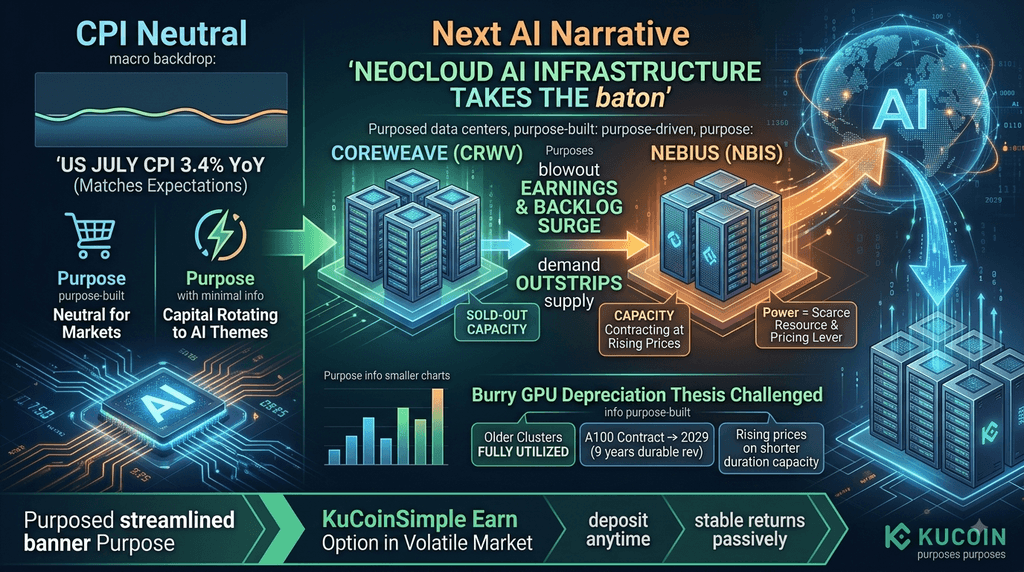
The US July CPI report came in at a predictable 3.4% year-over-year, matching expectations and failing to spark major macro moves. Yet US equity markets still delivered fireworks: after the storage-chip AI narrative cooled, traders immediately hunted for the next sector ready to carry the AI trade.
CoreWeave (CRWV) and Nebius (NBIS) — two pure-play Neocloud providers — posted blowout earnings and surged 19% and 34%, respectively, positioning AI infrastructure cloud as the clearest candidate to inherit the baton.
What Did the Latest CPI Data Actually Show?
The July 2026 Consumer Price Index rose 0.1% month-over-month and 3.4% year-over-year, according to the Bureau of Labor Statistics release on August 12. Core CPI (excluding food and energy) increased 0.2% monthly and 2.5% annually — both figures aligned with consensus forecasts. Energy prices declined 1.5% on the month while shelter and food each edged up 0.1%.
These numbers confirmed that the earlier energy spike has moderated without reigniting broader inflation fears. Markets treated the print as neutral rather than hawkish or dovish, freeing capital to rotate into thematic equity stories instead of macro hedges.
Why Is the Market Already Searching for the Next AI Narrative?
Storage-chip names had dominated recent AI trading momentum, but that leg of the trade lost short-term heat. Investors therefore rotated toward sectors still showing accelerating demand and sold-out capacity. Optical-communications stocks had already been flagged as one possible successor; last night’s Neocloud earnings made a stronger case for specialized AI cloud providers.
Both CoreWeave and Nebius demonstrated that hyperscalers, AI labs, and enterprises continue to lock in multi-year GPU capacity at rising prices. Capacity is fully contracted — and still insufficient — which keeps the AI infrastructure narrative alive even as other sub-themes cool.
How Strong Were CoreWeave and Nebius Earnings?
CoreWeave reported second-quarter revenue of $2.58 billion, more than doubling year-over-year and slightly beating estimates. Its revenue backlog reached approximately $104 billion as of June 30, up 246% from a year earlier. Management already secured more than $25 billion in additional net new customer commitments in the early weeks of the third quarter. The company guided third-quarter revenue to $3.45–$3.6 billion and raised full-year 2026 revenue guidance to $12.4–$13.2 billion.
Nebius delivered even more explosive growth. Group revenue hit $582.3 million, up 454% year-over-year, with its core AI-cloud segment contributing the vast majority. Adjusted EBITDA turned positive at $236.2 million after a loss in the year-ago period. Annualized run-rate revenue reached roughly $3 billion. The company closed four AI-cloud deals averaging more than $1 billion each, nearly quadrupling total contract value, and raised its 2026 contracted-power target to 5 gigawatts.
Both firms reported that available capacity is sold out and that demand continues to outstrip supply. Shares of CRWV closed roughly 19% higher and NBIS approximately 34% higher on the day, reflecting investor conviction that Neoclouds can sustain the AI trade.
Why Does Power Matter More Than GPUs for Neoclouds?
GPUs can be purchased relatively quickly with capital, but grid power cannot. Neocloud operators treat electricity as the true scarce resource and pricing lever. Nebius recently signed contracts in the $40–50 million per megawatt range for shorter-duration capacity — roughly double the $20–25 million per megawatt seen on longer-term deals — and cleared one auction 15% above its previous highest price. Management noted it could sell all planned 2027 capacity today yet deliberately withholds a portion because power constraints support higher future pricing.
CoreWeave similarly highlighted that older-generation clusters remain fully utilized. The ability to monetize power-constrained capacity at rising rates gives these firms pricing power that pure chip vendors lack. In short, controlling megawatts has become as strategically important as controlling the latest GPU SKUs.
Does the Burry GPU Depreciation Thesis Still Hold?
Michael Burry’s widely discussed bear case argued that GPUs have an economic life of only two to three years while companies depreciate them over five to six years, thereby overstating earnings. Both companies’ earnings calls directly challenged that view with fresh data.
Nebius reported that shorter-duration capacity is clearing at $40–50 million per megawatt versus $20–25 million on longer contracts — pricing inconsistent with assets whose useful life is nearly exhausted. CoreWeave disclosed an A100 contract extending into 2029 at attractive rates. The A100 launched in 2020, meaning nine years of contracted revenue on a three-generation-old chip. Management added that prior-generation pricing remains at or above levels seen years earlier and that older fleets are largely sold out.
Importantly, these recontracted clusters often carry no remaining debt; asset-level leverage is repaid within the initial term. Subsequent revenue therefore lands on fully depreciated, unlevered hardware where power and other operating costs are the primary expenses. The evidence from the latest earnings supports extended useful lives and sustained demand rather than rapid obsolescence.
What Sets Neoclouds Apart from Broader Cloud or Chip Plays?
Traditional hyperscalers offer general-purpose cloud services; Neoclouds specialize in high-density GPU clusters optimized for AI training and inference. This focus allows higher utilization rates and the ability to charge premium pricing for scarce, power-backed capacity. Unlike pure semiconductor names, Neocloud operators capture multi-year contracted revenue streams and benefit from both newer and older GPU generations remaining productive.
Capacity constraints and power scarcity create durable barriers. Customers continue to accept older hardware when cutting-edge chips are unavailable — the equivalent of accepting spam when wagyu is sold out — underscoring the intensity of demand.
KuCoin Offers A More Stable Option in A Volatile Market
If you worry about the frequent ups and downs in the market, and pursue a more stable option to earn money passively, KuCoin is the right place to come:
-
Simple Earn: Deposit and withdraw tokens anytime, earning stable returns.
-
Kucoin Earn: Earn stable profits with professional asset management.
-
Hold to Earn: Earn rewards by holding assets in Funding, Trading, Margin, Futures, Mining, and Unified Accounts.
-
Staking: Unlock the earning potential of on-chain assets.
-
Advanced Investments: Advanced Investments offer a variety of structured products to help your money grow in any market.
-
Shark Fin: Principal Protection and Guaranteed Gains
-
Dual Investment: Buy low and sell high with transparent return calculations.
-
Snowball: High yields, with price protection.
-
Discount Buy: Buy crypto at discount prices.
-
KCS Loyalty: Level up to enjoy exclusive perks by staking ≥ 1 KCS.
-
KuCoin Wealth: Discover future value and begin your smart investing journey.
-
KCS Benefits: Hold and stake KCS to access benefits across the platform.
-
KCS Staking 2.0: Participate in KCS on-chain governance to earn yield.

Conclusion
The July CPI print of 3.4% delivered no macro surprises, yet it cleared the way for equity markets to focus on the next leg of the AI trade. With storage-chip momentum fading, CoreWeave and Nebius stepped forward with sold-out capacity, rapidly expanding backlogs, and evidence of sustained pricing power. Their results highlight that power availability — not merely GPU supply — has become the critical bottleneck and value driver.
Data from the latest earnings calls also undercuts earlier concerns about short GPU economic lives. Multi-year contracts on older-generation chips and rising short-term capacity prices demonstrate durable demand. Neocloud providers therefore stand as credible candidates to carry the AI narrative forward. Investors and traders monitoring thematic rotation should continue watching capacity announcements, power contracts, and backlog growth for confirmation that the infrastructure layer remains the strongest expression of AI spending.
FAQs
What is a Neocloud?
A Neocloud is a specialized cloud provider focused on high-performance GPU clusters dedicated to AI training and inference rather than general-purpose computing.
Why did CoreWeave and Nebius stocks jump after earnings?
Both companies reported strong revenue growth, record or near-record backlogs, sold-out capacity, and rising pricing power, confirming continued AI infrastructure demand.
How does power scarcity affect AI cloud pricing?
Limited grid electricity constrains new capacity additions, allowing operators to charge higher rates and selectively withhold supply to maximize future pricing.