

How Do US Political Shifts Impact Real-World Asset Tokenization and Stablecoins?
Introduction
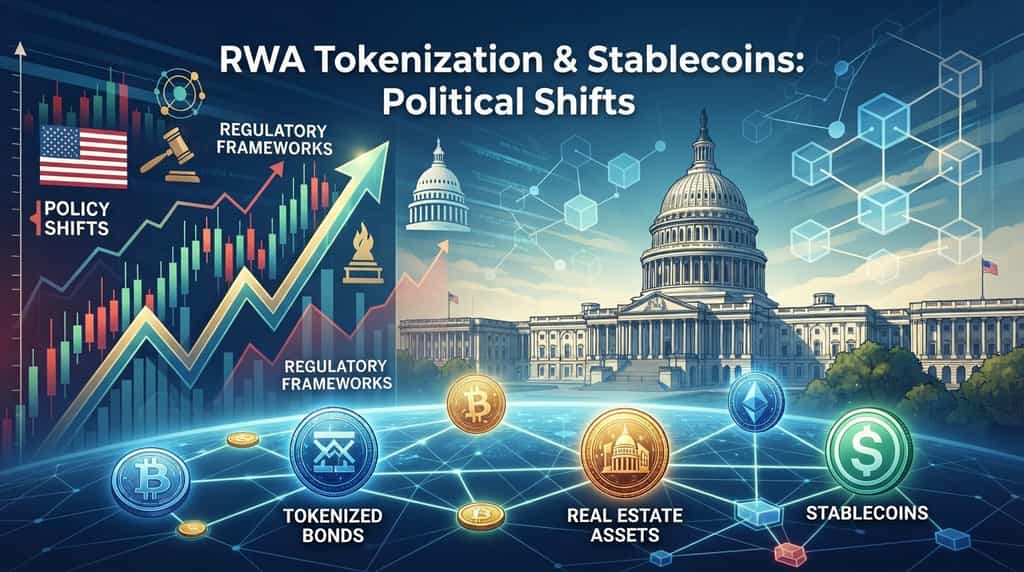
Real-world asset (RWA) tokenization and stablecoins may maintain regulatory momentum despite a Democratic sweep in recent United States elections, while broader digital asset market structures face extended uncertainty. As legislative control shifts, market observers are analyzing how institutional adoption of blockchain-based settlement rails will interact with evolving federal oversight. Understanding these dynamics is essential for market participants tracking institutional blockchain adoption and digital dollar infrastructure.
Key Takeaways
-
Core Conclusion: Stablecoin adoption and real-world asset tokenization are expected to retain institutional backing following the 2026 US elections, supported by bipartisan utility in modernizing financial market infrastructure.
-
Stablecoin Resilience: Stablecoins serve as vital on-chain liquidity providers and major purchasers of US Treasury securities, aligning with macroeconomic debt-management interests.
-
Tokenization Momentum: Traditional financial institutions continue to tokenize money market funds, bonds, and real estate to improve settlement efficiency, independent of broader digital asset classification disputes.
-
Legislative Uncertainty: Broader regulatory clarity concerning secondary market trading and token classification faces potential delays as legislative priorities shift under a Democratic majority.
-
Compliance Frameworks: Compliance obligations, anti-money laundering controls, and institutional risk management protocols remain central to the ongoing evolution of regulated on-chain assets.
What Is the Current Regulatory Outlook for Stablecoins and Tokenization?
Stablecoins and real-world asset tokenization occupy a distinct regulatory category compared to speculative digital tokens, benefiting from broader institutional and political acknowledgment of their role in financial efficiency. While comprehensive market-structure legislation for digital assets frequently stalls amid partisan divisions, payment stablecoins and institutional tokenization pilots attract consistent engagement from traditional financial institutions and policymakers.
As of November 2026, major global financial entities continue to expand tokenized deposit and settlement initiatives. According to market analysis published by CoinDesk on November 4, 2026, institutional use cases centered around tokenization and stablecoin rails demonstrate strong resilience against shifts in congressional control. This resilience stems primarily from their integration into traditional debt markets and settlement clearing systems, where blockchain technology offers measurable reductions in counterparty risk and operational friction.
Furthermore, regulatory discussions increasingly distinguish between payment instruments backed by sovereign debt and decentralized crypto assets lacking institutional counterparties. This differentiation allows stablecoin issuers and tokenized asset platforms to engage constructively with banking regulators, even when broader legislative packages face legislative gridlock.
Why Are Stablecoins Uniquely Positioned Amid Political Transitions?
Stablecoins function as digital representations of fiat currency, primarily US dollars, anchored by reserves held in cash equivalents and short-term US Treasury bills. This structural reliance on government debt creates a powerful alignment of interests between the digital asset sector and sovereign fiscal management.
-
Treasury Demand: Stablecoin issuers represent significant secondary-market buyers of short-dated US Treasury securities, contributing to liquidity management for government debt issuance.
-
Payment Efficiency: Corporate treasuries and cross-border payment providers utilize stablecoins for instantaneous settlement, bypassing legacy correspondent banking networks that involve multi-day delays.
-
Institutional Integration: Traditional payment giants and commercial banks continue to explore proprietary stablecoin models or participate in public-chain settlement networks to capture growing institutional demand.
Political shifts that alter oversight committees may influence the speed of dedicated stablecoin charter legislation, but the underlying economic utility ensures ongoing operational continuity. Regulatory agencies, including the Federal Reserve and the Office of the Comptroller of the Currency (OCC), maintain supervisory interest in ensuring proper reserve backing and operational resilience regardless of congressional majorities.
How Does Real-World Asset Tokenization Bridge Traditional Finance and Blockchain?
Real-world asset (RWA) tokenization involves issuing digital tokens on a blockchain that represent legal ownership or economic rights to physical or traditional financial assets. Prominent examples include US Treasury funds, commercial real estate equity, and corporate debt instruments.
Traditional financial institutions favor tokenization because it addresses fundamental inefficiencies in legacy market plumbing:
-
T+0 Settlement: Blockchain-based transactions enable atomic settlement, eliminating the multi-day settlement cycles (such as T+1 or T+2) traditional securities markets require.
-
Fractional Ownership: Tokenization lowers investment minimums by dividing high-value assets into divisible cryptographic tokens, broadening investor access.
-
Automated Compliance: Smart contracts can embed transfer restrictions and know-your-customer (KYC) verifications directly into the token code, ensuring compliance with securities regulations.
While comprehensive oversight for secondary token trading remains a subject of debate among lawmakers, the primary issuance of tokenized government securities operates within existing regulatory exemptions and private placement frameworks. Consequently, institutional adoption of RWA tokenization proceeds steadily, driven by cost-reduction incentives rather than legislative fiat.
What Are the Implications for Broader Crypto Market Structure Rules?
While stablecoins and tokenization exhibit resilience, broader digital asset legislation faces distinct structural headwinds following a Democratic sweep in Washington. Comprehensive bills intended to define the jurisdictional boundaries between the Securities and Exchange Commission (SEC) and the Commodity Futures Trading Commission (CFTC) often require broad bipartisan consensus.
When political control consolidates, legislative priorities frequently pivot toward traditional fiscal policy, tax reform, and executive appointments, leaving specialized digital asset bills sidelined. Consequently, market participants anticipate that regulatory guidance will continue to be shaped primarily through enforcement actions, administrative rulemakings, and judicial interpretations rather than statutory enactment.
This regulatory fragmentation introduces compliance challenges for decentralized finance (DeFi) protocols and secondary token exchanges, which must navigate overlapping state and federal mandates without the clarity of a dedicated statutory framework. Institutional investors evaluating exposure to digital assets typically prioritize regulated custody solutions and tokenized traditional instruments to mitigate legal uncertainty.
What Should Market Participants Consider Regarding Future Regulatory Developments?
Navigating the intersection of digital assets and traditional finance requires continuous evaluation of macroeconomic indicators, regulatory guidance, and technological standards. Market participants monitoring institutional adoption trends should focus on several key structural developments:
-
Reserve Transparency: The frequency and auditing rigor of stablecoin reserve attestations remain critical for assessing systemic risk and counterparty exposure.
-
Interoperability Standards: Financial institutions are actively developing cross-chain communication standards and institutional-grade permissioned networks to ensure secure asset transfers across disparate blockchains.
-
Global Regulatory Coordination: Multi-jurisdictional frameworks, such as the European Union's Markets in Crypto-Assets (MiCA) regulation, increasingly influence global compliance standards for stablecoin issuers operating internationally.
Understanding these operational parameters helps differentiate speculative market volatility from structural shifts in financial market infrastructure.
FAQs
What distinguishes stablecoins from other digital assets during political transitions?
Stablecoins are pegged to fiat currencies and backed by reserves such as US Treasury bills, aligning their utility with sovereign debt markets and traditional banking systems, which insulates them from some regulatory disputes affecting volatile cryptocurrencies.
Why is real-world asset tokenization expanding despite regulatory uncertainty?
Traditional financial institutions adopt tokenization primarily to reduce operational costs, eliminate settlement delays, and improve liquidity in asset classes like money market funds and bonds through efficiencies inherent in distributed ledger technology.
How do political shifts affect digital asset legislation in the United States?
Shifts in congressional majorities often reorder legislative priorities, frequently delaying comprehensive market-structure bills and shifting regulatory development toward administrative agencies and judicial enforcement.
Are tokenized real-world assets subject to traditional securities laws?
Yes. Tokens representing ownership in traditional financial instruments typically remain subject to existing securities regulations, requiring issuers to implement robust compliance and investor verification protocols.
What role do stablecoins play in government debt markets?
Major stablecoin issuers hold substantial portfolios of short-term US Treasury securities as reserve backing, making them notable participants in the secondary market for government debt.
Disclaimer
This general market information, possibly from third-party, commercial, or sponsored sources, is provided for reference and educational purposes only and does not constitute financial or investment advice, an offer, solicitation, or guarantee. We disclaim liability for its accuracy, completeness, reliability, and any resulting losses. Investments/trading are risky; past performance doesn’t guarantee future results. Users should research, judge prudently, and take full responsibility. For further details, please consult KuCoin’s Terms of Use and Risk Disclosure.