

Goldman Sachs Divided on AI Boom: Does $1.14 Trillion in Cloud Backlog Prove Big Tech's AI Investments Are Paying Off in November 2026?
Introduction
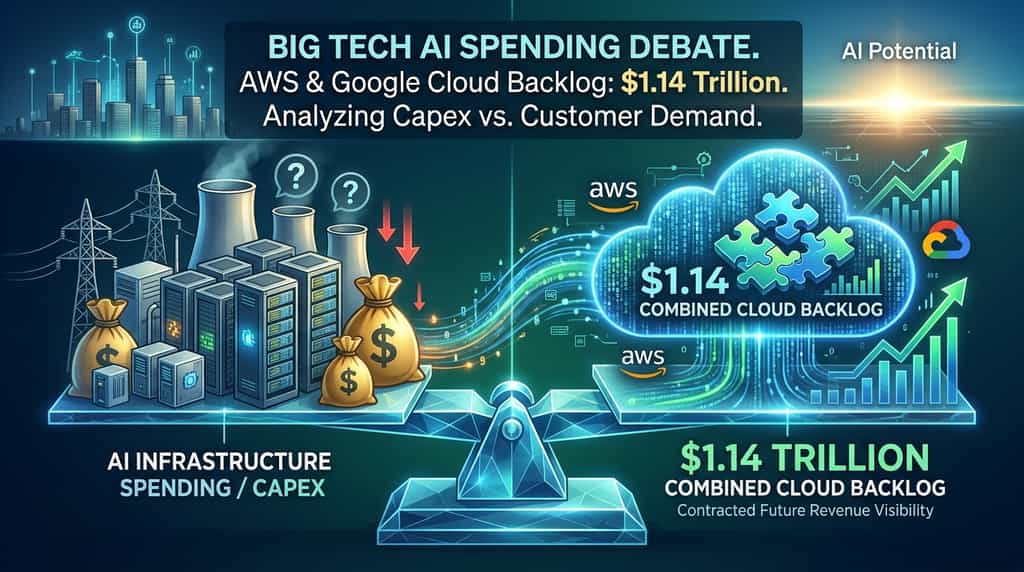
Is the artificial intelligence (AI) boom finally generating enough business demand to justify Big Tech's enormous infrastructure spending? A combined cloud backlog of approximately $1.14 trillion at Amazon Web Services (AWS) and Google Cloud offers a compelling reason to think that enterprise demand is expanding. However, a large backlog does not automatically prove that AI investments are profitable or that technology stocks can sustain their recent performance.
The debate has become more pronounced in November 2026. One bullish interpretation of the latest cloud results is that accelerating revenue and growing customer commitments demonstrate that AI infrastructure is being converted into commercial demand. A more cautious view is that rising capital expenditure, uncertain returns, and uneven earnings growth leave important questions unanswered.
Recent disclosures from Amazon, Alphabet, and Microsoft provide a useful way to evaluate both arguments. Their results show strong cloud growth and substantial contracted demand, but investors still need to distinguish between revenue visibility, actual cash generation, and returns on invested capital.
Does the $1.14 Trillion Cloud Backlog Prove That AI Spending Is Paying Off?
The $1.14 trillion combined backlog at AWS and Google Cloud demonstrates substantial contracted demand, but it does not independently prove that the companies have earned attractive returns on their AI investments. The figure combines approximately $578 billion in Amazon's disclosed future performance obligations, primarily related to AWS, with $560.8 billion in Google Cloud revenue backlog as of September 30, 2026.
According to Amazon's third-quarter 2026 Form 10-Q filed with the SEC, the company had approximately $578 billion in performance obligations associated with customer contracts for future services that had not yet been recognized in its financial statements. These commitments primarily related to AWS and covered contracts with original terms exceeding one year. Amazon reported a weighted-average remaining life of 6.1 years for its long-term contracts.
Alphabet's third-quarter 2026 Form 10-Q reported $567.7 billion in total revenue backlog, including $560.8 billion attributable to Google Cloud. Alphabet expected to recognize just over 55% of its total revenue backlog as revenue over the following 24 months, with the remainder recognized thereafter.
These figures should be interpreted carefully. Amazon's disclosed performance obligations and Alphabet's revenue backlog are related measures of contracted future business, but their reporting definitions and recognition schedules are not identical. They also do not mean that the entire amount represents AI-specific revenue. Cloud contracts cover a range of computing, storage, software, and other services, while the companies do not disclose that every commitment is directly attributable to AI workloads.
The backlog figure is therefore evidence of demand and future revenue visibility, rather than a direct calculation of investment returns. Whether the commitments produce attractive profits depends on service delivery, customer usage, pricing, infrastructure costs, depreciation, energy expenses, and the amount of capital required to support the contracts.
Why Are Goldman Sachs Analysts Divided on the AI Investment Boom?
The debate reflects two different ways of assessing the AI cycle: whether strong cloud demand validates infrastructure spending, and whether the resulting earnings and cash flows can justify the scale of investment.
The bullish interpretation focuses on accelerating cloud revenue and expanding contract backlogs. If customers are committing to large, multi-year cloud agreements and using more computing capacity, hyperscalers have stronger evidence that their infrastructure is serving real commercial demand. This supports the argument that AI spending is creating a growing market rather than merely funding speculative capacity.
The cautious interpretation focuses on the gap between revenue growth and investment returns. Building data centers requires substantial spending on servers, networking equipment, power infrastructure, land, and cooling systems. Even when demand is strong, these investments may take years to generate sufficient cash flow. A large backlog can also require substantial additional expenditure before the associated revenue is recognized.
Goldman Sachs Research's own analysis of global AI investment estimated that worldwide AI-related investment could exceed $1 trillion in 2026. Its estimate included investment by US hyperscalers, other public companies, private companies, and businesses outside the United States. The research also explained that estimates depend on assumptions about how much capital expenditure is genuinely AI-related and how financial leases are accounted for.
The two perspectives are not necessarily contradictory. Strong customer demand can validate the commercial relevance of AI infrastructure while leaving open the question of whether the companies building that infrastructure will earn sufficient returns. Investors need to evaluate both sides rather than treating either rising backlog or rising capital expenditure as conclusive evidence.
What Do Amazon's Latest AWS Results Reveal About AI Demand?
Amazon's third-quarter 2026 results show that AWS is converting strong customer demand into substantial cloud revenue growth. According to Amazon's official Q3 2026 results, AWS net sales reached $45.984 billion, increasing 39.3% year over year. Amazon said this was its fastest AWS growth rate in nearly five years.
The company's reported AWS performance also provides evidence that demand is not limited to future contractual commitments. AWS operating income reached $17.773 billion in the quarter, compared with $11.434 billion in the same period of 2025. This indicates that the cloud business is generating substantial operating profit while expanding its infrastructure.
Amazon also reported approximately $578 billion in future performance obligations, primarily associated with AWS. The company disclosed that the weighted-average remaining life of its long-term contracts was 6.1 years. This provides visibility into customer commitments, although revenue recognition depends on usage and Amazon's delivery of the contracted services.
The scale of these commitments is partly illustrated by major commercial arrangements. Amazon's SEC filing disclosed that AWS expanded its existing agreement with OpenAI by an additional $100 billion over eight years during the first quarter of 2026. In the second quarter, AWS and Anthropic announced an expansion of their strategic collaboration and existing commitment by more than $100 billion over ten years. These agreements include contractual obligations related to AWS chips.
For investors, the important distinction is that AWS is showing both revenue growth and operating income growth, while its long-term commitments provide additional demand visibility. However, the economics of these agreements still depend on infrastructure costs, customer usage, contract duration, and the capital required to provide computing capacity.
How Does Google Cloud's Growth Support the AI Bull Case?
Google Cloud's latest results provide particularly strong evidence of accelerating demand, with quarterly revenue more than doubling year over year. According to Alphabet's third-quarter 2026 Form 10-Q, Google Cloud revenue reached $30.709 billion for the three months ended September 30, 2026, compared with $15.157 billion in the corresponding period of 2025.
The same filing reported $560.8 billion in Google Cloud revenue backlog, representing most of Alphabet's $567.7 billion total revenue backlog. Alphabet expected to recognize just over 55% of its total backlog as revenue over the next 24 months. The company's disclosure therefore connects strong current cloud revenue with a substantial pipeline of contracted future business.
Google Cloud's expansion is relevant to the AI investment debate because cloud platforms provide computing resources, data infrastructure, and AI services that enterprises need to develop and operate AI applications. As businesses move from testing AI tools to deploying them in production environments, demand for computing capacity and cloud services may increase.
However, the backlog also contains important qualifications. Alphabet states that revenue recognition depends on contract duration, its ability to deliver services, and the timing of customer usage. The company also excludes cancelable contracts from its backlog calculation. Consequently, the reported amount should not be interpreted as cash already collected or guaranteed revenue for a particular quarter.
Investors should also assess the cost of supporting this expansion. Data centers, servers, networking systems, and energy infrastructure require substantial investment. Google Cloud's revenue growth is encouraging, but the longer-term financial question is whether the business can maintain attractive margins and generate sufficient cash flow as infrastructure capacity expands.
What Does Microsoft's $677 Billion Backlog Add to the AI Investment Picture?
Microsoft's latest commercial backlog provides further evidence that enterprise demand for cloud and AI-related services is substantial. According to Microsoft's first-quarter fiscal 2027 earnings release, published October 28, 2026, commercial remaining performance obligations increased 73% year over year to $677 billion as of September 30, 2026.
Microsoft's remaining performance obligations (RPO) represent contracted revenue allocated to future periods, including unearned revenue and amounts expected to be invoiced and recognized later. The company reported that its commercial RPO had a weighted-average duration of approximately 2.3 years, with around 30% expected to be recognized as revenue over the following 12 months.
The same quarterly release reported Microsoft Cloud revenue of $63.9 billion, up 30% year over year, while Azure revenue increased 48%. Revenue from Microsoft's Agents and Infra segment reached $76.8 billion, representing 25% growth. These figures show that Microsoft's cloud and infrastructure businesses are expanding alongside its AI product ecosystem.
Microsoft's figures should not simply be added to the $1.14 trillion AWS and Google Cloud total without explaining the difference in scope. Its $677 billion figure covers commercial RPO across a broader range of products and services, not Azure alone. It is therefore a useful additional indicator of enterprise demand, but not a directly equivalent measure of cloud backlog.
The company also highlighted the costs associated with expansion. Its latest filing noted that investment in cloud and data-center infrastructure could increase operating costs and place pressure on operating margins. This reinforces the central question in the AI debate: strong customer commitments matter, but the financial value of those commitments depends on the costs of fulfilling them.
How Should Investors Assess Whether AI Infrastructure Spending Is Paying Off?
Investors should assess AI infrastructure spending through a combination of demand indicators and financial return measures. No single metric can establish whether a hyperscaler's AI investment is successful, because revenue visibility and profitability measure different parts of the business.
| Metric | What it indicates | What investors should examine |
| Cloud revenue growth | Current customer spending on cloud services | Whether growth is sustained and supported by usage |
| Contract backlog or RPO | Future contracted revenue visibility | Contract duration, cancellation terms, and recognition schedule |
| Operating income and margin | Profitability of cloud operations | Whether revenue growth translates into operating profit |
| Capital expenditure | Investment required to expand capacity | Whether spending is matched by customer demand |
| Free cash flow | Cash remaining after operating costs and capital investment | Whether the business can fund expansion while generating cash |
| Return on invested capital | Efficiency of capital deployment | Whether returns justify the scale and cost of infrastructure |
The first step is to compare backlog growth with recognized revenue. A rapidly expanding backlog can signal strong future demand, but investors should check how much is expected to become revenue within the next 12 months or 24 months. Contract duration matters because a large commitment spread over many years has a different financial profile from one that converts into revenue quickly.
The second step is to examine operating profitability and cash flow. AWS, Google Cloud, and Microsoft Cloud report strong revenue growth, but the cost of new infrastructure must also be considered. Depreciation, energy expenses, staffing, and equipment purchases can affect the amount of cash generated from additional demand.
Finally, investors should compare actual financial performance with management guidance and market expectations. If revenue and profit growth remain strong while capital efficiency improves, the investment case becomes more convincing. If spending accelerates but margins and cash generation weaken, the market may question whether the scale of investment is justified.
Conclusion
The approximately $1.14 trillion combined cloud backlog at AWS and Google Cloud is strong evidence that enterprise demand for cloud services remains substantial in November 2026. Amazon reported $578 billion in future performance obligations, primarily related to AWS, while Alphabet disclosed $560.8 billion in Google Cloud revenue backlog. Microsoft adds another important indicator, with $677 billion in commercial remaining performance obligations.
These figures support the bullish argument that AI infrastructure is attracting real customer commitments and generating faster cloud revenue growth. AWS, Google Cloud, and Microsoft Cloud have all reported substantial expansion in their latest quarterly disclosures. However, contracted demand is not the same as recognized revenue, free cash flow, or a proven return on invested capital.
The more cautious perspective remains relevant because data centers, computing hardware, networking, and energy infrastructure require significant capital. The long-term outcome will depend on customer usage, pricing, operating margins, capital efficiency, and the ability to turn AI services into sustainable profits.
For investors, the central question is not simply how much Big Tech is spending or how large its backlog has become. It is whether the revenue and cash flow generated by AI can justify the capital committed to building it.
FAQs
1. What is cloud backlog in the AI industry?
Cloud backlog refers to contracted customer commitments for services that have not yet been recognized as revenue. It provides an indication of future business demand, but recognition depends on contract terms, service delivery, and customer usage.
2. How is the $1.14 trillion cloud backlog calculated?
The approximate figure combines Amazon's $578 billion in future performance obligations, primarily related to AWS, and Alphabet's $560.8 billion in Google Cloud revenue backlog as of September 30, 2026. The two companies use different reporting definitions, so the combined amount is an indicative comparison rather than a standardized accounting measure.
3. Does cloud backlog include only AI-related contracts?
No. Cloud backlog generally includes commitments for a range of services, such as computing, storage, databases, software, and other cloud products. Companies do not disclose that every contract in these figures is directly attributable to AI.
4. Why is free cash flow important when evaluating AI investment?
Free cash flow indicates how much cash a company generates after operating expenses and capital expenditure. It helps investors assess whether a business can fund infrastructure expansion while retaining cash for other corporate needs.
5. Does a larger cloud backlog mean a higher return on AI investment?
Not necessarily. A larger backlog indicates stronger contracted demand, but investment returns also depend on infrastructure costs, operating expenses, pricing, customer usage, and the capital required to deliver the services.
Disclaimer
This general market information, possibly from third-party, commercial, or sponsored sources, is provided for reference and educational purposes only and does not constitute financial or investment advice, an offer, solicitation, or guarantee. We disclaim liability for its accuracy, completeness, reliability, and any resulting losses. Investments/trading are risky; past performance doesn’t guarantee future results. Users should research, judge prudently, and take full responsibility. For further details, please consult KuCoin’s Terms of Use and Risk Disclosure.