

Filecoin (FIL) Tokenomics: How the End of Vesting Could Cut New Supply by 77% in 2026
The cryptocurrency landscape has witnessed a pronounced shift in capital allocation, driven by pervasive fatigue over high-inflation tokens featuring artificially low initial floats and protracted insider schedules. Decentralized finance and infrastructure investors increasingly demand sustainable monetary systems governed by deterministic issuance, genuine utility sinks, and real protocol revenue rather than relentless dilution. Against this backdrop, Filecoin has stood as an foundational pillar of decentralized data infrastructure, yet its primary market valuation has contended with a relentless stream of newly minted and unlocked tokens originating from its multi-year launch framework.
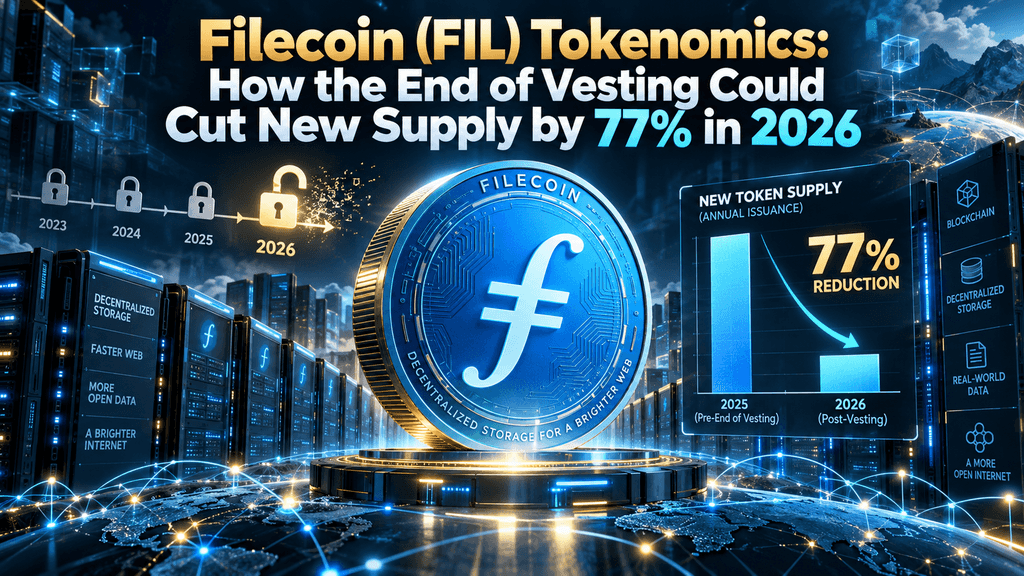
A structural transformation is now scheduled for October 15, 2026, marking the formal conclusion of the network’s six-year insider and foundation linear vesting schedules. This watershed calendar event represents far more than routine calendar maintenance; it marks the decisive turning point where external programmatic sell pressure ceases entirely, cutting fresh market-inflow volumes by roughly three-quarters. Understanding the mathematical realities of this transition illuminates how Filecoin is poised to shift from a network burdened by structured dilution into a protocol whose monetary trajectory is guided strictly by storage demand, collateral locks, and programmatic gas consumption.
Inside the 77% Supply Cliff: What Actually Happens on October 15, 2026?
The Dual Sources of FIL Issuance Explained
To comprehend the profound magnitude of this upcoming supply contraction, one must first dissect the two historical pipelines that have continuously delivered newly minted FIL into circulating secondary markets since the protocol’s mainnet debut in October 2020. The primary operational source of tokens stems from network storage providers who contribute proof-of-replication and proof-of-spacetime power to secure verifiable storage deals, earning programmatic block rewards governed by baseline and simple minting algorithms. Concurrently, a secondary, non-operational allocation was dedicated to early developmental capital, encompassing Protocol Labs, team contributors, the Filecoin Foundation, and private sale participants through structured linear distribution contracts designed to release fixed quotas over multi-year windows.
While the rewards granted to physical storage hardware operators are structurally linked to global network performance and collateralization covenants, the insider vesting streams have operated purely as a programmatic calendar distribution entirely decoupled from real-time utilization. Protocol Labs and the Filecoin Foundation allocations were calibrated across three-year and six-year timelines to guarantee operational longevity and long-term research development capital during the protocol's formative phases. As the final cohorts of these six-year distribution schedules reach their hard maturity date in late 2026, the artificial programmatic release pipeline will evaporate overnight, leaving hardware-driven storage mining rewards as the sole engine producing freshly minted supply across the entire ledger.
Breaking Down the Numbers: From 88M to 22M Annually
The mathematical reality of this conclusion reveals an unprecedented deceleration in net asset distribution across the decentralized physical infrastructure sector. Throughout the peak phases of the linear distribution horizon, the market absorbed an estimated eighty-eight million newly unlocked and minted FIL each calendar year, with insider and foundation allocations responsible for an overwhelming share amounting to approximately sixty-six million tokens. Upon passing the October 15 threshold, this sixty-six-million token release vanishes permanently from the ledger, causing total annual gross issuance to contract precipitously to an estimated twenty-two million tokens sourced entirely from consensus-level storage provider subsidies.
| Issuance Pipeline Phase | Foundation & Insider Vesting (Annual) | Storage Mining Block Rewards (Annual) | Total Gross Issuance (Annual) | Net Inflow Reduction |
| Active Vesting Horizon (Pre-Oct 2026) | ~66,000,000 FIL | ~22,000,000 FIL | ~88,000,000 FIL | Baseline |
| Post-Vesting Era (Post-Oct 2026) | 0 FIL | ~22,000,000 FIL | ~22,000,000 FIL | ~75% to 77% |
This catastrophic deceleration in issuance represents a seventy-five to seventy-seven percent contraction in the gross annualized velocity of newly created tokens flowing toward liquidity pools, OTC desks, and centralized trading venues. Market observers frequently conflate this transition with a forced token burn or an immediate cancellation of circulating assets, yet its actual economic consequence is far more structural: it permanently shuts down the single largest upstream supply channel. The sudden cessation of dozens of millions of newly released tokens per year transforms Filecoin from an asset subjected to continuous structural selling into one whose monetary expansion rate mirrors Bitcoin's halving dynamics, only compressed into an immediate structural adjustment rather than a multi-decade ramp.
The Deflationary Equation: Staking Locks and EIP-1559 Gas Burns
Storage Collateral: The Siphon on Circulating Liquidity
The true impact of this supply contraction cannot be evaluated solely through gross issuance figures; it requires analyzing the powerful liquidity sinks engineered directly into Filecoin’s consensus architecture. In order to commit active hard drive capacity to the global network and accept inbound commercial data archives, storage providers are mathematically required to lock up an upfront collateral deposit known as the Sector Initial Pledge. This pledge capital is algorithmically locked within decentralized escrow contracts for the entire duration of the sector's operational lifecycle—often lasting up to 540 days or longer—functioning as a collateral guarantee that penalizes hardware failure, data corruption, or unannounced server downtime via severe slashing mechanics.
Because the pledge requirement scales proportionally with the volume of committed storage and the overall baseline power of the network, hundreds of millions of circulating FIL remain permanently locked inside these programmatic security vaults at any given moment. Prior to the supply cliff, the immense volume of continuous vesting from foundation buckets routinely replenished circulating liquidity, counteracting the capital-locking pressure exerted by growing storage commitments. Once gross issuance plummets to merely twenty-two million FIL per year, expanding storage capacity or renewing existing commitments will force storage operators to source their collateral requirements directly from open liquidity markets, transforming the network's consensus design into an aggressive siphon that progressively depletes free-floating exchange reserves.
The Burn Mechanism: When Network Fees Overtake New Minting
Operating in tandem with collateral staking is Filecoin’s native message execution fee model, which directly mirrors the mechanics of Ethereum’s EIP-1559 base fee burning paradigm. Every transaction processed across the network—including routine storage proofs, block mining validations, message transfers, and smart contract computations initiated on the Filecoin Virtual Machine—requires an algorithmic base gas fee that is permanently burned and permanently expunged from the total supply ledger. Unlike traditional networks where fees are entirely recycled back to block producers to fund further operational expenditures, Filecoin's base fee destruction acts as a perpetual structural drain on circulating token density.
| Network Dynamic | Operational Mechanics | Direct Economic Influence on Token Ledger |
| Sector Initial Pledge | Mandatory upfront deposit locked per active storage sector to back service level agreements. | Locks tens of millions of FIL within consensus escrows, draining liquid exchange reserves. |
| EIP-1559 Base Burn | Real-time permanent destruction of computational base fees generated by messaging and storage proofs. | Permanently expunges tokens from total supply, counterbalancing gross inflationary block subsidies. |
| Slashing Penalities | Automatic forfeiture and burning of collateral when nodes fail to deliver proof of data availability. | Permanently reduces the gross supply balance while penalizing underperforming storage nodes. |
When the gross annual influx of new tokens was running at eighty-eight million FIL, the aggregate volume of daily gas burns and penalty slashings was insufficient to flip the network's net monetary trajectory into a deflationary state. However, against an altered baseline where fresh block rewards produce only an estimated sixty thousand FIL per day, the comparative weight of transaction destruction expands dramatically. In periods of elevated message throughput, heightened decentralized application activity, and aggressive sector renewal cycles, the daily volume of permanently burned FIL can easily match or eclipse gross daily mining distributions, unlocking a self-reinforcing deflationary state where the total supply ceiling begins contracting in absolute numerical terms.
Beyond Tokenomics: The Real-World Demand Fueling the Flywheel
The Shift from Storage Capacity to Paid Enterprise Data
Tokenomics enhancements cannot sustain capital expansion in isolation without organic, commercial demand validating the fundamental utility of the underlying technology. In its initial evolutionary chapters, the Filecoin network primarily incentivized the raw deployment of empty physical drive capacity, occasionally encouraging speculative hardware expansion that favored raw storage benchmarks over commercial enterprise integration. Recognizing this fundamental limitation, the ecosystem introduced targeted incentive structures such as Filecoin Plus, a verification governance framework that multiplies mining rewards tenfold specifically for storage providers that onboard authentic, cryptographically attested data payloads from enterprises, academic archives, scientific institutions, and media conglomerates.
This deliberate strategic alignment has accelerated the network’s transition toward capturing petabyte-scale workloads originating from high-throughput industries, particularly decentralized artificial intelligence training repositories, autonomous vehicle mapping archives, and high-performance Web3 data infrastructures. As genuine enterprise clients transition their cold-storage and distributed retrieval frameworks toward decentralized protocols to evade rising hyperscaler cloud expenditures, the demand for sustained storage contracts rises exponentially. This commercial demand demands persistent collateral pledge commitments from providers, ensuring that real-world institutional utilization directly tightens circulating asset availability during the exact window when programmatic token unlocks terminate.
FVM and Programmable Storage: Unlocking Capital Velocity
The maturation of the Filecoin Virtual Machine (FVM) has transformed what was historically a single-purpose storage ledger into a fully programmable execution environment capable of supporting sophisticated financial primitives and decentralized autonomous organizations. The introduction of EVM-compatible decentralized applications within the storage layer enables the seamless creation of liquid staking platforms, decentralized collateral lending markets, and automated cross-chain bridges tailored specifically to the liquidity requirements of physical storage hardware. Storage providers are no longer forced to self-fund the entirety of their sector pledge capital out-of-pocket, as institutional and retail market participants can deploy capital through trust-minimized yield protocols that route liquid tokens directly into profitable hardware operations.
By establishing these capital-efficient financial markets, the Filecoin Virtual Machine creates an internal velocity loop that traps considerable quantities of circulating FIL within decentralized finance smart contracts. Liquid staking primitives aggregate and hold massive pools of tokens away from speculative centralized exchanges, repurposing them as long-term collateral lines for verified hardware enterprises seeking operational scale. As secondary liquidity becomes increasingly locked across an expanding matrix of decentralized applications, decentralized autonomous data compute protocols, and algorithmic automated market makers, the residual free float of liquid FIL available to general market buyers shrinks to historically tight thresholds.
Market Repercussions: What the Supply Shock Means for Stakeholders
The Miner Economics Paradox
The termination of foundation vesting triggers a fundamental transformation in the operational profitability and revenue models governing storage providers globally. Historically, the relentless influx of newly vested foundation allocations exerted continuous downward price pressure on secondary markets, forcing independent hardware operators to immediately liquidate a dominant proportion of their daily block rewards to offset non-negotiable real-world operational overhead, including electricity tariffs, data center cooling, and physical component maintenance. This dynamic forged a structural cycle where continuous algorithmic supply additions depressed asset values, necessitating even larger volume sales from the very miners tasked with securing the network.
When the programmatic sixty-six million annual token dilution disappears from the macroeconomic equation, the secondary market balance shifts toward scarcity-driven pricing power. Even though consensus-level block minting rewards continue their natural algorithmic taper, an appreciating or stabilized token price drastically improves the real-world operating margins of physical data centers. Storage providers can achieve operational break-even while retaining an expanded fraction of their earned block rewards on their balance sheets, effectively replacing panic-driven hardware liquidations with strategic corporate treasury accumulation that further insulates the open market from unexpected liquidity avalanches.
Institutional Valuation Models: Moving to Real Cash-Flow Assets
From the vantage point of tier-one venture funds and institutional digital asset desks, high fully diluted valuations paired with aggressive unlock schedules have historically served as a significant deterrent against deploying strategic balance sheet capital. When an infrastructure project features tens of millions of dollars in unvested tokens waiting to flood the secondary float, institutional risk parameters mandate heavy valuation discounts to reflect impending dilution liabilities. The definitive closure of Filecoin’s six-year vesting schedule dismantles this structural obstacle, enabling institutional analysts to evaluate the asset using traditional corporate finance metrics centered around physical capital expenditure efficiency, verifiable market share gains across cloud storage verticals, and net yield generation.
As the fully diluted valuation of Filecoin aligns almost entirely with its actual circulating float, institutional market participants can model long-term financial allocations with high mathematical certainty. The removal of unpredictable supply variables allows large-scale capital allocators to benchmark Filecoin directly against alternative decentralized physical infrastructure protocols and legacy Web2 cloud storage monopolies like Amazon Web Services and Google Cloud. The structural evolution from a hyper-dilutive speculative experiment to an economically insulated digital physical infrastructure platform positions Filecoin to attract disciplined capital seeking exposure to the exponential expansion of global data generation without the structural penalty of unceasing insider dilution.
The Final Paradigm Shift for Filecoin
The conclusion of Filecoin’s six-year foundational vesting schedule on October 15, 2026, marks the end of an era defined by structural inflation and programmatic selling, transitioning the storage network into a fully autonomous, market-clearing economic system. With gross annual asset additions plummeting from eighty-eight million to just twenty-two million tokens, the protocol effectively eliminates its greatest historical valuation headwind, establishing an equilibrium where the balance between circulating liquidity and market pricing is dictated entirely by network security collateral, verifiable data onboarding, and programmatic gas consumption.
As the physical infrastructure sector matures and demands genuine decentralized alternatives to centralized cloud storage conglomerates, Filecoin’s revamped economic framework ensures that its underlying capital structure is fully aligned with long-term computational sustainability. By closing the door on insider allocations and establishing a model driven by programmatic hardware participation and verifiable enterprise adoption, the protocol stands poised to realize its foundational promise as the secure, economically durable, and sovereign data foundation for the global digital economy.
🔥 Beyond the Headlines: What KuCoin 5.0 Means for You
Market news moves fast — but where you act on it matters just as much. This October, KuCoin launches KuCoin 5.0, transforming KuCoin into a rebuilt platform. Here's what actually changes for you:
-
One account for everything. Older platforms split your money across separate "spot," "margin," and "futures" accounts and expected you to understand why. KuCoin 5.0's unified account removes that entirely — deposit once, and everything is simply there (only available to VIPs for now).
-
Stocks, indices, and commodities. KuCoin 5.0 expands beyond crypto into global markets. When crypto chops sideways and equities rally (or the reverse), you rotate in minutes instead of opening a brokerage account and waiting days for fiat rails.
-
Real-world assets (RWA). Tokenized exposure to traditional assets like commodities, right inside your crypto account. One of the fastest-growing segments in global finance is no longer reserved for institutions — you access it from the same balance you trade with.
-
Earn while you learn. Not ready to trade? KCUSD lets your stablecoins earn daily, auto-compounding interest. The lowest-stress way to put your idle deposit to work for 4% yield.
-
An AI assistant in plain language. Ask questions, get market context, understand what you're looking at — built into the platform, no jargon required.
-
An app that doesn't overwhelm. Faster, cleaner, and consistent — intuitive from the first tap, not after a tutorial.
-
Safety you can check, not just trust. A MiCAR-licensed EU entity, Proof of Reserves you can verify yourself, and internationally certified security (SOC 2 Type II, ISO 27001:2022).
Create your account in minutes — and start on the platform built for where crypto is going, not where it's been.
Frequently Asked Questions (FAQs)
Will the end of foundation vesting cause an immediate drop in Filecoin's circulating supply?
No. The circulating supply won't drop instantly. Instead, the rate at which new tokens enter the market will plummet by over 75%. It stops future dilution rather than burning existing tokens.
Does Filecoin have a theoretical hard cap on its total token supply?
Yes. Filecoin has a strictly defined maximum supply of 2 billion FIL. However, hundreds of millions remain mathematically locked for decades of future mining subsidies and cannot be arbitrarily increased.
How does the vesting cliff affect regular token holders who do not run storage hardware?
Everyday holders benefit directly from drastically reduced inflation. With the annual influx of 66 million vested tokens permanently ending, the passive dilution of existing holdings shrinks to the low single digits.
Could the network face a security crisis if mining rewards become the sole incentive?
No. Network security is enforced by the "Sector Initial Pledge"—mandatory collateral locked by storage providers. Because miners lose this collateral (slashing) if their hardware goes offline, the network remains securely governed by economic penalties, independent of foundation unlocks.
Disclaimer: This content is for informational purposes only and does not constitute investment advice. Investments carry risk. Please do your own research (DYOR).