

EU Tokenization Cap Too Low: Nasdaq Joins Call to Lift DLT Pilot Regime Limit
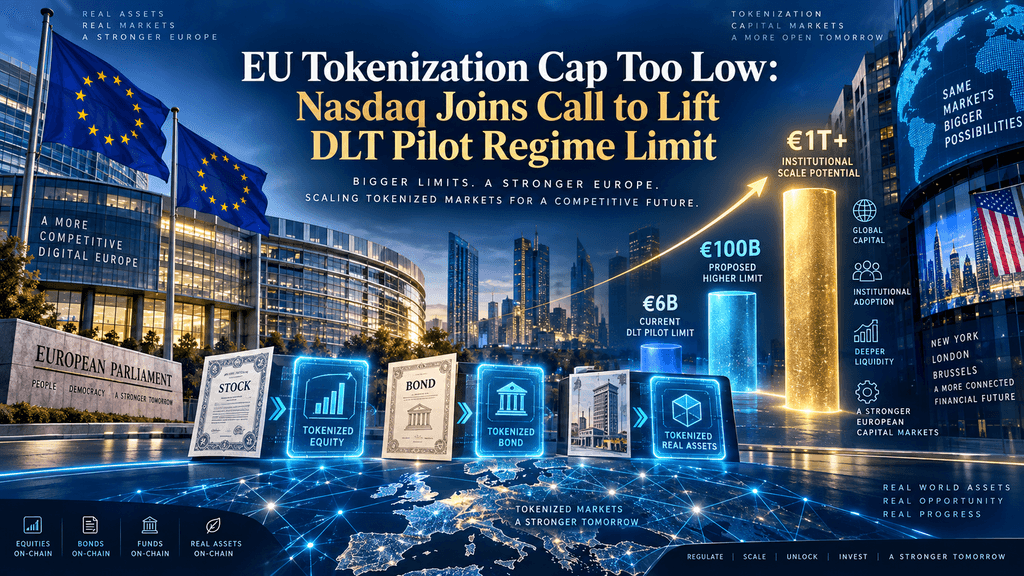
Europe’s push to build a regulated market for tokenized securities is entering a new phase. The question is no longer simply whether stocks, bonds and funds can be issued and settled on distributed ledger technology. Increasingly, the debate is about whether the regulatory framework gives those markets enough room to become economically meaningful.
Nasdaq, Börse Stuttgart and other financial-market participants have joined an industry push urging European policymakers to rethink the size limits of the EU’s Distributed Ledger Technology Pilot Regime. The current framework allows only about €6 billion of aggregate DLT financial instruments on an individual market infrastructure. The European Commission has already proposed raising that ceiling to €100 billion, but the industry argues that even this may be too restrictive for institutional-scale tokenization.
The timing is notable. Nasdaq has simultaneously been expanding its own tokenized-equities strategy, including a new $100 million investment agreement with Kraken parent Payward. The debate is therefore becoming less about experimental blockchain projects and more about who will build the infrastructure for the next generation of capital markets.
What Is the EU DLT Pilot Regime?
The EU DLT Pilot Regime has operated since March 2023 as a regulatory framework allowing authorized firms to experiment with trading and settling traditional financial instruments using distributed ledger technology. It provides targeted exemptions from parts of existing securities-market rules so that regulated operators can test structures that would otherwise be difficult to fit into conventional market infrastructure. In practice, this can allow tokenized shares, bonds and fund units to be issued, traded, recorded and settled using DLT rather than relying entirely on separate traditional trading and post-trade systems.
The regime was deliberately created with limits because regulators wanted to test DLT without immediately moving a substantial share of European securities markets onto relatively new infrastructure. One of the most important restrictions is the aggregate market-value ceiling. Under the existing framework, a DLT market infrastructure generally cannot continue admitting new instruments once the total value reaches roughly €6 billion. This is a limit on the value of securities admitted or recorded on the infrastructure, not simply a cap on daily trading volume.
That distinction has become increasingly important. A €6 billion experimental environment may be sufficient for proofs of concept and smaller issuances, but institutional market operators must justify significant investments in custody, surveillance, settlement, cybersecurity, compliance and liquidity infrastructure. The European Commission itself now acknowledges that existing thresholds have made it difficult for some large participants to develop viable businesses under the Pilot Regime.
Why Does the EU Want to Raise the Cap to €100 Billion?
The European Commission has already concluded that the original framework needs to scale. Under its wider Market Integration and Supervision Package, the Commission has proposed increasing the aggregate ceiling from €6 billion to €100 billion. It also wants to remove existing asset-specific limits and expand the range of financial instruments eligible for the regime. A separate simplified framework would apply to smaller infrastructures with up to €10 billion in recorded DLT financial instruments.
That is a substantial reform. Moving from €6 billion to €100 billion would increase the maximum scale by more than sixteen times and make it much easier for established financial institutions to develop larger tokenized markets. The Commission’s proposal also recognizes a fundamental change in the industry: tokenization is moving beyond isolated blockchain demonstrations toward infrastructures that may eventually handle real institutional issuance and settlement.
The dispute is therefore not accurately described as an innovation-friendly industry confronting an EU that refuses to change. Brussels already agrees that the existing limits are too restrictive. The disagreement concerns how much scale is enough. For smaller crypto markets, €100 billion may appear enormous. For operators accustomed to equity, bond and money-market systems measured in hundreds of billions or trillions of euros, it can still look like an artificial ceiling.
Why Does Nasdaq Think €100 Billion Is Still Too Low?
On September 8, 2026, Adan announced that it and 27 partners from traditional finance and the tokenized-asset industry were calling for further changes to the DLT Pilot Regime. Their preferred solution is straightforward: remove the aggregate cap under the standard framework. If policymakers insist on retaining quantitative limits, the coalition wants them set significantly higher and accompanied by a mechanism allowing the European Commission to increase them without a predetermined maximum.
Reporting on the industry letter says participants including Nasdaq and Börse Stuttgart have discussed €1.5 trillion as a fallback threshold if the cap cannot be removed entirely. That would be fifteen times the Commission’s proposed €100 billion ceiling. The size of that request illustrates the gap between a regulatory sandbox and what institutions consider commercially viable capital-market infrastructure.
Project Pythagore shows why the issue is more than theoretical. Banque de France and Euroclear are working to tokenize the Negotiable European Commercial Paper market. At launch, Banque de France described that market as having roughly €310 billion outstanding, while an Adan policy paper later cited a volume around €350 billion. Either figure is already several times larger than the Commission’s proposed €100 billion cap. If Europe wants DLT to support entire established asset markets rather than selected slices of them, the industry argues that the infrastructure needs significantly more regulatory headroom.
Nasdaq Is Already Betting on Tokenized Markets
Nasdaq’s involvement matters because it is not approaching tokenization merely as a lobbying issue. On September 10, Nasdaq Ventures agreed to invest $100 million in Payward, the parent company of Kraken. The two companies are expanding cooperation around the Nasdaq Equity Token framework, or NETs, as well as market surveillance and infrastructure for tokenized equities and more continuously accessible markets.
Nasdaq has also been building tokenization infrastructure in Europe. In March, it announced a partnership with Börse Stuttgart Group’s Seturion, a pan-European settlement platform for tokenized assets. Nasdaq’s European trading venues are expected to connect to Seturion so tokenized securities can trade through those venues and settle through a common post-trade platform. Seturion is designed to support both public and private DLTs as well as settlement against central-bank money and onchain cash.
These moves help explain why a regulatory ceiling has become commercially important. If tokenized securities remain a small experimental category, a €100 billion limit offers significant room. But if exchanges believe tokenization could eventually become a major part of ordinary equity and bond infrastructure, building systems that are legally required to stop scaling at a predetermined level is much harder to justify. Nasdaq’s latest investment suggests it increasingly sees tokenization as part of capital-market modernization rather than a temporary crypto trend.
Europe Is Racing the U.S. on Institutional Tokenization
Europe still has important advantages in this race. It already has a purpose-built regulatory regime for DLT financial-market infrastructure, and the European Central Bank is moving beyond policy discussions into operational settlement. Its Pontes project is designed to connect market DLT platforms with the Eurosystem’s TARGET Services so tokenized securities transactions can settle in central-bank money. The ECB plans to bring Pontes into operation in 2026 and progressively expand its capabilities.
Alongside Pontes, Appia is addressing the longer-term architecture of a European tokenized financial system. The initiative covers standards, interoperability, collateral, cross-border transactions, legal structures and future central-bank-money infrastructure, with a broader blueprint expected in 2028. The ECB’s goal is not merely to place existing securities on blockchains, but to prevent Europe from reproducing its fragmented traditional market structure in a new technological format.
Yet the U.S. market is moving quickly as well, and that creates urgency for European policymakers. The scale gap illustrates why. ECB estimates put tokenized assets on public blockchains at roughly €38 billion in February 2026, up from €7.4 billion at the beginning of 2024. That sounds like rapid growth, but global traditional financial assets were estimated at approximately €241 trillion at the end of 2025. Tokenization therefore remains tiny relative to the markets it ultimately hopes to modernize.
Why Tokenized Markets Need More Than Higher Caps
Removing the cap would not automatically create a successful European tokenized capital market. Regulation determines what institutions are permitted to build, but liquidity determines whether those markets actually work. The ECB has noted that secondary-market activity in tokenized securities remains limited. Issuing an asset on a blockchain can make it digitally transferable, but it does not automatically create buyers, sellers, market makers or deep order books.
Interoperability is another major challenge. If every bank, exchange, CSD and fintech develops an isolated tokenization platform, Europe could simply reproduce the fragmentation that already affects conventional securities markets. Tokenized stocks on one ledger may be unable to move efficiently to another, while cash settlement could remain divided between central-bank money, tokenized deposits and stablecoins. This is why Pontes and Appia matter alongside DLT Pilot reform: the market needs common settlement rails and standards as much as it needs higher regulatory thresholds.
The ultimate goal is more ambitious than faster databases. DLT can potentially combine issuance, trading, settlement, custody and servicing on connected infrastructure, while smart contracts automate parts of the asset lifecycle. Atomic settlement can allow the security and the cash leg to transfer simultaneously or not at all, potentially reducing settlement and counterparty risk. Project Agorá has already demonstrated atomic settlement across tokenized central-bank reserves and commercial-bank deposits in a cross-border setting.
What Could This Mean for RWA and Crypto Markets?
For the real-world asset sector, an expanded DLT Pilot Regime could be structurally important. A larger framework would give regulated institutions more room to issue and trade tokenized bonds, equities, investment funds, money-market instruments and other securities. It could also make it economically easier for exchanges, custodians and settlement providers to invest in infrastructure because their addressable market would no longer be constrained at experimental scale.
That does not, however, mean that an increase in the EU tokenization cap automatically translates into higher prices for Ethereum, Solana, Stellar or individual RWA tokens. The DLT Pilot Regime does not require institutional securities to use public permissionless blockchains. European operators may choose private DLTs, permissioned networks, public networks or hybrid architectures. Nasdaq and Seturion, for example, describe infrastructure intended to accommodate both public and private DLTs.
The more defensible market takeaway is therefore that regulatory expansion strengthens the institutional tokenization infrastructure narrative. Whether that value ultimately accrues to a particular blockchain token depends on where regulated assets are actually issued, where liquidity develops, what technology institutions adopt and how settlement is connected to regulated money. The policy shift could enlarge the overall market without producing an equal benefit for every crypto asset associated with the RWA theme.
Can Europe Become a Major Tokenization Hub?
Europe now has several pieces of the infrastructure required to become a major center for tokenized finance. The Commission is trying to scale the DLT Pilot Regime, the ECB is building central-bank-money settlement through Pontes, Appia is developing a longer-term architecture, and institutions such as Euroclear, Börse Stuttgart and Nasdaq are building commercial systems around tokenized securities.
What remains unresolved is whether the regulatory framework will permit these systems to become large enough to compete globally. The current regime effectively starts at €6 billion. The Commission wants €100 billion. The industry would prefer no standard cap at all, while reporting on the latest proposal points to roughly €1.5 trillion as a possible fallback if lawmakers insist on maintaining one.
The final answer will emerge through the EU legislative process, but the direction of the debate is already clear. Europe has moved beyond asking whether tokenized securities should be permitted. The harder question is whether regulators are prepared to let them grow from controlled experiments into genuine capital-market infrastructure.
🔥 Beyond the Headlines: What KuCoin 5.0 Means for You
Market news moves fast — but where you act on it matters just as much. This October, KuCoin launches KuCoin 5.0, transforming KuCoin into a rebuilt platform. Here's what actually changes for you:
-
One account for everything. Older platforms split your money across separate "spot," "margin," and "futures" accounts and expected you to understand why. KuCoin 5.0's unified account removes that entirely — deposit once, and everything is simply there.
-
Stocks, indices, and commodities. KuCoin 5.0 expands beyond crypto into global markets. When crypto chops sideways and equities rally (or the reverse), you rotate in minutes instead of opening a brokerage account and waiting days for fiat rails.
-
Real-world assets (RWA). Tokenized exposure to traditional assets like commodities, right inside your crypto account. One of the fastest-growing segments in global finance is no longer reserved for institutions — you access it from the same balance you trade with.
-
Earn while you learn. Not ready to trade? KCUSD lets your stablecoins earn daily, auto-compounding interest. The lowest-stress way to put your idle deposit to work for 4% yield.
-
An AI assistant in plain language. Ask questions, get market context, understand what you're looking at — built into the platform, no jargon required.
-
An app that doesn't overwhelm. Faster, cleaner, and consistent — intuitive from the first tap, not after a tutorial.
-
Safety you can check, not just trust. A MiCAR-licensed EU entity, Proof of Reserves you can verify yourself, and internationally certified security (SOC 2 Type II, ISO 27001:2022).
Create your account in minutes — and start on the platform built for where crypto is going, not where it's been.
Conclusion
The EU DLT Pilot Regime was designed at a time when regulated tokenization was still largely experimental, so strict limits made sense as regulators tested a new market structure. Three years later, the environment looks different. Tokenized assets are growing, the ECB is bringing central-bank-money settlement closer to DLT markets, Euroclear is preparing to tokenize an established commercial-paper market, and Nasdaq is putting real capital behind tokenized equities and always-on financial infrastructure.
Raising the aggregate cap from €6 billion to €100 billion would be a major step, but Nasdaq and other market participants argue that institutional markets require much more room to scale.
That makes the current debate less about whether Europe should loosen regulation for blockchain and more about what kind of financial market it wants to build. The next phase of European tokenization will be determined not by whether DLT works, but by whether regulation, settlement infrastructure and liquidity allow it to become large enough to matter.
FAQs
Does the DLT Pilot Regime Apply to Bitcoin?
No. The DLT Pilot Regime primarily concerns tokenized assets that qualify as financial instruments under EU securities law. Bitcoin is a native crypto asset rather than a tokenized stock, bond or fund unit and therefore falls outside the regime’s core scope.
Is the DLT Pilot Regime the Same as MiCA?
No. MiCA mainly regulates crypto-assets and crypto-asset service providers that fall within its scope. Financial instruments such as tokenized securities generally remain governed by existing EU securities legislation, with the DLT Pilot Regime providing a specialized framework for DLT-based market infrastructures. The ECB explicitly distinguishes tokenized traditional financial instruments from crypto-assets such as Bitcoin and stablecoins.
What Is a DLT Trading and Settlement System?
A DLT Trading and Settlement System, or DLT TSS, can combine functions that traditional European market rules generally separate between trading venues and securities settlement systems. This can make it possible to trade and settle eligible tokenized securities within a more integrated DLT-based infrastructure.
Can Stablecoins Settle Tokenized Securities in Europe?
They potentially can in appropriate regulated structures, but Europe is also emphasizing central-bank-money settlement for institutional markets. Pontes is specifically designed to connect private DLT platforms with TARGET Services, while the ECB expects private settlement assets such as stablecoins and tokenized deposits to coexist with central-bank money rather than necessarily replace it.
Does Raising the Cap Guarantee More RWA Investment?
No. A larger cap removes one regulatory constraint but does not create demand by itself. Sustainable tokenized markets still require issuers, investors, market makers, custody, interoperability, reliable settlement and secondary-market liquidity. The ECB has identified insufficient secondary liquidity as one of the major barriers to scaling tokenized securities.
Why Is Central-Bank-Money Settlement Important for Tokenization?
Central-bank money carries no commercial counterparty credit risk and acts as the settlement anchor of the conventional financial system. By connecting DLT transactions with TARGET Services, Pontes is intended to give institutional tokenized markets a similarly trusted settlement asset while enabling delivery-versus-payment structures.
Disclaimer: This article is for informational purposes only and does not constitute investment advice. Regulatory proposals, tokenization projects and financial-market infrastructure can change as legislation and implementation evolve. Readers should conduct their own research before making financial decisions.