

Elon Musk Reconsiders TSMC Role in Tesla Terafab Amid Intel and Production Uncertainty
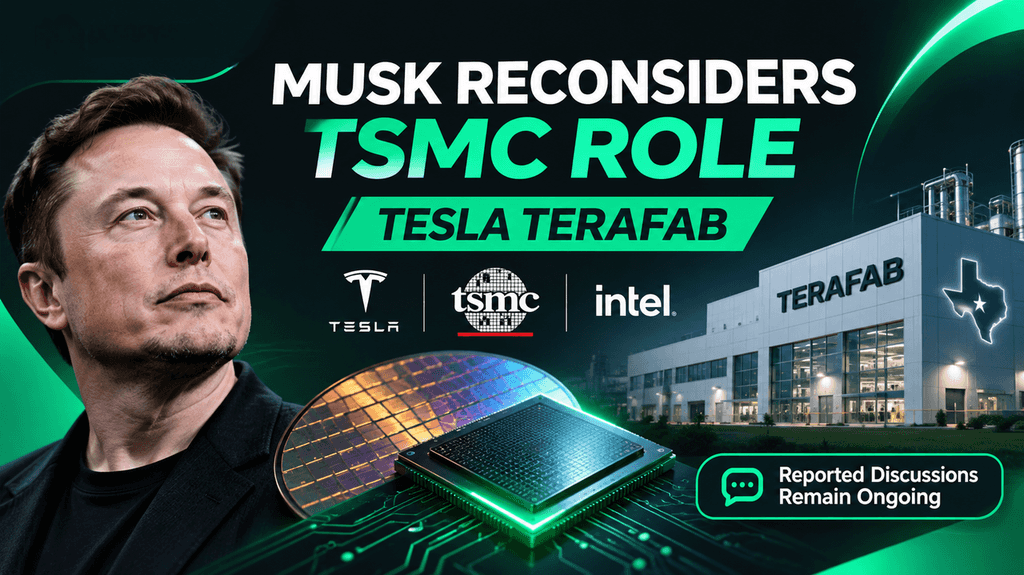
Elon Musk is reportedly reconsidering Taiwan Semiconductor Manufacturing Company's (TSMC) role in Tesla and SpaceX's proposed Terafab semiconductor project. A November 2, 2026, DIGITIMES report suggested that TSMC could assume greater responsibility for constructing and operating the Texas chipmaking facility, following earlier disagreements over manufacturing control. The potential change comes as Musk pursues an ambitious AI semiconductor strategy, with long-term project spending estimated to exceed $100 billion and commercial-scale production targeted for late 2028. However, no final agreement has been announced, leaving questions about Intel's involvement, financing responsibilities, and whether the proposed manufacturing schedule can be achieved.
Key Takeaways
-
TSMC's potential Terafab role: A November 2, 2026, DIGITIMES report suggested Musk may allow TSMC to take greater responsibility for the semiconductor project. No final agreement has been confirmed.
-
Manufacturing control remains unresolved: TSMC CEO C.C. Wei confirmed discussions on October 15, emphasizing that TSMC must operate any fabrication facility under its manufacturing responsibility.
-
Intel's future involvement is uncertain: Intel joined the Terafab initiative in April 2026, but a larger TSMC role could affect manufacturing responsibilities and technology arrangements.
-
Investment requirements are substantial: Musk estimated that Terafab could require tens of billions of dollars through early 2028, with long-term spending potentially exceeding $100 billion.
-
Production targets remain ambitious: Musk identified May or June 2027 for a functional research test chip and late 2028 as an aspirational timeframe for commercial-scale production.
-
Execution risks remain significant: Specialized equipment, manufacturing yields, infrastructure requirements, and unresolved funding arrangements could affect Terafab's costs and production schedule.
Why Elon Musk Is Reconsidering TSMC's Role in Tesla Terafab
Elon Musk's reported change in approach could give TSMC a larger role in developing the Terafab semiconductor complex. DIGITIMES reported on November 2, 2026, that Musk may be more willing to consider TSMC taking primary responsibility for constructing and operating the facility. The development, also covered in November 3 reporting on renewed Terafab negotiations, suggests the companies could revisit their earlier disagreement over manufacturing responsibilities. However, the reported discussions have not resulted in a publicly confirmed agreement or revised ownership structure.
How Musk's Earlier Position Differed From TSMC's Conditions
On October 7, 2026, Musk publicly rejected suggestions that TSMC would operate Terafab, stating that Tesla and SpaceX intended to build and manage the semiconductor complex themselves. He indicated that TSMC might sublease part of the facility but would not receive broader operational responsibilities. His position reflected a preference for maintaining direct oversight of the manufacturing infrastructure supporting his companies' artificial intelligence ambitions.
TSMC presented a different position during its October 15 earnings conference. CEO C.C. Wei confirmed that discussions were underway but emphasized that the company would need operational authority over any fabrication plant it managed. The company was also evaluating potential expansion opportunities in Texas as demand for advanced AI semiconductors continued to increase. The disagreement centered on manufacturing authority, rather than whether the companies could cooperate at all. These conditions were outlined in TSMC's October confirmation of Terafab discussions, although neither side announced a final arrangement.
Why TSMC's Manufacturing Expertise Could Influence Terafab Negotiations
The latest report suggests Musk may be considering a more collaborative operating structure as Terafab moves from an ambitious proposal toward the practical requirements of semiconductor production. Building an advanced chip factory requires more than constructing facilities and purchasing equipment. Manufacturers must integrate complex production processes, maintain consistent quality, and achieve commercially viable yields. TSMC's established foundry expertise could make it a valuable operating partner, although Musk has not publicly confirmed that these considerations motivated the reported change.
Several factors help explain the potential strategic benefits:
-
Advanced manufacturing expertise: TSMC has established capabilities in semiconductor fabrication, process optimization, and yield management that could help address the technical demands of a new facility.
-
Growing AI chip requirements: Tesla and SpaceX expect substantial computing demand from autonomous driving, robotics, and AI infrastructure, creating an incentive to expand access to advanced semiconductor production.
-
Unresolved partnership terms: Any expanded TSMC role would require agreement on operating responsibilities and commercial arrangements. The November report does not establish that those terms have been finalized.
The central question is whether Musk's companies can secure TSMC's manufacturing capabilities while retaining the strategic influence they want over Terafab's development.
How TSMC's Potential Role Could Reshape Tesla Terafab and Intel's Involvement
A larger role for TSMC could change how Tesla and SpaceX organize chip production, manage manufacturing technology, and coordinate with existing partners. Rather than developing every stage of semiconductor production internally, the companies could potentially separate chip design and supply requirements from factory operations. Such an arrangement would raise important questions about manufacturing control, intellectual property, and Intel's involvement, particularly because the two chipmakers operate different fabrication technologies. No final division of responsibilities has been announced.
How a TSMC-Operated Terafab Could Change Semiconductor Manufacturing
A TSMC-operated facility could allow Tesla and SpaceX to focus more closely on designing processors for their specific computing requirements while relying on an established foundry to manage fabrication. Semiconductor manufacturing involves hundreds of tightly coordinated processing steps, including lithography, material deposition, etching, and inspection. Each stage affects the performance and reliability of the finished chips. TSMC's manufacturing processes and quality-control systems could provide an established foundation for production, although using those capabilities at a new facility would still require extensive preparation and validation.
The proposed operating structure would also require clear agreements on technology licensing, confidential design information, production scheduling, and responsibility for manufacturing performance. Factory ownership and operational control are not necessarily the same. Tesla and SpaceX could potentially retain financial interests in the infrastructure while TSMC manages production, but this remains a possible arrangement rather than a confirmed business model. TSMC's existing contract-manufacturing relationships demonstrate how chip designers can use external fabrication capacity without operating their own factories.
What Could Happen to Intel's Role in Tesla Terafab?
Intel officially joined the Terafab initiative on April 7, 2026, bringing capabilities in semiconductor design, fabrication, and advanced packaging. On April 22, Musk said Tesla planned to use Intel's next-generation 14A manufacturing process for the project. Intel CEO Lip-Bu Tan subsequently indicated in October that the company would remain involved, a position reflected in reports on Intel's continued involvement in Terafab. However, the possibility of TSMC assuming greater operational responsibility creates uncertainty about which manufacturing technologies and services would ultimately be used.
Several technical considerations could influence Intel's future responsibilities:
-
Manufacturing process compatibility: Intel 14A and TSMC's fabrication technologies use different process designs and technical requirements. A chip developed for one process cannot simply move to another without engineering changes and validation.
-
Advanced packaging and integration: Intel could potentially contribute chip packaging, testing, or integration expertise even if another company handles some wafer fabrication. No such division has been formally confirmed.
-
Intellectual property and technology licensing: Any arrangement involving multiple semiconductor manufacturers would need to establish who can use specific process technologies and how proprietary manufacturing information is protected.
The involvement of both companies would not automatically mean that Intel and TSMC share the same production lines or manufacturing processes. Their potential responsibilities would depend on commercial agreements, technical compatibility, and the project's final design. There is currently insufficient evidence to conclude that Intel has been replaced or that Tesla has abandoned its previously stated interest in Intel 14A.
How TSMC's Involvement Could Affect Tesla's AI Chip Supply Strategy
Terafab is intended to support specialized computing requirements across Tesla's autonomous-driving technology, Optimus humanoid robots, and SpaceX-related AI infrastructure. These applications have different processing, power-efficiency, and reliability requirements, making semiconductor design and manufacturing coordination particularly important. A potential TSMC partnership could give Tesla access to established advanced-manufacturing capabilities while allowing its engineering teams to concentrate on application-specific processor designs. However, any actual improvement in chip supply would depend on the capacity allocated to the project, the selected manufacturing processes, and successfully qualified chip designs.
For investors, the distinction between developing semiconductor technology and operating a manufacturing business is important. Working with an established foundry could change Tesla's operational responsibilities and exposure to manufacturing execution risks, but it would not automatically guarantee lower chip costs, preferential production capacity, or stronger financial performance. The commercial terms would determine how manufacturing expenses, production commitments, and technology responsibilities are allocated. Until those details are disclosed, TSMC's potential involvement remains a strategic possibility rather than a measurable financial benefit.
Tesla Terafab Investment Costs, Production Timeline, and Key Challenges
Tesla and SpaceX's proposed Terafab semiconductor complex could become one of Musk's most capital-intensive manufacturing projects. The initiative involves substantial spending on fabrication equipment, specialized infrastructure, and the development of advanced production capabilities. Although Musk has outlined ambitious manufacturing targets, the project's financial structure and delivery schedule remain uncertain. Its progress will depend on equipment availability, successful testing, and the ability to scale semiconductor production without compromising quality or efficiency.
How Much Could Tesla and SpaceX Invest in Terafab?
During Tesla's October 21, 2026, third-quarter earnings call, Musk estimated that Terafab would require tens of billions of dollars in capital equipment through early 2028, with long-term spending potentially exceeding $100 billion. These figures represent management estimates rather than a finalized construction budget or approved investment commitment. Musk also acknowledged that Tesla and SpaceX had not determined how to divide the project's financial responsibilities.
The investment requirements extend beyond the physical construction of semiconductor facilities. Advanced chip production requires precision manufacturing equipment, cleanroom infrastructure, sophisticated process-control systems, and extensive testing capabilities. Tesla Chief Financial Officer Vaibhav Taneja confirmed during the earnings call that most initial equipment orders for the research fabrication facility had already been placed. However, those orders should not be interpreted as confirmation that equipment procurement for the larger commercial production complex is complete. For investors, the unresolved funding structure remains important because the timing and allocation of capital expenditures could influence future cash flow and investment priorities.
Tesla Terafab Production Timeline and Planned Texas Facilities
Terafab's development strategy involves two separate facilities with different manufacturing objectives. The Austin research fabrication facility is intended to test semiconductor equipment and production processes before the project advances toward large-scale manufacturing. During SpaceX's October 20, 2026, earnings call, Musk identified May or June 2027 as the target for producing a functional test chip using static random-access memory (SRAM) circuits. Such a chip would help engineers assess whether the experimental production line can successfully manufacture working semiconductor components.
The proposed main Terafab complex at Gibbons Creek, Texas, has a more ambitious objective. Musk outlined a possible start to volume chip production during the third or fourth quarter of 2028, while explicitly acknowledging the uncertainty surrounding that schedule. The timeframe was also covered in reporting on Terafab's proposed 2028 production target. Commercial production requires considerably more than a successful research chip: manufacturers must establish repeatable processes, achieve acceptable production yields, and demonstrate consistent chip performance. The late-2028 timeframe is therefore an aspirational milestone, not a confirmed completion date. Reuters' October 20 report also noted that leading-edge semiconductor factories in the United States can take three years or longer to construct, illustrating the demanding nature of Terafab's proposed schedule.
What Could Delay Tesla Terafab's Chip Production Plans?
One of Terafab's largest execution challenges is securing and integrating the equipment required for advanced semiconductor manufacturing. Musk has acknowledged the importance of suppliers such as ASML, whose extreme ultraviolet (EUV) lithography systems are used in leading-edge chip fabrication. Equipment from other semiconductor manufacturing companies, including Applied Materials and KLA, is also relevant to the broader production process. Although Musk thanked suppliers for accelerating deliveries, Reuters reported that he had not confirmed whether EUV machines had already been ordered for the project.
Several additional factors could affect Terafab's development:
-
Equipment installation and qualification: Advanced semiconductor tools require precise calibration and extensive testing before they can operate reliably in a production environment.
-
Manufacturing yields: Producing functional chips during research testing does not guarantee that a commercial facility can manufacture large quantities economically. Defect rates and process consistency will influence production efficiency.
-
Infrastructure requirements: Semiconductor factories depend on stable electricity supplies, highly purified water, environmental controls, and specialized materials. Delays in preparing these systems could affect factory commissioning.
-
Production integration: Terafab's proposed combination of advanced logic manufacturing, memory production, packaging, and testing would require careful coordination across multiple manufacturing stages.
Musk has described a longer-term ambition for Terafab to produce chips representing one terawatt of annual computing capacity for artificial intelligence applications. That figure is a proposed computing-output target, not an established production rate or a commitment to generate electricity. Achieving it would require sustained manufacturing expansion beyond the initial research milestones.
For investors assessing Tesla's semiconductor strategy, the most meaningful indicators will be verified equipment installations, successful test-chip production, factory commissioning, and evidence of improving manufacturing yields. These operational developments would provide a more reliable measure of Terafab's progress than ambitious production targets alone.
Conclusion
Musk's reported willingness to reconsider TSMC's operating role suggests a possible change in how Tesla and SpaceX approach advanced semiconductor manufacturing. TSMC's established fabrication capabilities could help address some of Terafab's technical demands, but a partnership would not eliminate the substantial costs and execution risks associated with developing a new chipmaking complex. The latest reporting also leaves important questions about Intel's future responsibilities and the division of financial commitments between participating companies.
For investors, the significance of any eventual agreement will depend on its commercial terms and the progress of the manufacturing project, rather than the reported negotiations alone. Future company disclosures should clarify ownership, capital commitments, equipment procurement, and production responsibilities. Progress toward the planned 2027 test-chip milestone will offer an early indication of technical execution, while commercial production remains an uncertain longer-term objective.
FAQs
Is Tesla Terafab a separate publicly traded company?
Terafab is a proposed semiconductor manufacturing initiative involving Tesla and SpaceX, not a separately listed company. Investors cannot purchase shares specifically representing Terafab. Its eventual financial impact will depend on the ownership structure, investment commitments, and commercial arrangements established by the participating companies.
Will Tesla Terafab manufacture AI chips for other companies?
Terafab is primarily intended to support the computing requirements of Tesla, SpaceX, and their associated AI activities. No confirmed plan establishes that the facility will offer commercial semiconductor manufacturing services to unrelated customers. External chip sales would depend on future production capacity and business decisions.
Could TSMC expand in Texas without joining Tesla Terafab?
Yes. TSMC has independently evaluated potential semiconductor manufacturing expansion in Texas as part of its broader US production strategy. The company already has substantial manufacturing investments in Arizona. A separate Texas facility could proceed without becoming part of Terafab, although no final arrangement has been confirmed.
Who would own the AI chip designs if TSMC manufactures them?
Semiconductor design ownership and manufacturing responsibility are separate matters. A company can retain ownership of its processor designs while contracting a foundry to manufacture them. Any Terafab agreement would need to establish intellectual property rights, licensing conditions, confidentiality protections, and responsibilities for production technology.
Disclaimer
This general market information, possibly from third-party, commercial, or sponsored sources, is provided for reference and educational purposes only and does not constitute financial or investment advice, an offer, solicitation, or guarantee. We disclaim liability for its accuracy, completeness, reliability, and any resulting losses. Investments/trading are risky; past performance doesn’t guarantee future results. Users should research, judge prudently, and take full responsibility. For further details, please consult KuCoin’s Terms of Use and Risk Disclosure.