

Donald Trump’s $1.4 Billion Crypto Profits Spotlight 5 Major Loopholes in the CLARITY Act
2026/08/12 08:00:00
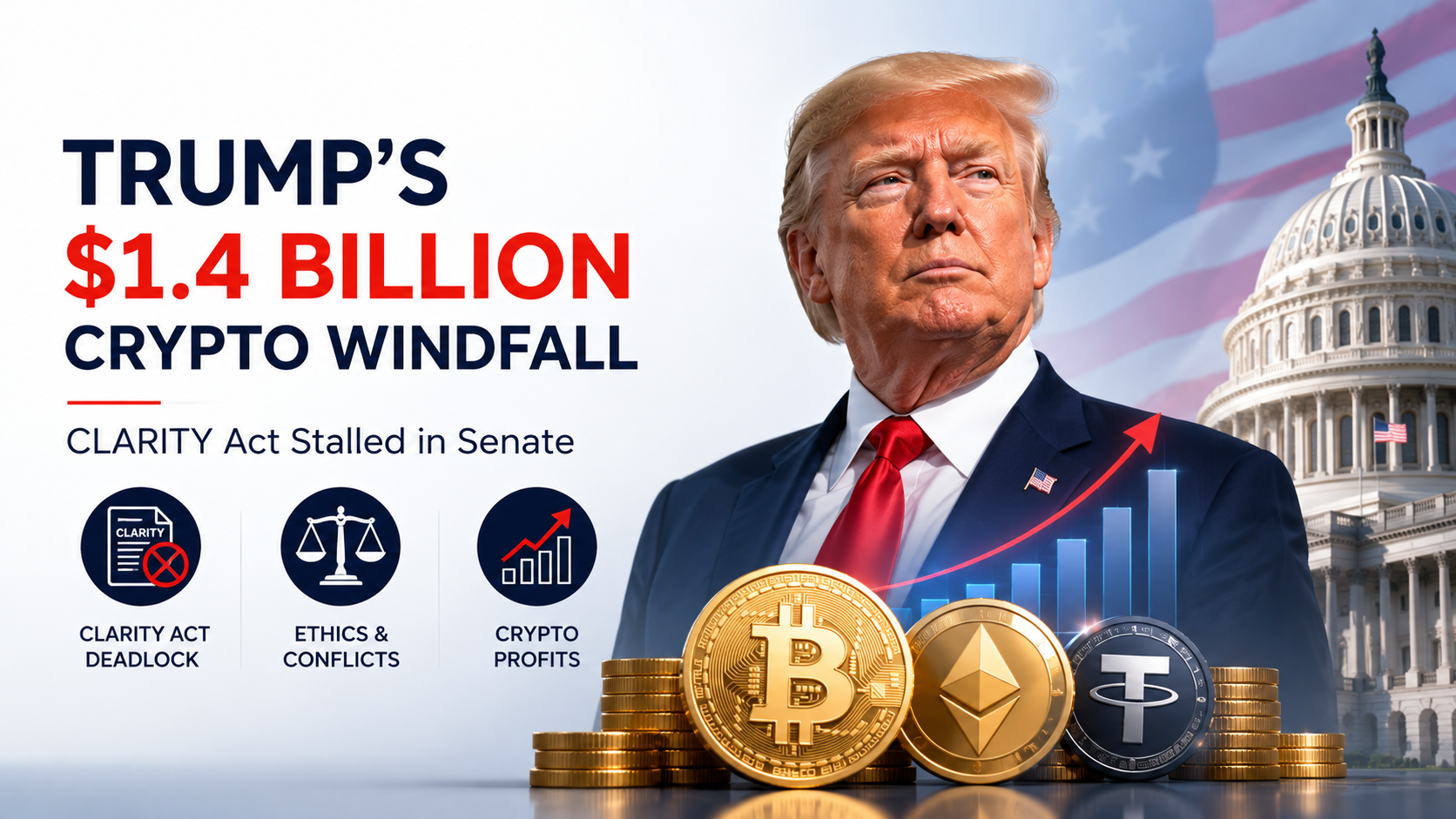
Key Takeaways
-
$1.4 Billion Crypto Profits: Official disclosures revealed President Donald Trump made over $1.4 billion from digital asset ventures in 2025—representing nearly two-thirds of his total personal income.
-
Senate Deadlock on CLARITY Act: The massive income surge triggered opposition from Senate Democrats, forcing Senate leadership to stall procedural votes on the landmark CLARITY Act until late 2026 over unaddressed executive conflict-of-interest issues.
-
Core Ethical Loopholes: Critics highlighted major structural gaps, including executive ethics exemptions, token self-certification bypassing SEC oversight, state anti-fraud preemption, traditional banking collateral exposure, and foreign capital flows via anonymous token sales.
-
Impact on Retail & Banking: High insider token ownership leaves retail traders vulnerable to sudden sell-offs, while community banking groups warn that non-bank stablecoin yields could siphon deposits away from local institutions.
-
U.S. vs. EU MiCA: The legislative gridlock highlights a sharp contrast between proposed U.S. light-touch self-certification policies and Europe's enforced MiCA framework, which mandates strict corporate governance and reserve backing.
Did President Donald Trump make over $1.4 billion from cryptocurrency in a single year while pushing for federal legislation to regulate the industry? Based on U.S. Office of Government Ethics disclosures released in mid-2026, President Donald Trump earned $1.4 billion from crypto ventures in 2025, accounting for nearly two-thirds of his total personal income. This windfall has placed intense scrutiny on the Digital Asset Market Clarity Act (CLARITY Act). Critics argue the proposed federal legislation contains massive structural loopholes regarding executive conflict of interest, token self-certification, state enforcement preemption, bank collateral exposures, and foreign capital flows. The revelation has stalled the landmark bill in the Senate as lawmakers debate whether current proposals provide regulatory clarity or statutory protection for political insider trading.
What Is the CLARITY Act and Why Has It Hit a Senate Deadlock?
The Digital Asset Market Clarity Act (CLARITY Act) faces an indefinite Senate deadlock due to partisan disputes over executive ethics, market oversight, and conflicts of interest. Passed by the House of Representatives in July 2025 by a 294—134 vote, the legislation was designed to establish a definitive framework for U.S. digital asset regulation. However, Senate leaders delayed procedural votes after financial disclosures exposed significant ethical vulnerabilities in the bill's draft.
How does the CLARITY Act divide jurisdiction between the SEC and CFTC?
The CLARITY Act assigns primary regulatory authority over decentralised digital commodities to the Commodity Futures Trading Commission (CFTC) while restricting Securities and Exchange Commission (SEC) jurisdiction to traditional digital securities. Under the proposed statute, a digital asset is classified as a commodity if the underlying blockchain network demonstrates sufficient decentralisation. This shift grants token developers and platforms lighter disclosure requirements compared to traditional equity frameworks supervised by the SEC.
Why did the Senate push the CLARITY Act vote to September 2026?
Senate leadership pushed procedural votes on the CLARITY Act to September 2026 because Senate Democrats refused to support the bill without strict ethics amendments barring elected officials from launching commercial crypto projects. Following Senate Banking Committee minority staff reports, lawmakers demanded statutory prohibitions against executive branch token sponsorship. Senate Majority Leader John Thune filed cloture on the motion to proceed before the August recess, postponing substantive debate until lawmakers return to Washington.
How Did Donald Trump Earn $1.4 Billion in Crypto Profits in 2025?
President Donald Trump earned $1.4 billion from digital asset ventures in 2025 through token sales, business equity transfers, memecoin royalties, and stablecoin holdings. According to financial disclosure documents published by the U.S. Office of Government Ethics, crypto earnings dwarfed Trump’s traditional real estate and licensing revenues, representing over 65% of his $2 billion total gross income for the year.
| Revenue Channel | 2025 Reported Earnings | Operational Context & Entity Structure |
| World Liberty Financial Token Sales | $550 Million | Direct sales of native project tokens co-founded by Trump family members |
| World Liberty Financial Equity Sale | $260 Million | Sale of equity stakes in the core operational fintech enterprise |
| Memecoin Business (CIC Digital) | $635 Million | Licensing royalties and token allocations from Celebration Coins |
| Stablecoin Holdco Equity | $196 Million | Equity liquidation from stablecoin infrastructure business holdings |
What role did World Liberty Financial play in Trump's crypto income?
World Liberty Financial (WLF) served as the central hub for Trump’s corporate crypto earnings, generating over $810 million in token sales and equity liquidations. Launched in September 2024 with Trump listed as "co-founder emeritus" and managed by his sons, WLF completed a high-profile token acquisition in 2025 that pushed its valuation to $1 billion. According to government filings, direct token sales brought in $550 million—a ninefold increase over 2024 earnings—while an additional $260 million was generated through business interest transfers.
How did memecoins, licensing fees, and stablecoins generate hundreds of millions?
Memecoin royalties and stablecoin liquidations provided over $830 million in supplemental digital asset revenue for Trump in 2025. His primary memecoin entity, CIC Digital, secured $635 million largely through licensing agreements with "Celebration Coins," a token suite launched shortly before his second presidential inauguration. Additionally, CIC Digital maintained $60 million in liquid digital wallets, while equity sales in Stablecoin Holdco yielded another $196 million. These assets remained held in a revocable trust managed by Donald Trump Jr., allowing the President full legal authority to modify the trust structure while in office.
What Are the 5 Major Loopholes in the CLARITY Act Exposed by Trump's Earnings?
An analysis by the Senate Banking Committee minority staff identified five major loopholes in the CLARITY Act that allow federal leaders to profit from self-regulated crypto projects without statutory conflict-of-interest checks. The analysis asserts that the proposed legal text inadvertently legalizes insider enrichment under the guise of statutory market clarity.
| Strategic Loophole Claim | Practical Impact / Ethics Concern |
| 1. Executive Ethics Exemptions | Fails to bar the President, Vice President, or federal officials from holding or issuing tokens. |
| 2. Reclassification / Self-Cert | Allows crypto projects to self-certify exemptions, removing assets from SEC securities oversight. |
| 3. Enforcement Preemption | Limits state AGs and private citizens from pursuing civil remedies or anti-fraud lawsuits. |
| 4. Banking System Exposure | Allows banks to hold larger digital asset collateral, transferring speculative risks to deposit insurance. |
| 5. Foreign Influence Channels | Lacks safeguards against foreign entities enriching elected officials via unverified token purchases. |
Why do executive ethics exemptions create systemic conflicts of interest?
The CLARITY Act contains no statutory language restricting the President, Vice President, or members of Congress from issuing, promoting, or owning proprietary crypto tokens. While federal executive employees face strict conflict-of-interest statutes under Title 18 of the U.S. Code, the President and Vice President are legally exempt from these specific criminal provisions. According to Senate Banking Committee analysts, this loophole allows a sitting commander-in-chief to sign executive orders or influence regulatory appointments that directly boost the market value of their family's token holdings.
How does decentralized token self-certification undermine SEC enforcement?
Token self-certification under the CLARITY Act allows crypto developers to bypass SEC securities registration by filing a notification asserting that their project is decentralized. Unless the SEC proves otherwise within a strict statutory timeframe, the asset defaults to CFTC jurisdiction as a digital commodity. According to financial consumer advocacy groups, this mechanism allows politically connected entities to shift speculative tokens away from standard SEC investor protection mandates, lowering disclosure obligations for insider token distributions.
How do preemption clauses impair state-level consumer protections?
The preemption provisions within the CLARITY Act prevent state Attorneys General and state securities regulators from enforcing local anti-fraud laws against federally registered digital asset platforms. By establishing federal supremacy over digital asset transactions, the bill restricts private citizens from filing class-action lawsuits in state courts. Critics assert that this statutory preemption strips local regulators of their primary tools to investigate fraudulent token schemes or unregistered celebrity token promotions.
What financial risks do bank collateral provisions pose to traditional deposits?
The CLARITY Act expands the authority of insured depository institutions to hold digital assets and stablecoins as regulatory collateral. Based on warnings from community banking associations, permitting banks to leverage volatile crypto assets creates contagion risks across the financial system. If speculative token valuations collapse suddenly, fractional-reserve institutions holding those tokens could experience severe liquidity shortfalls, placing FDIC deposit insurance funds under unneeded strain.
How do anonymous token purchases facilitate unmonitored foreign capital flows?
Decentralized token sales and memecoin liquidity pools lack global investor verification standards, enabling foreign state actors or sovereign entities to buy large token tranches from political figures anonymously. Under current U.S. political donation laws, foreign national contributions are strictly illegal. However, purchasing commercially issued crypto tokens from a private business linked to an elected official remains legal. The CLARITY Act contains no statutory prohibition against foreign entities buying digital tokens from companies owned by federal officeholders.
How Do These Regulatory Loopholes Impact Crypto Market Dynamics and Investors?
Unregulated token issuances by high-profile political figures distort market pricing, increase volatility, and subject retail investors to severe tail risk. When token valuations depend on political capital rather than underlying technology, retail traders face extreme downside risks once public attention shifts or insiders liquidate their holdings.
What risks do insider-backed token issuances pose to retail traders?
Retail traders in insider-backed tokens face asymmetrical information risks, extreme price manipulation, and liquidity concentration. Token projects tied to political figures frequently feature heavy insider ownership, with over 70% of total token supply held by early promoters and founders. When political insiders sell large portions of their holdings, market liquidity evaporates quickly, triggering sharp price declines for secondary retail purchasers.
Why are community banks concerned about stablecoin yield provisions in the bill?
Community banking organizations oppose the CLARITY Act's stablecoin yield rules because high-yield digital dollars draw deposits away from traditional local banks. Non-bank stablecoin issuers offering yield-bearing products pull capital out of insured checking and savings accounts. This deposit drain reduces the availability of commercial and residential lending capital in rural and suburban communities, transferring credit creation from regulated banks to unregulated fintech operators.
How Does U.S. Crypto Legislation Compare to Global Frameworks Like Europe's MiCA?
The European Union’s Markets in Crypto-Assets (MiCA) framework implements strict governance, conflict-of-interest, and consumer protection mandates that contrast sharply with the U.S. CLARITY Act proposals. While U.S. legislation remains stuck in political disputes over insider trading exemptions, European authorities actively enforce entity-level compliance, operational transparency, and strict governance rules across the European Economic Area.
| Regulatory Feature | U.S. CLARITY Act (Proposed Draft) | EU MiCA Framework (Enforced 2026) |
| Executive Ethics Restrictions | None — Exempts executive branch officials | Mandatory disclosure of officer conflicts |
| Primary Regulatory Authority | Split — CFTC (Commodities) / SEC (Securities) | National Competent Authorities under ESMA |
| Classification Mechanism | Developer Self-Certification for commodities | Strict whitepaper approval and legal status review |
| Stablecoin Issuer Requirements | State/Federal dual banking charter options | 100% reserve backing with strict liquidity ratios |
| Retail Consumer Recourse | Limited state court recourse via preemption | Mandatory civil liability for whitepaper errors |
What lessons can U.S. lawmakers learn from European MiCA compliance standards?
European MiCA standards show that regulatory clarity requires enforceable corporate governance rather than statutory exemptions for market issuers. Under MiCA regulations, crypto asset service providers must establish robust anti-money laundering controls, independent risk management, and verified conflict-of-interest policies to maintain operating licenses. Platforms operating under MiCA face operational restrictions if key compliance roles remain unfilled, demonstrating that institutional trust requires ongoing oversight rather than light-touch self-certification.
How to Trade Digital Assets on KuCoin?
Trading digital assets on KuCoin provides global retail and institutional investors with access to deep liquidity, advanced risk management tools, and secure multi-jurisdictional compliance infrastructure amidst evolving global regulations. As legislative bodies navigate regulatory frameworks like the CLARITY Act and MiCA, trading on a platform with multi-layer security ensures your crypto portfolio remains liquid, accessible, and protected.
How does KuCoin protect trader capital during market regulatory shifts?
KuCoin protects user funds by maintaining 1:1 Proof of Reserves (PoR), institutional-grade cold storage, and comprehensive risk mitigation systems. To safeguard user assets against market volatility caused by regulatory news or macroeconomic shifts, KuCoin publishes regular cryptographic reserve audits verified via Merkle tree proofs. This structural transparency ensures that user balances are fully backed at all times, providing high operational stability during periods of regulatory reclassification.
What features make KuCoin the premier platform for crypto trading?
KuCoin delivers a high-performance trading environment featuring over 800 listed digital assets, automated spot grid trading bots, low transaction fees, and deep order book depth. Traders can execute spot, margin, and futures orders seamlessly across web and mobile interfaces. Whether you are hedging against statutory regulatory changes or accumulating spot Bitcoin, KuCoin offers institutional liquidity, 24/7 customer support, and sophisticated risk control mechanisms tailored for all market environments.
To start trading top crypto assets with industry-leading security, create your free account on KuCoin today and join millions of traders worldwide.
Conclusion
Donald Trump’s $1.4 billion crypto earnings in 2025 have fundamentally reshaped the legislative debate surrounding the CLARITY Act in the U.S. Senate. What was initially designed as a bipartisan initiative to establish clear jurisdictional boundaries between the SEC and CFTC has become a battleground over executive ethics, political conflict-of-interest loopholes, and consumer protections. The Senate Banking Committee’s identification of five core structural vulnerabilities—ranging from token self-certification to foreign capital channels—has temporarily halted the bill's momentum ahead of crucial September 2026 votes.
As the United States grapples with statutory frameworks, global regulatory standards like Europe’s MiCA continue to demonstrate the importance of enforceable governance, complete reserve backing, and institutional transparency. For individual crypto investors navigating this shifting legislative terrain, utilizing established global exchanges like KuCoin ensures access to high liquidity, verified proof of reserves, and robust trading tools. The path forward for U.S. crypto regulation will depend on whether lawmakers can close executive ethical loopholes without compromising the financial innovation driving the digital asset economy.
Frequently Asked Questions (FAQs)
What is the primary objective of the CLARITY Act?
The primary objective of the CLARITY Act is to establish a clear U.S. federal regulatory framework for digital assets by defining jurisdictional boundaries between the SEC and CFTC based on blockchain network decentralization.
How much did Donald Trump earn from cryptocurrency in 2025?
Donald Trump earned $1.4 billion from cryptocurrency ventures in 2025, primarily through World Liberty Financial token sales, business equity transfers, memecoin licensing royalties, and stablecoin holdings.
What is the token self-certification provision in the CLARITY Act?
The token self-certification provision allows crypto developers to file a notice asserting that their token project is decentralized, automatically placing the asset under CFTC oversight unless the SEC successfully challenges the claim within a statutory timeframe.
Why are Senate Democrats blocking the CLARITY Act from passing?
Senate Democrats are withholding support for the CLARITY Act until statutory ethics provisions are added to prohibit high-ranking federal officials and their immediate families from issuing or commercializing digital assets while in office.
How does the CLARITY Act affect state-level crypto fraud enforcement?
The CLARITY Act includes federal preemption clauses that restrict state Attorneys General and state securities administrators from bringing local civil fraud enforcement actions against federally registered digital asset platforms.
This video features former House Financial Services Committee Chairman Patrick McHenry discussing Donald Trump's $1.4 billion crypto income disclosure and its legislative impact on Capitol Hill.