

Deutsche Bank Says SpaceX Political Risks Are Overestimated as AI Compute Demand Supports Growth
Introduction
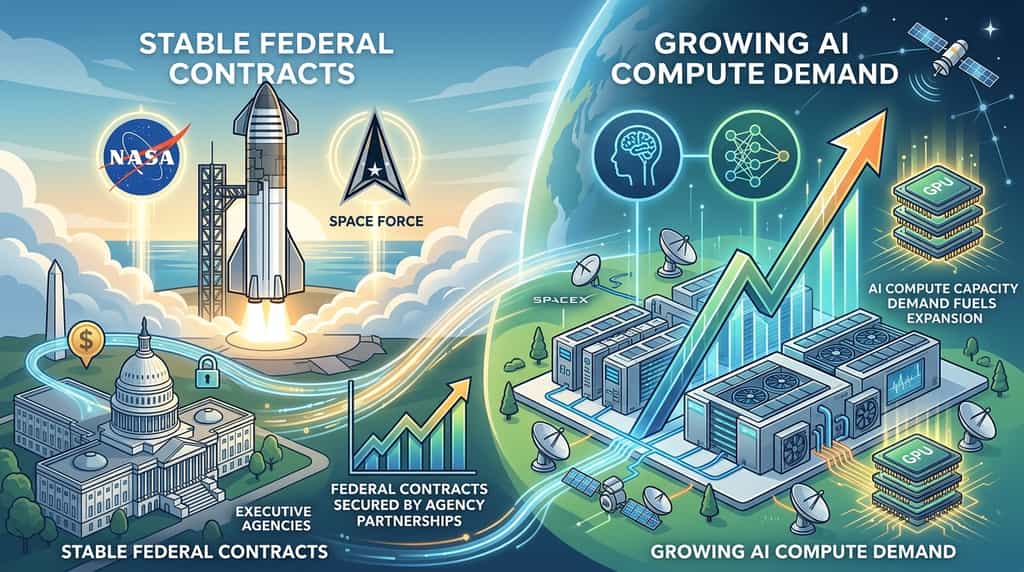
Deutsche Bank's latest analysis argues that concerns about political pressure on SpaceX following the U.S. midterm elections may be overstated, while growing demand for AI computing capacity could support the company's expansion. The bank's reasoning rests on two factors: SpaceX's key government contracts are handled by federal executive agencies, and its rapidly expanding computing infrastructure could benefit if the wider market faces tighter supply.
However, this does not mean political risks have disappeared. Congressional budget decisions, state-level permitting, infrastructure constraints, and the commercial returns on AI investment remain important uncertainties. SpaceX's share price reflected this tension in early November 2026, falling sharply after the election before rebounding on November 6.
Key Takeaways
Deutsche Bank considers the immediate political risks facing SpaceX manageable because many of its government contracts are administered by federal agencies, while the company's AI computing expansion could create an additional source of revenue if industry supply remains constrained.
-
Federal contracts: SpaceX's launch and satellite-service relationships are largely with executive-branch agencies. This limits the scope for direct congressional intervention in individual contracts, although Congress retains budgetary and oversight powers.
-
Texas policy: More restrictive scrutiny of data center projects could slow local expansion, but Deutsche Bank expects the impact on SpaceX's broader 2027 computing plans to be limited.
-
AI compute demand: If new computing capacity becomes harder to build, SpaceX could benefit from higher demand and pricing for available capacity.
-
Contract flexibility: Some cloud-computing agreements can be terminated with 90 days' notice, giving SpaceX flexibility to reallocate capacity but also making future revenue less certain.
-
Share-price reaction: SpaceX shares fell 9.05% on November 5 before rising 8.62% on November 6. The rebound indicates that the market response was not one-directional.
Why Does Deutsche Bank Think SpaceX's Political Risks Are Overstated?
Deutsche Bank's central argument is that political criticism does not automatically translate into direct control over SpaceX's existing government contracts. The bank distinguishes between the agencies that administer contracts and the lawmakers who influence budgets, legislation, and oversight.
The distinction matters because SpaceX works with several federal entities on launch services, satellite communications, and national-security-related programs. These relationships are not all managed through direct congressional decisions. For example, NASA selected SpaceX in September 2026 to provide launch services for its StarBurst mission under an existing launch-services contracting framework. The U.S. Space Force has also awarded SpaceX contracts for Starshield-related services.
This structure may make immediate contract disruption more difficult than a simple political headline suggests. Replacing an established launch or satellite-service provider can involve technical qualification, operational continuity, procurement procedures, and additional costs. In areas where alternative suppliers are limited, a sudden change could also create practical challenges for government agencies.
However, it would be inaccurate to conclude that Congress has no influence over SpaceX's business. Congress controls federal appropriations, conducts oversight, and can shape the legislative framework under which agencies operate. Changes in funding priorities or future procurement decisions could affect contract opportunities even if lawmakers cannot directly rewrite every existing agreement.
SpaceX itself acknowledges this exposure in its SEC registration statement. The company notes that its government relationships, contracts, and funding levels may be affected by which political party controls the presidency or either chamber of Congress. It also warns that adverse developments in these relationships could affect growth and its competitive position.
The distinction, therefore, is between limited direct intervention in individual contracts and broader political influence over future government spending and procurement. Deutsche Bank's argument concerns the former; the latter remains a genuine risk.
Why Could Tighter AI Compute Supply Benefit SpaceX?
Deutsche Bank's more unusual argument is that slower industry-wide data center expansion could create an advantage for SpaceX rather than simply acting as a constraint.
AI models require substantial computing resources for both training and inference. As companies deploy more capable models and AI applications attract more users, demand for high-performance computing can increase. However, new capacity cannot be brought online instantly. Data center construction, grid connections, power procurement, cooling equipment, and advanced GPU deliveries all impose practical limits.
If demand grows faster than available capacity, computing providers with operational facilities may gain pricing power. Customers that cannot secure enough capacity from one supplier may be willing to pay more for access elsewhere.
Deutsche Bank argues that SpaceX could be positioned to benefit because it has demonstrated an ability to build large computing facilities quickly and integrate infrastructure development with its existing engineering and manufacturing capabilities. If the company can continue adding capacity faster or at a lower cost than competitors, it may be able to capture demand that other providers cannot immediately serve.
This is the basis of the bank's supply-side argument:
-
AI adoption increases demand for training and inference capacity.
-
Power, construction, and equipment constraints limit the speed of industry expansion.
-
A tighter supply environment increases the value of computing capacity that is already available.
-
Providers with sufficient capacity and competitive operating costs may gain stronger pricing opportunities.
The argument is plausible, but it depends on several assumptions. SpaceX must bring its planned facilities online on schedule, secure the required equipment and power, maintain high utilization, and convert customer demand into profitable contracts. A shortage of computing capacity does not automatically guarantee that every available facility will generate attractive returns.
Does Alphabet's SpaceX Position Provide Another Signal of Investor Confidence?
Alphabet's latest quarterly holdings disclosure offers another data point on institutional exposure to SpaceX. Its Form 13F filing for the quarter ended September 30, 2026, was filed with the SEC on November 6.
The SEC filing and information table report approximately 555.04 million SpaceX shares, with a quarter-end market value of about $83.73 billion. The supplied reference material indicates that Alphabet increased its reported position by approximately 3.85 million shares during the third quarter.
The size of the disclosed position is notable. It suggests that SpaceX represents a substantial part of the securities reported in Alphabet's filing. However, a Form 13F is a periodic snapshot, not a real-time record of investment decisions. It does not explain the investor's reasons for holding the shares, disclose every type of exposure, or confirm whether the position remained unchanged after September 30.
Alphabet's reported position can therefore be treated as evidence of significant institutional exposure, but not as proof that the market has reached a consensus on SpaceX's valuation or future performance.
The broader context is that SpaceX's AI computing strategy has become an increasingly important part of its growth narrative. Its launch, satellite connectivity, and government-related businesses remain relevant, but investors are also assessing whether its computing infrastructure can develop into a large and sustainable revenue stream.
What Risks Could Still Challenge SpaceX's Growth Outlook?
Deutsche Bank's relatively constructive assessment does not remove the execution risks associated with SpaceX's expansion. Several variables could affect whether the company's AI computing strategy delivers the expected financial contribution.
Government spending and procurement remain political variables. SpaceX has significant relationships with federal agencies, but future contracts and funding are not guaranteed. Congressional appropriations, oversight, procurement priorities, and changes in agency budgets can affect the company's business over time.
State-level infrastructure constraints could delay expansion. Even if most planned computing capacity is located outside Texas, large data center projects still depend on electricity supply, land, cooling infrastructure, construction schedules, and local approvals. Delays in any of these areas could push back the date when new capacity begins generating revenue.
AI computing demand must translate into profitable utilization. Strong demand for computing resources does not automatically mean that every new facility will operate at full capacity or earn attractive margins. Hardware costs, power expenses, maintenance, financing obligations, and competition all influence the economics of providing computing services.
Customer concentration and contract flexibility affect revenue visibility. Short termination periods can help SpaceX adjust its capacity allocation, but they also mean that some revenue commitments may be less durable than long-term contracts with stronger minimum-purchase requirements.
Orbital data centers remain a longer-term execution challenge. SpaceX's plans for space-based AI computing depend on Starship development, launch frequency, satellite manufacturing, thermal management, and the economics of operating computing hardware in orbit. The company's SEC filing discusses an initial deployment timeline as early as 2028, but this remains a forward-looking plan rather than an established commercial business.
Finally, the scale of the investment itself deserves attention. SpaceX's approximately $40 billion GPU financing arrangement demonstrates the resources required to expand computing capacity. The company will need to generate sufficient revenue and operating cash flow to support the infrastructure over time. If AI demand slows, customer contracts change, or deployment costs rise, the financial contribution from the expansion could be lower than expected.
Conclusion
Deutsche Bank's assessment of SpaceX highlights a distinction between political headlines and the practical mechanisms through which government decisions affect a company's operations. The bank argues that concerns about immediate political retaliation may be overstated because many SpaceX contracts are administered by federal agencies and because alternative suppliers are limited in some areas. It also sees potential benefits from AI computing demand if industry-wide infrastructure constraints keep available capacity scarce.
However, the investment case depends on more than political stability. SpaceX must continue expanding computing capacity, securing power and equipment, maintaining customer demand, and generating sufficient returns to support its substantial infrastructure commitments. Texas-level policy decisions, congressional budget priorities, contract termination provisions, and the technical development of orbital computing remain relevant uncertainties.
The November 2026 share-price movements illustrate how quickly market expectations can change. The recovery on November 6 followed a sharp decline, but did not fully reverse the earlier losses. Ultimately, Deutsche Bank's analysis provides one interpretation of SpaceX's prospects, while future operating results and the execution of its AI strategy will determine whether that assessment is supported by the company's performance.
FAQs
-
Why Does Deutsche Bank Think SpaceX's Political Risks Are Overstated?
Deutsche Bank argues that many SpaceX government contracts are administered by federal executive agencies, limiting the scope for direct congressional intervention in individual contracts. However, Congress can still influence future funding, procurement priorities, and oversight.
-
Could Texas Data Center Policies Slow SpaceX's AI Expansion?
Yes. More restrictive reviews, land-use requirements, or infrastructure approvals could delay projects in Texas. Deutsche Bank expects the near-term effect to be limited because much of SpaceX's planned 2027 computing capacity is expected to be located outside the state.
-
How Could AI Compute Shortages Benefit SpaceX?
If demand for AI computing grows faster than new infrastructure can be built, providers with available capacity may gain stronger pricing power. SpaceX could benefit if it can deploy computing resources quickly, maintain competitive costs, and secure sufficient customer demand.
Disclaimer
This general market information, possibly from third-party, commercial, or sponsored sources, is provided for reference and educational purposes only and does not constitute financial or investment advice, an offer, solicitation, or guarantee. We disclaim liability for its accuracy, completeness, reliability, and any resulting losses. Investments/trading are risky; past performance doesn’t guarantee future results. Users should research, judge prudently, and take full responsibility. For further details, please consult KuCoin’s Terms of Use and Risk Disclosure.