

Cathie Wood Says Circle Is Challenging Traditional Payment Giants as Stablecoins Reshape Finance
2026/08/25 14:38:00
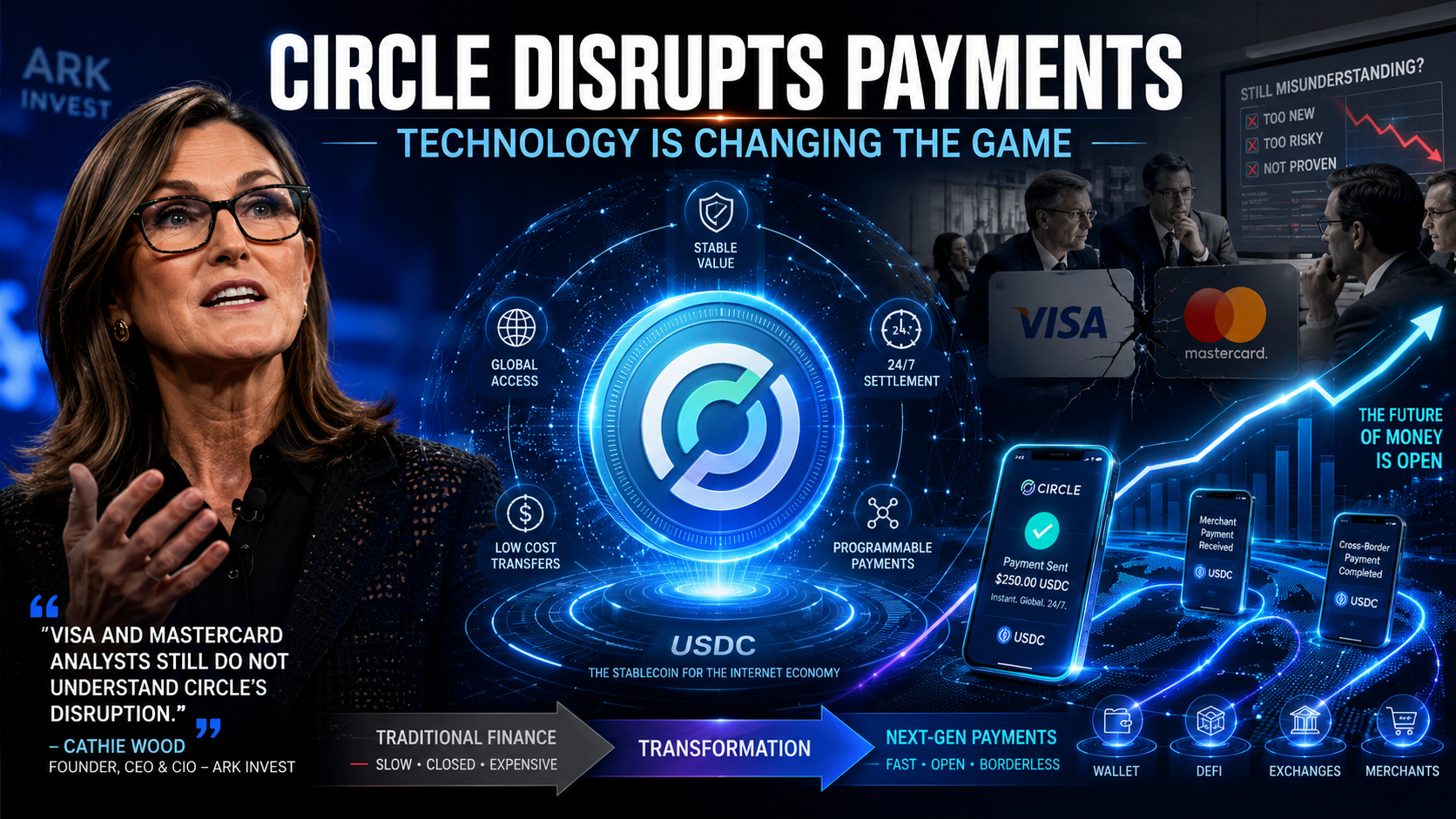
ARK Invest CEO Cathie Wood recently emphasized a significant disconnect that exists in the way public markets and traditional financial-services analysts assess and evaluate the performance of Circle Internet Group. In a detailed post on X dated August 23, 2026, she responded to a one-year performance chart that compared the stock performances of Visa, Mastercard, and Circle. In her analysis, she noted that short-term inefficiencies in the equity markets often obscure the longer-term technological shifts that are occurring in the payments space. Wood showed that many analysts, who have built their careers focusing on tracking the performance of Visa and Mastercard, find it challenging to fully comprehend Circle as a pure-play disruptor in the financial technology space.
This is particularly noteworthy given that Circle's shares have experienced substantial growth since its initial public offering (IPO) in June 2025, while the traditional incumbents have only posted modest gains during the same period. The ecosystem of payments is being reshaped by technology, rather than by the legacy analytical frameworks that have been traditionally applied by financial analysts. Circle is uniquely positioned as a primary beneficiary of this transformation, driven by the growing transaction dominance of its stablecoin, USDC, as well as ongoing regulatory progress and the development of institutional infrastructure, including its innovative Arc blockchain technology.
Wood Highlights Short-Term Market Inefficiencies in Circle’s Performance Chart
On August 23, 2026, Cathie Wood quoted analyst Alex Obchakevich’s comparison of one-year stock performances showing Visa up roughly 5 percent, Mastercard near flat, and Circle down significantly for much of the period. Wood described the chart as illustrating the short-term inefficiencies of public equity markets. Despite that one-year underperformance relative to the payment networks, Circle shares have appreciated approximately 84 percent since pricing its IPO at $31 on June 5, 2025, with some reports noting gains exceeding 180 percent from the IPO price after an opening surge. ARK Invest has continued accumulating shares through the volatility, with combined holdings reported around $329 million to more than $345 million in recent disclosures, representing a meaningful portfolio weight.
Wood emphasized that financial-services analysts whose long-term track records rest on Visa and Mastercard, companies that have risen roughly 33-fold and 150-fold, respectively, since their 2008 and 2006 listings, they find it difficult to assess a pure-play disruptor. She argued that today’s disruption stems from underlying technology rather than the analytical frameworks those specialists apply. Circle’s return to profitability in the second quarter of 2026, with net income of $48 million, and the doubling of certain transaction-related metrics provide concrete operational evidence supporting her view of structural change underway in digital payments infrastructure.
Circle’s USDC Dominates Adjusted Stablecoin Transaction Volumes in 2026
USDC, Circle’s dollar-pegged stablecoin, has captured a leading share of adjusted stablecoin transaction volumes according to Visa-compiled data. In the first half of 2026, USDC accounted for roughly 70 percent of adjusted volume, with USDT near 25 percent, reversing earlier patterns in which Tether held far higher shares. June 2026 alone saw a record adjusted stablecoin volume of $1.79 trillion, of which USDC processed approximately $1.21 trillion, or about 67 percent. Circle’s own reporting showed USDC on-chain transaction volume reaching $14.8 trillion in the second quarter, a 151 percent year-over-year increase, while average daily on-chain volume hit $163 billion.
Circulation stood at $73.3 billion at the end of Q2 2026, up 19 percent year-over-year even as the broader digital-asset market capitalization declined. Average circulation during the quarter reached $76.5 billion. These figures demonstrate rising network utility beyond pure speculative activity. Adjusted metrics that exclude bots and high-frequency noise reveal growing real-world and institutional use cases, including payments, collateral in decentralized finance, and tokenized asset settlement. The velocity of USDC, with high turnover relative to supply, underscores its role as institutional-grade infrastructure rather than solely a trading vehicle.
Second-Quarter Results Show Profitability and Expanding Platform Metrics
Circle reported total revenue and reserve income of $701 million for the second quarter of 2026, a 7 percent year-over-year rise. Net income from continuing operations reached $48 million, a sharp improvement from the prior-year period. Adjusted EBITDA grew to $143 million. USDC on-platform holdings expanded 106 percent year-over-year to $12.4 billion, while the Circle Payments Network achieved $14.7 billion in annualized transaction volume on a trailing 30-day basis, up 76 percent sequentially, with 175 financial institutions enrolled.
Reserve income continues to form the bulk of revenue, tied to interest on cash and short-term U.S. government securities backing USDC. Transaction revenue has shown acceleration, reflecting higher volumes and platform expansion. The company secured final OCC approval for its national trust bank, Circle National Trust, which opened in July 2026, and a New York limited-purpose trust charter. These regulatory milestones strengthen the institutional foundation for USDC issuance, custody, and related services, supporting further adoption by banks and asset managers seeking compliant digital-dollar rails.
Arc Blockchain Prepares for Public Mainnet with Institutional Validators
Circle scheduled the public mainnet launch of its Arc layer-1 blockchain for September 16, 2026. The network is already operating in a private mainnet with more than 100 ecosystem and institutional participants. Founding validators include BlackRock, DTCC, Visa, Mastercard, Galaxy, Global Payments, ICE, MoneyGram, SBI Group, Standard Chartered, Sumitomo Corporation, and Circle itself. This permissioned set of established financial institutions aims to provide the compliance and operational standards required for institutional settlement infrastructure.
BlackRock is expected to deploy its BUIDL tokenized money-market fund on Arc with native USDC integration, enabling subscription, redemption, and deployment within a single on-chain environment. DTCC plans collaboration on tokenization of custodied assets beginning in the second half of 2027. Additional explorations involve custody, FX, and repo infrastructure. Arc is designed for sub-second finality, USDC-denominated fees, multi-currency settlement, and optional privacy features. Day-one applications span DeFi protocols, payment providers, exchanges, and wallets, positioning the chain as a purpose-built settlement layer for stablecoin-native finance.
Traditional Payment Networks Participate in Competing Stablecoin Initiatives
Visa and Mastercard have joined the Open USD consortium alongside BlackRock, Coinbase, Stripe, and more than 140 other firms. Open USD aims to create a no-fee or shared-reserve-income stablecoin model that challenges existing issuers’ economics. Mastercard’s acquisition of BVNK further signals traditional networks’ direct engagement with stablecoin infrastructure. These moves demonstrate that corporate strategy teams at the incumbents recognize the shift even as some equity research coverage remains anchored in legacy frameworks.
Wood’s critique centers on the analytical community’s difficulty in modeling a pure-play issuer whose primary value derives from programmable digital dollars and associated network effects rather than interchange fees. Stablecoin transfers reached $33 trillion in the prior year, according to some industry data, with continued growth in real-world payment volumes reported at roughly 20 percent month-on-month in certain periods. The participation of Visa and Mastercard in both competing consortia and Circle’s Arc validator set illustrates simultaneous competition and collaboration in the growing payments ecosystem.
ARK Invest has repeatedly added to its Circle position during periods of price weakness. Disclosures show purchases in July and early August 2026 totaling tens of millions of dollars across ARKK, ARKW, and ARKF. Combined holdings have ranked among the firm’s larger crypto-related positions, with values reported near $329 million to $458 million in recent snapshots depending on share price and exact timing. Wood’s continued buying through a roughly 42 percent one-year decline in the stock underscores a multi-year investment horizon focused on technological disruption rather than near-term rate sensitivity or competitive noise.
The firm’s thesis treats Circle as a beneficiary of the broader shift toward on-chain capital markets, agentic payments, and tokenized assets. Bernstein analysts have maintained Outperform ratings with price targets implying substantial upside, citing independent growth drivers including stablecoin payments adoption and blockchain capital markets even without passage of specific legislation. These institutional flows and analyst views provide additional context for evaluating the gap Wood identified between short-term equity performance and underlying business momentum.
USDC’s Role Extends into Agentic Economy and Tokenized Markets
Circle has expanded infrastructure supporting autonomous software agents, with its Agent Stack launched in May 2026 hosting more than 900 paid services and the large majority of related payment volume settling in USDC. On-chain volume growth and high velocity metrics indicate USDC’s utility as collateral across decentralized finance, tokenized equities, real-world-asset perpetual futures, and prediction markets. Bernstein has estimated strong shares of certain decentralized exchange and finance volumes flowing through USDC.
Tokenized fund activity, exemplified by the planned BUIDL deployment on Arc, further embeds USDC in institutional workflows. Reserve-backed digital dollars enable near-instant settlement without traditional intermediary friction, altering cost structures for high-value transfers. As AI-driven agents and automated systems increase payment frequency and complexity, the programmable nature of USDC positions it to capture share that legacy card networks process less efficiently. These use cases move beyond retail interchange toward wholesale and machine-to-machine settlement.
Regulatory Milestones Strengthen Circle’s Institutional Positioning
The OCC’s final approval of Circle National Trust and the New York limited-purpose trust charter establish direct federal and state oversight frameworks for digital-asset custody and related fiduciary services. These charters support institutional clients seeking regulated access to mint, redeem, hold, and transfer USDC. Partnerships with major banks for on- and off-ramps in key markets further expand the regulated footprint.
While interest-rate sensitivity remains a factor in reserve income, the diversification into transaction and platform revenue, combined with the trust bank structure, reduces pure dependence on rate environments. Circle has emphasized multi-year growth targets for USDC circulation in the range of 40 percent compound annual growth under various scenarios. The regulatory progress addresses a key institutional adoption barrier that pure crypto-native issuers historically faced, aligning Circle more closely with the compliance expectations of traditional finance.
Dynamics and Open USD Consortium Implications
The launch of Open USD by a broad consortium including Visa, Mastercard, and BlackRock introduced competitive pressure that contributed to Circle's share-price volatility in mid-2026. The model’s emphasis on shared reserve income and reduced fees targets the economics of incumbent issuers. Circle management and some analysts have questioned the coordination challenges of large consortia and highlighted USDC’s existing network effects, liquidity depth, and regulatory status as durable advantages.
USDC’s leading share of adjusted transaction volume and its integration into Arc provide structural counters to new entrants. Circle has continued expanding partnerships, integrating with a high percentage of Open USD alliance participants, according to some reports, suggesting that liquidity and regulated leadership remain decisive. The simultaneous involvement of the same large institutions as Arc validators and Open USD backers reflects a market still sorting roles between issuance, settlement rails, and distribution.
Technology Layer Versus Legacy Analytical Frameworks
Wood’s core argument rests on the distinction between technology-driven disruption and the analytical playbooks developed around Visa and Mastercard’s historical growth. Those companies scaled through network effects in card acceptance, interchange, and consumer credit. Circle’s model centers on programmable, fully reserved digital dollars that settle on public or permissioned blockchains with near-instant finality and programmable logic. This architecture supports use cases, agentic payments, atomic settlement of tokenized assets, and cross-border transfers without correspondent banking layers that traditional rails handle less efficiently.
Historical multiples achieved by Visa and Mastercard since IPO demonstrate the value of dominant payment networks. Wood contends that the next generation of network effects will accrue to technology platforms, enabling digital-dollar utility at a global scale. Circle’s combination of USDC issuance, Arc settlement infrastructure, and institutional trust charters represents an attempt to capture that layer. Analysts trained on fee-based card economics may undervalue the optionality embedded in programmable money until transaction volumes and institutional adoption reach more obvious thresholds.
Market Reactions for Payments and Digital Asset Infrastructure
Stablecoin transaction volumes now rival or exceed certain traditional payment network metrics on adjusted bases in specific periods. The shift toward on-chain settlement for institutional flows, combined with tokenized fund growth and agent-driven payments, points to structural change in how value moves. Circle’s reported real-world payment volume growth and CPN expansion provide early indicators of this transition moving beyond crypto-native activity.
Investors and institutions monitoring the space must weigh short-term equity volatility, interest-rate impacts on reserve yields, and competitive responses against the multi-year trajectory of digital-dollar adoption. Wood’s public comments frame Circle as a concentrated pure-play vehicle for that trajectory. Continued volume leadership in adjusted metrics, regulatory charters, and the Arc validator cohort with major financial institutions supply measurable progress against the disruption thesis.
Practical Contemplation for Evaluating the Disruption Thesis
Practical evaluation requires separating reserve-income sensitivity from transaction and platform growth. Q2 2026 data showed circulation resilience and volume acceleration even amid broader market pressure. Partnership density with banks, asset managers, and payment providers, plus the September Arc mainnet, offer near-term catalysts that can be tracked against volume and adoption metrics.
Competitive intensity from consortia and potential new bank-issued tokens remains real. Yet USDC’s share of adjusted volume, liquidity depth, and regulatory positioning provide quantifiable differentiation. Market participants can monitor daily and monthly volume data from sources such as Visa’s analytics, Circle’s attestations, and on-chain explorers to test the durability of the trends Wood highlighted. The gap between traditional analyst coverage frameworks and on-chain activity metrics itself constitutes a form of information asymmetry that long-horizon investors may seek to exploit.
Indicators in Stablecoin and Blockchain Settlement
Key indicators include USDC circulation trends, adjusted transaction volume share, CPN enrollment and volume, Arc mainnet activity after September 16, and institutional product deployments such as BUIDL. Bernstein has pointed to macro regime shifts, tokenization, and agentic payments as independent growth drivers. The combination of these factors with established validator participation from Visa, Mastercard, and BlackRock creates a measurable pathway for technology to alter traditional payment economics.
Wood’s assessment places Circle at the center of that pathway. Whether equity markets close the valuation gap relative to operational progress will depend on the consistency of volume growth, successful Arc launch execution, and the ability to convert institutional partnerships into sustained revenue diversification beyond reserve yields. The data available through August 2026 support the view that technology is actively reshaping the competitive ecosystem.
FAQs
How has Circle’s stock performed relative to Visa and Mastercard over the past year according to recent commentary?
Recent one-year charts cited by analysts and referenced by Cathie Wood show Visa advancing approximately 5 percent and Mastercard remaining near flat while Circle experienced a steeper decline for much of the period before a partial recovery. Despite that relative one-year underperformance, Circle shares have recorded substantial appreciation since the June 2025 IPO pricing, with figures around 84 percent or higher reported in August 2026 commentary. ARK Invest’s continued purchases during the drawdown reflect a longer-term perspective focused on operational metrics rather than short-term equity comparisons.
What share of adjusted stablecoin transaction volume did USDC capture in the first half of 2026?
Visa-compiled adjusted data, which filters non-economic activity, indicate USDC accounted for roughly 70 percent of stablecoin transaction volume across the first six months of 2026, with USDT near 25 percent. June alone reached a record $1.79 trillion in total adjusted volume, of which USDC processed about two-thirds. Circle’s internal figures showed $14.8 trillion in on-chain volume for the second quarter, underscoring the divergence between supply-based market share and actual usage intensity.
When is Circle’s Arc blockchain scheduled for public mainnet, and who are the founding validators?
Public mainnet is set for September 16, 2026. The founding validator cohort includes BlackRock, DTCC, Visa, Mastercard, Galaxy, Global Payments, ICE, MoneyGram, SBI Group, Standard Chartered, Sumitomo Corporation, and Circle. The network has already operated in a private mainnet with more than 100 participants. BlackRock plans to deploy its BUIDL fund using native USDC integration, while DTCC collaboration on tokenized assets is targeted for the second half of 2027.
What were Circle’s key financial results for the second quarter of 2026?
Total revenue and reserve income reached $701 million, up 7 percent year-over-year. Net income stood at $48 million, marking a return to profitability. Adjusted EBITDA was $143 million. USDC circulation ended the quarter at $73.3 billion, up 19 percent year-over-year, while on-chain transaction volume grew 151 percent to $14.8 trillion. The Circle Payments Network recorded $14.7 billion in annualized trailing-30-day volume with 175 institutions enrolled.
How has ARK Invest positioned itself in Circle shares?
ARK has repeatedly added shares across its funds during periods of price weakness in 2026, with combined holdings valued in the hundreds of millions according to various August disclosures. The position ranks among the firm’s notable crypto-related exposures. Cathie Wood’s public comments frame the investment as a pure-play expression of payments disruption driven by technology rather than legacy card-network economics.
What role do Visa and Mastercard play in both Circle’s Arc and competing initiatives?
Both companies appear as founding validators for Arc. At the same time, they participate in the Open USD consortium alongside more than 140 firms. This dual involvement illustrates how traditional payment networks are engaging the stablecoin and blockchain settlement layer through multiple channels simultaneously, even as some equity research coverage continues to apply historical analytical frameworks.
🔥 KuCoin Offers A More Stable Option in A Volatile Market
If you worry about the frequent ups and downs in the market, and pursue a more stable option to earn money passively, KuCoin is the right place to come:

Simple Earn: Deposit and withdraw tokens anytime, earning stable returns.
Kucoin Earn: Earn stable profits with professional asset management.
Hold to Earn: Earn rewards by holding assets in Funding, Trading, Margin, Futures, Mining, and Unified Accounts.
Staking: Unlock the earning potential of on-chain assets.
Advanced Investments: Advanced Investments offer a variety of structured products to help your money grow in any market.
Shark Fin: Principal Protection and Guaranteed Gains
Dual Investment: Buy low and sell high with transparent return calculations.
Snowball: High yields, with price protection.
Discount Buy: Buy crypto at discount prices.
KCS Loyalty: Level up to enjoy exclusive perks by staking ≥ 1 KCS.
KuCoin Wealth: Discover future value and begin your smart investing journey.
KCS Benefits: Hold and stake KCS to access benefits across the platform.
KCS Staking 2.0: Participate in KCS on-chain governance to earn yield.
Disclaimer: This content is for informational purposes only and does not constitute investment advice. Cryptocurrency investments carry risk. Please do your own research (DYOR).