

Can Quantum Computers Hack Bitcoin? The Reality Behind the Threat to Satoshi’s Coins
2026/06/30 08:00:00
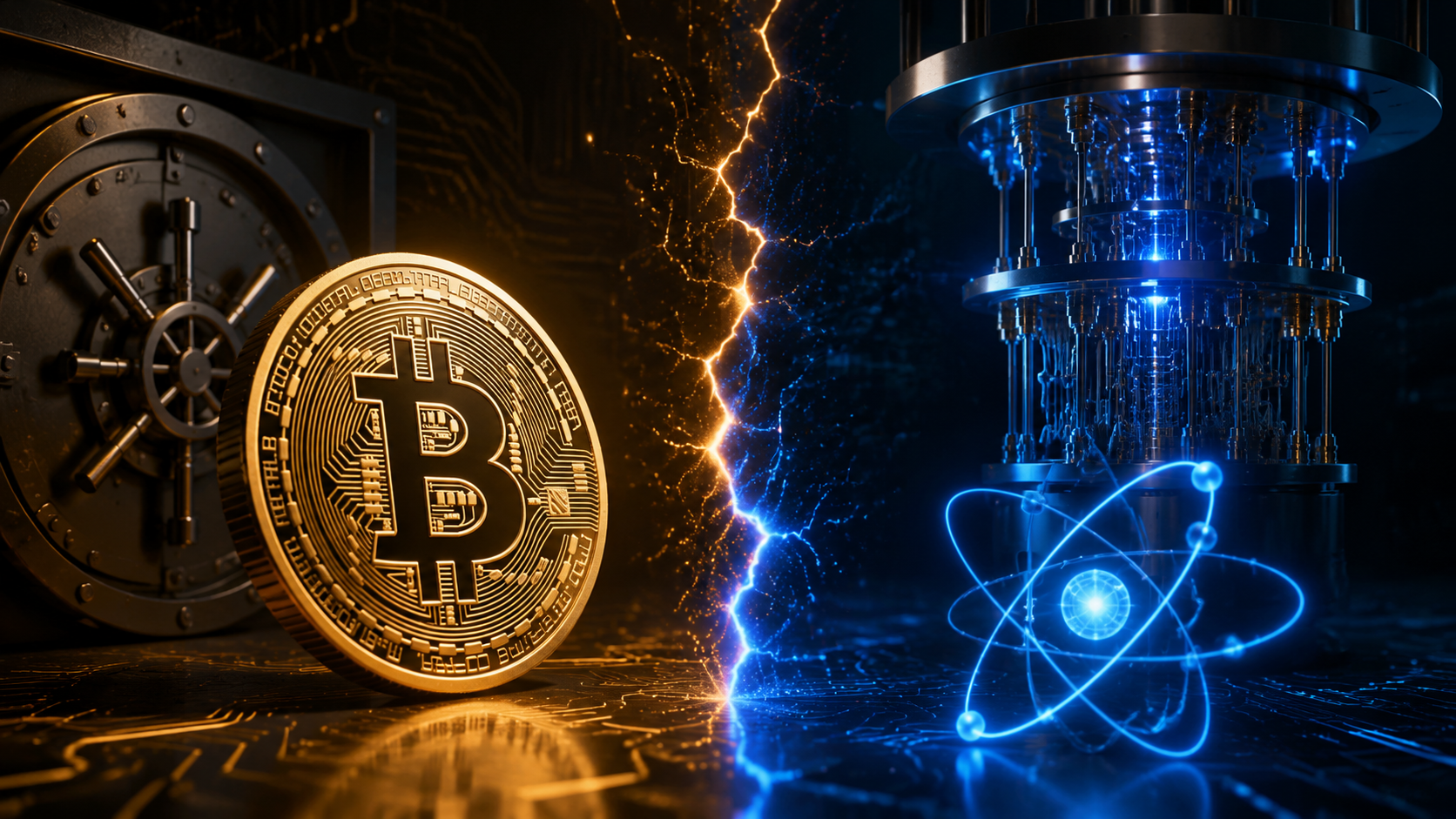
Could a single machine devalue the world’s most secure decentralized network overnight?According to a June 2026 report by CoinDesk and broader industry discussions, global attention on quantum computing has intensified as governments and research institutions accelerate efforts in post-quantum cryptography (PQC). While quantum computing is still in its early development stage, its potential impact on asymmetric cryptography has become an active topic across both academic and financial sectors. This is because the same technology designed for advanced computation could, in theory, challenge the mathematical assumptions that currently secure Bitcoin’s elliptic curve signatures. Although Bitcoin is not currently under immediate threat, researchers have identified theoretical vulnerabilities—particularly in systems where public keys are exposed—making quantum resistance a growing area of focus for the blockchain industry.
Key Takeaways
-
Shor’s Algorithm Threatens ECDSA: Quantum computers use Shor’s Algorithm to solve the Elliptic Curve Discrete Logarithm Problem ($$ECDL$$), collapsing the mathematical barrier that prevents a public key from being reversed into a private key.
-
Satoshi’s P2PK Coins Are Vulnerable: Roughly 1.1 million BTC mined by Satoshi Nakamoto reside in early Pay-to-Public-Key (P2PK) addresses, which expose unhashed public keys permanently on the blockchain ledger, making them ideal targets for offline quantum attacks.
-
Modern Addresses Contain Hash Protections: Pay-to-Public-Key-Hash (P2PKH) and SegWit (P2WPKH) addresses protect funds using SHA-256 and RIPEMD-160 algorithms, which resist Shor’s Algorithm and limit quantum exposure to a brief mempool transaction window.
-
The 2031 Cryptographic Timeline: Recent white papers from industry leaders indicate that a fault-tolerant quantum computer with enough logical qubits to attack public-key encryption could arrive by the early 2030s, aligning with federal compliance deadlines accelerated to 2031.
-
Protocol Upgrades Are Available: The Bitcoin network can implement Post-Quantum Cryptography (PQC) through soft forks like BIP-361, transitioning to lattice-based or hash-based signatures, though managing un-migrated dormant coins remains a major governance challenge.
What Is the Mathematical Threat of Quantum Computing to Bitcoin?
Quantum computers pose a direct threat to Bitcoin because they can solve the specific mathematical problems that protect blockchain private keys in a fraction of a second. Classical computers rely on binary bits (0s and 1s) and must use brute-force calculations to guess a private key from a public key, a process that would take billions of years. In contrast, quantum computers use quantum bits, or qubits, which exist in a state of superposition—allowing them to analyze massive combinations of numbers simultaneously.
Bitcoin relies on the Elliptic Curve Digital Signature Algorithm (ECDSA), specifically the
secp256k1 curve, to ensure that only the rightful owner of an address can spend the funds. This system operates on the Elliptic Curve Discrete Logarithm Problem (ECDLP). In standard cryptographic applications, a private key (k) is multiplied by a known generator point (G) on the curve to produce a public key (K):K=k⋅G
For classical computers, reversing this formula to find k when given K and G is practically impossible. However, an algorithm known as Shor’s Algorithm changes the mathematics completely. Shor’s Algorithm is a quantum computing protocol designed to find the prime factors of a composite integer or determine the period of a periodic function in polynomial time.
When applied to elliptic curve cryptography, Shor’s Algorithm transforms the discrete logarithm problem into a period-finding exercise. The algorithm constructs a quantum superposition of states representing a two-variable function:
f(x,y)=x⋅G+y⋅K
Because K=k⋅G, this can be rewritten as:
f(x,y)=(x+yk)⋅G
This function contains an underlying periodic structure. By applying a Quantum Fourier Transform (QFT), a quantum computer can isolate the periods (Δx,Δy) where the function produces identical outputs, meaning:
Δx+Δy⋅k≡0(modn)
Where n represents the prime order of the elliptic curve group. Once the quantum machine solves for these periods, a hacker can easily calculate the private key using standard modular arithmetic on a classical computer:
k≡−ΔyΔx(modn)
This mathematical shortcut reduces the time required to break a Bitcoin private key from billions of years to mere minutes, completely bypassing the cryptographic barriers established by ECDSA.
Why Are Satoshi Nakamoto’s Locked Coins Uniquely Vulnerable to Quantum Attacks?
Satoshi Nakamoto’s estimated 1.1 million coins are highly vulnerable because they reside in early address formats that permanently expose their public keys to the public ledger. To understand why these coins are targeted, it is necessary to examine how the Bitcoin network evolved its address architecture. The table below outlines how public keys are handled across different Bitcoin address implementations.
| Address Type | Common Prefix | Public Key Visibility on Blockchain | Quantum Vulnerability Level |
| Pay-to-Public-Key (P2PK) | Raw Scripts (Early Blocks) | Permanently Exposed | Extremely High |
| Pay-to-Public-Key-Hash (P2PKH) | 1... | Hidden until spent (Stored as Hash) | Low (Exposed only during mempool window) |
| Pay-to-Witness-Public-Key-Hash (P2WPKH) | bc1q... | Hidden until spent (Stored as Hash) | Low (Exposed only during mempool window) |
In the earliest days of Bitcoin (2009–2010), the software utilized the Pay-to-Public-Key (P2PK) transaction script. When an address received mining rewards or transactions under P2PK, the full, unhashed public key (K) was written directly into the public blockchain history. Because Satoshi Nakamoto mined over one million coins using this precise script—and because those coins have remained completely dormant for over 15 years—their unhashed public keys sit completely exposed in the global ledger. A quantum computer running Shor’s Algorithm would not need to intercept any live data; a malicious actor could simply copy Satoshi’s public keys directly from the historic blockchain ledger, compute the corresponding private keys offline, and sign a transaction to drain the funds.
Modern Bitcoin addresses use an upgraded mechanism called Pay-to-Public-Key-Hash (P2PKH) or native SegWit (P2WPKH). For these addresses, the public address distributed to the world is not the public key itself, but rather a double-cryptographic hash of the public key:
Address=RIPEMD160(SHA256(K))
Quantum computers running Shor’s Algorithm cannot break hash functions like SHA-256 or RIPEMD-160 because hashes do not rely on the algebraic period-finding structures found in elliptic curves. To attack a hash, a quantum computer must use Grover’s Algorithm, which only provides a quadratic speedup. This means a 256-bit hash retains 128 bits of security under quantum analysis, rendering it mathematically uncrackable.
Consequently, modern address holders are only exposed to quantum theft during a very brief window. When a user transmits a transaction to spend their funds, they must broadcast their raw public key to the peer-to-peer network so nodes can validate the digital signature. The public key sits in the unconfirmed transaction pool (mempool) for roughly 10 to 60 minutes before being written into a block. To steal these funds, a quantum hacker would have to detect the broadcasted public key in the mempool, compute the private key via Shor's Algorithm, forge a new transaction with a higher fee, and execute a Replace-by-Fee (RBF) attack to front-run the original transaction before a miner archives it. While theoretically possible, this time-constrained attack is infinitely more complex than stealing stationary assets from exposed P2PK addresses.
How Far Away Are We From a Quantum Threat to Cryptography?
A quantum computer capable of breaking Bitcoin’s underlying cryptography does not exist today, but global timelines indicate the window for preparation is narrowing toward the next decade. Modern quantum devices, such as those operated by technology companies and research institutions, belong to the NISQ (Noisy Intermediate-Scale Quantum) era. These machines contain several hundred to a few thousand physical qubits, but they lack error correction and suffer from extreme environmental noise, making them incapable of running complex algorithms over sustained periods.
To successfully execute Shor’s Algorithm against a 256-bit ECDSA key, an attacker requires a fault-tolerant quantum computer. Cryptographic research indicates that approximately 2,048 stable, error-corrected logical qubits are necessary to break the encryption. Because maintaining a single logical qubit requires a protective shield of hundreds or thousands of raw physical qubits to mitigate errors, an operational attack machine would need an architecture containing roughly 500,000 to several million physical qubits.
The timeline for achieving this scale is accelerating due to state-sponsored initiatives. According to the June 2026 executive order signed by President Trump, the US federal framework has established strict deadlines to prepare for this shift, mandating that government systems transition to National Institute of Standards and Technology (NIST) approved post-quantum cryptography (PQC) for key establishments by December 31, 2030, and for digital signatures by December 31, 2031. Furthermore, the White House directed the Department of Energy to deliver a scalable quantum computer optimized for application development by 2028. Academic and industrial defense experts generally project that a state-backed laboratory or heavily funded tech enterprise could realistically field a fault-tolerant quantum computer capable of breaking public-key cryptography somewhere between 2030 and 2035.
What Solutions Is the Bitcoin Community Developing to Defend the Network?
The Bitcoin developer ecosystem is actively building cryptographic defenses to ensure the network can withstand quantum deployment without compromising decentralized ledger integrity. Because Bitcoin is an open-source software protocol governed by node consensus, its cryptographic signature rules can be modified through network upgrades.
The primary line of defense involves integrating Post-Quantum Cryptography (PQC) directly into the Bitcoin protocol. Cryptographers are currently focusing on two major alternatives to replace ECDSA:
-
Based-on-Hash Signatures: Schemes like the eXtended Merkle Signature Scheme (XMSS) and Leighton-Micali Signatures (LMS) rely entirely on the security of one-way cryptographic hashes. Because hash functions are resistant to Shor's Algorithm, these signature methods offer proven quantum protection.
-
Lattice-Based Cryptography: Algorithms like ML-DSA (formerly known as Dilithium), which was officially standardized by NIST, rely on the geometric hardness of high-dimensional lattice problems. These problems are too complex for both classical and quantum architectures to solve efficiently.
Implementing these algorithms into Bitcoin requires technical compromises. Quantum-resistant signatures are significantly larger than current ECDSA signatures; an ECDSA signature requires roughly 64 bytes of data, whereas an ML-DSA or XMSS signature can require several kilobytes. This data expansion would reduce the number of transactions a single Bitcoin block can hold, potentially driving up transaction fees and straining layer-1 data capacity.
To minimize friction, developers are utilizing structural foundations laid by previous network upgrades. The activation of Taproot introduced a framework that allows different script types to be executed via Merkelized Alternative Script Trees (MAST). This design enables developers to introduce quantum-safe signature scripts via a soft fork upgrade. Proposals such as BIP-361 are actively exploring how to standardize quantum-resistant address formats, allowing users to voluntarily migrate their capital to secure addresses before fault-tolerant quantum machines become operational.
The Philosophical and Political Dilemma of Dormant Bitcoins
The most complex hurdle in securing Bitcoin against quantum computers is not the underlying mathematics, but the political governance of inactive addresses. If a quantum soft fork occurs, active market participants can easily generate a new, quantum-safe address format and execute an on-chain transfer to safeguard their funds. However, millions of early bitcoins sit in legacy P2PK addresses where the owners have either passed away, lost their private seed phrases, or intentionally left their coins untouched—as is the case with Satoshi Nakamoto's estimated 1.1 million BTC.
If these coins remain un-migrated when a functional quantum computer emerges, a malicious actor could steal them, immediately inflating the circulating supply and causing a massive market liquidation event. To prevent this, the Bitcoin developer community has debated two main strategies:
-
The Forced Burn/Freeze Strategy: The network could implement an upgrade with a multi-year warning window. This rule would declare that any exposed, legacy P2PK address that fails to move its funds to a post-quantum address format by a specific block height will be permanently frozen or invalidated by network consensus.
-
The Immutability Conflict: Freezing assets directly violates Bitcoin’s core ideological value proposition—absolute immutability and censorship resistance. If the community agrees to alter the ledger to lock away Satoshi's coins, it proves that human social consensus can override protocol rules, setting a precedent that critics argue mimics centralized banking systems.
Resolving this debate will likely be the definitive challenge for the Bitcoin ecosystem as the quantum timeline approaches. The community must collectively choose whether preserving the economic stability of the network justifies breaking the absolute immutability of its historic addresses.
How to Trade Bitcoin on KuCoin?
KuCoin provides a highly secure, reliable infrastructure for users looking to trade or hold Bitcoin as the global cryptographic landscape adapts to emerging technologies. To begin your trading journey, you can easily set up an account and access a wide array of spot and futures markets.
-
Create and Verify Your Account: Sign up on the official KuCoin platform using your email address or phone number, and complete the Identity Verification process to unlock full deposit limits and enhanced account security.
-
Fund Your Wallet: Navigate to the asset dashboard and deposit cryptocurrency directly, or use the "Buy Crypto" gateway to purchase Bitcoin using fiat currencies through supported credit cards, bank transfers, or peer-to-peer (P2P) channels.
-
Navigate to the Trading Dashboard: Open the KuCoin Spot Market interface and search for the BTC/USDT or BTC/USDC trading pair to view real-time order books and advanced charting indicators.
-
Execute Your Order: Select your preferred order format—such as a Market Order for instant execution or a Limit Order to target a specific price entry—input your desired capital allocation, and click "Buy BTC" to finalize your purchase.
-
Secure Your Position: Utilize KuCoin’s advanced internal safety mechanisms, including multi-factor authentication, anti-phishing codes, and separate trading passwords, to ensure your digital portfolio remains fully protected.
Conclusion
Quantum computing represents a fundamental shift in digital cryptography, but it does not signal an unpreventable catastrophe for Bitcoin. While Shor’s Algorithm introduces a viable method to compromise the Elliptic Curve Digital Signature Algorithm (ECDSA), this vulnerability is overwhelmingly concentrated within early address structures, such as the legacy P2PK scripts holding Satoshi Nakamoto's 1.1 million coins. Modern address designs that hash public keys remain highly insulated against direct quantum discovery, restricting an attacker's window of opportunity to the brief period an unconfirmed transaction sits in the mempool. Furthermore, global administrative deadlines—including the United States' transition toward NIST post-quantum cryptography standards by 2031—have provided a clear, actionable timeline for open-source developers to integrate quantum-safe alternatives like lattice-based signatures and hash-based XMSS scripts. Ultimately, Bitcoin's survival will depend less on engineering limitations and more on human governance. The network possesses the structural tools to update its code; the true test will be whether the decentralized community can reach consensus on how to handle legacy, dormant assets without fracturing the core philosophical principles upon which the blockchain was built.
Frequently Asked Questions (FAQs)
What is the difference between a physical qubit and a logical qubit?
A physical qubit is the raw, quantum-mechanical component (such as a superconducting circuit or trapped ion) that processes information but is highly susceptible to environmental interference and calculation errors. A logical qubit is a collection of thousands of interconnected physical qubits working in tandem alongside error-correcting codes to function as a single, stable, and completely reliable unit capable of executing long cryptographic calculations.
Can a quantum computer steal Bitcoin if the private key is kept on a cold storage hardware wallet?
Yes, if the funds are stored in an older address format where the raw public key is openly displayed on the blockchain ledger (such as a P2PK address). The security of a hardware wallet relies on keeping the private key isolated from internet-connected devices, but it cannot alter the data structures already written onto the public blockchain history; if the public key is exposed on-chain, a quantum computer can recalculate the private key completely independent of your physical device.
Will a quantum computer be able to reverse a SHA-256 hash function?
No, quantum computers running Grover’s Algorithm cannot mathematically reverse or decrypt a SHA-256 hash function. Grover's Algorithm only provides a quadratic acceleration for unstructured search problems, meaning it reduces the security of a 256-bit hash to a still entirely uncrackable 128 bits of computational resistance, ensuring that unexposed, hashed addresses remain secure.
What happens to a user's Bitcoin if they do not update their wallet after a post-quantum upgrade?
If the Bitcoin network implements a soft fork to transition to post-quantum cryptography and enacts a deadline to freeze vulnerable, un-migrated addresses, any user who fails to transfer their funds to the new address format will lose the ability to spend or move their capital after that block height is reached.
Why doesn't Bitcoin upgrade to quantum-resistant encryption algorithms immediately?
Bitcoin has not transitioned immediately because post-quantum cryptographic signatures require significantly more data storage space than current ECDSA signatures. Implementing them right now would drastically lower transaction throughput, heavily congest the layer-1 blockchain architecture, and drive up processing fees for users before the physical threat of a fault-tolerant quantum computer actually exists.