

Ethereum Treasury Companies Struggle to Generate Alpha: Why BitMine’s Near-Perfect ETH Correlation Limits Excess Returns
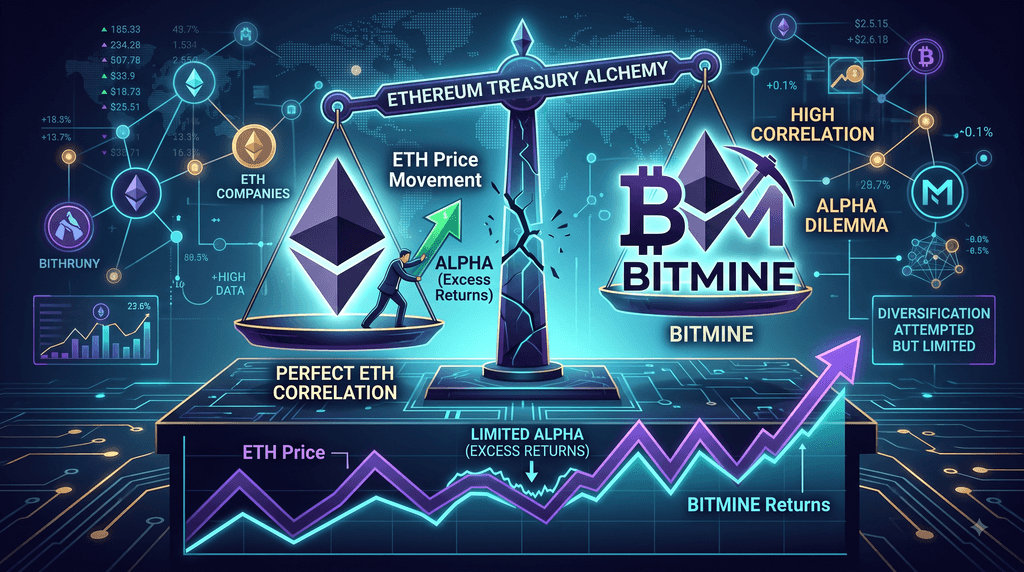
Ethereum Treasury Companies Face an Alpha Problem as Stocks Track ETH
Public companies that hold substantial Ethereum treasuries have increasingly captured the attention of investors, who view them as leveraged or liquid vehicles for gaining exposure to ETH. Among these companies, BitMine Immersion Technologies (BMNR) stands out as the largest firm by holdings, having amassed an impressive total of approximately 5.81 million ETH. This amount represents about 4.8 percent of the total circulating supply of Ethereum as of the latest update on August 10, 2026. In addition to its Ethereum holdings, BitMine's total assets, which include cryptocurrency, cash, and related investments, are valued at nearly $11.6 billion. A significant portion of these holdings, exceeding 5.06 million ETH, is currently staked through its MAVAN platform and various partners. This staking strategy is projected to generate annualized revenue of around $257 million, based on recent yields that hover near 2.6 percent.
However, market analysis and performance data reveal a persistent challenge that these companies face: the stock price of BitMine is tightly linked to fluctuations in ETH price movements. This close correlation leaves limited opportunities for generating excess returns, or alpha, when compared to simply holding the cryptocurrency itself. The central thesis posits that companies with Ethereum treasuries encounter inherent structural constraints that hinder their ability to generate alpha. The high correlation with ETH prices, coupled with staking yields that remain relatively modest in absolute terms, along with net asset value (NAV) multiples that tend to expand or contract primarily in response to market sentiment, means that these equities often operate more as high-beta proxies rather than as independent creators of value. Achieving significant outperformance typically necessitates shifts in investor risk appetite or an expansion of multiples, rather than relying solely on operational differentiation or unique business strategies.
BitMine’s Scale as the Dominant Ethereum Treasury Holder
BitMine has firmly established itself as the unequivocal leader among corporate holders of Ethereum. As of early August 2026, the firm proudly reported an impressive total of 5,805,238 ETH, which represents approximately 4.8 percent of the estimated 120.7 million circulating supply of Ethereum. This remarkable figure places BitMine an impressive 96 percent of the way toward achieving its ambitious target, referred to as the “alchemy of 5 percent.” The company has maintained a consistent strategy of weekly purchases, which have continued uninterrupted for over a year since it made a strategic pivot to an ETH-focused treasury strategy. In the latest update, the company’s total holdings, which also include a smaller position in Bitcoin, as well as cash, marketable securities, and equity stakes that are described as moonshots, amounted to approximately $11.6 billion.
This significant scale creates a unique combination of both opportunity and constraint for the firm. As the largest corporate treasury of ETH and the second-largest overall treasury in the cryptocurrency space, trailing only behind Strategy’s Bitcoin position, BitMine enjoys considerable visibility and heightened institutional interest. However, the sheer magnitude of its ETH position means that the value reflected on the balance sheet and the performance of its stock are heavily influenced by fluctuations in the underlying asset. While staking a high percentage of its holdings generates a recurring yield, it is important to note that this yield has not effectively decoupled the returns of the equity from the price movements of ETH in any sustained manner.
Measured Correlation Between BMNR and ETH Remains Elevated
Performance comparison data indicate a significant co-movement between BitMine shares and Ethereum, highlighting a strong relationship between the two assets. Over the past year, BitMine's stock, represented by the ticker BMNR, has experienced a return of approximately -71 percent. In contrast, Ethereum (ETH) has returned about -59 percent during the same timeframe. This performance has resulted in a one-year correlation reading of around 0.63, as reported in one widely tracked dataset. Furthermore, the all-time correlation since the mid-2025 registration period sits at approximately 0.52. Various analyses have characterized this relationship as sufficiently tight, leading to the stock being frequently regarded as a high-beta equity proxy for exposure to Ethereum. The elevated correlation between BMNR and ETH significantly limits the potential for generating alpha, which refers to the excess return on an investment relative to the return of a benchmark index.
When Ethereum experiences price increases or decreases, BitMine shares tend to move in the same direction, often exhibiting amplified volatility in response to these price fluctuations. There have been periods of temporary dislocation, such as weekend movements in Ethereum's price that the stock cannot immediately reflect. However, despite these short-term discrepancies, the longer-term linkage between the two assets tends to reassert itself over time. For investors who are specifically seeking pure exposure to Ethereum, there are more direct avenues available, such as spot markets or exchange-traded funds (ETFs). Those who choose to invest in BitMine, on the other hand, are effectively paying for a corporate wrapper that is primarily driven by the same underlying asset, Ethereum. This dynamic underscores the importance of understanding the relationship between BitMine shares and Ethereum for making informed investment decisions.
Staking Yields Provide Income but Limited Differentiation
BitMine has established a significant position by staking a large majority of its Ethereum (ETH) holdings. Recent data indicates that over 5.06 million ETH have been staked, which translates to approximately 87 percent of the company’s treasury in a single update. This substantial staking activity is projected to generate annualized revenue close to $257 million, based on seven-day yields hovering around 2.6 percent. Previous forecasts, which considered higher yields or more comprehensive staking rates, have suggested potential revenues in the range of $250 to $300 million. To effectively capture this income and bolster institutional staking efforts, the firm has developed and operates its own Made in America Validator Network.
The staking yield, which falls within the range of 2 to 3 percent, produces meaningful absolute dollar amounts given BitMine’s scale. However, it offers only modest differentiation when compared to the inherent volatility associated with ETH itself. In the short to medium term, the fluctuations in the price of the treasury, whether it appreciates or depreciates, far exceed the contributions made by the staking yield. Additionally, network-wide staking yields have experienced compression over time as an increasing amount of ETH is staked, which further limits the income advantage that can be realized. For equity investors, this situation implies that the primary avenue for achieving outperformance in comparison to ETH continues to hinge on fluctuations in the stock’s net asset value (NAV) multiple, rather than on the generation of superior yield.
NAV Multiples Function Like Sentiment-Driven Valuation Ratios
Crypto treasury companies typically engage in trading activities at multiples of their net asset value (NAV) that are subject to fluctuations driven by investor sentiment. Recent market commentary has highlighted a range for these multiples, which spans from approximately 0.5 times to as high as 3.0 times NAV. The behavior of these multiples is akin to that of price-to-earnings (P/E) ratios observed in traditional financial markets: they tend to expand during periods characterized by optimism and investor confidence, while they contract when risk appetite diminishes and market participants become more cautious. BitMine, as an ETH treasury firm, has experienced trading at both discounts and premiums relative to the market value of its holdings at various points throughout its operational history. This variability in trading conditions reflects the broader dynamics of the crypto market.
Given that the multiple is sensitive to sentiment, it has the potential to generate temporary alpha or, conversely, lead to underperformance when compared to ETH. Investors who are diligent and strategic may seek to capitalize on these fluctuations by purchasing shares when the stock is trading at a discount and subsequently selling when the premium becomes excessively extended. However, achieving sustained excess returns is a more complex endeavor; it necessitates either a consistent expansion of the multiple or operational enhancements that can justify a structurally higher multiple over time. The high correlation between the stock and the underlying asset complicates the ability to achieve the former independently of the broader conditions prevailing in the cryptocurrency market. As such, investors must navigate these challenges with a keen understanding of market sentiment and the factors influencing NAV multiples.
Broader Challenges Across Ethereum Treasury Companies
The challenge of generating alpha is not an issue that is exclusive to BitMine. In fact, other publicly traded companies that are implementing ETH treasury strategies encounter similar structural dynamics. These dynamics include substantial concentrated holdings in a highly volatile asset, relatively modest staking yields when compared to the significant price fluctuations, and equity valuations that tend to closely follow the broader crypto market cycle. The introduction of Spot Ethereum ETFs has further complicated the investment landscape by providing a more straightforward and often lower-cost means of exposure, which can lead to a compression of the premium that has historically been associated with equities of treasury companies.
When the price of ETH experiences a decline, the unrealized losses on treasury holdings can result in substantial reported net losses, even in situations where staking revenue is on the rise. On the other hand, when there are strong rallies in the price of ETH, both the net asset value (NAV) and, quite frequently, the stock price itself can see significant increases. However, it is important to note that the excess return generated over simply holding ETH remains limited once the correlation between the two is taken into account. Consequently, this leads to the emergence of a category of equities that, while providing convenient listed exposure and potential leverage, face considerable difficulties in demonstrating consistent alpha after making adjustments for the dominant risk factor that influences their performance.
BitMine has actively engaged in substantial share repurchases under a multi-billion-dollar authorization, demonstrating a strong commitment to returning value to its shareholders. Since early July 2026, the cumulative buybacks have impressively reached tens of millions of shares, as highlighted in recent weekly updates. These strategic actions are designed to support the stock price and effectively reduce the overall share count, which can potentially enhance various per-share metrics that are crucial for investors. Additionally, the firm has strategically maintained smaller positions in a diverse range of other assets and cash reserves, although it is important to note that cash levels have experienced fluctuations as the accumulation of ETH has continued.
The buybacks, along with ancillary investments, represent thoughtful attempts to create value that extends beyond the pure beta associated with ETH. However, it is essential to recognize that their impact remains secondary to the overall performance of the core treasury. In periods when ETH experiences weakness, the buybacks that are funded by the remaining cash or through equity issuance encounter the same valuation headwinds that affect the broader equity market. Thus, the primary economic engine driving the firm's performance continues to be the size and yield of the ETH position, rather than the capital-return programs that are often employed by other companies in the sector.
Institutional Ownership and Index Inclusion Add Visibility
BitMine has successfully attracted a diverse and impressive roster of institutional investors, and it was officially added to the prestigious Russell 1000 index in the middle of the year 2026. Among its prominent backers are various entities that are closely associated with well-known and highly regarded investors in the rapidly evolving digital-asset space. The inclusion in this index can significantly broaden the shareholder base and enhance liquidity, making it more appealing to a wider range of investors. Furthermore, the stock’s status as one of the more actively traded names that are linked to crypto treasuries serves to further elevate its profile in the market.
However, it is important to note that visibility in the market does not automatically translate into alpha, which refers to the excess return on an investment relative to the return of a benchmark index. Institutional ownership can amplify both inflows during periods of favorable sentiment and outflows during risk-off periods, which can create volatility. The fundamental return driver for BitMine remains the correlation with ETH, as well as the market’s willingness to assign a premium or discount to the corporate structure of the company. While index membership and the presence of blue-chip shareholders provide a degree of stability in ownership, they do not fundamentally alter the high-beta character of the equity, which can lead to significant price fluctuations.
Volatility Amplification and High-Beta Trading Dynamics
Market participants often perceive BMNR as a leveraged or high-beta representation of ETH, which is a significant aspect of its trading dynamics. The intraday price swings can be quite sharp and pronounced, and the existence of various leveraged products associated with the stock has the potential to reinforce reflexive trading behaviors among investors. When ETH experiences rapid movements, the equity can display magnified responses, whether on the upside or downside, leading to heightened volatility. This particular characteristic is appealing to traders who are actively seeking amplified exposure to price movements; however, it simultaneously increases the complexity and difficulty of generating risk-adjusted excess returns over extended investment horizons.
Moreover, the high volatility inherent in this trading environment also impacts the reliability of staking income as a stabilizing factor for investors. While staking revenue is relatively predictable when measured in ETH terms, its dollar value is subject to fluctuations that correspond with the price movements of ETH itself. Additionally, mark-to-market changes on the substantial treasury position held by the company tend to dominate the reported financial results. Consequently, investors who are focused on achieving alpha must take into account the elevated levels of volatility and the limited capacity of operational income to effectively offset significant price movements in the underlying asset. This interplay of factors creates a challenging landscape for those looking to navigate the complexities of the market.
Context With Bitcoin Treasury Models
Bitcoin treasury companies, particularly those like Strategy, have been functioning within a remarkably similar high-correlation dynamic for an extended period. In contrast, the Ethereum (ETH) treasury cohort encounters comparable constraints, but with the additional characteristic of native staking yield that Bitcoin does not possess. This staking yield offers a modest income stream and contributes to a narrative of productivity; however, the absolute yield level, currently situated in the low-to-mid single digits, has not demonstrated the capability to drive sustained equity outperformance that is independent of ETH price movements.
While there are notable differences in corporate structure, debt utilization, and methods of capital raising among various firms, the predominant risk factor continues to be the exposure to the underlying cryptocurrency asset. For both Bitcoin and Ethereum treasury equities, periods characterized by premium expansion have resulted in strong relative returns, whereas instances of premium compression or net asset value (NAV) discounts have led to underperformance. This recurring pattern highlights that alpha within this category is more frequently a function of the timing of valuation rather than a reflection of operational superiority or excellence.
Pathways That Could Support Future Excess Returns
Meaningful alpha would likely require either a sustained expansion of the NAV multiple driven by improved sentiment toward crypto equities, successful productization of staking and related services that diversifies revenue, or a structural change in how the market values productive digital-asset treasuries relative to passive holdings. BitMine’s development of the MAVAN staking platform and efforts to attract institutional validators represent steps in the second direction.
Until such differentiation becomes large enough to move the equity independently of ETH, the stocks will continue to trade primarily as proxies. Investors can still generate returns by correctly timing entry and exit around NAV multiples or by accepting the high-beta profile as the intentional exposure. Generating consistent excess returns above the underlying asset, however, remains a high bar under current conditions of elevated correlation and modest yields.
Investor Considerations Around Correlation and Yield
Market participants evaluating Ethereum treasury equities must weigh the convenience of a listed vehicle, the potential for multiple expansion, and staking income against the reality of high correlation and limited short-term differentiation. Buying at a discount to NAV and selling into premium expansions has been cited as a disciplined approach. Holding through cycles exposes investors to the full volatility of ETH plus the additional equity-specific risks of corporate structure, dilution, and liquidity.
The category continues to evolve as more firms adopt treasury strategies and as staking infrastructure matures. For now, the evidence from BitMine’s scale, correlation statistics, and yield profile illustrates why excess returns have proven elusive. The stocks offer accessible exposure and operational income, yet they have not consistently delivered alpha beyond what an investor could achieve by holding ETH itself.
FAQs
What is BitMine’s current Ethereum treasury size?
As of its August 10, 2026, update, BitMine reported holdings of 5,805,238 ETH, representing about 4.8 percent of circulating supply. Combined with cash, other crypto, and equity stakes, total assets were approximately $11.6 billion. A large majority of the ETH is staked.
How correlated is BMNR stock with Ethereum?
Available performance data indicate a one-year correlation around 0.63 and an all-time figure near 0.52 since the relevant period began. Market commentary frequently describes the relationship as sufficiently tight that the stock functions as a high-beta proxy for ETH.
What level of staking revenue does BitMine generate?
With more than 5 million ETH staked, recent projections place annualized staking revenue near $257 million based on yields around 2.6 percent. Full staking of the treasury at similar rates has been projected in the $290 million range in prior updates.
Why do Ethereum treasury companies struggle to produce alpha?
High correlation with ETH means stock returns largely track the underlying asset. Staking yields in the 2–3 percent range provide income but limited differentiation relative to ETH price volatility, while NAV multiples expand and contract mainly with sentiment.
How do NAV multiples affect these stocks?
Crypto treasury equities can trade between roughly 0.5x and 3.0x the market value of their holdings. Multiples behave like traditional valuation ratios, rising with optimism and falling with risk aversion, creating opportunities for relative performance around sentiment shifts.
Has BitMine conducted share buybacks?
Yes. The company has executed substantial repurchases under a multi-billion-dollar authorization, with cumulative buybacks reaching tens of millions of shares in the weeks following early July 2026.
🔥 KuCoin Offers A More Stable Option in A Volatile Market
If you worry about the frequent ups and downs in the market, and pursue a more stable option to earn money passively, KuCoin is the right place to come:

Simple Earn: Deposit and withdraw tokens anytime, earning stable returns.
Kucoin Earn: Earn stable profits with professional asset management.
Hold to Earn: Earn rewards by holding assets in Funding, Trading, Margin, Futures, Mining, and Unified Accounts.
Staking: Unlock the earning potential of on-chain assets.
Advanced Investments: Advanced Investments offer a variety of structured products to help your money grow in any market.
Shark Fin: Principal Protection and Guaranteed Gains
Dual Investment: Buy low and sell high with transparent return calculations.
Snowball: High yields, with price protection.
Discount Buy: Buy crypto at discount prices.
KCS Loyalty: Level up to enjoy exclusive perks by staking ≥ 1 KCS.
KuCoin Wealth: Discover future value and begin your smart investing journey.
KCS Benefits: Hold and stake KCS to access benefits across the platform.
KCS Staking 2.0: Participate in KCS on-chain governance to earn yield.
Disclaimer: This content is for informational purposes only and does not constitute investment advice. Cryptocurrency investments carry risk. Please do your own research (DYOR).