

Apple Stock Falls After Q4 2026 Earnings Beat: Why Margins and Memory Costs Worry Investors
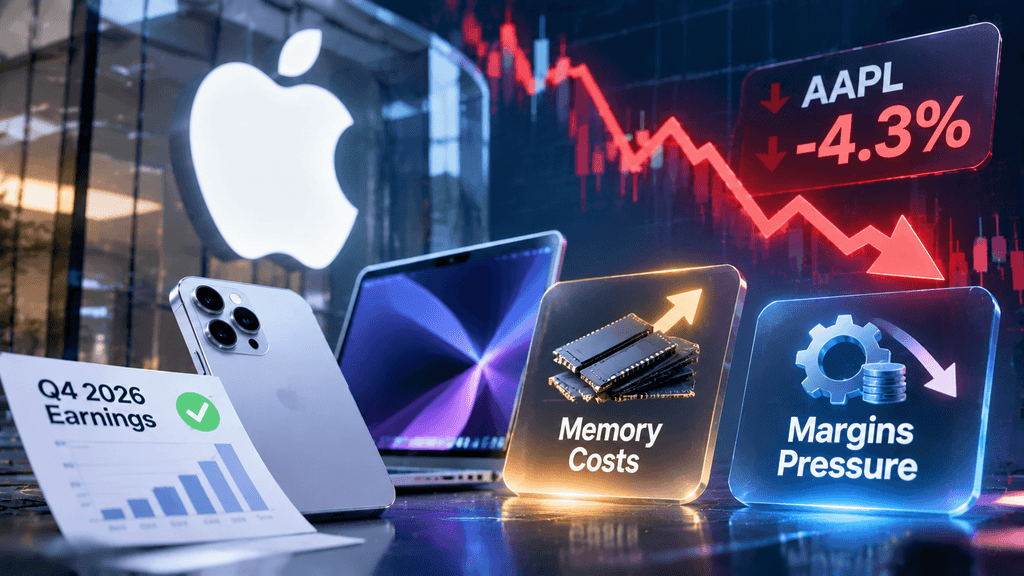
Apple delivered a stronger-than-expected fiscal fourth-quarter performance, with revenue reaching $114.48 billion and diluted earnings per share hitting $2.10. However, the positive results failed to sustain investor confidence after management warned that rising memory-chip prices could pressure profitability during the crucial holiday quarter. Apple's shares fell approximately 4% during its November 2 earnings call before recovering part of the decline, reflecting growing concerns about its forward margin outlook.
The central issue is the changing economics of the AI industry. As technology companies expand AI data centers, demand for high-performance memory and server components is increasing, creating cost pressures for downstream hardware manufacturers. Apple is responding through pricing adjustments, supply commitments, and inventory management, but management expects memory prices to keep rising into 2027. For investors, the earnings report raises a broader question: can AI-driven demand generate sustainable growth without undermining the profitability of established technology companies? The answer could also have implications for semiconductor suppliers, AI infrastructure developers, and cryptocurrency mining businesses exploring high-performance computing.
Key Takeaways
-
Apple beat Q4 revenue and EPS estimates, supported by strong iPhone and Mac sales.
-
December-quarter gross margin guidance fell to 45%–46%, reflecting higher memory costs and Siri AI expenses.
-
AI data center expansion is changing semiconductor demand and supply priorities.
-
Memory manufacturers may benefit from stronger pricing, while consumer electronics companies face cost pressure.
-
Bitcoin miners with suitable power and data center infrastructure may find opportunities in AI and HPC.
What Happened to Apple Stock After Q4 2026 Earnings?
Apple Beats Revenue and EPS Expectations
Apple reported fiscal Q4 2026 revenue of $114.48 billion, up approximately 12% year over year, compared with analyst expectations of $113.39 billion. Diluted EPS reached $2.10, exceeding the $1.99 consensus estimate, while net income increased to approximately $30.71 billion. The results were supported by strong demand for the iPhone 18 Pro lineup, higher product prices, and solid Mac sales. Importantly, even excluding the $0.05-per-share benefit from tariff refunds, Apple's EPS still exceeded expectations. The company also reported a record fiscal-year revenue of approximately $478.8 billion, demonstrating that its growth remained resilient despite supply-chain challenges.
Why Did AAPL Shares Fall Despite the Earnings Beat?
The market reaction changed when executives discussed the outlook for the December quarter. Apple forecast gross margins of 45%–46%, below the September quarter's reported 47.9%, while projecting services revenue growth of 8%–9%. These figures raised concerns about whether strong product demand could translate into equally strong earnings growth. Shares declined approximately 4% during the earnings call before recovering some losses, eventually trading around 2% lower after the initial reaction. The response illustrates an important principle in equity markets: investors evaluate future earnings potential, not just historical performance. A company can beat quarterly estimates and still disappoint shareholders if its forward guidance suggests weakening profitability.
Which Apple Businesses Beat Expectations and Which Fell Short?
iPhone and Mac Drive Revenue Growth
The iPhone remained Apple's largest growth engine, generating approximately $57.6 billion in revenue, up 17% year over year. Demand for the iPhone 18 Pro lineup helped the company achieve a September-quarter revenue record for its flagship product category. Mac revenue reached approximately $10.8 billion, also exceeding analyst expectations. These results indicate that Apple's premium hardware strategy continues to attract customers despite higher component costs and broader uncertainty in consumer electronics. However, supply constraints affected iPhone, Mac, and iPad availability, suggesting that stronger demand did not necessarily translate into unrestricted sales growth during the quarter.
Services and Other Hardware Show Mixed Performance
Apple's services business generated approximately $31.6 billion, growing 10% year over year and reaching another all-time revenue record. Video, cloud services, payment services, and advertising contributed to the performance. Nevertheless, management projected slower services growth of 8%–9% for the December quarter, partly reflecting foreign exchange and third-party licensing headwinds. Other hardware categories were less consistent, with wearables, home, and accessories revenue declining 8% year over year. The contrast between strong iPhone demand and weaker performance in certain secondary categories suggests that Apple's growth remains dependent on its flagship products and its ability to maintain a profitable ecosystem.
| Business segment | Q4 FY2026 revenue | Key development |
| iPhone | $57.6B | Up 17% YoY |
| Mac | $10.8B | Above analyst expectations |
| Services | $31.6B | Up 10% YoY |
| iPad | $6.2B | Supply and demand challenges |
| Wearables, Home and Accessories | $8.3B | Down 8% YoY |
Source: Apple's Q4 earnings call and financial disclosures.
How Is AI Driving Up Memory Chip Costs?
Why AI Data Centers Need More Memory
Modern AI systems depend on more than powerful processors. They also require high-speed memory and storage to move, process, and retain the enormous volumes of information generated by model training and inference. High-bandwidth memory (HBM) is particularly important because it provides GPUs with rapid access to data. Conventional DRAM supports server and device operations, while NAND flash is widely used in SSDs and other storage products. As cloud providers and technology companies expand AI infrastructure, demand for these components is increasing. Large AI workloads require substantial memory capacity and bandwidth, making semiconductor manufacturing investment and product allocation increasingly important to the technology supply chain.
How AI Demand Is Reshaping Semiconductor Supply
Major manufacturers, including Samsung Electronics, SK Hynix, and Micron Technology, are expanding their capabilities to serve the growing AI market. However, HBM, conventional DRAM, and NAND are not interchangeable products. Their manufacturing processes and applications differ, meaning that stronger HBM demand does not automatically create shortages across every memory category. The broader pressure comes from capital allocation, production capacity, equipment requirements, and suppliers prioritizing products with attractive margins. When manufacturers direct more investment toward advanced memory, other customers may encounter tighter supply conditions or higher procurement costs. This creates a challenge for consumer electronics manufacturers that need stable supplies of memory components across large product portfolios.
Why Apple Cannot Fully Avoid Higher Memory Prices
Apple benefits from purchasing scale, long-term supplier relationships, and substantial inventory management capabilities. Nevertheless, these advantages cannot completely isolate the company from industry-wide price increases. CEO John Ternus described the current memory pricing environment as unprecedented, explaining that higher costs had already affected the September quarter and were expected to increase further in December. Apple has adjusted prices on several products, including Mac, iPad, and iPhone models, to offset some of the pressure. It has also increased manufacturing purchase obligations by $33 billion between the June and September quarters to secure supplies. These commitments demonstrate the importance of supply availability, but they do not guarantee that every future purchase will be made at favorable prices.
Why Are Rising Memory Costs Threatening Apple's Margins?
Apple's Gross Margin Could Fall to 45%–46%
Apple's September-quarter gross margin was 47.9%, but this figure included approximately one percentage point of favorable impact from tariff refunds. Management indicated that, excluding these refunds, gross margin had already declined by approximately one percentage point sequentially, primarily because of higher memory costs. The December-quarter forecast of 45%–46% therefore represents a further profitability challenge. CFO Kevan Parekh said most of the expected sequential decline would be driven by memory costs, with additional pressure from expenses associated with the Siri AI rollout. Investors are particularly concerned because the December quarter is traditionally important for Apple's holiday sales and overall profitability.
Tariff Refunds and AI Expenses Add to the Pressure
The tariff refunds provided a temporary benefit to Apple's reported profitability, but they do not represent a recurring improvement in its underlying manufacturing economics. Meanwhile, AI investments are creating additional operating expenses. Apple's operating expenses reached approximately $19.2 billion in Q4, up 21% year over year, partly reflecting increased research and development spending. The company also expects costs associated with the rollout of Siri AI to affect its December-quarter margin. These expenses illustrate that AI investment can influence both sides of a company's financial structure: hardware demand can increase revenue opportunities, while infrastructure, development, and memory procurement can raise costs.
Can Apple Pass Higher Costs to Consumers?
Apple has several ways to mitigate rising component expenses. It can increase product prices, negotiate supply agreements, use existing inventory, and optimize its product mix toward premium devices. Price adjustments on iPhone and Mac models have already provided some offset, while carry-in inventory helped reduce the immediate impact of memory inflation. However, raising prices carries its own risks. Consumers may delay upgrades or choose lower-priced alternatives if device affordability deteriorates. Apple's challenge is therefore to protect margins without weakening demand, particularly during the holiday shopping season. Its premium positioning provides some pricing flexibility, but sustained cost increases could eventually test customers' willingness to pay more.
Why Did Investors React So Negatively to Apple's Earnings?
Weak Forward Guidance Overshadowed Strong Results
The difference between Apple's historical results and its forward guidance explains much of the negative market reaction. Revenue and EPS exceeded expectations, but the projected decline in gross margin suggested that future earnings could face greater pressure. Apple also forecast December-quarter revenue growth of 7%–10%, while warning that supply constraints would continue to affect certain products. Although management expects the December quarter to generate the highest revenue in the company's history, investors must also consider how much profit that additional revenue will produce. Strong sales growth is less attractive when manufacturing costs rise faster than the company's ability to increase prices.
Apple's Valuation Leaves Less Room for Disappointment
Apple is one of the world's largest publicly traded technology companies, and its valuation reflects expectations of durable earnings growth, strong customer loyalty, and recurring services revenue. When investors assign a premium valuation to a company, even a modest deterioration in forward profitability can trigger a reassessment. The latest results therefore raise questions about whether Apple's earnings multiple adequately reflects higher memory costs, AI investment requirements, and potential supply constraints. However, a short-term decline does not automatically indicate a deterioration in the company's long-term fundamentals. Apple's installed base, premium product positioning, and ability to generate substantial operating cash flow remain important strengths.
Slower Services Growth Adds to Investor Concerns
Services has become an increasingly important component of Apple's business because it generates recurring revenue and maintains a higher gross margin than hardware. In Q4, services gross margin reached 76%, compared with 37.2% for products. Consequently, slower services growth could affect the company's overall profitability mix, even if hardware sales remain strong. Apple expects services revenue to grow 8%–9% in the December quarter, below the approximately 10.7% analyst expectation reported by Reuters. Foreign exchange and third-party licensing were cited as factors behind the more cautious outlook. Investors will therefore monitor whether services can maintain its role as a reliable source of high-margin growth.
How Will Apple's AI Strategy and New Leadership Shape Its Future?
John Ternus Faces His First Major Earnings Test
The Q4 report was the first earnings release under CEO John Ternus, who took over the position in September 2026. His immediate challenge is to preserve Apple's reputation for operational efficiency while navigating rising semiconductor costs and increasing competition in AI. Ternus has extensive experience in hardware engineering and product development, but the company must now demonstrate that its AI strategy can create meaningful commercial value. This requires balancing product innovation, supply-chain management, and the financial discipline expected by investors. Apple's ability to secure memory supplies and manage the cost of its expanding product lineup will be an important early test of the new leadership team.
Can Apple's AI Investments Generate New Revenue?
Apple's AI strategy focuses on integrating intelligent features into its existing ecosystem rather than competing solely through large-scale cloud infrastructure spending. The new Siri architecture, AI-assisted device functions, and integration across Apple's operating systems could strengthen customer loyalty and encourage hardware upgrades. However, more advanced AI features also require development resources and server-side computing capacity. Management acknowledged that the Siri AI rollout would contribute to December-quarter costs, while some server-dependent features could face usage limitations. The commercial opportunity is significant, but investors still need evidence that these investments can improve device demand, subscription revenue, or ecosystem engagement enough to justify their costs.
What Does Apple's Earnings Mean for Tech Stocks and Crypto Markets?
AI Infrastructure Creates Winners and Losers
Apple's earnings highlight how AI investment can create different financial outcomes across the technology supply chain. Semiconductor manufacturers may benefit from stronger demand for advanced memory, while downstream hardware companies face higher component expenses. AI data center operators also need to manage rising hardware, electricity, cooling, and construction costs. This divergence is important for investors because exposure to the AI theme does not guarantee similar returns across every company. The financial performance of each business depends on its position in the supply chain, pricing power, capital requirements, and ability to convert demand into sustainable earnings.
Why Bitcoin Miners Are Exploring AI and HPC
The connection to cryptocurrency lies primarily in infrastructure rather than memory-chip demand. Bitcoin miners use specialized ASIC machines designed for SHA-256 calculations, whereas AI data centers rely heavily on GPUs, high-bandwidth memory, and advanced networking. Nevertheless, both industries require substantial electricity, land, cooling systems, and data center facilities. This overlap has encouraged companies such as IREN, Core Scientific, HIVE Digital Technologies, and TeraWulf to explore AI and high-performance computing (HPC) services.
For miners, enterprise AI contracts may offer a way to diversify revenue beyond Bitcoin production. Existing power access and industrial facilities can provide a foundation for expansion, although converting a mining site into an AI data center requires significant investment in electrical systems, cooling, GPUs, and networking. Investors should distinguish between announced projects, signed customer contracts, operational capacity, and revenue actually recognized in financial statements. AI diversification can improve long-term business opportunities, but it also introduces new capital expenditure and execution risks.
Could Apple's Stock Weakness Affect Bitcoin?
Apple's share-price decline does not directly determine Bitcoin's direction. However, major technology stocks and cryptocurrencies can respond to some of the same macroeconomic factors, including interest rates, liquidity, institutional risk appetite, and expectations for economic growth. If concerns about AI profitability spread across the Nasdaq, investors may reassess exposure to other growth-oriented assets, including digital currencies. Conversely, continued AI infrastructure investment could benefit crypto-related companies that successfully provide computing capacity and power resources. Bitcoin investors should therefore treat Apple's earnings as an indicator of broader technology-sector sentiment rather than a standalone BTC trading signal.
What Should Investors Watch Next?
The next stage of Apple's earnings story will depend on whether the company can manage memory inflation while maintaining demand during the holiday quarter. Investors should monitor the December-quarter gross margin against the 45%–46% guidance, alongside iPhone and Mac supply availability, services growth, and AI-related operating expenses. Semiconductor investors should follow DRAM, NAND, and HBM pricing as well as earnings updates from Samsung Electronics, SK Hynix, and Micron. For cryptocurrency investors, the most relevant indicators include AI infrastructure capital expenditure, Bitcoin miner HPC revenue, power availability, and enterprise contract execution. These metrics will help determine whether AI demand is translating into sustainable profitability across the technology and digital asset industries.
Conclusion
Apple's Q4 2026 earnings demonstrate that strong revenue growth does not necessarily translate into stronger investor confidence. Although the company exceeded earnings expectations, rising memory prices, additional AI expenses, and weaker forward margin guidance created concerns about future profitability. The broader AI investment cycle is also reshaping semiconductor supply chains, creating opportunities for memory manufacturers while increasing costs for downstream hardware companies.
For cryptocurrency investors, the more important development is the growing intersection between AI infrastructure and Bitcoin mining. Companies with access to electricity and data center facilities may benefit from expanding HPC demand, although successful diversification requires substantial investment. Ultimately, Apple's next earnings results will show whether its pricing strategy, supply-chain management, and AI investments can protect margins while sustaining growth.
FAQs
What Is Apple's Fiscal Year and Why Does It Differ From the Calendar Year?
Apple's fiscal year does not follow the traditional January-to-December calendar. Its fiscal fourth quarter generally covers July through September, with the fiscal year ending in late September. Therefore, Q4 FY2026 refers to the three months ended September 26, 2026, rather than the final three months of the calendar year.
What Is the Difference Between Gross Margin and Operating Margin?
Gross margin measures the percentage of revenue remaining after subtracting the cost of goods sold. Operating margin goes further by accounting for operating expenses such as research and development, sales, and administration. Gross margin helps investors evaluate production economics, while operating margin provides a broader view of business profitability.
Why Do Memory Chip Prices Change So Quickly?
Memory prices are influenced by manufacturing capacity, inventory levels, demand forecasts, production investment, and technology transitions. Because semiconductor manufacturing requires substantial capital and time, supply cannot always respond immediately to changes in demand. This can create significant price fluctuations during periods of rapid technology expansion.
How Do Investors Calculate an Earnings Surprise?
An earnings surprise measures the difference between a company's reported results and analysts' consensus expectations. For EPS, investors compare reported earnings per share with the average analyst forecast. Revenue surprises are calculated in a similar way. A positive surprise does not automatically mean a stock will rise, because investors also consider forward guidance, valuation, and future profitability.
What Is the Difference Between Contract Memory Prices and Spot Prices?
Contract prices are negotiated between suppliers and buyers for specified quantities and delivery periods. Spot prices reflect transactions in the current market and can fluctuate more quickly with changes in supply and demand. Large electronics manufacturers typically rely heavily on supplier agreements, so changes in spot prices do not necessarily translate immediately into their procurement costs.
Disclaimer: This general market information, possibly from third-party, commercial, or sponsored sources, is provided for reference and educational purposes only and does not constitute financial or investment advice, an offer, solicitation, or guarantee. We disclaim liability for its accuracy, completeness, reliability, and any resulting losses. Investments/trading are risky; past performance doesn’t guarantee future results. Users should research, judge prudently, and take full responsibility. For further details, please consult KuCoin’s Terms of Use and Risk Disclosure.