

Nado – Project Introduction and Potential Analysis (High-Performance DEX)
2026/04/04 14:11:46
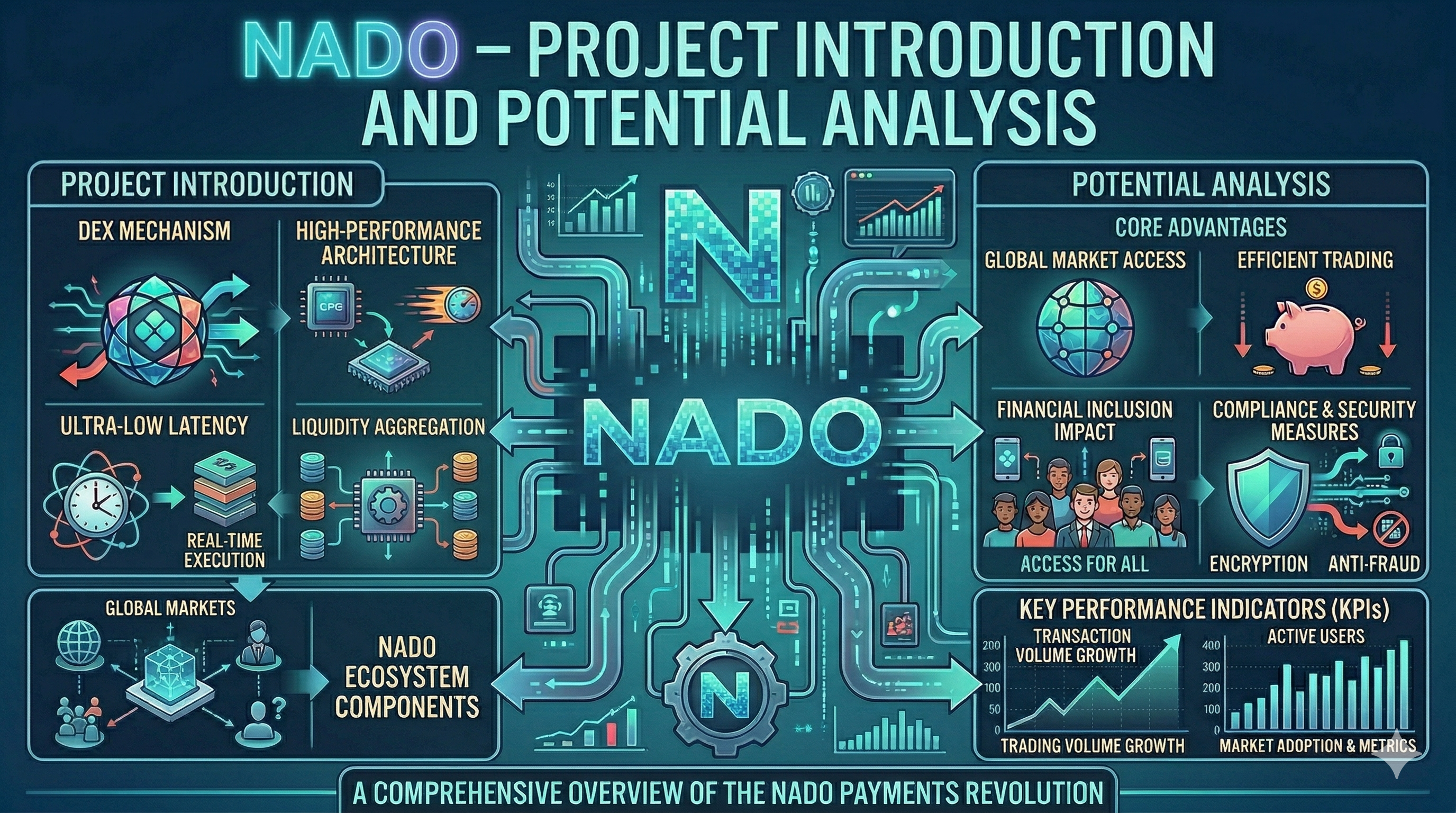
Nado represents a new generation of decentralized exchanges built to rival centralized trading platforms in speed, execution, and capital efficiency, while preserving user custody and transparency through blockchain infrastructure. Its architecture, built on the Ink Layer-2 ecosystem and powered by a central limit order book model, reflects a broader shift in decentralized finance toward performance-driven design, positioning Nado as a serious contender in the evolving derivatives trading market.
New Breed of Exchange Built for Speed and Precision
Nado has entered the decentralized finance space at a time when expectations around performance have changed significantly. Traders no longer accept slow execution or wide spreads simply because a platform is decentralized. Nado addresses this directly by introducing a trading experience that mirrors the speed and responsiveness of centralized exchanges while maintaining on-chain settlement.
The platform operates using a hybrid model where orders are matched off-chain for speed, then settled on-chain for transparency. This combination allows execution speeds measured in milliseconds, a key factor in attracting professional traders who rely on precision timing. Reports suggest latency can reach as low as 5–15 milliseconds, bringing it close to centralized trading environments. The focus here is not just technical improvement but a philosophical shift, building DeFi systems that compete directly with high-performance trading venues.
The result is a system that feels familiar to experienced traders while still delivering the benefits of decentralization, including asset control and verifiable settlement. This positioning has become central to Nado’s identity, defining it as a performance-first decentralized exchange rather than a simple alternative to automated market maker platforms.
The Core Architecture: Orderbook Meets Blockchain
Nado uses a central limit order book (CLOB), a trading system commonly found in traditional finance and centralized crypto exchanges. This approach gives traders more control over how their orders are placed and executed, supporting both limit and market orders instead of relying on automated liquidity pools. It leads to more accurate pricing, tighter spreads, and stronger liquidity, especially when handling larger trades. The platform runs on a dual-layer structure where an off-chain matching engine processes trades quickly, while on-chain smart contracts handle settlement and ensure transparency.
This separation allows the platform to achieve both speed and security without compromising either. Additional infrastructure includes a protocol-level risk engine that continuously monitors positions and collateral in real time. This design supports advanced trading strategies such as hedging and arbitrage, which are often difficult to execute efficiently on AMM-based platforms.
The architecture also reflects a broader industry trend where decentralized systems adopt proven mechanisms from traditional finance, adapting them for blockchain environments. By combining these elements, Nado delivers a system that feels structurally familiar yet technologically advanced, offering traders tools that align with professional trading standards.
Built on Ink: The Infrastructure Behind Nado
Nado operates on the Ink network, a Layer-2 blockchain ecosystem designed to support high-performance financial applications. Ink itself has been associated with infrastructure development tied to major exchange-grade systems, which gives Nado a strong technical foundation. According to Ink on Chain, the network is optimized for decentralized applications that require both speed and scalability, particularly in trading environments.
This becomes critical when handling derivatives markets, where latency and execution quality directly impact profitability. Ink’s architecture allows Nado to process trades quickly while maintaining on-chain transparency, solving one of the long-standing challenges in DeFi. The relationship between Nado and Ink reflects a deeper integration than typical DEX deployments, as the exchange appears designed specifically for this environment rather than adapted to it.
This alignment allows features such as unified margin and real-time risk management to function seamlessly. As a result, Nado is not just a standalone application but part of a broader ecosystem designed to support high-frequency financial activity. This foundation gives it a structural advantage compared to platforms that rely on general-purpose blockchain networks.
Unified Margin: A Shift in Capital Efficiency
One of the defining features of Nado is its unified margin system, which allows users to manage spot and derivatives positions within a single collateral pool. This approach significantly improves capital efficiency, as traders do not need to allocate separate funds for different positions. According to report, this system dynamically adjusts collateral across trades, enabling real-time risk netting. The impact is substantial, particularly for active traders who operate multiple strategies simultaneously.
Traditional DeFi platforms often lock liquidity into isolated pools, limiting flexibility and increasing capital requirements. Nado’s model addresses this limitation by allowing funds to flow across positions, reducing idle capital. Reports indicate that this unified approach consolidates spot balances, unrealized profits, and margin requirements into a single system.
This design mirrors advanced trading systems used in centralized exchanges, where capital efficiency is a critical factor in performance. By integrating this feature into a decentralized framework, Nado offers a more sophisticated trading environment that aligns with institutional practices while remaining accessible to individual users.
Trading Capabilities: Spot, Perpetuals, and Beyond
Nado supports both spot trading and perpetual futures, offering a wide range of strategies for users. Perpetual contracts, in particular, allow traders to take leveraged positions without expiry dates, making them a popular instrument in crypto markets. According to CoinLaunch, the platform supports over 30 trading pairs and offers leverage of up to 20x, depending on market conditions. This range enables traders to engage in directional bets, hedging strategies, and complex portfolio management. The integration of spot and derivatives trading within a single interface creates a seamless experience, eliminating the need to move funds between platforms.
This integration is further enhanced by the unified margin system, which allows users to manage risk across all positions simultaneously. The platform also includes liquidity vaults, where users can contribute funds to support trading activity and earn yield from fees and liquidations. These features position Nado as more than a simple exchange; it functions as a comprehensive trading environment that combines multiple financial instruments into a cohesive system.
Performance Metrics and Market Traction
Early data suggests that Nado has gained significant traction within the DeFi community. Reports indicate strong growth in user activity, trading volume, and total value locked. According to CoinLaunch, the platform has recorded over $50 million in total value locked and generated notable revenue within its early stages. Additional data shows daily active users exceeding 2,000, reflecting growing adoption. In derivatives markets, Nado has also demonstrated competitive volume levels, with reports placing it among the top-performing perpetual DEX platforms globally. These metrics are important because they signal real usage rather than speculative interest. Growth in trading volume often correlates with liquidity depth, which in turn improves execution quality for all users.
Social traction has also been notable, with the project attracting attention from influential traders and rapidly increasing its follower base. This combination of on-chain activity and social momentum suggests that Nado is not just a theoretical innovation but a platform actively gaining relevance in the market.
The Kraken Connection and Market Narrative
Nado’s development has been linked to teams associated with the major exchange Kraken, which adds a layer of credibility to the project. According to multiple reports, the platform is built by contributors connected to Kraken’s infrastructure and engineering ecosystem. This connection has influenced how the market perceives Nado, positioning it as a serious attempt to bridge centralized and decentralized trading environments. The narrative around this connection has also played a role in driving attention, as traders often look for projects backed by experienced teams.
The involvement of professionals familiar with high-performance trading systems is evident in Nado’s design, particularly in its matching engine and margin architecture. While the project maintains a decentralized structure, the influence of centralized exchange expertise is clear in its execution model. This blend of experience and innovation has helped shape Nado’s identity, making it stand out in a crowded DeFi landscape where many projects struggle to deliver consistent performance.
Liquidity Design and the NLP Vault Mechanism
Liquidity remains one of the most critical elements for any exchange, and Nado approaches this through a structured system known as the NLP vault. This mechanism allows users to deposit assets into a shared pool that supports market-making activities. These funds are used to facilitate trading and provide depth to order books, while participants earn a share of the platform’s revenue. This approach differs from traditional AMM liquidity pools, as it is directly tied to the orderbook system rather than automated pricing formulas. The result is a more controlled liquidity environment, where spreads and execution quality can be optimized.
Reports also indicate that the vault has offered competitive returns during early phases, attracting users interested in passive income opportunities. This dual role, supporting trading while generating yield, adds an additional layer of functionality to the platform. It also reinforces the idea that Nado is building a complete financial system rather than a single-purpose exchange.
The Points System and Airdrop Dynamics
Nado has introduced a points-based system designed to reward user activity and engagement. Participants earn points through trading, providing liquidity, and interacting with the platform. These points are expected to play a role in future token distribution, potentially converting into ecosystem tokens at a later stage. This model has become increasingly common in DeFi, as it allows projects to incentivize early adoption without immediately launching a token.
The system also encourages consistent activity, as rewards are tied to participation rather than one-time actions. Early users often view such programs as opportunities to gain exposure to future token distributions, which can drive significant engagement. The structure of Nado’s points system reflects a broader trend where projects use gamified incentives to build communities and bootstrap liquidity. This approach has proven effective in attracting users during early stages, particularly when combined with strong product fundamentals.
Positioning in the DEX Landscape
The decentralized exchange landscape has become highly competitive, with numerous platforms offering derivatives trading and advanced features. Nado’s positioning focuses on performance, execution quality, and capital efficiency. According to PANews, it ranks among high-volume perpetual DEX platforms, indicating its ability to compete with established players. Its use of a CLOB model differentiates it from many DeFi platforms that rely on automated market makers. This distinction matters because it aligns the platform with professional trading standards, making it more appealing to experienced users.
The combination of low latency, deep liquidity, and advanced order types creates an environment that feels closer to centralized exchanges. This positioning allows Nado to target a specific segment of the market, traders who want performance without giving up control of their assets. As the industry evolves, this segment is expected to grow, particularly as more users seek alternatives to centralized platforms.
Potential Growth Direction and Market Outlook
Nado’s growth potential is closely tied to broader trends in decentralized finance. The demand for high-performance trading platforms continues to increase, driven by the expansion of derivatives markets and the growing sophistication of users. The platform has already demonstrated strong trading volumes, suggesting that it is capturing a meaningful share of market activity.
The integration of advanced features such as unified margin and orderbook trading positions it well for future expansion. Continued development of the Ink ecosystem may also play a role in supporting growth, as infrastructure improvements can enhance performance and scalability.
The direction of Nado will depend on its ability to maintain liquidity, attract users, and expand its feature set. Early indicators suggest that it has the technical foundation and market interest needed to sustain growth, though the competitive landscape remains intense.
Final Assessment: A Performance-Driven DeFi Contender
Nado represents a shift in how decentralized exchanges are designed and perceived. Its focus on speed, execution quality, and capital efficiency reflects a deeper understanding of what modern traders require. The integration of a central limit order book, unified margin system, and high-performance infrastructure creates a platform that stands apart from traditional DeFi models.
Data from multiple sources highlights strong early traction, both in terms of user activity and trading volume. The project’s connection to experienced development teams further strengthens its position, suggesting that it is built with long-term scalability in mind. While the market remains competitive, Nado’s approach aligns with the direction in which decentralized finance is evolving. Its success will ultimately depend on execution, adoption, and continued innovation, but its current trajectory places it among the more compelling projects in the high-performance DEX category.
FAQs
-
What is Nado in simple terms?
Nado is a decentralized exchange that allows users to trade crypto using an orderbook system, similar to centralized exchanges but with self-custody.
-
What makes Nado different from other DEXs?
It uses a central limit order book, unified margin, and high-speed execution instead of automated liquidity pools.
-
Does Nado support leverage trading?
Yes, it offers perpetual futures trading with leverage of up to around 20x depending on conditions.
-
Is there a Nado token?
As of now, no official token has been launched, but a points system may lead to future distribution.
-
What blockchain does Nado use?
Nado is built on the Ink Layer-2 network.
Disclaimer
This content is for informational purposes only and does not constitute investment advice. Cryptocurrency investments carry risk. Please do your own research (DYOR).