

U.S. Inflation: Why the Dollar Has Lost 22.4% of Its Purchasing Power Since 2021
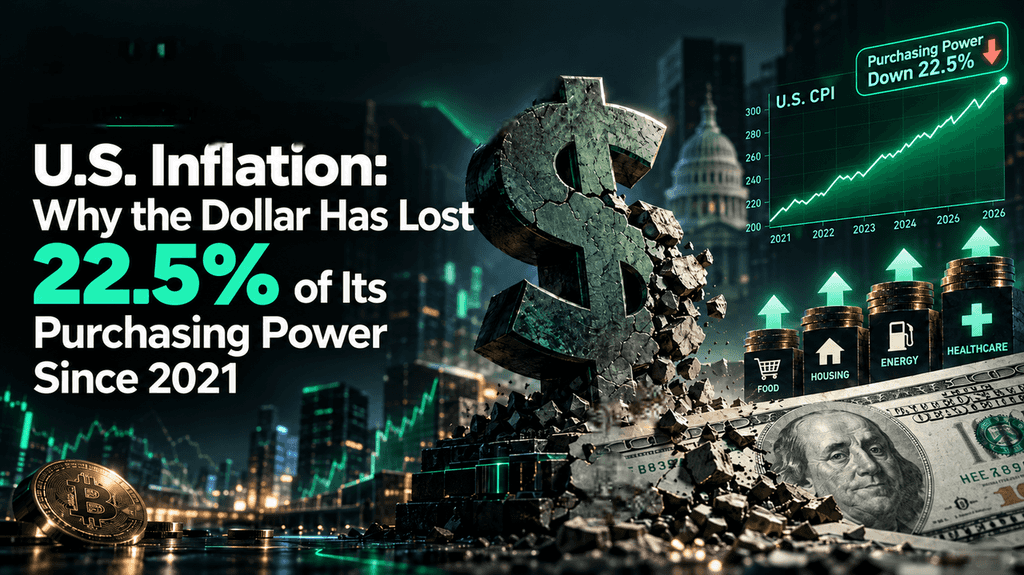
U.S. inflation has significantly reduced the dollar's purchasing power since 2021, leaving Americans paying considerably more for everyday goods and services. According to the Bureau of Labor Statistics (BLS), consumer prices increased approximately 28.8% between January 2021 and September 2026, equivalent to a 22.4% decline in the dollar's buying power. The latest Consumer Price Index (CPI) report, released on October 14, 2026, showed annual inflation accelerating to 3.7%, driven largely by higher energy prices. Although inflation has moderated from its 2022 peak, persistent housing expenses, production costs, and renewed energy pressures continue to affect household budgets, savings, wages, and financial markets.
Key Takeaways
-
U.S. dollar purchasing power: The dollar lost approximately 22.4% of its purchasing power between January 2021 and September 2026. A consumer basket costing $100 at the beginning of that period would cost approximately $128.81 by September 2026.
-
Inflation since 2021: U.S. inflation peaked at 9.1% in June 2022, driven partly by supply disruptions, strong consumer demand, and rising energy costs. Slower inflation in subsequent years did not reverse earlier consumer price increases.
-
September 2026 CPI data: Annual U.S. inflation accelerated to 3.7%, while monthly consumer prices increased 0.6%. Gasoline prices jumped 9.1% during September, accounting for more than half of the monthly headline CPI increase.
-
Impact on wages and savings: BLS data showed real average hourly earnings declined 0.7% between September 2025 and September 2026. Cash savings also lose purchasing power when their after-tax returns remain below inflation.
-
Financial markets and investments: Persistent inflation can influence Federal Reserve interest-rate decisions, Treasury yields, and stock valuations. Bitcoin's limited supply does not guarantee protection against inflation, as cryptocurrency prices remain sensitive to liquidity and market sentiment.
-
Federal Reserve inflation target: The Fed's official 2% inflation objective applies to the Personal Consumption Expenditures (PCE) price index, not CPI. Claims of 67 consecutive published monthly CPI readings above 2% require qualification because October 2025 headline CPI data were unavailable.
Why the U.S. Dollar Has Lost 22.4% of Its Purchasing Power Since 2021
The U.S. dollar has lost approximately 22.4% of its purchasing power since January 2021, reflecting the cumulative impact of rising consumer prices over more than five years. This means Americans need more dollars to purchase the same general basket of goods and services. Unlike annual inflation figures, which measure price changes over 12 months, cumulative inflation captures the combined increase across several years. The decline reflects the dollar's reduced buying power within the United States rather than a corresponding fall in its foreign-exchange value.
How the Consumer Price Index Measures the Dollar's Declining Purchasing Power
The U.S. Bureau of Labor Statistics (BLS) measures inflation through the Consumer Price Index (CPI), which tracks changes in consumer expenses, including housing, food, transportation, and healthcare. According to official BLS data, the CPI-U increased from 261.582 in January 2021 to 336.940 in September 2026, representing a 28.81% cumulative increase in consumer prices. This comparison uses the national, non-seasonally adjusted index to measure how the cost of a representative basket of goods and services has changed over time.
-
Cumulative inflation calculation: The percentage increase is calculated by comparing the starting and ending CPI values rather than adding annual inflation rates together.
-
Different household expenses: Actual inflation varies depending on spending habits, location, and housing arrangements. Households spending more on rapidly rising necessities may experience greater financial pressure.
-
Impact on purchasing power: A fixed amount of cash buys fewer goods and services as prices increase. Wage growth, employment income, and savings returns can influence how strongly inflation affects an individual's finances.
Why a 28.8% Increase in Consumer Prices Equals a 22.4% Purchasing-Power Loss
Although consumer prices increased nearly 29%, the dollar's purchasing power declined by approximately 22.4% because the two percentages use different starting values. Cumulative inflation measures how much prices increased relative to their earlier level, while purchasing-power loss measures how much less the same amount of money can purchase at the higher price level. This mathematical difference explains why the percentage increase in prices is greater than the corresponding percentage decline in the value of money. Both calculations must use the same starting and ending dates to produce an accurate comparison. Using the verified CPI figures, the relationship becomes clear through three calculations.
-
Consumer price increase: A basket of goods and services costing $100 in January 2021 would cost approximately $128.81 in September 2026, representing cumulative inflation of 28.81%.
-
Dollar purchasing-power decline: Dividing the January 2021 CPI of 261.582 by the September 2026 CPI of 336.940 gives approximately 0.7763, indicating a 22.37% loss in purchasing power.
-
Value of $100 over time: By September 2026, $100 could purchase approximately the same amount of goods and services that $77.63 could buy in January 2021, illustrating the cumulative erosion of the dollar's domestic buying power.
U.S. Inflation From 2021 to 2026 and the Key Factors Driving Higher Consumer Prices
U.S. inflation between 2021 and 2026 developed through several economic shocks that pushed consumer prices higher across different industries. Pandemic-related supply disruptions, strong consumer demand, rising energy costs, and persistent housing expenses contributed to the initial surge. Although inflation moderated after reaching its 2022 peak, new pressures emerged from trade policies, geopolitical conflicts, and higher production costs. Understanding these developments helps explain why the cost of living remains elevated despite periods of slower inflation and why price pressures continue to influence the broader U.S. economy.
Pandemic Supply Disruptions and Strong Consumer Demand Fueled the 2021–2022 Inflation Surge
The initial acceleration in U.S. inflation followed the reopening of businesses and consumer markets after COVID-19 restrictions. Government stimulus payments, accumulated household savings, and increased consumer spending strengthened demand for goods while manufacturers struggled with production delays, labor shortages, and shipping disruptions. Limited supplies of vehicles, electronics, and household products made it difficult for businesses to meet demand without raising prices. Research from the Federal Reserve Bank of San Francisco found that both supply constraints and stronger demand contributed substantially to the inflation surge, although their relative influence changed throughout 2021 and 2022.
Inflation intensified in 2022 as Russia's invasion of Ukraine disrupted international energy and agricultural markets, adding pressure to transportation, fuel, and food costs. According to the Bureau of Labor Statistics, annual U.S. inflation reached 9.1% in June 2022, its highest rate since November 1981. Energy prices increased 41.6% year over year, while food prices rose 10.4%, showing how inflation had spread beyond pandemic-sensitive products. As global supply chains gradually recovered and consumer spending patterns normalized, some of these pressures eased, helping inflation decline from its peak without reversing the earlier increases in the overall price level.
Housing Costs, Service Inflation, and Trade Policies Sustained Consumer Price Pressures
Housing expenses became an important source of persistent inflation after the initial surge in goods prices began to moderate. Rental costs and owners' equivalent rent often adjust more slowly than prices for frequently purchased products because housing contracts are typically renewed over longer periods. Higher borrowing costs and limited housing affordability also affected households, although their relationship with measured shelter inflation is complex. Meanwhile, businesses in service industries continued adjusting prices in response to operating expenses, labor costs, and changing customer demand. These developments helped sustain core inflation, which excludes the more volatile food and energy categories, even as some pandemic-related supply problems subsided.
Trade policies introduced another source of price pressure during 2025 and 2026. Import tariffs can increase costs for businesses purchasing foreign-made products, components, and raw materials, although companies may absorb part of these expenses rather than pass them entirely to consumers. In an April 2026 Federal Reserve analysis, researchers estimated that tariffs implemented through November 2025 had raised core goods Personal Consumption Expenditures (PCE) prices by approximately 3.1% through February 2026. The estimate applies to core goods within the PCE index rather than the overall CPI. Together with energy-related supply shocks and continued spending, these pressures complicated efforts to achieve a sustained decline in inflation. However, their effects varied across industries and did not necessarily produce uniform increases in consumer prices.
September 2026 CPI Data Reveals Renewed Energy Inflation and Persistent Living Costs
The latest available Consumer Price Index report showed that annual U.S. inflation accelerated to 3.7% in September 2026, compared with 3.4% in August, while consumer prices increased 0.6% during the month. According to the October 14 BLS report, gasoline prices climbed 9.1% on a seasonally adjusted monthly basis, accounting for more than half of the increase in headline inflation. Energy-market disruptions associated with geopolitical tensions contributed to higher fuel costs, while tariffs remained another source of pressure on goods prices. Federal Reserve Bank of San Francisco research also identified inflation in selected consumer technology products linked to AI infrastructure demand, although broader effects on overall inflation remained limited. Three additional indicators help explain the latest consumer-price trends.
-
Housing and shelter inflation: Shelter costs increased 0.4% in September and 3.2% over the previous 12 months. Rising rental and housing-related expenses remained an important component of consumer inflation, particularly because shelter carries substantial weight in the CPI.
-
Food and everyday expenses: Overall food prices were unchanged during September but remained 2.5% higher than a year earlier. Grocery prices increased 1.8% annually, while food purchased away from home rose 3.5%, illustrating the different inflation pressures facing households depending on their spending habits.
-
Underlying consumer price pressures: Core CPI increased 0.3% during September and 2.6% year over year, showing that inflation extended beyond volatile energy markets. Price increases in recreation, education, airline fares, and selected consumer goods contributed to continued underlying inflation, even though some categories recorded monthly declines.
Additional evidence of producer-level inflation emerged on October 15, when the BLS reported that the Producer Price Index increased 1.3% in September and 6.3% annually. Final-demand energy prices rose 10.8% during the month, contributing significantly to the overall increase. Higher producer costs can eventually affect consumer prices when businesses pass expenses along, but the timing and extent of that transmission remain uncertain. The figures indicate continued upstream price pressures rather than confirming that consumer inflation will accelerate in the coming months.
Impact of Declining Dollar Purchasing Power on Savings, Wages, Investments, and the U.S. Economy
The decline in U.S. dollar purchasing power since 2021 has affected household finances, investment decisions, and broader economic activity. Higher living costs can reduce the amount families save, while inflation changes the real value of wages, investment returns, and outstanding debt. For investors, persistent price pressures also influence interest-rate expectations, asset valuations, and cryptocurrency market prices and trading activity. The financial consequences depend on how quickly incomes and investment returns adjust to changing economic conditions.
How Inflation Reduces the Real Value of Cash Savings and Bank Deposits
Inflation gradually reduces the purchasing power of money held in cash or low-interest savings accounts, particularly when deposit rates remain below consumer-price inflation. Although the nominal balance in a bank account may increase through interest payments, its inflation-adjusted value can still decline. For example, a savings account earning 3% annually would lose purchasing power if inflation remained at 3.7% over the same period. This difference highlights the importance of real returns, which measure investment or savings performance after accounting for inflation. Households holding substantial cash reserves may therefore face challenges preserving their long-term purchasing power, even when their account balances remain stable.
Several factors determine how strongly inflation affects personal savings:
-
Savings account interest rates: High-yield savings accounts and certificates of deposit may offer higher nominal returns than traditional accounts, although their ability to preserve purchasing power depends on prevailing inflation and applicable taxes.
-
Emergency fund requirements: Maintaining accessible cash remains important for unexpected expenses, even when inflation reduces its real value. Longer-term savings decisions involve a different balance between liquidity, risk, and potential returns.
-
Tax treatment of savings income: Interest earnings may be subject to income taxes, reducing the effective return available to savers. After-tax returns can therefore differ considerably from advertised deposit rates.
Impact of Rising Consumer Prices on Real Wages and Household Purchasing Power
The relationship between wages and inflation determines whether workers can maintain their standard of living. Nominal wages represent the amount employees receive before adjusting for price changes, while real wages measure their purchasing power. Real average hourly earnings for private-sector employees declined 0.7% between September 2025 and September 2026, despite an increase in nominal pay. Real average weekly earnings also decreased 0.1% over the same period. These figures indicate that recent price increases outpaced average earnings growth, although the experience varied across occupations, industries, and individual households.
Lower real earnings can create financial pressure when families must allocate more of their income toward essential expenses, leaving less available for discretionary purchases and long-term financial goals. Workers receiving salary increases below inflation may experience a decline in purchasing power even when their paychecks become larger. The effects can be particularly challenging for households with limited financial reserves, fixed incomes, or substantial debt obligations. However, workers whose earnings rise faster than inflation may maintain or improve their purchasing power, making income growth an important factor in assessing the economic consequences of higher prices.
Effects of Persistent U.S. Inflation on Stocks, Bonds, and Bitcoin Investments
Inflation influences financial markets through changes in borrowing costs, corporate profitability, and investor expectations. When inflation remains elevated, investors may anticipate tighter monetary policy or higher interest rates for longer periods, which can affect the valuation of financial assets. The relationship is not uniform because different investments respond to inflation according to their underlying characteristics, income potential, and sensitivity to economic conditions. This is also relevant when assessing inflation-hedged cryptocurrency assets, whose ability to preserve purchasing power can vary across market conditions. Understanding these differences helps investors assess inflation-adjusted investment returns rather than focusing exclusively on nominal price movements.
-
U.S. stocks: Higher operating costs can reduce corporate profit margins when businesses cannot fully pass expenses to customers. Companies with stronger pricing power may be better positioned to protect earnings, while higher interest rates can reduce the present value of expected future profits, particularly for growth-oriented stocks.
-
Treasury bonds and fixed-income investments: Inflation reduces the real purchasing power of fixed coupon payments. Rising market yields can also push existing bond prices lower, creating risks for investors who sell before maturity. Treasury Inflation-Protected Securities (TIPS) offer principal adjustments linked to CPI inflation, although their market prices remain sensitive to interest-rate changes.
-
Bitcoin and cryptocurrency markets: Bitcoin's fixed supply of 21 million coins is sometimes presented as a potential defense against currency depreciation. However, Bitcoin is not a consistently reliable short-term inflation hedge, as its market price and performance also respond to market liquidity, real interest rates, regulatory developments, and investor sentiment. Higher inflation may increase interest in alternative assets, but tighter financial conditions can simultaneously reduce demand for risk-sensitive cryptocurrencies.
How Declining Dollar Purchasing Power Influences U.S. Economic Growth and Federal Reserve Policy
Persistent inflation can affect the U.S. economy by changing consumer spending patterns, business investment decisions, and the cost of borrowing. When household purchasing power weakens, consumers may reduce discretionary spending, potentially affecting businesses that depend on nonessential purchases. Companies also face uncertainty when planning wages, inventories, and capital expenditures under changing cost conditions. The Federal Reserve attempts to manage inflation through monetary policy, but higher interest rates can also restrain credit demand, housing activity, and economic growth. Policymakers must therefore assess price stability alongside employment conditions and broader financial risks. The Fed's official 2% inflation objective applies to the PCE price index rather than CPI, making both measures relevant but not interchangeable when assessing monetary policy. Looking ahead, inflation expectations, labor-market developments, energy costs, and consumer demand could influence the direction of interest rates. A sustained improvement in purchasing power would depend partly on wages and other income growing faster than consumer prices, rather than necessarily requiring prices to return to their earlier levels.
Conclusion
U.S. inflation since 2021 has substantially reduced the dollar's purchasing power, with cumulative consumer price increases leaving households facing higher costs across essential goods and services. Official CPI data show that the dollar lost approximately 22.4% of its domestic buying power between January 2021 and September 2026, while renewed energy inflation and persistent service costs continue to complicate the economic outlook.
For consumers and investors, the main concern is whether income growth and investment returns can keep pace with inflation. Future developments in Federal Reserve policy, energy markets, labor conditions, and consumer demand will influence the inflation outlook. However, even a sustained decline in annual inflation would not automatically reverse the price increases accumulated since 2021. Preserving purchasing power therefore remains an important consideration for household financial planning and long-term investment decisions.
🔥 Beyond the Headlines: What KuCoin 5.0 Means for You
Market news moves fast — but where you act on it matters just as much. This October, KuCoin launches KuCoin 5.0, transforming KuCoin into a rebuilt platform. Here's what actually changes for you:
-
One account for everything. Older platforms split your money across separate "spot," "margin," and "futures" accounts and expected you to understand why. KuCoin 5.0's unified account removes that entirely — deposit once, and everything is simply there (only available to VIPs for now).
-
Stocks, indices, and commodities. KuCoin 5.0 expands beyond crypto into global markets. When crypto chops sideways and equities rally (or the reverse), you rotate in minutes instead of opening a brokerage account and waiting days for fiat rails.
-
Real-world assets (RWA). Tokenized exposure to traditional assets like commodities, right inside your crypto account. One of the fastest-growing segments in global finance is no longer reserved for institutions — you access it from the same balance you trade with.
-
Earn while you learn. Not ready to trade? KCUSD lets your stablecoins earn daily, auto-compounding interest. The lowest-stress way to put your idle deposit to work for 4% yield.
-
An AI assistant in plain language. Ask questions, get market context, understand what you're looking at — built into the platform, no jargon required.
-
An app that doesn't overwhelm. Faster, cleaner, and consistent — intuitive from the first tap, not after a tutorial.
-
Safety you can check, not just trust. A MiCAR-licensed EU entity, Proof of Reserves you can verify yourself, and internationally certified security (SOC 2 Type II, ISO 27001:2022).
Create your account in minutes — and start on the platform built for where crypto is going, not where it's been.
FAQs
What Is the Difference Between CPI Inflation and PCE Inflation?
The Consumer Price Index (CPI) measures price changes for goods and services purchased by urban consumers, while the Personal Consumption Expenditures (PCE) Price Index covers a broader range of household spending. The Federal Reserve uses PCE for its official 2% inflation target because it better accounts for changes in consumer spending patterns and includes certain expenses paid on behalf of households.
Can the U.S. Dollar Strengthen While Losing Purchasing Power?
Yes. The U.S. dollar can strengthen against foreign currencies while losing purchasing power domestically. Exchange rates reflect factors such as interest-rate differences, international investment flows, and economic expectations. Domestic purchasing power depends on U.S. consumer prices, so a stronger exchange rate does not necessarily mean Americans can purchase more goods and services at home.
What Is the Base Effect in U.S. Inflation Data?
The base effect occurs when unusually high or low prices from the previous year influence the annual inflation comparison. For example, if gasoline prices surged 12 months earlier, the annual inflation rate could decline as that earlier increase drops out of the comparison. This statistical change does not necessarily indicate that current prices are falling.
Does the Consumer Price Index Include Home Prices and Mortgage Payments?
The CPI does not directly include home purchase prices, mortgage principal payments, or mortgage interest as consumer expenses. Instead, it measures housing consumption through rent and owners' equivalent rent, which estimates the rental value of owner-occupied housing. Consequently, changes in property prices and mortgage rates may not immediately appear in measured shelter inflation.
Disclaimer
The information provided on this page may originate from third-party sources and does not necessarily represent the views or opinions of KuCoin. This content is intended solely for general informational purposes and should not be considered financial, investment, or professional advice. KuCoin does not guarantee the accuracy, completeness, or reliability of the information, and is not responsible for any errors, omissions, or outcomes resulting from its use. Investing in digital assets carries inherent risks. Please carefully evaluate your risk tolerance and financial situation before making any investment decisions. For further details, please consult KuCoin’s Terms of Use and Risk Disclosure.