

Trump Accounts Bought Strategy (MSTR) Near 2026 Lows as Shares Rebound Around 80%
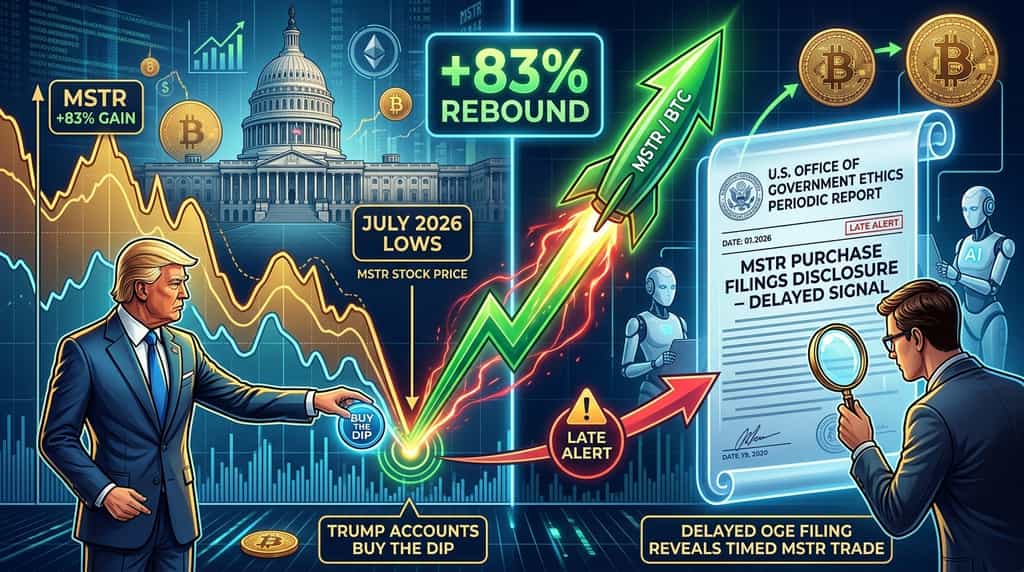
Can a late-summer ethics filing change how traders look at a Bitcoin treasury stock? Accounts listed under President Donald Trump bought Strategy Inc. (NASDAQ: MSTR) on July 24 and July 27, 2026, near the stock's 2026 lows, according to a U.S. Office of Government Ethics periodic transaction report posted on September 22. Strategy closed at $91.67 on July 24 and at $167.33 on September 22, an advance of about 83%. The White House has said third-party managers run the accounts on a discretionary basis and that Trump does not place the trades.
The filing shows two new July purchases of Strategy Class A shares after an earlier sale that month. According to the Office of Government Ethics Form 278-T posted on September 22, the accounts sold $1,001 to $15,000 of Strategy stock on July 8, bought $1,001 to $15,000 on July 24, and bought $50,001 to $100,000 on July 27.
The form reports dollar ranges, not share counts or exact fill prices. Bitcoin Treasuries summarized the same three July Strategy lines and noted that the July 24 and July 27 buys were new trades from a later reporting window, not restatements of earlier filings.
The 37-page July report lists 1,156 securities transactions. Strategy is only a small slice of that activity. The same document also records large sales in other names, including $5 million to $25 million each of Microsoft and Amazon stock on July 20, according to coverage that cites the OGE ranges.
This is not the first Strategy appearance in 2026 disclosures. A May 278-T covering January through March listed eight Strategy Class A trades. The largest buy in that window was February 12 in the $50,001 to $100,000 band. An August 22 filing showed June 23 and June 24 sales totaling $16,002 to $65,000 and no June purchases.
MSTR rose about 83% from the July 24 close to the September 22 close. According to StockAnalysis historical prices, Strategy closed at $91.67 on July 24 and at $167.33 on September 22. The larger July 27 purchase came when the stock closed at $98.65, leaving that ticket up roughly 70% by September 22.
The data for September 23 shows MSTR closed at $162.20, down 3.07% on the day, with a 52-week range of $81.81 to $365.21. The 52-week low of $81.81 sits close to the summer trough that preceded the late-July buys.
Price action after the buys was not a straight line. The stock remained under pressure into August, then accelerated in September as Bitcoin recovered and Strategy resumed treasury purchases. September 18 and September 21 sessions posted large percentage gains, according to StockAnalysis daily closes of $153.92 and $168.50.
The 83% figure tracks the July 24 close to September 22 close. Using the September 23 close of $162.20 trims the gain from July 24 to about 77%. Either way, the rebound from the summer low is the market fact that made the delayed ethics filing a headline.
The available record does not show that Trump personally selected the July 24 or July 27 tickets. The White House has said the stock and bond book sits in discretionary accounts managed by third-party firms and that neither Trump nor his family directs individual trades.
OGE rules still require disclosure because Trump is the beneficiary. That legal design creates a public paper trail without proving personal order placement. The July form lists 1,156 trades, a volume consistent with model portfolios and professional managers rather than a handful of discretionary bets.
The same accounts sold Strategy in June and on July 8 before buying later in July. That sequence looks more like rebalancing than a single one-way conviction trade. Earlier 2026 filings already showed both buys and sells in Strategy Class A shares.
Political scrutiny still follows any crypto-linked holding in a presidential disclosure. Lawmakers have previously asked whether personal finance disclosures create conflicts with official digital-asset policy. The filing itself does not answer that question. It only records ranges, dates, and asset names.
Traders should separate three facts: the accounts bought MSTR near the summer low, the stock later rallied with Bitcoin, and the managers — not a documented personal order ticket — executed the trades.
The July window included more than Strategy. Accounts also bought Coinbase shares and sold Bitcoin miners MARA Holdings and CleanSpark, according to summaries of the same OGE report. The July 27 Strategy purchase was the largest crypto-linked ticket identified in that filing.
June activity leaned the other way. An earlier periodic report showed Strategy sales on June 23 and June 24 totaling $16,002 to $65,000, plus Coinbase sales and a Coinbase purchase later that month. Robinhood appeared as a small June buy.
First-quarter filings already showed Coinbase, Strategy, and MARA activity. The largest Coinbase purchase in that earlier window was February 10 in the $100,001 to $250,000 range. Strategy's largest Q1 buy was February 12 in the $50,001 to $100,000 range — the same band as the July 27 ticket.
These names give different Bitcoin exposure. Strategy is a treasury compounder. Coinbase is an exchange and infrastructure business. MARA and CleanSpark are miners with hash-rate, power, and production risk. Mixing buys and sells across that set is consistent with a diversified book, not a single-theme bet.
None of the filings publish a running share balance. Readers can see tickets, not a current position size. That gap matters. A $50,001 to $100,000 buy can add to a leftover long, cover a prior sale, or sit inside a model sleeve that later sells again.
Political trade alerts are lagged signals, not live order flow. OGE Form 278-T reports arrive weeks after execution. The July Strategy buys became public on September 22, after most of the 83% move from the July 24 close had already printed.
The forms use ranges. A $50,001 to $100,000 line can mean very different share counts depending on the print that day. They also omit strategy notes, stop levels, and whether a ticket sits in an index-tracking sleeve.
Copying a disclosure after publication is buying the news, not the original fill. By September 23, MSTR had already pulled back to $162.20 from the September 22 close of $167.33, according to Yahoo Finance.
The useful research question is why Strategy was cheap in July, not who the beneficiary of the account is. The stock was near its 52-week low of $81.81 while the company paused BTC purchases and issued equity. The later rally tracked Bitcoin's rebound and a return to treasury buying of 950 BTC.
Risk remains two-sided. Yahoo Finance shows a 52-week high of $365.21, which means the stock is still far below last year's peak even after the summer rebound. High beta, dilution, preferred-stock structure, and Bitcoin drawdowns can reverse an 83% bounce as quickly as they created it.
Market news moves fast — but where you act on it matters just as much. This October, KuCoin launches KuCoin 5.0, transforming KuCoin into a rebuilt platform. Here's what actually changes for you:
-
One account for everything. Older platforms split your money across separate "spot," "margin," and "futures" accounts and expected you to understand why. KuCoin 5.0's unified account removes that entirely — deposit once, and everything is simply there (only available to VIPs for now).
-
Stocks, indices, and commodities. KuCoin 5.0 expands beyond crypto into global markets. When crypto chops sideways and equities rally (or the reverse), you rotate in minutes instead of opening a brokerage account and waiting days for fiat rails.
-
Real-world assets (RWA). Tokenized exposure to traditional assets like commodities, right inside your crypto account. One of the fastest-growing segments in global finance is no longer reserved for institutions — you access it from the same balance you trade with.
-
Earn while you learn. Not ready to trade? KCUSD lets your stablecoins earn daily, auto-compounding interest. The lowest-stress way to put your idle deposit to work for 4% yield.
-
An AI assistant in plain language. Ask questions, get market context, understand what you're looking at — built into the platform, no jargon required.
-
An app that doesn't overwhelm. Faster, cleaner, and consistent — intuitive from the first tap, not after a tutorial.
-
Safety you can check, not just trust. A MiCAR-licensed EU entity, Proof of Reserves you can verify yourself, and internationally certified security (SOC 2 Type II, ISO 27001:2022).
Create your account in minutes — and start on the platform built for where crypto is going, not where it's been.
Accounts disclosed under President Trump bought Strategy stock on July 24 and July 27 near 2026 lows, according to the Office of Government Ethics Form 278-T posted on September 22. The July 24 close of $91.67 and the September 22 close of $167.33 produced an 83% gain on StockAnalysis data, while the July 27 close of $98.65 left that larger $50,001 to $100,000 ticket up about 70% by the same date.
The White House says discretionary managers placed the trades. The same accounts sold Strategy in June and on July 8, and earlier 2026 filings already showed both buys and sells. Strategy remains the largest public corporate Bitcoin holder, with 846,000 BTC as of September 21 according to Bitcoin Treasuries, and it added 950 BTC in mid-September.
MSTR is a high-beta Bitcoin proxy, not a substitute for spot crypto. Yahoo Finance's September 23 close of $162.20 and 52-week range of $81.81 to $365.21 show both the rebound and the remaining distance from prior highs. Political disclosures arrive late, use ranges, and do not prove personal timing. Traders following Bitcoin treasury themes should focus on BTC holdings, issuance, and volatility — then decide whether equity, spot Bitcoin, or listed crypto products fit their risk limits.
Did the ethics filing publish Trump's exact MSTR share count?
No. OGE Form 278-T reports value ranges only, such as $1,001 to $15,000 and $50,001 to $100,000, without share totals or a running position.
Was July 24 the exact 2026 low for MSTR?
No. Yahoo Finance lists a 52-week low of $81.81. July 24's $91.67 close was near that summer trough, not the printed low.
Does an 83% bounce mean the Strategy trade is still open?
Unknown. Filings show tickets, not whether managers later sold the shares after September 22.
Why do analysts still treat MSTR as a Bitcoin trade?
Because Strategy holds 846,000 BTC, according to Bitcoin Treasuries data as of September 21, so the equity usually tracks BTC with added corporate leverage.
Can users get similar exposure without buying the Nasdaq stock?
Yes. Spot Bitcoin and BTC derivatives on platforms such as KuCoin express the same underlying asset that drives most of Strategy's price variance.
Disclaimer: This article is for informational purposes only and does not constitute financial, legal, or investment advice. Always conduct your own research before interacting with digital assets.