

ZetaChain's ZETA-to-Solana Migration: 55M Token Burn and November 2026 Governance Vote Explained
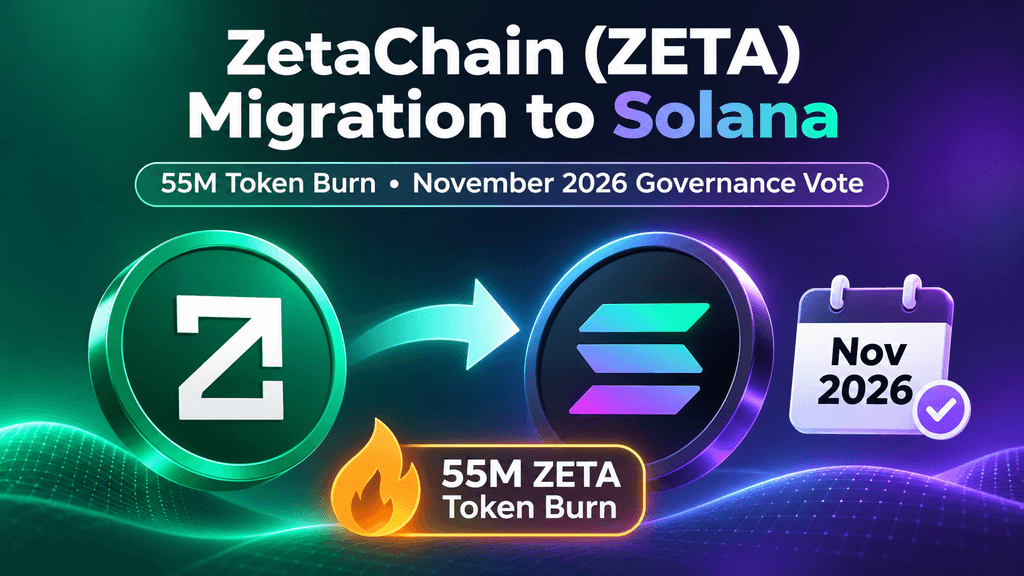
ZetaChain's proposed ZETA-to-Solana migration could fundamentally change the project's blockchain infrastructure, token supply, and future development strategy. Following an initial governance approval in September 2026, ZetaChain introduced a second proposal on November 4 to finalize the migration process, targeting December 9, 2026, for its Layer 1 shutdown. The plan includes a 1:1 conversion of native ZETA to Solana, a proposed burn of approximately 55 million undistributed tokens throughout 2027, and a shift toward AI-powered services through ZetaLabs. However, implementation remains conditional on the November 7 governance vote and completion of the required security review.
Key Takeaways
-
ZetaChain's proposed Solana migration targets December 9, 2026, subject to the November governance vote and completion of security reviews.
-
ZetaChain plans to retire its Layer 1 blockchain and shift development toward ZetaLabs, a Solana-based platform focused on private AI applications.
-
Approximately 55 million ZETA tokens from undistributed validator rewards could be burned throughout 2027, reducing the planned supply without guaranteeing price appreciation.
-
Native ZETA would convert to Solana at a 1:1 ratio, with eligible balances recorded through a blockchain snapshot before the network shutdown.
-
ZETA holder requirements vary across self-custody wallets, staking positions, exchanges, and wrapped assets, with different eligibility conditions and claim procedures.
-
ZETA's future market outlook remains uncertain, influenced by migration execution, trading liquidity, token supply changes, ZetaLabs adoption, and broader cryptocurrency market conditions.
ZetaChain's ZETA-to-Solana Migration and November 2026 Governance Vote Explained
ZetaChain is preparing to migrate its native ZETA token to the Solana blockchain as part of a broader restructuring of its network and token ecosystem. Under the proposed plan, ZETA would become a Solana SPL token at a 1:1 conversion ratio, while ZetaChain's existing Layer 1 blockchain would permanently shut down. The migration is targeted for December 9, 2026, subject to governance approval and completion of the required security review. The transition would also end the network's validator rewards and introduce a revised token supply model, including a proposed burn of approximately 55 million undistributed ZETA tokens throughout 2027.
The migration follows an earlier governance decision in which ZETA holders supported moving away from the project's independent blockchain infrastructure. On September 20, 2026, Proposal 68 passed with 99.44% support, establishing the strategic direction for the transition. However, that approval did not finalize the migration process. A second governance proposal, submitted on November 4, outlines the technical implementation, token conversion mechanism, network shutdown procedures, and protections for existing holders. This proposed 1:1 conversion is a form of cryptocurrency token swap, in which a project's token representation changes as it transitions between blockchain networks.
What the November 2026 ZetaChain Governance Vote Would Approve
ZetaChain's second governance vote, recorded on-chain as Proposal 70, runs from November 4 to November 7, 2026, with voting scheduled to close at 16:12:51 UTC. The proposal requires a 40% participation quorum and more than 50% approval, subject to its veto rules. A successful vote would authorize the network snapshot at block 20,755,000, the permanent shutdown of ZetaChain's Layer 1, and the distribution of equivalent ZETA balances on Solana. It would also approve the proposed monthly token burns, validator wind-down arrangements, and migration protections.
If approved, ZetaChain would implement the migration using a recorded snapshot of eligible balances rather than a third-party token bridge. The Foundation would mint the corresponding ZETA supply on Solana and revoke the mint authority after completing the allocation. If the proposal fails, the September decision to pursue migration would remain valid, but ZetaChain would need to submit revised implementation terms for another governance vote. As of November 6, 2026, the second vote remains pending, making its outcome the immediate milestone for the project's transition.
Why ZetaChain Plans to Shut Down Its Layer 1 Network and Shift to Solana-Based ZetaLabs
Why ZetaChain Is Retiring Its Cosmos SDK Layer 1 Blockchain
ZetaChain's decision to retire its independent Layer 1 blockchain reflects a strategic shift from cross-chain interoperability infrastructure toward consumer-focused artificial intelligence applications. Originally developed to connect blockchain networks, ZetaChain used its Cosmos SDK-based architecture to support smart contracts interacting with assets across networks such as Bitcoin, Ethereum, and Solana. However, maintaining a dedicated blockchain requires ongoing validator coordination, security updates, and infrastructure resources. ZetaChain's development team argues that these responsibilities are no longer essential to its primary product strategy, making an established blockchain a more practical foundation for its next phase.
The move would allow ZetaChain to concentrate development resources on private AI services instead of maintaining independent blockchain consensus and validator operations. Solana offers an existing ecosystem of wallets, decentralized applications, payment infrastructure, and blockchain-based tools that ZetaChain intends to use. This approach could reduce the project's direct infrastructure responsibilities while providing access to an established blockchain ecosystem. However, the transition also increases ZetaChain's dependence on Solana's network performance and infrastructure, making technical reliability and successful product development important considerations.
How Solana-Based ZetaLabs Will Expand Private AI Services and ZETA Token Utility
ZetaLabs represents ZetaChain's planned transition toward an AI application that combines multiple AI models, cryptocurrency market information, and user-controlled memory. Building on technology developed for Anuma Chat, the platform aims to let users access AI-powered research while keeping personal conversations and stored information encrypted under user-controlled keys. The proposed application includes market research covering cryptocurrencies, stocks, commodities, and other financial assets. ZetaChain plans to integrate live market data with AI-assisted analysis, allowing users to research financial markets through a unified interface. These privacy and functionality claims describe the project's intended design rather than independently established performance guarantees.
The shift also introduces a different role for the ZETA token. Instead of primarily supporting Layer 1 network operations, ZETA is intended to support ZetaLabs payments, premium access, and governance participation. The project's roadmap includes discounted AI usage payments with ZETA, token locking for ZetaLabs Premium, and voting on supported AI models and data sources. Additional features, including expanded market intelligence and research tools, are planned for the first quarter of 2027. These proposed changes also affect ZETA's tokenomics model, particularly the relationship between token utility, supply, and network incentives. Their longer-term significance will depend on product adoption and sustained user demand.
How the 55 Million ZETA Token Burn Could Change Supply, Inflation, and Tokenomics
ZetaChain's proposed migration to Solana includes a significant adjustment to ZETA's tokenomics, with approximately 55 million ZETA tokens scheduled for burning throughout 2027 if the November governance proposal passes. The tokens come from undistributed validator incentives originally reserved for securing the project's Layer 1 blockchain. Rather than releasing these rewards after network operations end, ZetaChain plans to permanently retire them through scheduled monthly burns. This form of token burning would reduce the total supply over time while preserving existing vesting arrangements.
Validator Incentives
ZetaChain originally allocated 210 million ZETA, representing 10% of its 2.1 billion maximum supply, to validator incentives. By October 26, 2026, approximately 148.3 million tokens had been emitted, with another 152,000 ZETA being issued daily. Based on projected emissions through the December 9 network shutdown, roughly 55 million tokens would remain undistributed. The exact amount will be determined at the migration snapshot. Previously earned staking rewards will remain credited to eligible holders, while future validator emissions will stop when the network shuts down.
Monthly Burn Schedule
The proposal calls for 12 monthly token burns between January and December 2027, averaging approximately 4.6 million ZETA per month. The Foundation would place the undistributed validator allocation in a dedicated Solana burn reserve and permanently destroy one-twelfth each month. Every completed transaction is expected to be publicly recorded and displayed through the ZETA Dashboard, allowing the reduction to be independently verified. The schedule follows the original pace of validator reward emissions rather than introducing an accelerated release pattern.
Supply and Inflation
Burning approximately 55 million ZETA would represent a 2.62% reduction relative to the original 2.1 billion maximum supply, leaving an indicative post-burn supply of around 2.045 billion tokens. However, this does not mean circulating supply would immediately decrease by the same percentage, because the proposed burn concerns undistributed rewards. ZetaChain also plans to eliminate the original 2.5% annual inflation mechanism scheduled to begin in the network's fourth year. Following the migration, the Solana-based ZETA token would have no continuing inflationary issuance, with its mint authority permanently revoked once the initial allocation is completed.
Vesting and Unlocks
Existing token vesting arrangements would remain unchanged despite the proposed supply reduction. The Purchasers and Advisors allocation of 336 million ZETA and the Core Contributors allocation of 472.5 million ZETA are scheduled to become fully unlocked on January 1, 2027. Separately, the ZetaChain Foundation has committed not to sell newly released tokens from specified Foundation-controlled allocations during 2027. These commitments could affect future token availability, but they do not prevent other holders from selling. Ultimately, ZETA's market performance will depend on trading liquidity, holder behavior, broader cryptocurrency conditions, and demand for its proposed Solana-based utility, rather than the token burn alone.
ZETA Migration Timeline, 1:1 Solana Conversion, and What Token Holders Need to Know
ZetaChain's proposed migration to Solana establishes a timeline for transferring native ZETA balances while protecting existing token ownership. If the November 2026 governance proposal passes, the migration will target December 9, 2026, when the existing blockchain is expected to stop processing transactions and eligible holders can begin claiming ZETA on Solana. The conversion will maintain a 1:1 ratio, meaning one native ZETA will correspond to one Solana-based ZETA, subject to the proposal's claim requirements. However, the process differs depending on whether tokens are held in personal wallets, staking positions, exchanges, or decentralized finance protocols.
Migration Timeline and 1:1 Conversion
The migration will use a blockchain snapshot at block 20,755,000, expected around December 9, 2026, to record eligible ZETA balances before the network shuts down. The ZetaChain Foundation plans to mint an equivalent supply of ZETA as a Solana SPL token with nine decimal places, rather than transferring assets through a third-party bridge. Once the allocation is completed and verified, the token's mint authority will be revoked. Eligible self-custody holders will be able to connect their original ZetaChain wallets through the official ZetaHub migration portal, sign a message specifying their Solana wallet address, and claim their recorded balances. The proposed claim process requires no migration fee or SOL balance, although each address must hold at least 10 ZETA at the snapshot. The portal is scheduled to open on December 9, subject to governance approval and completion of an independent security review.
Holder Requirements and Security
Staked ZETA, unbonding balances, and unclaimed staking rewards will be included in the migration snapshot, meaning holders do not need to unstake before the network shutdown. However, self-custody users must still complete the claim process to receive their Solana-based tokens. Exchange-held ZETA is expected to convert without individual holder action through participating platforms, with each exchange responsible for announcing its own schedule. Holders of wrapped ZETA or tokens deposited in liquidity pools would need to withdraw them to eligible personal wallets before the snapshot because contract-held balances cannot be claimed directly through individual wallet signatures. Separately, eligible ZRC-20 assets bridged into ZetaChain can be claimed on their original networks through a dedicated process, subject to a minimum value of $5 per token. Existing ERC-20 ZETA on Ethereum remains unaffected by the proposed native-token conversion.
Security remains an important consideration because token migrations can attract fraudulent websites and misleading token listings. ZetaChain has engaged Hacken to review the migration program and claim infrastructure, with the audit report and official Solana token address scheduled for publication before the portal opens. The project states that legitimate claims will require wallet signatures, not disclosure of wallet recovery phrases. The proposal does not specify a fixed claim deadline, and claims are designed to remain available after the original blockchain stops operating. Nevertheless, the December 9 schedule remains conditional on governance approval and the security review, making implementation updates important for holders.
ZETA Price Outlook, Migration Risks, and Key Developments to Watch in 2027
ZETA's price outlook will depend on how investors assess ZetaChain's transition to Solana, the project's changing token economics, and the commercial potential of its AI-focused ecosystem. The migration could introduce new opportunities for token utility and liquidity, but it also creates uncertainty surrounding implementation and future demand. The planned supply reduction alone does not guarantee price appreciation, particularly as cryptocurrency valuations remain sensitive to market sentiment, trading activity, and broader economic conditions.
ZETA Price and Market Outlook
ZETA traded near $0.0372 on November 6, 2026, with CoinGecko reporting approximately $63.4 million in market capitalization and $5.9 million in 24-hour trading volume at the time of retrieval. These are point-in-time observations, not continuous market quotes. Historical ZETA price movements and market capitalization provide additional context for evaluating the cryptocurrency's valuation alongside governance developments. However, short-term price movements cannot be attributed solely to the migration announcement without stronger evidence. Looking ahead, trading liquidity, investor confidence, exchange support, and demand for ZETA-based services could influence its valuation. While reduced future issuance may change long-term supply conditions, sustained price performance would also require meaningful demand and market participation.
Governance and Migration Risks
The immediate uncertainty is whether ZetaChain can complete its proposed transition on schedule. The November governance vote must satisfy its approval requirements, while the migration infrastructure remains subject to an independent security review. Technical complications, delays in distributing tokens, or inconsistent exchange conversion schedules could affect holder confidence. Moving to Solana also introduces greater reliance on that network's availability, transaction processing, and broader ecosystem infrastructure. Successful execution will require transparent verification of token allocations, secure claims, and reliable coordination with supported platforms. Any delays or unexpected technical problems could create additional uncertainty for the token's market outlook.
ZetaLabs Adoption and Token Demand
A longer-term factor for ZETA will be whether ZetaLabs attracts users who actively use its AI-powered financial research and privacy features. The project intends to connect token utility with paid services, premium access, and participation in product governance. However, the economic significance of these functions remains uncertain until the platform demonstrates sustained engagement and practical demand. ZetaLabs will also compete with established AI applications, cryptocurrency analytics services, and other blockchain-based tools. User retention, product reliability, competitive pricing, and the usefulness of ZETA payments will be more meaningful indicators of long-term adoption than the initial launch alone.
Key ZETA Catalysts in 2027
The first quarter of 2027 is expected to be an important development period, with ZetaChain targeting the introduction of ZetaLabs Premium, Lens transaction analysis, expanded market intelligence, and Zeta MCP integrations. These services are intended to extend the platform beyond basic AI conversations into more specialized financial research and external application connectivity. Investors can also monitor the project's public supply dashboard, execution of scheduled token burns, and actual uptake of token-based features throughout the year. The most useful measures of progress will include delivered functionality, active user engagement, and verifiable ecosystem activity. Whether these developments translate into sustained ZETA demand will remain uncertain, making execution and adoption more important than speculative price targets.
Conclusion
ZetaChain's proposed migration to Solana represents a substantial change in the project's blockchain infrastructure, token economics, and long-term direction. The November 2026 governance proposal would establish the conditions for retiring its independent Layer 1 network, converting native ZETA balances at a 1:1 ratio, and shifting development resources toward the AI-focused ZetaLabs ecosystem. The planned burn of approximately 55 million undistributed validator tokens throughout 2027 would also change the project's supply structure without guaranteeing any particular market outcome.
The immediate focus remains the November 7 governance decision and the proposed December 9 migration, both of which carry implementation and security considerations. Beyond the transition, ZETA's longer-term outlook will depend on successful execution, token utility, market liquidity, and whether ZetaLabs achieves sustained adoption. These factors will determine the practical significance of the migration beyond its initial technical and tokenomics changes.
FAQs
1. Is there a deadline to claim ZETA tokens after the Solana migration?
ZetaChain has not announced a final claim deadline. The proposed migration portal is scheduled to open on December 9, 2026, subject to governance approval. Claims will use recorded blockchain balances, allowing eligible holders to access their tokens even after the original network shuts down. Any future changes to claim availability would be communicated through official ZetaChain announcements.
2. What happens if a wallet holds fewer than 10 ZETA tokens?
Individual ZetaChain addresses holding fewer than 10 ZETA at the migration snapshot will not qualify for direct claims. The minimum applies separately to each address, rather than combining balances across multiple wallets. Consolidating eligible balances before the snapshot may affect eligibility, although transaction costs and custody risks remain relevant considerations.
3. Can multisignature wallets and institutional custodians migrate ZETA?
Yes. The governance proposal includes migration arrangements for multisignature wallets and exchange-managed custody addresses. These holders can use the standard claim process where compatible or coordinate a manual claim to a designated Solana token account when required. Specific procedures may vary depending on the wallet configuration and custody provider.
4. Will ZetaChain transaction history remain accessible after the shutdown?
Yes. ZetaChain plans to keep its ZetaScan blockchain explorer available and provide a read-only archive node through at least October 31, 2027. The project also intends to publish the migration snapshot and verification data. These records can support historical transaction reviews, balance verification, and documentation for accounting or tax reporting.
5. Can migrated ZETA tokens return to the original ZetaChain network?
No. The proposed migration is a one-way transition because the original ZetaChain Layer 1 will permanently stop processing transactions. Once native ZETA balances are represented on Solana, they cannot be transferred back to the retired blockchain. Any subsequent movement between Solana and other supported networks would depend on separately available interoperability services.
6. Will the ZETA-to-Solana migration create a taxable event?
The tax treatment of a ZETA token migration depends on the holder's jurisdiction, ownership circumstances, and applicable cryptocurrency tax rules. A 1:1 conversion does not automatically establish that the transaction is tax-free everywhere. Original acquisition records, migration confirmations, and transaction history may be relevant when determining reporting obligations under local tax regulations.