

WTO: Stablecoins Are Only 3% of Global Payments — Fragmented Regulation Is the Real Bottleneck
For decades, international trade has relied on correspondent banking networks, which often involve multiple intermediary balance sheets, differing time zones, manual reconciliation processes, and multi-day settlement cycles.
Against this backdrop, fiat-pegged stablecoins, such as USDT, USDC, and newly emerging bank- and fintech-issued tokens, have experienced widespread adoption across decentralized finance and peer-to-peer corridors. Between 2020 and mid-2024, global cross-border stablecoin transaction volume expanded by 35-fold, driven by demand for dollar liquidity and near-instant settlement.
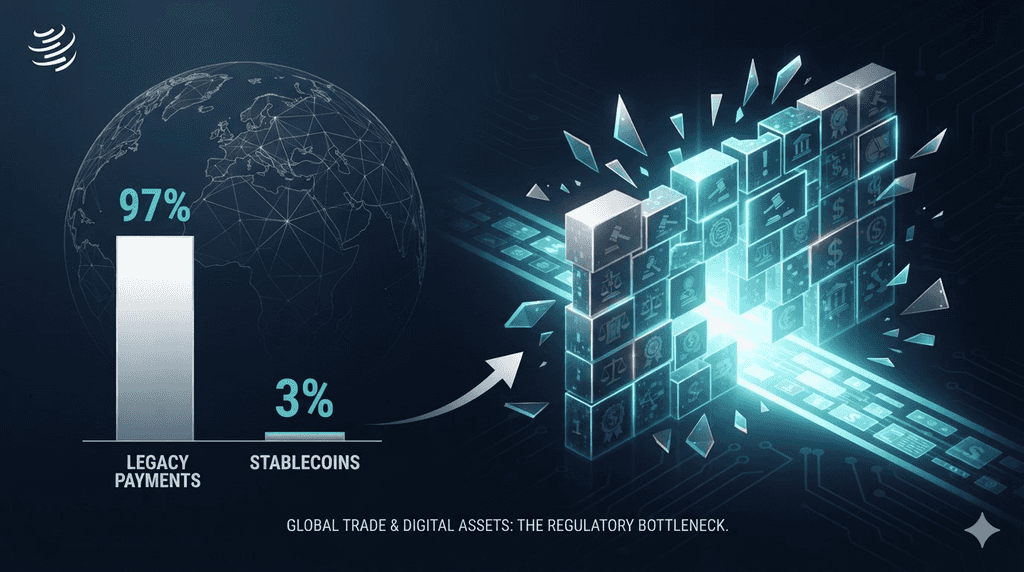
However, an empirical assessment published by the World Trade Organization (WTO) during World Trade and Technology Day on September 14, 2026, presents a stark contrast: stablecoins represent merely 3% of total global payments.
According to the findings, the primary barrier preventing digital dollars from moving beyond speculative trading and remittance niches into enterprise supply chains is not blockchain scalability, network gas fees, or smart contract performance. The principal obstacle is global regulatory fragmentation. Without harmonized legal standards across trading jurisdictions, stablecoins will continue to operate as an underutilized settlement mechanism in global commerce.
Key Takeaways
-
A study from the World Trade Organization (WTO) shows that while cross-border stablecoin transfer volumes grew 35-fold between 2020 and mid-2024, stablecoins still account for only approximately 3% of total global international payments.
-
The WTO identified regulatory fragmentation, rather than technical throughput or blockchain latency, as the leading impediment to widespread commercial adoption in cross-border trade.
-
Citing assessments from the Financial Stability Board (FSB), only 11 out of 28 major surveyed jurisdictions (roughly 39%) have implemented comprehensive regulatory regimes for stablecoins, leaving cross-border merchants exposed to legal and jurisdictional uncertainty.
-
The report confirms that stablecoins possess the technical capacity to mitigate five longstanding inefficiencies in legacy international trade: transaction costs, settlement speed, access disparities, operational opacity, and foreign exchange (FX) bottlenecks.
The discrepancy between stablecoin issuance metrics and real-world commercial trade adoption highlights the current state of blockchain-based payment infrastructure.
The 35-Fold Growth Cycle
Between early 2020 and the middle of 2024, cumulative cross-border transaction volumes settled via dollar-pegged stablecoins multiplied by 35 times. This period saw aggregate stablecoin circulating supply expand from roughly $20 billion to well over $160 billion, with annual settlement throughput reaching multiple trillions of dollars.
Much of this transactional velocity was driven by specific market segments:
-
Offshore Capital Movement: Entities moving liquidity across regional digital asset exchanges without exposure to traditional banking delays or wire cut-off times.
-
Emerging Market Capital Preservation: Businesses and individuals in high-inflation jurisdictions utilizing digital dollars to hedge local currency devaluation.
-
Peer-to-Peer (P2P) Remittances: Small-scale, non-merchandise remittances along bilateral corridors, particularly in Latin America, Southeast Asia, and Sub-Saharan Africa.
The 3% Market Reality
Despite these headline figures, the WTO study clarifies that stablecoins account for only 3% of aggregate international payment flows. Traditional banking networks and interbank clearing systems, such as SWIFT, Fedwire, and CHIPS, continue to handle the remaining 97% of total cross-border transactional value.
The reason for this divergence lies in the underlying nature of stablecoin volume. The vast majority of recorded on-chain stablecoin transactions reflect inter-exchange arbitrage, automated market maker (AMM) rebalancing, algorithmic trading, and decentralized lending collateral management. True commercial payments, involving invoice settlements, bill-of-lading escrows, multinational payroll, and wholesale corporate treasury management, make up only a small fraction of observed on-chain activity.
How Stablecoins Address the 5 Key Frictions in International Trade
While the WTO report underscores current market limitations, it does not dismiss the underlying technology. On the contrary, the study highlights that stablecoins are technically equipped to address the five most persistent structural frictions in cross-border commerce.
Cost Reduction
Traditional international wire transfers incur charges across multiple intermediaries. A single business-to-business (B2B) payment through correspondent banks typically accumulates receiving bank charges, correspondent intermediary fees, and foreign exchange conversion spreads. According to World Bank benchmarks, cross-border payment fees average between 3% and 6% for smaller enterprises, and flat fees of $25 to $50 per transaction for corporate accounts.
In contrast, public blockchain transfers execute with network fees ranging from fractions of a cent on Layer-2 rollups and specialized settlement chains to several dollars on high-demand base layers, regardless of the transaction's nominal value.
Settlement Speed and Finality
The legacy correspondent system operates on batch-processing mechanisms restricted by standard commercial banking hours, national holidays, and cut-off windows. A cross-border wire routinely takes two to five business days (T+2 to T+5) to reach settlement finality.
Stablecoins achieve deterministic, programmatic settlement on public ledgers within seconds to minutes, operating continuously. This operational speed eliminates settlement queues and reduces floating capital requirements for international trade participants.
Financial Access for Underserved Markets
Exporters and small-to-medium enterprises (SMEs) in emerging economies frequently face barriers accessing correspondent banking networks due to the operational costs and compliance demands of the "de-risking" trend among global money-center banks. Over the past decade, major international banks have terminated thousands of correspondent relationships in developing nations to reduce anti-money laundering (AML) compliance overhead.
Public blockchains provide permissionless access layers. Any business with an internet connection can set up a cryptographic wallet, receive international payments in dollar-denominated tokens, and participate in cross-border trade without requiring a direct relationship with a tier-one foreign bank.
Operational Transparency
Tracking a traditional cross-border wire has historically been opaque. A payment entering a correspondent chain often resembles an unmonitored transfer until the receiving institution confirms ledger entry. If an error occurs, tracking the missing funds requires manual investigation requests across multiple institutions.
Public distributed ledgers offer verifiable, timestamped transparency. Both the buyer and seller can independently verify the transaction status, sender address, destination address, and settlement block on-chain, eliminating reconciliation disputes and lowering audit overhead.
Foreign Exchange (FX) and Capital Controls
In jurisdictions subject to strict local foreign currency rationing or illiquid domestic currency exchange markets, multinational buyers and suppliers frequently encounter delays in obtaining U.S. dollars through official banking channels.
Stablecoins provide alternative access to high-liquidity dollar equivalents, enabling commercial enterprises to settle transactions directly without encountering local central bank liquidity rationing or high currency conversion margins.
Comparative Analysis: Legacy Correspondent Banking vs. Stablecoins
| Operational Dimension | Traditional Correspondent Banking | Fiat-Backed Stablecoins |
| Typical Settlement Time | 2 to 5 business days (T+2 to T+5) | Real-time (Seconds to minutes, 24/7/365) |
| Transaction Intermediaries | Originating bank, intermediary correspondents, central clearinghouse, receiving bank | Public blockchain network validators/nodes |
| Fee Structure | Layered percentage fees, FX spreads, and fixed wire charges ($25–$50+) | Network gas fees (Predictable; fixed per block transaction) |
| Tracking and Reconciliation | Opaque; requires bilateral SWIFT gpi or manual tracing requests | Fully auditable on public ledgers via transaction hashes |
| Counterparty Dependency | Strict reliance on correspondent bilateral credit lines | Direct peer-to-peer ledger balance transfer |
| Regulatory Standing | Globally recognized, standardized compliance frameworks | Fragmented; varies widely across individual jurisdictions |
Why Regulatory Fragmentation Stalls Institutional Adoption
Given the measurable efficiencies offered by digital assets, why does stablecoin utilization remain at 3%? The WTO study attributes this stagnation to a single factor: the absence of a cohesive, predictable international regulatory framework.
The FSB Assessment: A 39% Compliance Rate
During the report presentation, Juan Marchetti, Director of the Trade in Services and Investment Division at the WTO, emphasized empirical data from the Financial Stability Board (FSB).
In an evaluation of 28 major global financial jurisdictions:
-
Only 11 jurisdictions (roughly 39%) had implemented comprehensive, functional regulatory regimes governing stablecoin issuers, custodians, and payment intermediaries.
-
More than 60% of surveyed jurisdictions (17 nations) lacked comprehensive legal definitions, operational reserve mandates, redemption guarantees, or specific regulatory frameworks for stablecoins.
This statistical divide highlights that when an enterprise uses stablecoins to settle cross-border transactions involving trade partners across multiple continents, it immediately encounters conflicting legal and operational standards.
The Risk of a Regulatory Patchwork
Multinational corporations, industrial importers, and international retail chains do not run their treasuries on operational ambiguity. For an enterprise handling hundreds of millions of dollars in annual inventory, utilizing a payment rail that is legally recognized in one port but classified as unregulated or non-compliant in another introduces significant legal and operational hazards:
Uncertain Legal Classification: In one country, a dollar-pegged stablecoin may be classified as an electronic money token. In another jurisdiction, it might be categorized as a security, a deposit, a commodity, or an unapproved foreign exchange instrument.
Asymmetric Redemption Guarantees: A primary concern for corporate treasurers is the legal enforceability of par value redemptions. If an offshore stablecoin issuer encounters liquidity problems or banking friction, corporate holders in jurisdictions without statutory reserve transparency or direct claims on underlying reserves risk experiencing asset write-downs.
AML/CFT and Sanctions Enforcement: Enterprises must comply with strict Anti-Money Laundering and Combating the Financing of Terrorism (AML/CFT) frameworks. Because wallet screening methodologies, travel rule implementations, and regulatory oversight standards differ significantly across countries, corporate compliance officers often refuse to approve transaction rails that expose their organizations to liability.
Tax and Accounting Ambiguity: Different jurisdictions apply conflicting accounting standards to stablecoin holdings. While some tax authorities treat stablecoins like cash equivalents, others classify them as intangible assets, triggering complex capital gains reporting requirements for every routine commercial invoice paid.
Why Legacy Banking Retains Institutional Commerce
Beyond statutory compliance, the WTO’s 3% statistic illustrates the practical realities of traditional wholesale trade settlement. The existing banking system provides corporate services that current public stablecoin networks do not natively reproduce.
Working Capital and Trade Credit Lines
International business-to-business commerce rarely operates on a simple cash-on-delivery basis. The majority of global trade relies on credit facilities:
-
Letters of Credit (LCs): Banks act as trusted intermediaries, guaranteeing payment to the exporter once shipping documentation is verified.
-
Open-Account Financing: Importers pay 30, 60, or 90 days following goods delivery, backed by revolving credit lines extended by commercial lenders.
Current public stablecoins operate primarily as immediate cash-settlement instruments. They transfer liquidity, but they do not inherently provide the embedded credit, risk underwriting, and dispute-resolution services that institutional traders require. Until programmable smart-contract credit facilities can securely substitute for institutional trade finance agreements, stablecoins will remain limited to pure cash transactions.
Balance Sheet Liquidity and Treasury Management
Large enterprises manage working capital through comprehensive liquidity management systems that interface directly with commercial banks. Corporate cash balances generate overnight interest, are protected by federal deposit insurance up to statutory thresholds, and can be integrated into commercial paper, repo, and currency-hedging markets.
Non-yield-bearing stablecoins, even when fully collateralized, impose an opportunity cost on corporate treasurers. Holding millions of dollars in non-interest-earning digital tokens on a corporate balance sheet when risk-free sovereign yields remain elevated is financially suboptimal. While yield-bearing and interest-distributing stablecoins are technically viable, their introduction introduces additional regulatory hurdles under global securities laws.
What Must Change to Unlock Global Trade Adoption
If stablecoins are to advance from 3% to a meaningful share of global trade settlements, the transition will require structural alignment across regulators, banks, and technology providers.
Multilateral Regulatory Harmonization
Individual national frameworks—such as the European Union’s Markets in Crypto-Assets (MiCA) regulation, the NYDFS trust standards in the United States, and licensing frameworks in Singapore and the United Arab Emirates—are positive developments toward regulatory clarity. However, bilateral and multilateral mutual recognition agreements remain necessary.
International bodies such as the Financial Stability Board, the Basel Committee on Banking Supervision, and the WTO must work toward interoperable definitions of reserve backing, custody segregation, and regulatory compliance. Without standardized cross-border frameworks, multinational companies will continue to avoid unstandardized payment rails.
Integration with Regulated Financial Intermediaries
The future of commercial stablecoins depends on integration with regulated banking infrastructure rather than complete disintermediation. The expansion of compliant, bank-sponsored stablecoins, as well as institutional custodial networks, offers a practical path forward. When corporations can hold and transfer stablecoins within institutional-grade accounts, concerns regarding custodial risk, counterparty exposure, and tax reporting begin to resolve.
Convergence with Smart Trade Infrastructure
-
Smart contracts programmed to release stablecoin escrow balances automatically upon public verification of electronic bills of lading and customs clearances.
-
The development of enterprise-grade, over-collateralized or identity-attested credit markets that provide working capital financing directly in stablecoins.
Conclusion
The World Trade Organization’s analysis clarifies the state of stablecoin adoption. Digital dollars have established utility within high-frequency trading, offshore liquidity management, and regional retail transfers. However, their 3% share of aggregate international payments confirms that digital assets have not yet meaningfully penetrated traditional trade finance.
The primary constraint is not technical scalability or throughput. It is regulatory fragmentation. With more than 60% of major financial jurisdictions operating without clear, coordinated stablecoin policies, the legal and operational risks of using these assets across international borders remain prohibitive for enterprise supply chains.
The technology to achieve continuous, real-time, low-cost international settlements already exists. The critical variable is whether international policymakers can coordinate a unified regulatory baseline before traditional interbank systems modernise and narrow the efficiency gap themselves.
🔥 Beyond the Headlines: What KuCoin 5.0 Means for You
Market news moves fast — but where you act on it matters just as much. This October, KuCoin launches KuCoin 5.0, transforming KuCoin into a rebuilt platform. Here's what actually changes for you:
-
One account for everything. Older platforms split your money across separate "spot," "margin," and "futures" accounts and expected you to understand why. KuCoin 5.0's unified account removes that entirely — deposit once, and everything is simply there.
-
Stocks, indices, and commodities. KuCoin 5.0 expands beyond crypto into global markets. When crypto chops sideways and equities rally (or the reverse), you rotate in minutes instead of opening a brokerage account and waiting days for fiat rails.
-
Real-world assets (RWA). Tokenized exposure to traditional assets like commodities, right inside your crypto account. One of the fastest-growing segments in global finance is no longer reserved for institutions — you access it from the same balance you trade with.
-
Earn while you learn. Not ready to trade? KCUSD lets your stablecoins earn daily, auto-compounding interest. The lowest-stress way to put your idle deposit to work for 4% yield.
-
An AI assistant in plain language. Ask questions, get market context, understand what you're looking at — built into the platform, no jargon required.
-
An app that doesn't overwhelm. Faster, cleaner, and consistent — intuitive from the first tap, not after a tutorial.
-
Safety you can check, not just trust. A MiCAR-licensed EU entity, Proof of Reserves you can verify yourself, and internationally certified security (SOC 2 Type II, ISO 27001:2022).
Create your account in minutes — and start on the platform built for where crypto is going, not where it's been.
FAQs
What did the WTO report say about stablecoin adoption?
The World Trade Organization reported that while cross-border stablecoin transfer volume expanded 35-fold between 2020 and mid-2024, stablecoins still represent only about 3% of all global cross-border payments. The WTO identified fragmented national regulations as the primary obstacle preventing broader adoption in commercial trade.
Why do stablecoins only represent 3% of international payments?
The vast majority of stablecoin transactions represent speculative trading, exchange liquidity, and inter-protocol decentralized finance activities. True international commercial trade remains predominantly serviced by legacy correspondent banking networks due to compliance clarity, embedded credit lines (such as Letters of Credit), and established treasury management systems.
What are the main regulatory risks preventing enterprises from using stablecoins?
Enterprises face conflicting legal classifications for stablecoins across different countries, inconsistent compliance expectations regarding AML/CFT rules, uneven reserve backing and redemption guarantees, and uncertain tax treatment for corporate balance sheets.
What did the Financial Stability Board (FSB) discover regarding stablecoin rules?
Data presented alongside the WTO report indicated that out of 28 major surveyed financial jurisdictions, only 11 (approximately 39%) have finalized comprehensive regulatory frameworks for stablecoins, leaving over 60% of markets without formal, clear guidance.
Disclaimer
The information provided on this page may originate from third-party sources and does not necessarily represent the views or opinions of KuCoin. This content is intended solely for general informational purposes and should not be considered financial, investment, or professional advice. KuCoin does not guarantee the accuracy, completeness, or reliability of the information, and is not responsible for any errors, omissions, or outcomes resulting from its use. Investing in digital assets carries inherent risks. Please carefully evaluate your risk tolerance and financial situation before making any investment decisions. For further details, please consult KuCoin’s Terms of Use and Risk Disclosure.