

Will Bitcoin Go Up After the 2026 FIFA World Cup? Historical Patterns, Cycle Analysis, and Post-Event Outlook
Introduction
Bitcoin has climbed dramatically with every FIFA World Cup since its early days, rising from pennies in 2010 to over $65,000 heading into the 2026 tournament in North America. Yet World Cup years have often aligned with periods of consolidation or correction in crypto markets. With the 2026 final recently concluded, many traders now ask: will Bitcoin go up after the World Cup?
Historical precedent and current cycle positioning suggest Bitcoin has strong potential to rally in the months following the 2026 World Cup. The event’s conclusion removes a period of distraction and capital diversion, often coinciding with renewed focus on macro catalysts like institutional adoption and supply dynamics. Bitcoin currently trades around $64,000–$65,500 as of July 20–21, 2026, showing resilience after testing lower supports earlier in the year.
Historical Bitcoin Performance Across World Cup Cycles
Bitcoin has posted massive long-term gains across every World Cup edition, even when short-term performance during the tournament proved choppy.
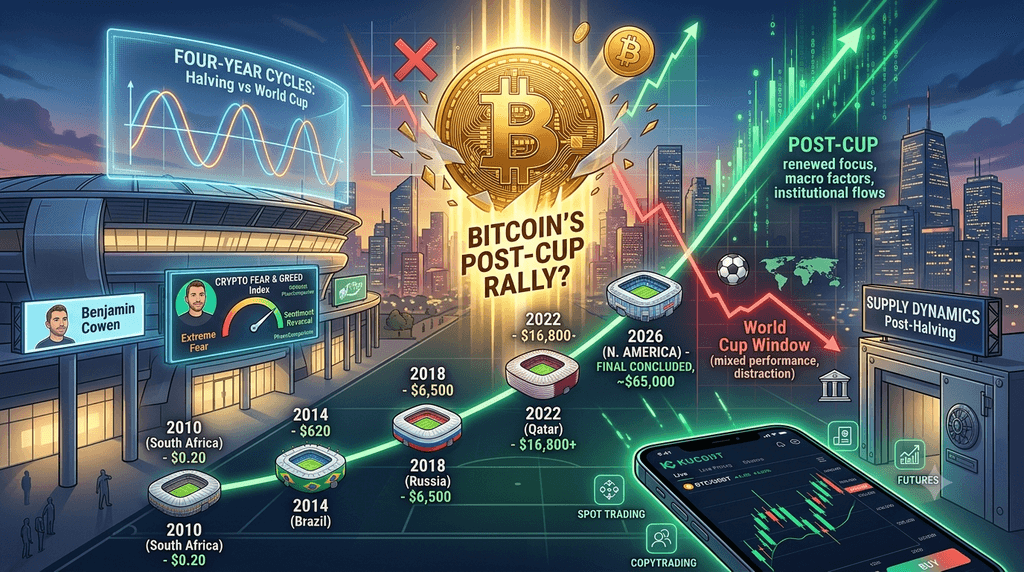
In 2010 (South Africa), Bitcoin traded near $0.20. By the 2014 Brazil World Cup, it reached approximately $620 — a gain of over 3,000x in four years. It climbed further to roughly $6,500 for the 2018 Russia edition and about $16,800–$20,000 range around the 2022 Qatar tournament. Heading into 2026, Bitcoin sat near $62,000–$66,000, representing continued compounding growth.
Short-term World Cup periods have delivered mixed or negative results in bearish cycle years. Bitcoin declined during the 2014, 2018, and 2022 tournaments, which coincided with broader market corrections. Average returns during those event windows were often flat to negative, with heightened volatility as global attention shifted to sports.
The 2026 cycle followed a similar script initially, with Bitcoin experiencing a pullback amid “extreme fear” sentiment in early July. However, the post-halving environment and growing institutional base differentiate it from prior cycles.
Benjamin Cowen’s Four-Year Cycle Comparison
Analyst Benjamin Cowen highlighted a striking parallel in July 2026: Bitcoin and the FIFA World Cup both operate on recurring four-year cycles. Cowen noted this framing during a period when the Crypto Fear & Greed Index dropped to 19 — “Extreme Fear” territory — arguing the downturn represented a normal phase rather than a structural break.
The four-year rhythm aligns Bitcoin’s halving cycles with World Cup timing. Halvings reduce new supply every four years, often preceding bull phases. World Cup years have frequently marked late-stage distribution or capitulation points before recoveries. In 2022, Bitcoin bottomed near the tournament period and launched a significant recovery afterward. Similar chart alignments have traders eyeing the end of the 2026 World Cup as a potential turning point.
Cowen’s view emphasizes that current weakness reflects cycle positioning investors have seen before, not a failure of Bitcoin’s long-term thesis.
Key Factors That Could Drive Bitcoin Higher Post-World Cup
Institutional Adoption and Corporate Balance Sheets Remain Bullish Drivers. Michael Saylor of MicroStrategy continues to advocate for Bitcoin as a superior asset, noting its censorship-resistant properties and fixed supply in contrast to fiat debasement. As companies and governments increase exposure, demand pressure builds independent of seasonal events.
Supply Dynamics Post-Halving. The most recent halving tightened issuance, supporting higher prices over time. Realized price metrics and long-term holder behavior indicate strong conviction at current levels around $60,000–$65,000.
Macro Environment and ETF Flows. Bitcoin ETFs have matured as key vehicles for traditional capital. Easing inflation narratives and potential monetary policy shifts could catalyze inflows once global events like the World Cup conclude and attention returns to markets.
Technical Setup and Sentiment Reversal. As of mid-July 2026, Bitcoin has recovered from sub-$60,000 levels and holds above key supports. Analysts note patterns echoing 2022’s post-tournament bottom, with potential for moves toward $74,000–$80,000 if resistance levels break.
Potential Risks and Counterarguments
Not every analyst agrees a strong rally is imminent. Some argue the 2026 cycle deviates due to higher institutional participation, potentially muting traditional four-year volatility. Others warn of prolonged consolidation if macroeconomic headwinds persist, with possible retests toward $55,000–$58,000.
Historical “World Cup curse” narratives in bear phases highlight distraction risk, though the event’s conclusion typically refocuses capital. Prediction markets around the tournament also drove significant on-chain activity, which may now rotate back into core assets like Bitcoin.
Should You Trade Bitcoin on KuCoin After the World Cup?
KuCoin offers a robust platform to position for potential post-World Cup upside with deep liquidity, competitive fees, and advanced tools. Whether you’re spot trading BTC/USDT pairs, using futures for leveraged exposure, or exploring margin, KuCoin provides seamless access. The exchange supports instant deposits via multiple channels and features user-friendly charting for monitoring cycle developments.
If you worry about the recent volatility, you may resort to KuCoin's copytrading hub or TraderPro campaign, to follow other lead traders' strategies, or register as the lead traders.

Conclusion
Bitcoin’s long-term growth across World Cup cycles remains undeniable, with each tournament edition showing higher price floors. While tournament periods have sometimes coincided with weakness — particularly in correction phases — the conclusion of the 2026 FIFA World Cup removes a major distraction and often signals renewed market focus. Benjamin Cowen’s four-year cycle parallel, combined with tightening supply, institutional momentum, and technical recoveries from recent lows, supports a constructive outlook for Bitcoin in the coming months.
Current prices near $65,000 reflect a market in “extreme fear” that has historically preceded strong recoveries. While risks of further consolidation exist, Bitcoin’s fundamental strengths and historical post-event patterns point toward upside potential. Traders monitoring key supports and resistance levels, alongside macro developments, stand well-placed to navigate the next phase of the cycle.
The 2026 World Cup chapter has closed, but Bitcoin’s multi-year story continues. With disciplined risk management and a long-term perspective, the asset’s trajectory favors those prepared for the opportunities ahead.
FAQs
1. Did Bitcoin always rise during past World Cups?
No. While long-term prices increased dramatically between tournaments, short-term performance during the events was often flat or negative in 2014, 2018, and 2022 due to broader market conditions.
2. What is Benjamin Cowen’s main point about Bitcoin and the World Cup?
Cowen highlights that both follow predictable four-year cycles, positioning current weakness in July 2026 as a normal phase rather than a breakdown.
3. How has the 2026 World Cup affected crypto prediction markets?
The event drove record trading volumes in prediction markets, with billions in activity as fans and traders bet on outcomes, temporarily diverting some attention from spot Bitcoin.