

Why Did Venice (VVV) Price Surge So Rapidly in 2026? Catalysts, Fundamentals, and Outlook
2026/05/13 15:21:02
Introduction
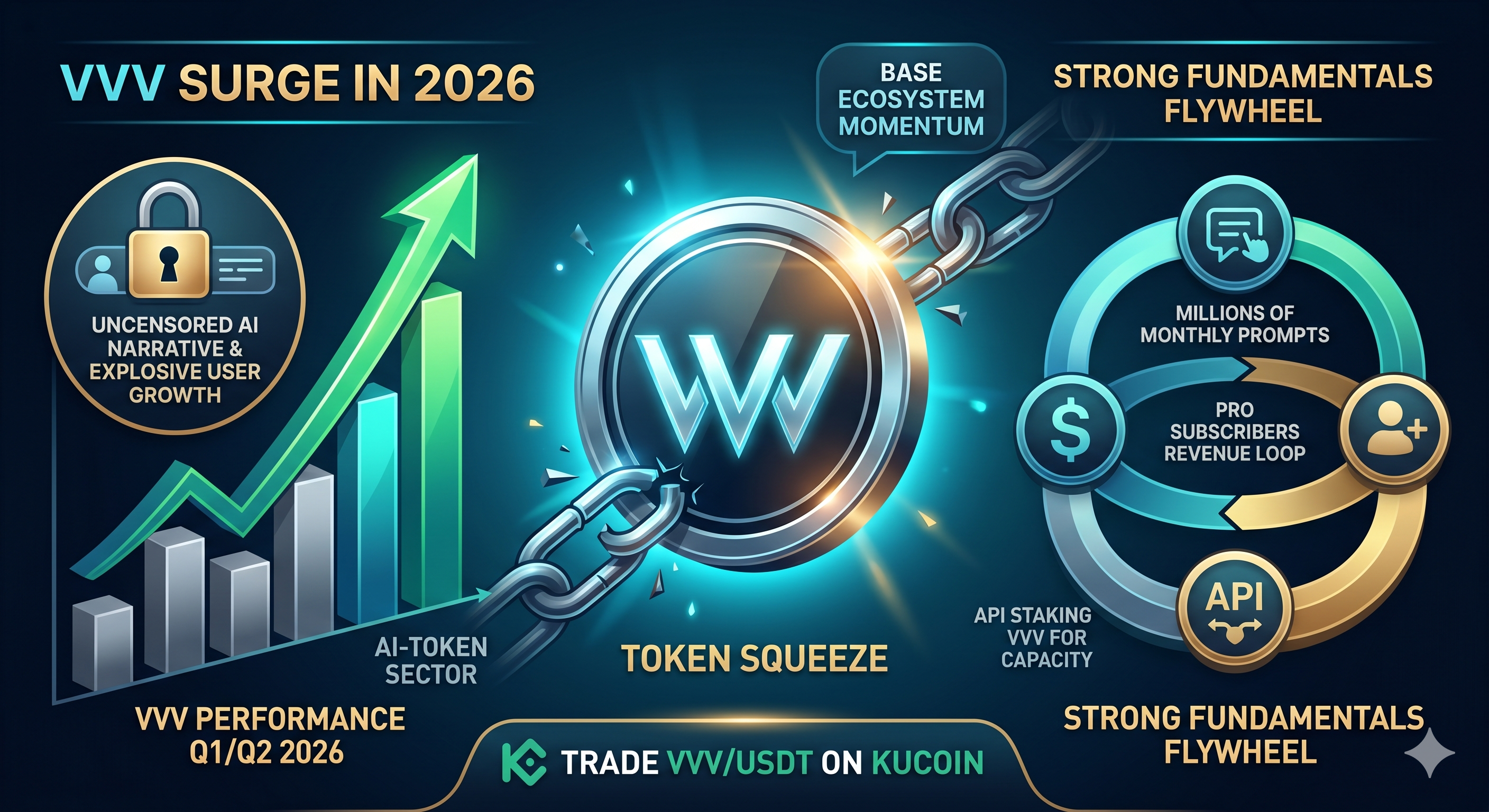
Venice AI's native token VVV has emerged as one of 2026's standout decentralized AI (DeAI) performers, with price action repeatedly outpacing the broader AI-token sector during Q1 and Q2. The rapid surge stems from a convergence of catalysts: explosive user growth on the Venice.ai private inference platform, a tightening token emission schedule, the rise of "uncensored AI" narratives following new U.S. and EU AI compliance debates, and renewed institutional attention on Base-ecosystem assets. Founder Erik Voorhees's public advocacy for permissionless AI has also amplified retail demand.
This article breaks down exactly why VVV surged so rapidly in 2026, what fundamentals support the move, the risks traders should weigh, and how to position on KuCoin if you want exposure.
What Is Venice (VVV) and Why Does It Matter in 2026?
Venice (VVV) is the utility and staking token of Venice.ai, a private, permissionless generative AI platform that routes inference across decentralized GPU providers. Unlike centralized AI services, Venice does not store prompts, does not apply ideological content filters beyond illegal-content guardrails, and processes requests through encrypted, non-retentive pipelines.
The token, launched in January 2025 on Base, gives holders pro-rata access to Venice's API inference capacity. Staking 1 VVV entitles the holder to a proportional share of daily compute — effectively turning the token into a productive asset tied to real platform usage rather than pure speculation.
Why VVV Stands Out Among AI Tokens
VVV differs from most AI tokens because it is backed by a working consumer product with paying users. According to Venice.ai's public dashboards through early 2026, the platform serves millions of monthly prompts and has converted a meaningful share of free users to paid Pro subscribers. That revenue loop — paid subscriptions plus API customers staking VVV for capacity — creates structural buy pressure that most narrative-driven AI tokens lack.
What Triggered the VVV Price Surge in 2026?
The VVV surge in 2026 was triggered by four overlapping catalysts hitting within a short window: regulatory tailwinds for "uncensored" AI, accelerating Pro user growth, a supply-side squeeze from staking, and macro rotation back into small-cap AI tokens.
Catalyst 1: The "Uncensored AI" Regulatory Narrative
Renewed debate over AI content moderation in the U.S. and EU pushed traders toward privacy-first AI platforms in early 2026. As major centralized models tightened refusal policies and several jurisdictions floated AI-output liability rules, demand spiked for inference providers that emphasize user sovereignty. Venice.ai's positioning — no prompt logging, no behavioral profiling, no ideological filtering — became a direct beneficiary of that narrative shift.
According to commentary published by PANews in 2026, Venice has been repeatedly cited as the reference example of "permissionless AI" by crypto-native KOLs, driving organic discovery and account sign-ups.
Catalyst 2: Pro Subscriber and API Revenue Growth
Venice's Pro subscriber base and API customer count expanded sharply heading into 2026, tightening the relationship between platform usage and token demand. Every API customer needing reliable inference capacity must either pay fiat at a premium or stake VVV — and staked VVV earns a pro-rata claim on daily compute.
This creates a mechanical flywheel:
-
More users → more API demand
-
More API demand → more VVV staked for capacity
-
More VVV staked → less circulating supply
-
Less circulating supply + steady buying → upward price pressure
Catalyst 3: Supply-Side Squeeze
The portion of VVV locked in staking climbed significantly through late 2025 and into 2026, sharply reducing freely tradable float. With a fixed maximum supply and a declining emission curve, the percentage of tokens staked for compute access has been the dominant supply variable. When staked supply rises faster than new emissions, even modest demand inflows translate into outsized price moves.
Catalyst 4: Base Ecosystem Momentum
The broader Coinbase-backed Base L2 ecosystem saw renewed activity in 2026 as Coinbase expanded onchain product integrations. VVV, as one of Base's flagship AI-native tokens, captured rotational flows from traders looking for high-beta Base exposure beyond DEX and memecoin plays.
How Strong Are Venice's Fundamentals?
Venice's fundamentals are stronger than most AI tokens because the product has measurable usage, recurring revenue, and a clear token-to-utility link. The platform is not pre-revenue, not pre-product, and not dependent on a future roadmap to justify its valuation.
Product and Usage Metrics
Venice.ai offers text generation, image generation, code assistance, and document analysis through both a consumer web app and a developer API. The platform aggregates inference from multiple open-weight models — including Llama-family, Qwen-family, and image models like Flux — routed across decentralized GPU partners.
Key fundamental drivers include:
-
A consumer-grade UI that competes with mainstream AI chatbots
-
A paid Pro tier providing higher rate limits and advanced features
-
A developer API with VVV-staking-based capacity allocation
-
Private-by-design architecture that does not retain user prompts
Token Utility and Economics
VVV's token utility is direct and non-speculative: stake to receive inference capacity. Unlike governance-only tokens, VVV holders gain something tangible — compute — proportional to their stake. This converts the token from a bet on future utility into a current claim on production capacity.
|
Token Dimension
|
Venice (VVV) Approach
|
|
Primary utility
|
Stake for proportional daily inference capacity
|
|
Supply model
|
Fixed maximum supply with declining emissions
|
|
Demand driver
|
API customers and Pro users needing capacity
|
|
Value accrual
|
Staking yield via compute access, not inflation rewards
|
Who Is Erik Voorhees and Why Does He Matter for VVV?
Erik Voorhees, Venice's founder, matters for VVV because his decade-plus reputation in crypto provides credibility and consistent narrative amplification. Voorhees previously founded ShapeShift, was an early Bitcoin advocate, and has been one of the most visible proponents of permissionless financial and informational systems.
His public commentary on AI censorship, privacy, and individual sovereignty has aligned Venice with a clearly defined ideological position — one that resonates strongly with crypto-native users. That alignment translates into organic distribution: every podcast appearance, op-ed, or social post by Voorhees that frames AI access as a free-speech issue tends to drive measurable spikes in Venice sign-ups and VVV trading volume.
What Are the Risks of Trading VVV?
The main risks of trading VVV are competitive pressure from centralized AI providers, regulatory uncertainty around uncensored AI, and high token-price volatility relative to fundamentals.
Competitive Risk
Centralized AI platforms have far larger compute budgets, proprietary model improvements, and enterprise distribution. If consumer demand for "private AI" plateaus or if mainstream providers add stronger privacy guarantees, Venice's differentiation narrows. Traders should monitor monthly active user trends and Pro conversion rates as leading indicators.
Regulatory Risk
Uncensored AI sits in an evolving legal gray zone. New AI-output liability frameworks, mandatory content-watermarking rules, or platform-level moderation requirements could force changes to Venice's architecture or limit its accessible markets. A material adverse rule in the U.S. or EU would likely compress VVV's valuation multiple quickly.
Volatility Risk
VVV is a small-to-mid-cap token and trades with high realized volatility. Rapid surges of the kind seen in 2026 are frequently followed by sharp corrections as short-term traders rotate out. Position sizing, defined stop levels, and avoiding leverage on illiquid pairs are essential risk-management practices.
Smart Contract and Platform Risk
Venice depends on its smart-contract staking system and on third-party GPU providers for inference. A contract exploit, a major outage among GPU partners, or a critical model-licensing dispute could disrupt the utility loop that supports VVV demand.
How Does VVV Compare to Other DeAI Tokens?
VVV compares favorably to most decentralized AI tokens on the dimension that matters most: real product usage tied to token demand. Many DeAI tokens monetize narrative; VVV monetizes inference capacity that customers actively consume.
|
Comparison Factor
|
VVV (Venice)
|
Typical DeAI Token
|
|
Live consumer product
|
Yes — Venice.ai
|
Often roadmap or beta
|
|
Token-to-utility link
|
Stake for compute access
|
Governance or speculative
|
|
Revenue source
|
Pro subscriptions plus API
|
Grants, treasury, or none
|
|
Founder profile
|
Public, long-tenured
|
Often anonymous or new
|
That said, larger DeAI ecosystems may offer broader infrastructure exposure (training, data, agent frameworks), while Venice is concentrated on inference. Traders building a DeAI basket often hold VVV alongside infrastructure-layer tokens rather than as a sole exposure.
How to Trade Venice (VVV) on KuCoin
You can trade Venice (VVV) on KuCoin through the spot market by following a straightforward account setup and execution process.
Step-by-Step Guide
-
Create or log in to your KuCoin account and complete identity verification to unlock full trading limits.
-
Deposit funds — either crypto (such as USDT on a supported network) or fiat via supported payment channels.
-
Navigate to the spot trading interface and search for the VVV/USDT you want to trade.
-
Choose your order type — market orders for immediate execution or limit orders to target a specific entry price.
-
Set position size based on your risk tolerance and confirm the trade.
-
Monitor the position and use stop-loss or take-profit orders to manage downside.
Trading Tips for Volatile AI Tokens
-
Use limit orders during high-volatility surges to avoid slippage.
-
Size positions conservatively — VVV can move double-digit percentages in a single session.
-
Track Venice.ai platform metrics (Pro subscribers, API growth) as leading indicators alongside chart analysis.
-
Avoid concentrated leverage on small-cap AI pairs; funding rates can spike during squeezes.
New users can now register at KuCoin and Get Up to 11,000 USDT in New User Rewards.
Conclusion
Venice (VVV)'s rapid 2026 surge reflects a rare alignment of narrative, product, tokenomics, and macro positioning. The "uncensored AI" regulatory backdrop pushed users toward privacy-first inference, Venice.ai's Pro and API growth converted that interest into recurring revenue, and the staking-for-compute model translated platform demand into structural VVV buying. Founder Erik Voorhees's consistent advocacy added credibility and distribution that few competitors can match.
At the same time, the rally is not risk-free. Competitive pressure from centralized AI providers, evolving regulation around uncensored content, smart-contract dependencies, and the inherent volatility of small-to-mid-cap AI tokens all warrant careful position management. The strongest case for VVV is its working product and direct token-utility link; the strongest caution is the gap between near-term price action and long-term fundamental trajectory.
For traders comfortable with the risk profile, KuCoin offers a practical venue to access VVV with the liquidity and tooling needed to trade it responsibly through the next phase of the AI cycle.
FAQs
Is VVV an inflationary or deflationary token?
VVV operates on a fixed maximum supply with a declining emission schedule, making it disinflationary over time. Circulating supply growth slows each year, and rising staking participation further reduces freely tradable float.
Can I earn yield by holding VVV?
Yes — staking VVV entitles holders to a proportional share of Venice.ai's daily inference capacity, which can be used directly or rented to API customers. The yield is denominated in compute rather than additional tokens, so its dollar value depends on inference demand.
How is Venice different from running a local open-source AI model?
Venice removes the hardware burden and ongoing maintenance of self-hosting while preserving most of the privacy benefits. Local models give you full control but require powerful GPUs and technical setup; Venice offers comparable privacy with cloud-grade convenience.
Does Venice store my prompts or conversation history?
No — Venice's architecture is designed to avoid prompt retention and behavioral profiling. Conversation history, when available, is stored locally in the user's browser rather than on Venice servers, distinguishing it from mainstream AI services.
What should I watch to anticipate VVV's next move?
Monitor four signals: Venice.ai Pro subscriber growth, API customer additions, the percentage of VVV staked for compute, and regulatory developments around AI content rules. Shifts in any of these tend to precede meaningful VVV price moves.