

What Is Derive V3? Key Features, How It Works, and What Traders Should Know
Introduction
Can crypto options trading combine the execution speed of a centralized exchange with the transparency and composability of decentralized finance? Derive V3 aims to make that combination more practical by redesigning the infrastructure behind onchain derivatives trading.
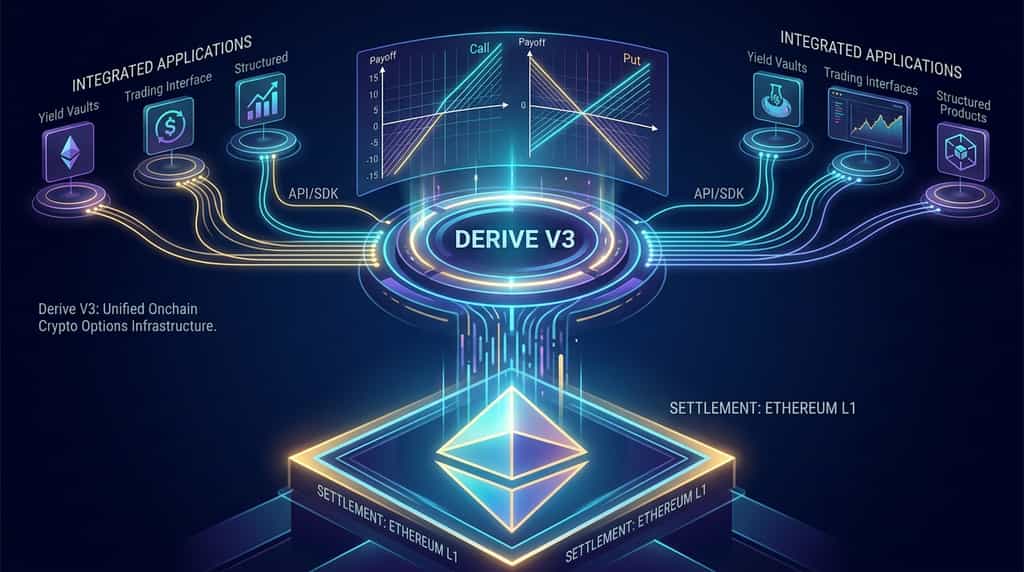
Derive V3 is the latest version of Derive, a decentralized derivatives platform focused on cryptocurrency options and perpetual futures. Its updated architecture is designed to simplify trading infrastructure, improve execution efficiency, and make onchain options liquidity easier for third-party applications to integrate. According to Derive Labs' October 2026 developer update, V3 brings its trading stack into a single zero-knowledge virtual machine (ZKVM) application settling on Ethereum Layer 1, while providing developers with APIs and software development kits (SDKs).
The upgrade matters because onchain derivatives have historically faced challenges involving liquidity fragmentation, complex integrations, transaction costs, and risk management. Understanding Derive V3 requires examining its architecture, trading features, potential benefits, and remaining risks before deciding whether it fits a particular trading strategy.
What Is Derive V3?
Derive V3 is an upgraded onchain derivatives trading infrastructure designed to connect options liquidity, risk management, and trade execution through a unified system. Rather than functioning solely as a standalone trading interface, the platform also aims to provide infrastructure that wallets, fintech applications, and other developers can integrate into their own products.
Derive evolved from Lyra, an early decentralized options protocol, and expanded into a broader derivatives ecosystem. Its earlier architecture combined onchain settlement with specialized trading components. V3 moves toward a more unified execution and settlement environment, reducing the number of separate systems that developers need to manage when building options-based applications.
According to Derive Labs' developer update, the new architecture is designed to let integrators use Derive's liquidity without independently building a matching engine, recruiting market makers, or operating their own derivatives risk engine. This approach could lower the technical barriers to embedding options trading into consumer-facing financial applications.
How Does Derive V3 Differ From Earlier Versions?
The primary difference is the way the trading infrastructure is organized. Earlier iterations of Derive used a combination of blockchain settlement, matching services, and specialized protocol components. V3 emphasizes a consolidated application architecture that settles on Ethereum Layer 1.
This distinction matters because a derivatives platform must do more than display prices and accept orders. It needs to match buyers and sellers, calculate margin requirements, monitor positions, process liquidations, and settle trades. Each additional system can introduce integration complexity, operational dependencies, and potential failure points.
By bringing these functions into a more unified architecture, Derive V3 aims to simplify the process of building on its infrastructure. However, a unified design does not automatically eliminate smart contract risk, operational failures, or market liquidity constraints. The actual benefits depend on the implementation, the security assumptions, and the quality of liquidity available for each market.
Is Derive V3 a Decentralized Exchange?
Derive V3 is part of the decentralized finance (DeFi) ecosystem, but its architecture should not be confused with a system in which every operation is executed independently on a public blockchain.
A derivatives venue may use specialized infrastructure for order matching while relying on blockchain-based mechanisms for settlement and asset security. This hybrid approach can improve execution performance compared with placing every order-book operation directly onchain.
Derive's current V3 architecture is designed around a ZKVM application that settles on Ethereum Layer 1. This arrangement combines a dedicated execution environment with Ethereum settlement, although users should consult the protocol's technical documentation to understand exactly which operations are proven, how state transitions are verified, and what security assumptions apply.
For traders, the practical question is not simply whether a platform is labeled decentralized. It is whether the platform provides understandable custody arrangements, verifiable settlement, reliable execution, transparent risk controls, and a clear process for handling failures.
What Are the Key Features of Derive V3?
Derive V3 focuses on several connected capabilities: unified infrastructure, low-latency order execution, integrated options liquidity, simplified application development, and support for derivatives-based financial products. Together, these features are intended to make onchain options more accessible to traders and developers.
1. Unified Infrastructure Settling on Ethereum
Derive V3 uses a ZKVM-based application architecture that settles on Ethereum Layer 1, according to Derive Labs' developer update. The objective is to consolidate the trading stack rather than require integrators to coordinate multiple independent systems.
For developers, fewer infrastructure dependencies can simplify deployment and maintenance. An application integrating Derive may be able to access order execution, derivatives liquidity, and the protocol's risk-management capabilities through a more consistent interface instead of assembling each component separately.
For traders, a unified architecture may reduce some operational friction, but it does not guarantee lower transaction fees, zero downtime, or complete decentralization. Ethereum settlement also does not mean every order is individually processed as a separate Ethereum mainnet transaction. The execution model and settlement process must be evaluated separately.
2. Low-Latency Order Matching
Derive V3 is designed to support fast order execution through specialized trading infrastructure. Derive Labs' developer update describes an architecture intended to remove the need for integrators to operate their own matching engines.
Order matching is the process of pairing compatible buy and sell orders. In options markets, effective matching is particularly important because liquidity is distributed across different strike prices, expiration dates, and contract types. Slow execution or inconsistent prices can make complex strategies expensive to enter and exit.
Lower matching latency can improve responsiveness and help trading applications provide a more familiar experience to users accustomed to centralized exchanges. Nevertheless, execution speed is only one component of trade quality. Slippage, bid-ask spreads, market depth, fees, and partial fills can have a greater effect on the final price a trader receives.
Developers and professional traders should also distinguish between matching latency and end-to-end settlement time. A rapidly matched order may still require additional processing before its resulting position or balance is reflected in the relevant settlement system.
3. Shared Onchain Options Liquidity
Derive V3 is designed to let third-party applications access its options liquidity without building a complete derivatives exchange from scratch. This could help developers create new interfaces and financial products while relying on existing trading infrastructure.
Options liquidity is a persistent challenge in DeFi because markets are divided across multiple expiration dates and strike prices. A platform may offer many contracts but still have limited depth in a particular market. This can lead to wide bid-ask spreads, high slippage, or difficulty closing positions at a desired price.
A shared liquidity layer can help applications access existing market participants rather than requiring each new application to attract its own independent pool of traders and market makers. It may also reduce duplicated infrastructure across the ecosystem.
However, shared access does not create liquidity automatically. Market depth still depends on actual trading activity, market-maker participation, collateral availability, and the attractiveness of individual contracts. Users should assess liquidity at the specific strike and expiration they intend to trade rather than assuming all Derive V3 markets are equally liquid.
4. Developer APIs and SDKs
Derive V3 provides developer-oriented integration tools, including APIs and SDKs, to help applications connect to its trading infrastructure. Derive Labs identifies TypeScript, Python, and Rust SDKs in its V3 developer announcement.
APIs allow software applications to communicate with trading systems, while SDKs package commonly used functions into tools that developers can incorporate into their own code. These capabilities are important for teams building automated trading systems, portfolio interfaces, or financial applications that use options behind the scenes.
For example, a wallet developer could build an interface that lets users explore a defined-risk options strategy without requiring them to navigate a full options order book. A quantitative trading team could integrate market data and order-routing functionality into its existing workflow.
Such integrations can make sophisticated financial products easier to access, but the user experience must not conceal the underlying risk. Applications should communicate potential losses, expiration conditions, fees, collateral requirements, and relevant liquidation rules clearly.
5. No-Code Vaults and Structured Financial Products
Derive V3's broader infrastructure model is designed to support applications such as yield vaults, structured products, and automated options strategies. Derive Labs has specifically identified options-based yield products as one potential use case for developers building on V3.
A vault generally pools assets and applies a predefined strategy according to its rules. An options-based vault might sell covered calls, use spreads, or combine multiple positions to pursue a particular payoff profile. A structured product can package derivatives into a more accessible financial arrangement with defined conditions or targeted outcomes.
No-code interfaces can reduce the technical expertise required to configure such products. However, no-code does not mean risk-free. The underlying strategy may still incur losses, suffer from poor execution, or behave differently during sharp market movements.
Users should examine the vault's strategy, underlying positions, withdrawal rules, fee structure, and historical performance methodology before depositing assets. They should also distinguish between yield generated by trading activity and promotional incentives or token rewards, which may have different sources and sustainability.
How Does Onchain Options Trading Work on Derive V3?
Onchain options trading lets users take positions based on an underlying asset's future price without necessarily buying or selling the asset itself. Derive V3 provides infrastructure intended to support these contracts while integrating execution and settlement into a blockchain-oriented trading system.
An options contract gives its buyer the right, but not the obligation, to buy or sell an underlying asset at a specified strike price under defined conditions. A call option generally benefits from an increase in the underlying price, while a put option generally benefits from a decrease. The actual profit or loss depends on the premium paid or received, the strike price, expiration, implied volatility, and other contract terms.
What Are the Main Types of Options Strategies?
Traders can use options for directional speculation, hedging, or strategies based on volatility and time decay. Derive's infrastructure is designed to support applications that use these different approaches, although available contracts and execution features may vary by market.
-
Buying call options: A trader pays a premium for exposure to an upward price move. The buyer's loss on the option is generally limited to the premium paid, excluding additional fees.
-
Buying put options: A trader pays a premium for exposure to a downward price move or to hedge an existing asset position.
-
Covered calls: An asset holder sells call options against an existing position to collect premiums, while accepting the risk of having to sell the asset at the strike price.
-
Options spreads: A trader combines multiple options to shape the potential payoff, often trading some upside or downside in exchange for a lower premium or more defined risk profile.
-
Volatility strategies: A trader combines calls and puts to express a view on the magnitude of price movements rather than simply their direction.
These strategies have different risk profiles and capital requirements. In particular, selling options without adequate collateral can expose traders to substantial losses. A strategy should be evaluated using its complete payoff structure rather than the premium it initially generates.
How Does Margin Management Affect Traders?
Margin management determines how much collateral a trader must maintain to support open positions. Derive's broader protocol design emphasizes derivatives risk management, and its V3 infrastructure is intended to make these capabilities available to integrated applications.
Margin requirements depend on the position, collateral, market conditions, and the protocol's risk parameters. If a position becomes insufficiently collateralized, it may be liquidated under the applicable rules. Liquidation can crystallize losses at an unfavorable price, particularly during volatile markets or when liquidity is limited.
Traders should understand the distinction between initial margin and maintenance margin. Initial margin is the collateral required to open a position, while maintenance margin is the minimum collateral needed to keep it open. The precise terminology and calculations can differ by platform and contract.
Before trading on Derive V3, users should review the applicable margin methodology, collateral eligibility, liquidation thresholds, and treatment of unrealized profits and losses. They should not assume that a more capital-efficient system eliminates the possibility of liquidation.
Beyond the Headlines: What KuCoin 5.0 Means for You
Market news moves fast — but where you act on it matters just as much. This October, KuCoin launches KuCoin 5.0, transforming KuCoin into a rebuilt platform. Here's what actually changes for you:
-
One account for everything. Older platforms split your money across separate "spot," "margin," and "futures" accounts and expected you to understand why. KuCoin 5.0's unified account removes that entirely — deposit once, and everything is simply there (only available to VIPs for now).
-
Stocks, indices, and commodities. KuCoin 5.0 expands beyond crypto into global markets. When crypto chops sideways and equities rally (or the reverse), you rotate in minutes instead of opening a brokerage account and waiting days for fiat rails.
-
Real-world assets (RWA). Tokenized exposure to traditional assets like commodities, right inside your crypto account. One of the fastest-growing segments in global finance is no longer reserved for institutions — you access it from the same balance you trade with.
-
Earn while you learn. Not ready to trade? KCUSD lets your stablecoins earn daily, auto-compounding interest. The lowest-stress way to put your idle deposit to work for 4% yield.
-
An AI assistant in plain language. Ask questions, get market context, understand what you're looking at — built into the platform, no jargon required.
-
An app that doesn't overwhelm. Faster, cleaner, and consistent — intuitive from the first tap, not after a tutorial.
-
Safety you can check, not just trust. A MiCAR-licensed EU entity, Proof of Reserves you can verify yourself, and internationally certified security (SOC 2 Type II, ISO 27001:2022).
Create your account in minutes — and start on the platform built for where crypto is going, not where it's been.
Conclusion
Derive V3 represents an infrastructure-focused development in onchain derivatives trading. By consolidating key components into a ZKVM application settling on Ethereum Layer 1, the platform aims to simplify integrations, support responsive order execution, and make options liquidity accessible to a broader range of applications. Its APIs, SDKs, subaccount tools, and support for options-based financial products are particularly relevant to developers building trading interfaces, automated strategies, and structured products.
The upgrade also reflects a broader trend toward making decentralized financial infrastructure easier to integrate into familiar consumer and institutional applications. However, technical improvements should not be confused with guaranteed trading advantages. Execution latency does not guarantee favorable prices, shared liquidity does not ensure deep markets, and blockchain settlement does not remove smart contract or operational risks.
For traders, the priority should be understanding the underlying options contracts, collateral requirements, fees, and liquidation mechanisms before opening a position. For developers, the key considerations are integration complexity, security assumptions, available documentation, and the responsibilities involved in building on shared infrastructure. Derive V3's longer-term significance will depend on its security, adoption, liquidity, and ability to deliver reliable execution under real market conditions.
FAQs
1. Is Derive V3 a blockchain?
Derive V3 is a derivatives trading system built around a ZKVM application that settles on Ethereum Layer 1, rather than a conventional independent Layer 1 blockchain. Its architecture is designed to combine specialized execution with Ethereum settlement.
2. Does Derive V3 support Bitcoin options?
Derive's supported assets and contracts can change as markets are introduced or upgraded. Check the current official trading interface and documentation to confirm whether the specific Bitcoin option contract you want is available.
3. Can beginners use Derive V3?
Potentially, but beginners should first understand options premiums, expiration, implied volatility, collateral, and liquidation risks. An application built on Derive V3 may simplify the interface without making the underlying financial instruments less complex.
4. Does Derive V3 guarantee lower trading fees?
No. A unified architecture and efficient execution may reduce certain infrastructure costs, but actual trading expenses depend on protocol fees, spreads, slippage, network-related costs, and the specific market or application used.
5. Can developers build their own trading applications on Derive V3?
Yes. Derive Labs describes V3 as infrastructure that developers can integrate into their own products using APIs and SDKs. Developers should consult the official documentation for current integration requirements, supported functions, and applicable commercial terms.
Disclaimer: This article is for informational purposes only and does not constitute financial, legal, or investment advice. Cryptocurrency options and other derivatives involve substantial risks, including the potential loss of capital. Always conduct your own research before interacting with digital assets.