

Pirate Chain Rolls Back to Block 4,176,944 to Remove 39.82M Counterfeit ARRR
Pirate Chain Rolls Back Exploit Block to Restore Supply Integrity
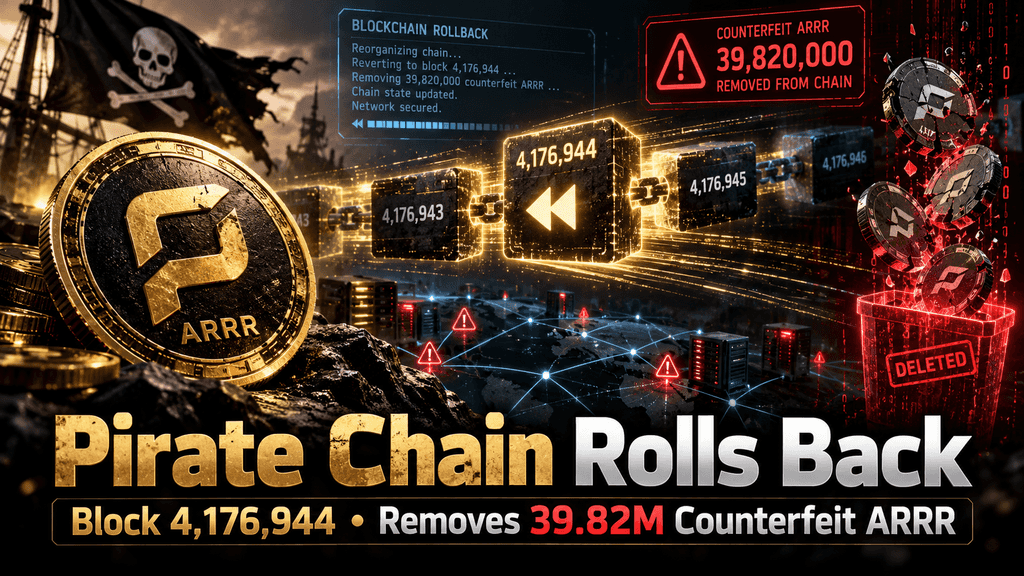
Privacy-focused cryptocurrency Pirate Chain faced a critical supply integrity crisis in mid-October 2026 when attackers exploited validation flaws tied to its recent Ironwood upgrade. On October 14, roughly 39.82 million unauthorized ARRR tokens were minted in the transparent Coinbase pool, temporarily expanding circulating supply by about 20 percent against a hard maximum of 200 million. The response required coordinated action across the network. After community, mining pool, exchange, and delayed proof-of-work (dPoW) notary consensus, the chain was rolled back to block 4,176,944, the final pre-exploit block at 19:55:14 UTC on October 14. Mandatory software version 6.0.14 enforces rejection of the exploit branch, restores pre-attack balances, and triggers full reindexing.
This context tests the practical limits of consensus-driven recovery on a fully shielded privacy coin and underscores how tightly supply accounting must be enforced when most activity occurs inside cryptographic pools that external observers cannot monitor in real time. The October 2026 Pirate Chain incident demonstrates that even mature privacy protocols remain vulnerable to subtle validation errors introduced during upgrades, yet rapid multi-party coordination can restore economic integrity without permanent dilution of the fixed supply.
Ironwood Upgrade Timeline and the Emergence of Dual Validation Flaws
Pirate Chain activated the Ironwood upgrade on October 3, 2026, introducing changes to the transparent accounting layer that tracks overall supply. Eleven days later, on October 14, an attacker combined two distinct validation failures: a bypassed issuance check that should have blocked unauthorized coin creation and an incorrect interpretation of output scripts that allowed the newly created tokens to be treated as valid. These flaws resided in the transparent coinbase pool rather than the core zk-SNARK cryptography or the dPoW notarization keys. Official statements confirmed that neither notary keys nor the shielded-transaction primitives were compromised. The counterfeit tokens were moved almost immediately into the Sapling shielded pool, where balances and subsequent transfers become opaque by design.
This quick shielding limited the ability of external parties to track further movement, although one exchange, NonKYC, identified related deposits and restricted the associated accounts before significant off-chain conversion could occur. The episode illustrates how an upgrade intended to improve accounting visibility can, if imperfectly validated, create a narrow window for supply inflation that is difficult to reverse once coins enter the private pool. Developers later described the response as closing the exploit path in record time, but the eleven-day exposure window remains a concrete data point for teams planning future protocol changes.
Quantifying the 39.82 Million Token Mint and Its Immediate Supply Impact
The unauthorized issuance totaled approximately 39.82 million ARRR, equivalent to roughly one-fifth of the circulating supply at the moment of the attack. Pirate Chain maintains a strict maximum supply of 200 million tokens; the temporary addition therefore represented a meaningful breach of that ceiling rather than a marginal accounting discrepancy. Market observers noted that the inflation occurred entirely outside scheduled emission schedules. Because the tokens entered the shielded pool so quickly, public explorers could not fully reconstruct subsequent transfers, yet the project stated that activity remained largely confined to on-chain movements. Temporary pauses in deposits and withdrawals at participating exchanges, combined with voluntary suspension of dPoW notarizations, constrained further distribution.
Once the rollback was completed, the circulating supply returned to its pre-attack figure, and the 200 million cap was reaffirmed without alteration. This quantitative restoration provides a measurable benchmark for assessing whether the recovery succeeded. Holders and analysts can now cross-check explorer data against the known pre-exploit state to confirm that the inflated balances have been eliminated. The scale of the mint also highlights why fixed-supply privacy coins treat validation rules around coinbase generation as first-order security concerns.
Community and Stakeholder Consensus That Enabled the Chain Reversion
Because Pirate Chain operates as a decentralized network, no single party can unilaterally freeze or rewrite history. Recovery therefore depended on voluntary alignment among node operators, mining pools, exchanges, and the dPoW notaries that periodically record the chain state onto Komodo Classic and Litecoin. After the initial disclosure on October 15, these groups agreed to pause normal operations while a fixed release was prepared. By October 22, the coordinated decision produced a clean reversion to block 4,176,944. Version 6.0.14 causes nodes to reject the exploit block and every subsequent block built upon it.
Concurrently, the dPoW notaries committed to resume notarization exclusively on the corrected branch, starving the divergent chain of further security anchors. This multi-party process demonstrates that even privacy-focused networks can achieve rapid economic restoration when incentives align around preserving the integrity of the fixed supply. The episode also shows the practical value of having a pre-existing notarization layer that can be redirected by consensus rather than by a hard fork alone.
Technical Mechanics of the Rollback to Block 4,176,944
The chosen rollback height, block 4,176,944, corresponds to the final valid state immediately before the exploit transaction appeared at 19:55:14 UTC on October 14. Nodes running version 6.0.14 or higher automatically refuse to accept the exploit block or any blocks that descend from it. Upon first launch, the new software performs a full chain reindex followed by a wallet rescan that reconstructs shielded balances from the restored history. A pre-indexed bootstrap option shortens the recovery time for users who elect it. All transactions and balances that existed prior to the attack are reinstated; the counterfeit issuance is simply absent from the rewritten ledger.
The project emphasized that this approach avoided permanent economic damage and left the 200 million maximum supply untouched. For operators, the process requires suspending older binaries, installing the updated release from official GitHub or website sources, and allowing the automatic reindex to complete without interruption. The technical design therefore converts a consensus decision into an enforceable protocol rule that every upgraded node follows independently.
Mandatory v6.0.14 Release and Network-Wide Upgrade Requirements
On October 22, 2026, the development team declared version 6.0.14 the mandatory minimum. All Treasure Chest wallet users, command-line node operators, miners, pools, exchanges, and service providers were instructed to discontinue older versions immediately. The release packages the exploit rejection logic, the reindex procedure, and several minor P2P networking improvements identified during the incident response. Official download channels include the project’s GitHub repository and the main website wallet page.
Users are advised to select the built-in “Reindex and Rescan with Bootstrap” option where available to accelerate recovery. Failure to upgrade leaves a node on the discarded branch, which will receive no further dPoW notarizations and will eventually lose economic relevance. The coordinated upgrade window therefore serves both as a security patch and as a practical test of the network’s ability to converge on a single, corrected history within days of discovery.
Role of dPoW Notaries in Securing the Corrected Chain
Pirate Chain’s delayed proof-of-work mechanism periodically notarizes its state onto the Komodo and Litecoin chains, providing an external security layer against deep reorganizations. During the incident, notaries voluntarily suspended notarizations as a precaution. After consensus formed around the rollback, the same notaries agreed to resume service exclusively on the chain that begins at block 4,176,944. The divergent branch that contained the counterfeit tokens receives no further notarizations, effectively isolating it.
This redirection of an existing security resource allowed the network to discard the inflated history without requiring a complete redesign of its consensus rules. The episode illustrates how an external notarization layer can function as a flexible recovery tool when the primary chain experiences an accounting failure. Operators monitoring notarization status can therefore use the presence or absence of recent notarizations as one independent signal that a node has correctly joined the restored chain.
Exchange and Mining Pool Responses During the Containment Period
Participating exchanges and mining pools voluntarily paused deposits, withdrawals, and, in some cases, block production while the recovery plan was developed. NonKYC moved especially quickly, identifying suspicious deposits linked to the exploit and restricting the relevant accounts before large-scale conversion could occur. These pauses reduced the surface area available for the counterfeit tokens to leave the network. Once version 6.0.14 became available and the rollback height was confirmed, the same venues were positioned to resume operations on the corrected chain.
The coordinated pause also limited the number of legitimate transactions that would later need to be reversed, simplifying the balance-restoration process. For market participants, the episode underscores the operational importance of having clear communication channels between privacy-coin projects and the venues that list them. Rapid, voluntary suspension proved more effective than attempting to freeze a decentralized ledger after the fact.
Supply Cap Integrity and the Restoration of Pre-Attack Balances
Pirate Chain’s design enforces a hard maximum of 200 million ARRR tokens. The temporary creation of 39.82 million unauthorized tokens breached that ceiling for approximately one week. After the rollback, every balance that existed before the exploit was restored, and the counterfeit coins simply ceased to exist on the canonical chain. No compensatory inflation or claw-back mechanism was required because the tokens never became part of the accepted history. This outcome preserves the economic assumptions that holders and long-term observers rely upon.
Analysts can now verify the circulating supply against the known pre-October 14 figure and confirm that the 200 million cap remains intact. The clean restoration also removes the need for secondary market adjustments that sometimes accompany partial freezes or token burns on other networks. In practical terms, the supply schedule that existed on the morning of October 14 is once again the operative schedule for the entire network.
Shielded Pool Dynamics and the Challenges of Tracing Unauthorized Issuance
Because Pirate Chain mandates shielded transactions for all activity, the newly minted tokens disappeared from public view the moment they entered the Sapling pool. Subsequent movements inside that pool cannot be reconstructed by external observers. The project stated that it believes related activity remained primarily on-chain and that NonKYC’s rapid account restrictions further limited leakage. The opacity that normally protects legitimate users therefore also complicated forensic analysis of the exploit.
This dual-edged property is inherent to fully private systems: validation rules must be correct at the moment of issuance because later detection becomes far more difficult. The incident provides a concrete case study of how a transparent-layer flaw can inject value into an opaque pool and why the subsequent recovery focused on rewriting history rather than attempting selective blacklisting of shielded notes.
How the Incident Shapes Market Sentiment Toward Privacy Coins
Privacy-focused assets operate in a market environment where supply credibility is a core value proposition. Temporary inflation of the magnitude seen on Pirate Chain can erode confidence if left unaddressed. The rapid restoration of the original supply schedule, combined with transparent communication of the rollback height and upgrade requirements, limited the duration of uncertainty. Market data services that track circulating supply will need to reflect the corrected figures once the majority of nodes and venues complete the upgrade.
Observers monitoring market movement and broader digital-asset liquidity often treat privacy-coin events as secondary signals of overall market risk appetite. The Pirate Chain recovery therefore offers a data point on how quickly a decentralized network can reassert its monetary rules when an accounting failure occurs.
Lessons for Protocol Upgrade Processes on Privacy Networks
The Ironwood upgrade had been live for only eleven days when the dual validation flaws were discovered. That short exposure window still proved sufficient for a substantial unauthorized mint. Future upgrade processes on similar networks may place greater emphasis on formal verification of issuance checks and output-script handling before activation. Independent audits focused specifically on transparent accounting layers that feed into shielded pools could reduce the probability of comparable events.
The successful coordination of the rollback also shows that privacy networks can maintain effective recovery pathways even when most activity is cryptographically private. Clear pre-established channels among notaries, pools, and exchanges proved decisive. These operational lessons are likely to influence how other privacy projects structure both their technical review pipelines and their incident-response playbooks.
User and Operator Guidance for Completing the Transition
Holders and operators are advised to obtain version 6.0.14 exclusively from official sources, suspend any older binaries, and allow the automatic reindex and wallet rescan to finish without interruption. Selecting the bootstrap option where available reduces recovery time. After the process completes, balances should match the pre-attack state and the node should reject any blocks descending from the exploit height. Monitoring dPoW notarization status provides an independent confirmation that the node has joined the corrected chain.
Exchanges and pools that paused operations can resume once a sufficient majority of the network has upgraded. Users who held ARRR through the incident will find their pre-October 14 balances restored; any tokens that existed solely because of the unauthorized mint no longer appear. This practical checklist converts the high-level consensus decision into concrete steps that individual participants can execute.
What the Incident Means for Privacy Cryptocurrencies With Fixed Supplies
Fixed-supply privacy coins derive part of their value proposition from the credibility of their monetary rules. An unauthorized mint of nearly 20 percent of circulating supply tests that credibility in real time. Pirate Chain’s ability to reverse the inflation through consensus and a mandatory software update demonstrates that such systems can recover without permanent dilution. The episode also illustrates the continuing importance of the transparent accounting layer even when the vast majority of transactions are shielded.
Validation logic at the point of coin creation remains a critical control surface. For the wider set of privacy-focused projects, the October 2026 events supply both a cautionary example of upgrade risk and a practical demonstration that coordinated recovery remains feasible when the network’s stakeholders prioritize supply integrity.
FAQs
How did the two validation flaws allow 39.82 million counterfeit ARRR to be created?
One flaw bypassed issuance checks, while the other misinterpreted output scripts, allowing unauthorized tokens to be accepted. The patch in version 6.0.14 fixed both issues, which did not affect zk-SNARK cryptography or notary keys.
What happens to transactions after block 4,176,944?
All subsequent blocks are discarded in the rollback, reversing transactions made during that period. Users may need to re-initiate legitimate transfers after the network stabilizes.
Is the 200 million ARRR maximum supply still intact?
Yes. The rollback removed the counterfeit tokens, restoring the pre-attack supply. The 200 million ARRR hard cap remains unchanged.
Why was a full chain rollback chosen over a token burn or blacklist?
Because the counterfeit tokens had entered the shielded pool, making individual identification impractical. A rollback removed the unauthorized issuance and restored legitimate balances to their pre-attack state.
What role did NonKYC play in limiting the damage?
NonKYC restricted associated accounts and blocked withdrawals, preventing some counterfeit tokens from being converted into other assets.
How long does reindexing take for ordinary users?
It depends on hardware, disk speed, and whether a pre-indexed bootstrap is used. Users should let the process finish uninterrupted before rescanning shielded balances.
Disclaimer: This general market information, possibly from third-party, commercial, or sponsored sources, is provided for reference and educational purposes only and does not constitute financial or investment advice, an offer, solicitation, or guarantee. We disclaim liability for its accuracy, completeness, reliability, and any resulting losses. Investments/trading are risky; past performance doesn’t guarantee future results. Users should research, judge prudently, and take full responsibility. For further details, please consult KuCoin’s Terms of Use and Risk Disclosure.