

MicroStrategy's First Bitcoin Sale Since 2022: Why Analysts Believe the Long-Term HODL Strategy Remains Intact
2026/06/03 15:31:00

Introduction
For years, MicroStrategy — now operating as Strategy under the leadership of Michael Saylor — became synonymous with one of the strongest Bitcoin accumulation strategies in corporate history. The company repeatedly purchased Bitcoin during bull and bear markets alike while publicly promoting a "never sell" philosophy.
That narrative was challenged in June 2026 when Strategy disclosed its first Bitcoin sale since 2022. The company sold 32 BTC worth approximately $2.5 million to help fund dividend payments on its preferred stock program. The announcement immediately triggered debate across the crypto industry, with some investors questioning whether the world's largest corporate Bitcoin holder was abandoning its long-standing HODL approach.
However, most analysts argue that the transaction does not represent a fundamental shift in Strategy's Bitcoin treasury strategy. Instead, they view it as a tactical financial management decision involving a tiny fraction of the company's massive Bitcoin reserves.
This article examines why Strategy sold Bitcoin, how markets reacted, and whether the company's long-term Bitcoin accumulation strategy has truly changed.
Why Did MicroStrategy Sell Bitcoin for the First Time in Four Years?
The primary reason for the sale was to fund dividend payments rather than reduce Bitcoin exposure.
According to Strategy's latest regulatory filing, the company sold 32 BTC between May 26 and May 31, 2026, generating roughly $2.5 million in proceeds. The funds were earmarked for distributions associated with STRC, the company's preferred stock product. According to recent company disclosures reported by major financial media outlets, the transaction represented the first Bitcoin sale since late 2022.
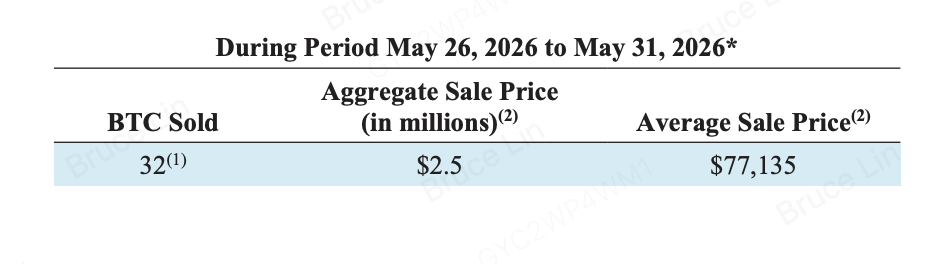
The scale of the transaction is important. Strategy still holds more than 843,700 BTC, making the sale almost insignificant relative to its overall treasury position. Based on recent reporting, the sale represented approximately 0.004% of the company's total Bitcoin holdings.
This distinction matters because selling a small amount of Bitcoin to satisfy a specific financial obligation is fundamentally different from reducing a treasury allocation or abandoning a long-term accumulation strategy. In practical terms, Strategy remains overwhelmingly exposed to Bitcoin price appreciation.
How Large Is Strategy's Bitcoin Treasury Today?
Strategy remains the largest corporate Bitcoin holder in the world.
Recent filings show the company controls approximately 843,706 BTC acquired at an average purchase price near $75,699 per Bitcoin. At current market valuations, the treasury is worth tens of billions of dollars and represents one of the largest Bitcoin positions globally.
Does the Sale Mean the HODL Strategy Is Over?
Most analysts believe the answer is no.
Several market analysts described the transaction as economically immaterial and argued that it does not alter Strategy's long-term accumulation thesis. According to recent reporting, Wall Street analysts generally view the sale as a tactical move designed to support capital structure obligations rather than a signal that Strategy plans to become a regular Bitcoin seller.
The company's actions also support this interpretation.
Even after selling 32 BTC, Strategy continues to hold more than 843,000 BTC. The company remains more heavily invested in Bitcoin than any other publicly traded corporation. A meaningful strategic reversal would likely involve substantial treasury reductions, which have not occurred.
Furthermore, Strategy has continued raising capital through equity and preferred-share offerings in order to support its broader Bitcoin-focused corporate model. Recent company statements continue to emphasize Bitcoin accumulation and Bitcoin-per-share growth as key objectives.
Why Analysts Are Not Concerned
Analysts point to three major reasons why the market may be overreacting.
First, the amount sold is negligible compared with total holdings.
Second, the proceeds were directed toward dividend obligations rather than operational distress.
Third, Strategy had already indicated that selective Bitcoin sales could occur under specific circumstances. Executives previously suggested that limited Bitcoin sales may be used if they improve long-term shareholder value or support capital management objectives.
As a result, many institutional observers view the sale as a technical adjustment rather than a philosophical shift.
Why Did the Market React Negatively?
The market reacted negatively because the sale challenged one of Bitcoin's most recognizable narratives.
For years, Michael Saylor repeatedly advocated a strict HODL approach and became one of the most visible proponents of never selling Bitcoin. As a result, investors came to view Strategy's Bitcoin treasury as effectively untouchable.
When the company disclosed a sale, even a tiny one, investors interpreted it as a symbolic break from that commitment.
According to recent market reports, Strategy shares fell between 5% and 7% following the announcement, while Bitcoin also experienced short-term weakness.
The reaction illustrates how strongly market sentiment can be influenced by expectations rather than economic reality.
The Importance of the "Never Sell" Narrative
The controversy is largely psychological rather than financial.
Many investors assigned a premium valuation to Strategy because of its unwavering commitment to accumulating Bitcoin. The idea that the company would never sell reinforced confidence that its treasury would continue expanding over time.
Once that assumption changed, some investors worried that future sales could become more frequent.
However, critics of this concern note that every corporate treasury must maintain some degree of financial flexibility. Selling a tiny amount of Bitcoin to satisfy dividend obligations is very different from abandoning a Bitcoin-first balance sheet strategy.
Could Strategy Sell More Bitcoin in the Future?
The company has acknowledged that future Bitcoin sales are possible.
Recent executive commentary suggests Strategy is willing to sell limited amounts of Bitcoin when doing so improves financial efficiency or supports shareholder returns. This represents a more flexible approach than the absolute "never sell" position previously associated with Michael Saylor.
That said, flexibility does not necessarily imply large-scale liquidation.
The company's business model remains deeply linked to Bitcoin ownership. Significant Bitcoin sales would undermine the investment thesis that attracts shareholders and preferred-stock investors in the first place.
Many analysts therefore expect future sales, if they occur, to remain limited and strategic.
What Financial Pressures Is Strategy Managing?
Strategy has expanded beyond simply holding Bitcoin.
The company now operates a sophisticated capital structure involving common shares, convertible securities, and multiple preferred-stock products. These instruments create dividend obligations and financing requirements that occasionally require liquidity management.
Recent market commentary highlights that maintaining dividend payments while preserving shareholder value has become an increasingly important objective. Small Bitcoin sales may therefore function as a treasury-management tool rather than a source of long-term funding.
This evolution reflects the reality that Strategy has become both a Bitcoin treasury company and a public-market financing vehicle.
What Does This Mean for Bitcoin Investors?
The immediate impact on Bitcoin itself appears minimal.
A 32 BTC sale is insignificant relative to both Strategy's holdings and Bitcoin's daily trading volume. The transaction does not materially affect Bitcoin supply, liquidity, or market structure.
Instead, the event matters because it reveals how institutional Bitcoin holders may manage their assets as the ecosystem matures.
Corporate treasuries are increasingly treating Bitcoin as a strategic reserve asset rather than a speculative trade. Like other reserve assets, Bitcoin can occasionally be used to support broader financial objectives without changing the underlying investment thesis.
For long-term Bitcoin investors, the more important takeaway is that Strategy remains one of the largest and most committed corporate holders in the market.
The company's balance sheet continues to be overwhelmingly aligned with Bitcoin's long-term success.
Conclusion
Strategy's sale of 32 Bitcoin marks an important symbolic moment because it ended a four-year period without any Bitcoin disposals. However, the transaction appears far less significant than many headlines initially suggested.
The sale represented only about 0.004% of the company's total Bitcoin holdings and was conducted primarily to support preferred-stock dividend payments. Most analysts view the move as a tactical treasury-management decision rather than evidence that Strategy is abandoning its Bitcoin-first corporate strategy.
While the company has adopted a more flexible stance toward occasional Bitcoin sales, its balance sheet remains overwhelmingly concentrated in Bitcoin. With more than 843,000 BTC still on its books, Strategy continues to be the largest corporate Bitcoin holder in the world and one of the most influential participants in the digital asset ecosystem.
For investors, the key lesson is that corporate Bitcoin adoption is evolving. Strategic asset management does not necessarily contradict a long-term bullish outlook. At least for now, the evidence suggests that Strategy's commitment to Bitcoin remains firmly intact, even if its approach has become slightly more pragmatic.
FAQs
-
How much Bitcoin did Strategy sell?
Strategy sold 32 BTC between May 26 and May 31, 2026, generating approximately $2.5 million in proceeds.
-
Was this Strategy's first Bitcoin sale ever?
No. It was the company's first Bitcoin sale since 2022, making it the first sale in roughly four years.
-
How much Bitcoin does Strategy still own?
Strategy still holds approximately 843,706 BTC, making it the largest corporate Bitcoin holder globally.
-
Why did Strategy sell Bitcoin instead of issuing more shares?
Management indicated that selling a small amount of Bitcoin could be a more efficient way to fund dividend obligations while limiting shareholder dilution.
-
Could other corporate Bitcoin holders follow the same approach?
Yes. As corporate Bitcoin adoption grows, some companies may periodically sell small portions of their holdings for treasury management, liquidity needs, or shareholder-related obligations without changing their long-term Bitcoin strategy.