

Jensen Huang: Why AI Memory Chip Oversupply May Not Arrive Until 2029
Introduction
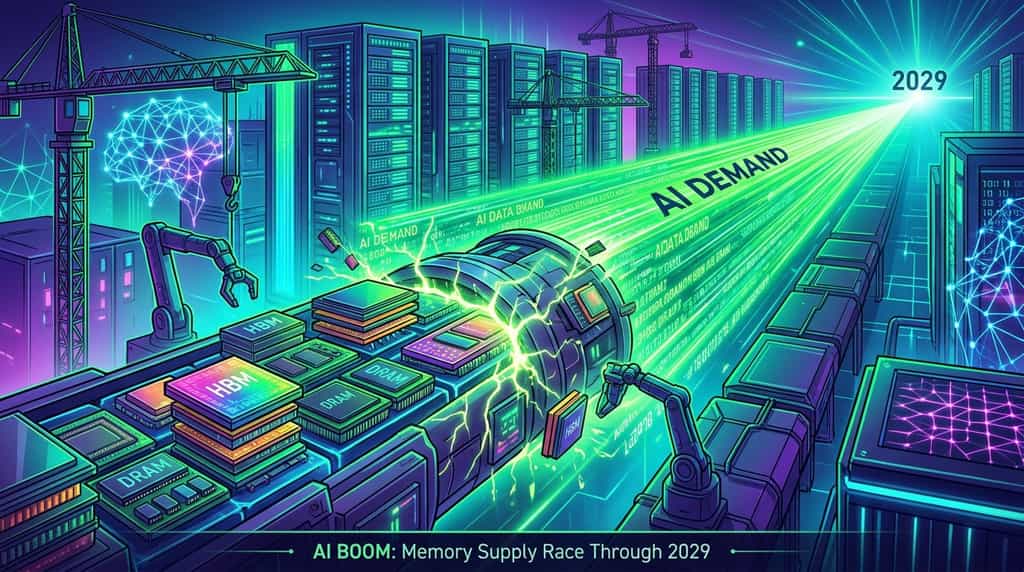
Could the artificial intelligence boom keep memory chips in short supply through 2029? NVIDIA CEO Jensen Huang believes a major memory glut is unlikely by that year, arguing that expanding AI workloads will continue to require more memory. His view challenges concerns that manufacturers could add too much capacity after a period of rapid investment, potentially triggering a sharp downturn in the semiconductor cycle.
The debate matters because memory chips are essential components in AI servers, data centers, personal computers, and smartphones. High-bandwidth memory (HBM), server DRAM, and enterprise solid-state drives are particularly important as AI infrastructure expands. However, sustained demand does not guarantee permanently tight supply: production investments, technology transitions, customer spending, and inventory changes can all alter market conditions.
In 2026, the key question is whether AI-driven memory demand can absorb new production capacity as it comes online. Understanding Huang's argument requires examining the role of HBM, the time needed to expand manufacturing, the difference between memory products, and the risks that could still produce an oversupply.
Why Does Jensen Huang Believe Memory Chip Oversupply May Not Happen Before 2029?
Huang's argument is that AI systems will continue consuming more memory as models, data centers, and computing workloads expand. In comments reported from NVIDIA's GTC event in Berlin on October 22, 2026, he expressed doubt that memory supply would exceed demand by 2029 and emphasized the continuing usefulness of greater memory capacity. His view reflects the changing role of memory in AI infrastructure, where performance increasingly depends on moving large amounts of data efficiently as well as processing it.
Memory is not a single interchangeable product. AI systems use different types of memory for different tasks, including HBM positioned close to accelerators, DRAM used by servers and other computing systems, and NAND-based storage used in solid-state drives. As AI workloads grow, demand can rise across several of these categories, although the scale and timing will vary.
However, Huang's comments are a forecast, not a guarantee. Memory demand could weaken if AI infrastructure spending slows, efficiency improvements reduce memory requirements per task, or manufacturers add capacity faster than customers consume it. The central question is whether growth in AI-related demand will outpace the combined effect of new factories, higher production yields, and changing customer inventories.
How Is AI Driving Demand for HBM, DRAM, and NAND?
AI infrastructure is increasing demand for several memory technologies because models need fast access to data, enough working memory to handle complex tasks, and storage for large datasets and model parameters. HBM attracts particular attention, but server DRAM and enterprise storage also play important roles in the overall system.
Why Is High-Bandwidth Memory Critical for AI?
HBM is designed to provide very high data bandwidth in a compact package near processors such as AI accelerators. It helps move data quickly between memory and compute units, reducing a key performance bottleneck in demanding AI workloads. As models become larger and inference activity expands, the amount of memory available and the speed at which it can supply data can influence system throughput.
HBM production is also technically demanding. Manufacturers must manage advanced packaging, power efficiency, thermal constraints, and yields, while keeping pace with new generations of AI processors. This means capacity cannot always be expanded as quickly as conventional manufacturing output might suggest. A factory's ability to produce memory chips does not automatically mean it can immediately deliver every high-value product required by AI customers.
Samsung Electronics' official second-quarter 2026 results reported record performance in its Memory Business amid strong AI demand and limited capacity. Samsung also described continued development and sales of HBM4 products. These company disclosures illustrate how AI demand is influencing product mix and manufacturing priorities, although they do not establish how long tight conditions will persist.
Why Do Server DRAM and Storage Matter Too?
HBM is only one part of the memory requirement. Server DRAM supplies working memory for CPUs and other system components, while enterprise solid-state drives store data and support workloads that cannot remain entirely in high-speed memory. AI systems can therefore increase demand across multiple products rather than relying on one memory type alone.
As AI applications expand, data centers need to balance bandwidth, capacity, latency, energy consumption, and cost. Different architectures make different trade-offs. Some workloads may prioritize HBM bandwidth, while others rely more heavily on server DRAM or storage. Improvements in software and hardware efficiency could also change how much memory each workload requires.
This diversity strengthens the argument that AI demand can support several segments of the memory market. It also complicates forecasts: a shortage in HBM does not necessarily mean every DRAM or NAND product is undersupplied. Investors and industry observers should evaluate each segment separately rather than treating memory as a single market with one supply-demand balance.
What Could Cause a Memory Chip Glut Before 2029?
A memory chip glut could emerge before 2029 if manufacturers expand capacity faster than customers increase consumption. Huang's forecast reflects confidence in long-term AI demand, but the semiconductor industry remains cyclical, and supply-demand imbalances can develop even when the underlying technology continues to grow.
Several factors could weaken the tight-supply outlook:
-
Slower AI infrastructure spending: Cloud providers and other large customers could delay data-center projects if returns take longer than expected or budgets tighten.
-
Faster production expansion: Multiple manufacturers could bring new facilities and equipment online around the same time, increasing available output.
-
Improved memory efficiency: Advances in hardware, software, and system architecture could reduce the memory required for some workloads or improve utilization of existing capacity.
-
Weaker demand from other industries: PCs, smartphones, and traditional enterprise systems also consume memory. If these markets weaken, total demand may not absorb all new production.
-
Inventory corrections: Customers may order aggressively during shortages and later reduce purchases once they have sufficient inventory, amplifying a downturn in orders.
These risks matter because memory manufacturing has high fixed costs and long investment cycles. When demand is strong, companies have incentives to expand capacity. If new supply arrives after market conditions change, manufacturers may face falling prices, lower utilization, and weaker margins. This pattern has occurred in semiconductor markets before and remains a relevant risk even during a major technology transition.
It is also possible for different memory segments to experience different conditions at the same time. HBM could remain constrained while some conventional memory products become more readily available. A broad claim that the entire market will either remain undersupplied or enter a glut may therefore conceal important differences between products, manufacturers, and customer groups.
Join KuCoin's Futures Trading Competition
Looking to put your market analysis and trading skills to the test? Join the KuCoin Futures Trading Competition and explore an opportunity to compete with other traders.

Whether you are tracking AI-related stocks like Micron or following broader market trends, disciplined risk management remains essential when trading volatile assets. Before participating, review the competition rules, eligibility requirements, reward details, and trading conditions on the official event page. Futures trading involves substantial risk and may not be suitable for every trader.
Conclusion
Jensen Huang's view that a memory chip oversupply may not emerge before 2029 reflects the growing importance of memory in AI infrastructure. As AI models and data centers expand, demand for HBM, server DRAM, and enterprise storage may continue to support the semiconductor industry. At the same time, advanced memory production requires significant investment, technical expertise, and time to bring new capacity into operation.
Recent disclosures from Samsung Electronics and SK hynix show how AI demand is influencing product priorities and financial performance. Deloitte's analysis also highlights the potential for supply constraints to persist while new capacity is being developed. These factors support the possibility of a prolonged period of tight supply, but they do not establish a guaranteed timeline.
A glut remains possible if manufacturers expand output faster than demand grows, AI infrastructure spending slows, or customers adjust inventories. Investors should monitor capacity additions, product-level pricing, customer commitments, and manufacturer financial results rather than relying on a single forecast. The central issue is not simply whether AI demand will increase, but whether that demand will grow quickly enough to absorb the supply that eventually reaches the market.
FAQs
1. What did Jensen Huang say about memory chip oversupply in 2029?
Huang expressed doubt that the memory market would face oversupply by 2029, arguing that AI infrastructure will continue to require substantial memory capacity. This is his outlook, not a guarantee of future market conditions.
2. Why does AI need so much memory?
AI systems need memory to hold model parameters, process data, and support the computing operations involved in training and inference. HBM supplies high bandwidth near accelerators, server DRAM supports system operations, and storage retains large datasets and other information.
3. What is the difference between HBM, DRAM, and NAND?
HBM is designed for high-bandwidth access near processors, DRAM serves as working memory in computers and servers, and NAND is commonly used in solid-state storage. Each technology serves a different purpose, so their supply and demand conditions can differ.
4. Does strong AI demand mean memory manufacturers will keep earning more?
No. Revenue and profit also depend on selling prices, production costs, manufacturing yields, competition, and capital expenditure. Strong demand can support results, but it does not guarantee that margins or earnings will continue to increase.
5. What is the biggest risk to the 2029 memory supply outlook?
The main risk is that new production capacity arrives faster than customers increase their purchases. Slower AI infrastructure investment, improved memory efficiency, or inventory corrections could also weaken demand and contribute to a market surplus.
Disclaimer
This general market information, possibly from third-party, commercial, or sponsored sources, is provided for reference and educational purposes only and does not constitute financial or investment advice, an offer, solicitation, or guarantee. We disclaim liability for its accuracy, completeness, reliability, and any resulting losses. Investments/trading are risky; past performance doesn’t guarantee future results. Users should research, judge prudently, and take full responsibility. For further details, please consult KuCoin’s Terms of Use and Risk Disclosure.