

Japan Raises Rates to 1%: The Era of “Borrow for Free” May Be Slowing Down
2026/06/16 16:29:00
Introduction
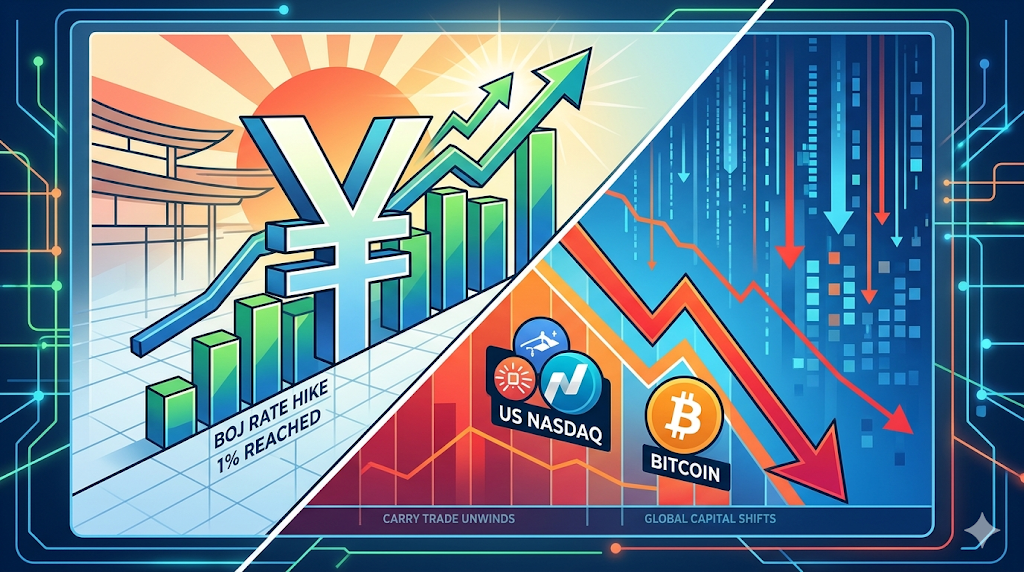
On June 16, the Bank of Japan voted 7–1 to approve its latest round of rate adjustments, raising the benchmark interest rate by 25 basis points to 1.0%.
This marks the first policy move since December 2025, following three consecutive meetings without changes. The 1.0% level represents an interest-rate height Japan has not seen in three decades—the last time rates reached this level was back in 1995. At the same time, the central bank announced that it will suspend further reductions to government bond purchases starting in April 2027, maintaining monthly purchases at approximately JPY 2 trillion.
For most retail investors, a Bank of Japan rate hike may sound like distant news. After all, Japan’s economy has been described as “lost” for thirty years, and fluctuations in the yen hardly seem relevant to someone holding U.S. stocks.
But reality may be quite the opposite. This policy shift in Tokyo could quietly reshape the direction of global capital flows—and your Nasdaq ETF, or even your Bitcoin holdings, may already be caught in the current.
A Thirty-Year Currency Trade Worth Trillions
To understand why the Bank of Japan’s rate hike matters, you first need to understand a mechanism that has operated across global markets for decades: the U.S.–Japan interest rate carry trade.
The logic is surprisingly simple:
Borrow Japanese yen at ultra-low cost → convert into U.S. dollars → invest in higher-yielding U.S. assets (Treasuries, tech stocks, etc.) → earn the interest differential.
For the past thirty years, Japan maintained ultra-low and even negative interest rates, making yen funding extraordinarily cheap. Meanwhile, U.S. benchmark rates—and expected returns from U.S. bonds and equities—remained significantly higher.
That spread created one of the largest arbitrage opportunities in global finance.
For example: suppose you borrow JPY 1 billion in Tokyo at an annual funding cost of 0.1%, convert it into U.S. dollars, and buy a 10-year U.S. Treasury yielding 4.5%.
Ignoring currency movements, you would earn roughly a 4.4% annual spread. Apply 10× leverage, and the absolute return becomes substantial.
This is far from a niche strategy.
Multiple estimates suggest that cumulative carry trade exposure has reached into the trillions of dollars, spreading across nearly every major asset class—from U.S. Treasuries and Nasdaq technology stocks to high-yield debt and emerging markets.
These flows operate like underwater currents beneath global markets: invisible most of the time, but capable of violently moving everything above the surface once the direction reverses.
More importantly, a meaningful portion of these positions are leveraged.
Investors are not only borrowing yen to buy dollar assets—they are often borrowing again to amplify exposure.
That means when interest rates or exchange rates shift, forced unwinding pressure can multiply.
What Does a 1% Rate Actually Mean? The Current Begins to Turn
Now let’s examine how this policy shift could affect markets.
First: funding costs are rising in real terms.
When Japan’s benchmark rate moves from 0.75% to 1.0%, all carry positions funded in yen become more expensive to maintain.
For highly leveraged strategies, higher financing costs directly compress profit margins. Once returns become too thin relative to risk, deleveraging becomes the rational choice.
Second: currency expectations are changing.
Rate hikes typically strengthen the domestic currency.
If the yen enters an appreciation cycle, investors holding U.S. assets while carrying yen liabilities face pressure from both sides: rising funding costs and worsening FX translation. The stronger the yen becomes, the stronger the incentive to unwind.
Third: Japanese domestic assets are becoming more attractive.
As Japanese government bond yields rise, local pension funds and insurance companies may increasingly allocate capital back into domestic markets.
These institutions have historically been among the world’s largest buyers of U.S. Treasuries. A shift in their allocation means reduced structural demand for U.S. Debt. Less buying pressure pushes Treasury prices down and yields up—raising financing costs across the broader U.S. economy.
For U.S. equities, these three channels point in the same direction:
the hidden liquidity tailwind supporting the market may weaken.
High-valuation sectors—especially technology and AI-related names—could face short-term selling pressure. The Nasdaq tends to be particularly sensitive because elevated valuations often depend on abundant and inexpensive liquidity.
Bitcoin’s Historical Pattern: None of These Episodes Were Easy
The impact of carry trade unwinding on crypto markets also deserves attention. Looking back at previous rounds of Bank of Japan tightening, Bitcoin showed a remarkably consistent reaction:
| Date | Policy Move | BTC Drawdown |
| Mar 2024 | End of negative rates | ~23% |
| Jul 2024 | +15bps to 0.25% | ~25–30% |
| Jan 2025 | +25bps hike | ~31% |
| Dec 2025 | +25bps hike | ~25% |
| Average | ~22–26% |
Four meetings. Four policy adjustments. Four meaningful corrections. This pattern is not necessarily coincidence. Bitcoin, as a high-volatility and high-beta risk asset, is highly sensitive to shifts in global liquidity.
When carry capital flows back into yen and dollar liquidity tightens at the margin, crypto often reacts more aggressively than traditional markets.
Of course, historical data is not destiny. But ignoring recurring patterns is equivalent to refusing to look at the sky before a storm.
There’s No Need for Panic
After discussing the risks, an important qualification is necessary: A single 25-basis-point hike is unlikely to trigger systemic collapse across global markets.
The reason is straightforward: The U.S.–Japan rate differential remains large.
Even at 1.0%, Japanese rates remain far below current U.S. policy rates. As long as that spread persists, the fundamental logic behind carry trades still exists.
Some marginal positions may unwind, but core positioning remains economically viable. The bigger issue is a longer-term scenario:
If the Bank of Japan continues hiking over the coming quarters while the yen enters a sustained appreciation trend, carry trade unwinding could evolve from a marginal disturbance into a broader liquidity drain.
At that stage, pressure on global risk assets would likely extend far beyond current expectations. The key today is not panic—it is observation.
Watch future BOJ guidance. Watch USD/JPY. Watch U.S. Treasury yields. Those indicators will reveal whether the current beneath the market is accelerating or slowing.
How Should You Invest in U.S. Stocks When Uncertainty Increases?
Global liquidity conditions are changing. Geopolitical risk remains unresolved. Concentrating all your exposure on one macro outcome may not be a resilient strategy. Three principles remain useful:
Principle 1: Use Dollar-Cost Averaging to Reduce Timing Risk
Trying to predict the exact day and magnitude of market reactions to yen tightening is extremely difficult. A better approach is disciplined investing:
Allocate fixed amounts at regular intervals into assets you believe in long term. If markets correct, you accumulate more at lower prices. If markets continue higher, your existing holdings appreciate.
You are not betting on direction—you are exchanging time for probability.
Principle 2: Build Structure Into Your Portfolio
Avoid exposing your entire portfolio to one assumption: permanently easy liquidity. A more resilient framework might look like:
Core Allocation (50–70%): Broad U.S. equity ETFs such as the S&P 500.
Defensive Layer (10–30%): Healthcare, utilities, consumer staples, or high-ROE, low-debt companies.
Stabilizer (10–40%): U.S. Treasuries or money-market funds based on age and risk tolerance.
These act as shock absorbers and provide dry powder during corrections.
Principle 3: Let Quality Survive the Cycle
When liquidity recedes, weak businesses get exposed first. Prioritize companies with real earnings power, durable moats, and healthy cash flows.
AI, cloud computing, and automation remain long-term trends.
But investors should distinguish between industry leaders with actual execution and companies supported only by narratives. The former may survive cycles. The latter often struggle when liquidity tightens.
Final Thoughts
Japan’s move to raise rates to 1% for the first time since 1995 is more than a numerical adjustment. It signals that a nearly three-decade experiment in ultra-loose monetary policy may be entering its final phase—and marks a potentially historic shift in global capital flows.
For investors moving from crypto into U.S. equities. This is an important perspective shift: U.S. stocks are not crypto. Their performance is shaped not only by narratives and sentiment, but also by monetary policy, cross-border capital movements, exchange rates, and macroeconomic forces.
Understanding how these forces work, accepting that they cannot be predicted perfectly, and building an investment discipline that does not depend on forecasting—that that may ultimately be more valuable than any individual stock recommendation.