

Google Could Take a Stake in Bitcoin Miner TeraWulf's $19.1B AI Project if Anthropic Defaults
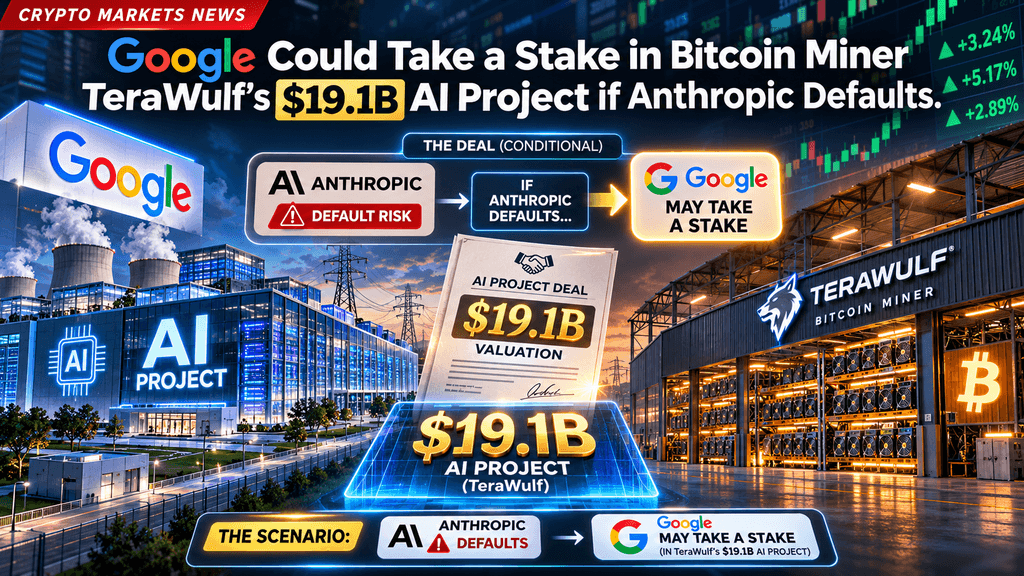
Google is providing credit support for Bitcoin miner TeraWulf's approximately $19 billion AI data center project with Anthropic, creating a financing arrangement that could give Google an ownership interest in the underlying infrastructure if the AI company defaults. Announced on November 4, 2026, the agreement supports a 20-year lease covering approximately 401 megawatts (MW) of critical IT capacity at TeraWulf's Justified Data Campus in Hawesville, Kentucky. If Anthropic fails to meet specified payment obligations or experiences a qualifying insolvency event, Google can either assume the lease and continue paying rent or, under applicable conditions, pay a termination fee and elect to acquire equity in the project's landlord subsidiary, Raylan Data LLC.
The transaction highlights a growing connection between artificial intelligence financing and the Bitcoin mining industry. TeraWulf is using its energy and infrastructure development capabilities to expand into high-performance computing (HPC), while Google is helping strengthen the financing structure behind Anthropic's long-term computing capacity. For cryptocurrency investors, the deal raises a broader question: could AI infrastructure become an increasingly important source of long-term revenue for Bitcoin miners as competition for computing capacity intensifies?
Key Takeaways
-
Google signed credit support agreements with TeraWulf, Anthropic, and related project entities on November 4, 2026, supporting approximately $19 billion in long-term Anthropic lease commitments.
-
The project covers approximately 401 MW of critical IT capacity at TeraWulf's Justified Data Campus in Kentucky, with phased delivery expected from late 2027 through the second quarter of 2028.
-
If Anthropic experiences a qualifying default, Google can assume the lease or exercise a contractual rejection option involving a termination fee and the right to acquire equity in Raylan Data LLC.
-
Google's potential ownership interest is in the project landlord subsidiary, not automatically in publicly traded TeraWulf shares (NASDAQ: WULF).
-
Anthropic's $895.4 billion in aggregate computing and infrastructure spending commitments highlight the financing demands associated with large-scale AI expansion.
-
The agreement demonstrates how Bitcoin miners can diversify into AI infrastructure by converting energy access and data center development capabilities into long-term computing leases.
What Is Google's $19.1 Billion TeraWulf AI Deal?
Google's agreement with TeraWulf is a contractual credit support arrangement designed to strengthen financing for a large AI infrastructure project leased to Anthropic. Rather than directly purchasing TeraWulf shares or acquiring the Kentucky data center, Google is providing a credit backstop for certain obligations under the long-term lease. This support can improve the project's financing profile by giving lenders additional contractual protection if Anthropic cannot fulfill its obligations.
The project is located at TeraWulf's Justified Data Campus in Hawesville, Kentucky. Its subsidiary, Raylan Data LLC, entered into a 20-year lease with Anthropic in July 2026, covering approximately 401 MW of critical IT load across three data center buildings identified as CB-1, CB-2, and CB-3. The approximately $19 billion headline contract value represents expected lease commitments over the contractual term rather than cash received upfront or guaranteed net profit. Anthropic's rent obligations begin when the relevant data hall is delivered, making construction and commissioning milestones central to the agreement's financial performance.
| Deal Component | Details |
| Bitcoin Miner | TeraWulf (NASDAQ: WULF) |
| AI Tenant | Anthropic |
| Credit Support Provider | Google LLC |
| Project Location | Hawesville, Kentucky |
| Contract Value | Approximately $19 billion |
| Lease Duration | 20 years |
| Critical IT Capacity | Approximately 401 MW |
| Data Center Buildings | CB-1, CB-2, and CB-3 |
| Expected Delivery | Late 2027 to Q2 2028 |
The November 4 announcement also included a definitive engineering, procurement, and construction (EPC) agreement with Fluor Enterprises for the three data center buildings. The agreement expands Fluor's responsibilities to engineering, procurement, construction, testing, and commissioning, with defined delivery milestones and cost-management provisions. TeraWulf expects phased ready-for-service completions to begin in late 2027 and continue through the second quarter of 2028.
How Could Google Acquire Equity in TeraWulf's AI Project if Anthropic Defaults?
The most significant part of the agreement is Google's ability to choose between assuming Anthropic's lease and terminating it in exchange for a contractual termination fee. These provisions are designed to protect the underlying infrastructure financing if the project's primary tenant experiences a qualifying payment default or insolvency event.
Option 1: Google Assumes Anthropic's Lease
If Anthropic fails to make required payments or experiences a qualifying insolvency event, Google can elect to assume the lease under the credit support agreement. In this scenario, Google would replace Anthropic as the tenant through a contractual novation process and become responsible for the applicable rent obligations. It would also have to pay qualifying outstanding rent and assume the relevant continuing obligations under the modified lease.
This option would allow Google to preserve the underlying data center arrangement rather than allowing the facility to lose its primary tenant. Given Google's substantial involvement in AI infrastructure and computing services, assuming the lease could provide access to capacity that may support its broader computing requirements. However, the agreement does not establish that Google would automatically exercise this option following any financial difficulty at Anthropic. The decision remains subject to the contractual default conditions and election procedures.
Option 2: Google Pays a Termination Fee and Acquires Project Equity
Google also has a contractual rejection option. If it elects this route, the applicable lease is terminated, and Google must pay a termination fee determined under the agreement's schedule. After paying the fee, Google can elect to acquire an equity interest in Raylan Data LLC, the landlord subsidiary associated with the project.
The equity interest is calculated using the termination fee paid relative to the total cost of developing the land and constructing the buildings and supporting infrastructure, including specified financing costs. In simplified terms:
Google Equity Interest = Termination Fee Paid / Total Project Development Cost
For example, if eligible project development costs were $1 billion and Google paid a $300 million termination fee, the contractual formula would produce a potential 30% equity interest, assuming the relevant costs and payment were established under the agreement. This is an illustrative calculation, not a disclosed estimate of the actual ownership percentage.
An important distinction is that Google would acquire an interest in Raylan Data LLC rather than automatically becoming a shareholder of TeraWulf Inc. The termination fee schedule and certain financial parameters in the publicly filed agreement contain redacted or unfilled information, so the actual potential ownership percentage cannot currently be calculated from the disclosed materials.
Why Google's Exit Options Are Subject to Conditions
The agreement also contains a significant timing restriction. Google generally cannot exercise the rejection option during the first six years after the relevant credit support agreement becomes effective unless an Equipment Capacity Trigger occurs. That trigger is linked to the installed TPU pods being capable of consuming less than 50% of the tenant's critical power when operational.
This provision matters because it limits Google's ability to terminate the lease immediately under the rejection option while preserving an alternative path under the assumption option. The agreement also provides a verification period following a qualifying default trigger, during which Google can review the circumstances before making its election. Under certain payment-default circumstances without an insolvency event, Google may also defer its election while covering specified unpaid rent.
These conditions demonstrate that the arrangement is more complex than a simple promise to buy the project if Anthropic fails. Google's rights, payment responsibilities, and potential ownership interest depend on the precise contractual triggers, timing restrictions, and financing arrangements.
Why Is Google Supporting Anthropic's AI Infrastructure?
Google's credit support reflects the growing financial requirements of large-scale AI computing. Training and operating advanced AI models require substantial computing capacity, including accelerators, networking systems, storage, electricity, and specialized data center facilities. As AI demand expands, companies such as Anthropic need to secure infrastructure years in advance rather than relying exclusively on short-term computing purchases.
Anthropic's Revenue Growth and Massive Compute Commitments
Anthropic's financial disclosures provide important context for the agreement. According to Reuters' November 2 report on the company's amended IPO filing, third-quarter 2026 revenue increased 47% quarter over quarter to $16.96 billion, compared with 144% growth in the second quarter. Its net loss narrowed to $23.29 billion from $66.3 billion in the previous quarter, while its operating results reflected a $567 million loss.
More importantly, Anthropic disclosed approximately $895.4 billion in aggregate computing and infrastructure spending commitments with partners. Nearly half of these commitments were expected to be incurred before the end of 2030, while approximately $69.8 billion was due during the 12 months following September 30, 2026. These figures represent contractual spending commitments rather than current debt or cash already paid.
Anthropic also warned that certain computing providers and infrastructure partners rely on third-party financing or credit support to acquire chips and develop capacity. If this financing becomes unavailable or more expensive, contracted computing capacity could be delayed, repriced, reduced, or not delivered. Google's agreement with TeraWulf addresses part of this infrastructure financing challenge by providing additional contractual credit support for a specific project.
Google's Strategic Interest in AI Computing Capacity
Google's participation also has a strategic dimension. As a major AI developer and cloud infrastructure provider, Google has an interest in maintaining access to reliable computing resources and supporting the broader expansion of AI infrastructure. Its credit support can strengthen TeraWulf's ability to obtain long-term project financing while providing Google with contractual rights if Anthropic cannot continue fulfilling the lease.
The arrangement also demonstrates how large technology companies can participate in infrastructure financing without immediately purchasing or operating the underlying facilities. Credit support, lease guarantees, long-term computing agreements, and infrastructure partnerships can help distribute project risks among developers, tenants, lenders, and technology companies. For Google, this creates a more flexible way to participate in the AI infrastructure ecosystem while maintaining contractual options tied to the project's future.
Google's TPU Strategy: Why Hardware Matters in the TeraWulf Agreement
The agreement's references to Google's Tensor Processing Units (TPUs) add another dimension to the transaction. TPUs are specialized accelerators developed by Google for machine learning workloads, including AI training and inference. They form part of Google's broader effort to build an AI computing ecosystem that combines hardware, cloud infrastructure, software, and enterprise services.
The credit support agreement defines an Equipment Capacity Trigger based on whether installed TPU pods can consume at least 50% of the tenant's critical power when operational. This provision is relevant to Google's contractual rejection option and should not be confused with a blanket requirement that all of Anthropic's computing capacity must use Google hardware. The distinction is important because the agreement establishes specific conditions around TPU capacity rather than proving that Google has replaced other AI chip suppliers across Anthropic's infrastructure.
For the semiconductor industry, the transaction highlights the growing competition between specialized AI accelerators and GPU-based computing systems. Nvidia remains a major supplier of AI GPUs, while Google is expanding the role of its proprietary TPU architecture. As AI infrastructure investment grows, hardware suppliers may compete not only on chip performance but also on software compatibility, power efficiency, availability, and the total cost of operating large computing clusters.
Why Is TeraWulf Moving From Bitcoin Mining to AI Data Centers?
TeraWulf's transaction reflects a broader transformation within the Bitcoin mining industry. Mining companies traditionally generate revenue by operating specialized ASIC hardware to validate transactions and compete for block rewards. Their profitability depends heavily on Bitcoin prices, network difficulty, mining efficiency, and electricity costs. AI and HPC infrastructure offer a different revenue model based on long-term computing leases and data center services.
Bitcoin Mining and AI Data Centers Share Infrastructure Requirements
Both businesses require substantial electricity, cooling systems, industrial facilities, and reliable power connections. Bitcoin mining facilities are designed around ASIC machines, while AI data centers require GPUs or other accelerators, high-performance networking, advanced cooling, and more demanding infrastructure configurations. Consequently, mining companies with suitable sites and energy resources may have an opportunity to redevelop or expand their facilities for AI computing.
However, converting a Bitcoin mining site into an AI data center is not automatic. AI customers often require different building specifications, power redundancy, network connectivity, equipment layouts, and operational standards. Companies must also secure construction financing, specialized hardware, and long-term customer agreements. TeraWulf's partnership with Fluor demonstrates the importance of dedicated engineering and construction capabilities in this transition.
TeraWulf's Long-Term AI Revenue Opportunity
The approximately $19 billion Anthropic lease could give TeraWulf a more predictable long-term revenue framework than relying exclusively on mining economics. Once the three data center buildings are delivered and rent obligations commence, the company expects to generate contracted revenue over a 20-year period, subject to the lease's terms and performance conditions.
A simple average of the approximately $19 billion headline value over 20 years would equal roughly $950 million annually. However, this calculation should not be interpreted as guaranteed annual revenue. Rent commencement depends on delivery of the relevant facilities, and actual cash generation will also depend on operating costs, financing expenses, construction performance, and contractual payment arrangements. The project therefore represents a significant infrastructure opportunity, but its ultimate profitability cannot be determined from the headline lease value alone.
How Does TeraWulf Compare With Other Bitcoin Miners Entering AI Infrastructure?
TeraWulf is part of a wider group of Bitcoin mining companies exploring AI and HPC opportunities. The attraction is clear: mining operators already understand large-scale electricity procurement, industrial infrastructure development, cooling, and data center operations. However, each company has a different strategy, project pipeline, customer base, and financing structure.
| Company | AI and HPC Strategy | Key Consideration |
| TeraWulf (WULF) | Long-term Anthropic lease at Justified Data Campus | Google credit support and 401 MW capacity |
| IREN (IREN) | AI cloud and GPU infrastructure | Computing capacity and customer contracts |
| Core Scientific (CORZ) | HPC data center hosting | Long-term infrastructure agreements |
| Hut 8 (HUT) | Energy and digital infrastructure development | Power-backed expansion |
| MARA Holdings (MARA) | Diversification into broader digital infrastructure | Capital allocation beyond mining |
TeraWulf's agreement stands out because it combines a large long-term AI lease with credit support from Google and a formal EPC agreement with Fluor. These arrangements create a financing and construction framework that may help the company transition from development plans toward operational AI infrastructure.
For other Bitcoin miners, the transaction could serve as an example of how energy access and infrastructure development capabilities may support new business models. Nevertheless, investors should compare actual signed contracts, construction progress, financing terms, and customer credit quality rather than assuming that every mining company can achieve similar economics.
What Are the Main Risks for TeraWulf and Its AI Infrastructure Project?
Despite the scale of the agreement, the project carries several risks that investors should evaluate before interpreting the $19 billion contract value as a measure of future profitability.
Construction and delivery are among the most immediate concerns. The three data center buildings are expected to become operational in phases from late 2027 through the second quarter of 2028. Delays in construction, equipment procurement, power connections, or testing could postpone rent commencement and increase project costs. Fluor's EPC agreement provides defined milestones and cost-management provisions, but it does not eliminate every execution risk.
Counterparty and financing risks are also important. Anthropic's large infrastructure commitments must be supported by sustainable revenue growth, access to financing, and continued demand for AI computing. Google's credit support provides contractual protection for specified obligations, but it is not an unlimited guarantee of every project liability or all of TeraWulf's corporate debt. The disclosed termination fee schedule also contains redacted information, limiting the ability to calculate Google's maximum potential equity interest.
Finally, technology and market conditions could change over the project's long development and operating life. AI accelerator performance, power efficiency, cloud pricing, and customer demand may evolve significantly over 20 years. TeraWulf will need to maintain competitive facilities and manage its capital structure to ensure that the project generates sustainable returns after construction and financing costs.
What Should Investors Watch Next?
The most important developments will be TeraWulf's project financing arrangements, construction milestones, and Anthropic's financial performance. The Google credit support agreement is intended to strengthen the financing structure, so investors should monitor the actual debt terms, borrowing costs, and the extent to which the credit support improves project economics.
The next major milestone is the phased completion of the three data center buildings. Progress toward ready-for-service delivery will determine when Anthropic's rent obligations begin and when TeraWulf can start generating revenue from the project. Investors should also examine whether Fluor meets the announced construction schedule and how the company reports project costs as engineering and procurement advance.
Anthropic's future revenue growth, operating losses, and computing commitments will provide additional information about its ability to sustain long-term infrastructure spending. Meanwhile, Google-related contractual developments, including the effectiveness of the credit support and the conditions governing its assumption and rejection options, will remain important. For cryptocurrency investors, the broader indicator is the contribution of AI and HPC activities to TeraWulf's revenue mix compared with its traditional Bitcoin mining business.
Conclusion
Google's credit support agreement with TeraWulf represents an important development at the intersection of AI infrastructure financing and the Bitcoin mining industry. By supporting approximately $19 billion in long-term Anthropic lease commitments, Google is helping strengthen the financing framework for a 401 MW data center project in Kentucky. If Anthropic experiences a qualifying default, Google can assume the lease or, under specified conditions, pay a termination fee and elect to acquire equity in Raylan Data LLC. The arrangement does not give Google an immediate ownership stake in TeraWulf itself. For TeraWulf, the project offers an opportunity to diversify beyond Bitcoin mining and establish a long-term AI infrastructure business. However, construction execution, financing costs, tenant credit quality, and technology changes will determine whether the agreement produces sustainable returns. Investors should focus on actual project delivery and cash flow rather than treating the headline contract value as guaranteed profit.
FAQs
Why Is Google Supporting TeraWulf's $19.1 Billion AI Project?
Google is providing contractual credit support for the financing of TeraWulf's long-term data center lease with Anthropic. The arrangement strengthens the project's financing profile and gives Google specific contractual options if Anthropic defaults on its obligations.
Can Google Own Part of TeraWulf If Anthropic Defaults?
Google can elect to pay a contractual termination fee and acquire an equity interest in Raylan Data LLC under specified conditions. Raylan is the project landlord subsidiary, so this does not automatically give Google shares in publicly traded TeraWulf (NASDAQ: WULF).
How Much Is TeraWulf's Anthropic AI Data Center Contract Worth?
The lease represents approximately $19 billion in contracted commitments over 20 years. It covers around 401 MW of critical IT capacity at the Justified Data Campus in Hawesville, Kentucky. This figure represents expected lease value over the contractual term, not immediate cash revenue or net profit.
Why Is TeraWulf Moving From Bitcoin Mining to AI Infrastructure?
Bitcoin mining and AI data centers both require significant electricity, cooling systems, and specialized facilities. By expanding into AI and HPC services, TeraWulf aims to diversify its revenue sources and build longer-term infrastructure contracts that are less directly dependent on Bitcoin mining economics.
When Will TeraWulf's Anthropic Data Center Project Become Operational?
TeraWulf expects phased ready-for-service completions to begin in late 2027 and continue through the second quarter of 2028. The schedule covers three data center buildings and depends on construction, equipment installation, testing, and commissioning.
Disclaimer: This general market information, possibly from third-party, commercial, or sponsored sources, is provided for reference and educational purposes only and does not constitute financial or investment advice, an offer, solicitation, or guarantee. We disclaim liability for its accuracy, completeness, reliability, and any resulting losses. Investments/trading are risky; past performance doesn’t guarantee future results. Users should research, judge prudently, and take full responsibility. For further details, please consult KuCoin’s Terms of Use and Risk Disclosure.