

Global Space Economy Investment Set to Top $100 Billion in 2026 as SpaceX IPO Fuels Growth
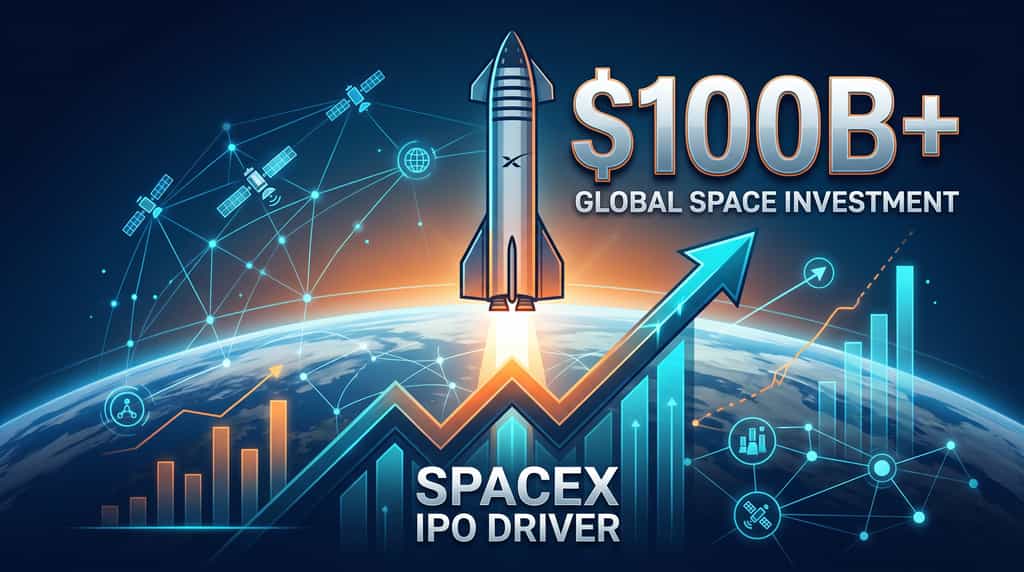
SpaceX IPO and Defense Spending Fuel Space Economy Investment Boom
Investment flowing into the global space economy is set to break the $100 billion mark for the first time in a single year during 2026. Space Capital’s third-quarter analysis shows $92.5 billion already deployed through the first nine months, surpassing the full-year record established in 2025, with $22.2 billion recorded in the third quarter alone. The surge is powered by SpaceX’s blockbuster initial public offering completed in June 2026, which raised approximately $75 billion at $135 per share and valued the company near $1.8 trillion, alongside elevated defense spending and the urgent need for expanded launch and orbital infrastructure.
This capital influx shows a structural move rather than temporary enthusiasm. Investors are reallocating toward companies that can address capacity bottlenecks created by SpaceX’s growing internal demands and its plans to phase out the Falcon 9, while governments seek independent satellite networks and sovereign space capabilities. The result is a broader, more diversified investment space in which more space firms are reaching unicorn valuations than at any previous point, even as high valuations introduce execution risks for business models dependent on still-maturing technologies.
Space Capital’s Q3 Figures Place 2026 on Track for Historic $100 Billion Milestone
Space Capital’s Space IQ report documents $22.2 billion invested across space infrastructure, distribution, and applications in the third quarter of 2026, bringing the year-to-date total to $92.5 billion. That nine-month figure already exceeds the previous full-year high set in 2025, positioning the sector for its first calendar year above $100 billion. The firm, which has tracked private-market space activity since 2017 and maintains one of the longest continuous datasets in the field, notes that the pace exceeds the intensity of the 2021 SPAC-driven cycle. Chad Anderson, chief executive of Space Capital, observed that the earlier boom “looks like a blip compared to what’s happening now.” The data cover more than 3,000 companies and are briefed quarterly in partnership with Nasdaq.
The composition of the capital reveals clear priorities. Pure-play launch companies alone secured a record $7.8 billion across 58 funding rounds through the third quarter. Infrastructure-related activity dominated overall flows, consistent with parallel reporting from Seraphim that showed space startups attracting $20.8 billion in the same quarter, nearly triple the prior period’s total even after adjusting for large individual rounds. North America continues to account for roughly 70 percent of global funding year-to-date, yet regional diversification is accelerating. The figures presented here, sourced from Space Capital’s publicly available analysis and supported by timely news reports, provide a solid foundation of reality rather than mere hopeful estimates.
SpaceX’s June 2026 IPO Recalibrates Valuations Across the Broader Space Sector
SpaceX priced its initial public offering at $135 per share in June 2026, raising approximately $75 billion and achieving a valuation of roughly $1.77 trillion to $1.8 trillion, the largest IPO on record. Shares began trading under the ticker SPCX and initially traded higher, showing intense institutional and retail demand. The transaction returned substantial liquidity to earlier private investors and simultaneously prompted market participants to reassess the strategic importance of other space companies. Anderson noted that the offering led investors to view additional space firms as more essential than previously assumed, contributing to elevated valuations and increased deal activity throughout the subsequent quarters.
The IPO’s influence extends beyond its own capital raise. By demonstrating that public markets will absorb large-scale space and related technology equity at premium multiples, it has encouraged both venture and growth investors to deploy larger checks into earlier-stage and growth-stage space businesses. At the same time, the company’s post-listing performance and operational priorities have created secondary effects, particularly around launch capacity allocation, that are now driving capital toward competitors. The combination of a successful mega-listing and the operational consequences of that company’s internal roadmap has produced a self-reinforcing cycle of higher sector valuations and accelerated fundraising.
Falcon 9 Phase-Out Plans and Capacity Constraints Open the Field for Alternative Providers
SpaceX has indicated its intention to sunset the Falcon 9 in the years ahead and has already stopped accepting rideshare reservations beyond late 2028. Starlink missions now constitute a substantially higher share of Falcon 9 flights than in earlier years, reducing available slots for third-party commercial payloads. Several satellite operators have been informed that capacity is effectively booked into 2028–2029. This tightening of supply has removed the long-standing assumption that Falcon 9 launches would remain readily available on commercial terms, prompting capital to move toward alternative launch solutions faster than policy or regulatory changes.
Anderson described the resulting scarcity as “the best thing to happen to the launch industry in a decade,” because it forces the market to develop second-, third-, and fourth-position providers. Investors have responded by funding companies capable of delivering independent launch capacity. The move is visible in the record capital flowing to pure launch firms and in the willingness of institutional investors to back vehicles still in development. The practical outcome is a more resilient launch ecosystem, albeit one that carries near-term schedule and technology risk for satellite operators dependent on timely access to orbit.
Blue Origin Completes Landmark External Fundraising Round of at Least $10 Billion
Blue Origin, founded by Jeff Bezos, completed its first external capital raise in 26 years, securing at least $10 billion. The round was reported as oversubscribed, indicating demand exceeded the amount the company sought. The financing arrives as the company advances its New Glenn vehicle and expands satellite constellation and infrastructure ambitions. For a firm previously funded almost entirely by its founder, the introduction of outside capital marks a significant maturation step and provides a valuation benchmark for peer companies.
The size of the raise places Blue Origin among the largest private financings in the sector this year and signals that deep-pocketed investors are prepared to support established alternative providers at scale. The capital is expected to accelerate vehicle development, manufacturing capacity, and operational cadence. Market observers note that the oversubscribed nature of the round reflects both the launch-capacity shortage and broader confidence in the commercial space infrastructure thesis that underpins the overall $100 billion investment direction.
Stoke Space Secures $1 Billion Series E to Advance Fully Reusable Nova Architecture
Stoke Space Technologies closed an initial $1 billion Series E financing round in September 2026, bringing its cumulative capital raised to $2.3 billion. The round was co-led by Point72 Ventures and Spark Capital, with participation from a range of growth and strategic investors. Proceeds will support preparation for the first orbital flight of the Nova Pathfinder vehicle, expansion of production and launch infrastructure, and continued development of the larger Nova Block 2 vehicle designed to deliver approximately 15 metric tons to low Earth orbit.
The company, founded by former Blue Origin engineers, is pursuing full and rapid reusability of both stages, an approach that differs from partial reusability models already in commercial service. The Series E valuation was described as being close to $10 billion, reflecting the excitement and confidence in the company's future. The funding arrives before Pathfinder has flown, illustrating investor willingness to back high-conviction technical architectures that address the capacity gap created by constraints on existing vehicles. The dual focus on near-term Pathfinder operations and the larger Block 2 vehicle positions Stoke to capture both rideshare and dedicated-mission demand as the market diversifies.
Pure Launch Providers Draw Record $7.8 Billion as Investors Seek Capacity Alternatives
Through the third quarter of 2026, pure launch companies raised a record $7.8 billion across 58 funding rounds. This figure represents a clear acceleration relative to prior periods and reflects the market’s response to tightening Falcon 9 availability. Capital has flowed to a range of developers pursuing reusable architectures, higher payload capacities, and more frequent flight rates. The concentration of capital in launch infrastructure underscores that access to orbit remains the foundational constraint for the broader space economy.
Investors appear to be pricing in both the near-term scarcity and the longer-term growth in satellite constellations, Earth observation systems, and government missions that will require multiple independent launch providers. The 58 rounds indicate breadth as well as depth: capital is not concentrated solely in a handful of late-stage players but is also supporting earlier-stage efforts. This diversification reduces systemic dependence on any single provider while creating a more competitive pricing and scheduling environment over time.
European space firms attracted $6.3 billion in the third quarter of 2026, accounting for 28 percent of global investment, the highest regional share since 2019, and marking a record for the second consecutive quarter. Year-to-date European totals reached approximately $13.5 billion, already exceeding any previous full-year figure for the region. The capital has supported a mix of launch, satellite manufacturing, and infrastructure activities aligned with both commercial and sovereign priorities.
The elevated European share demonstrates that capital is no longer confined primarily to North American ecosystems. Governments and investors across the continent are responding to the same capacity and sovereignty drivers visible elsewhere, resulting in larger individual rounds and broader participation. The sustained quarterly records suggest structural rather than one-off momentum, contributing meaningfully to the global trajectory toward $100 billion in annual investment.
Defense and Sovereign Requirements Drive Sustained Demand for Space Assets
High demand from the U.S. Department of Defense and from sovereign nations seeking independent satellite networks and space infrastructure forms a core pillar of the current investment cycle. Governments are prioritizing domestic capabilities for communications, Earth observation, positioning, and resilience, and reducing reliance on foreign providers. This institutional demand provides a more stable backlog for launch, manufacturing, and orbital infrastructure companies than purely commercial markets alone.
The combination of defense budgets and national space strategies has encouraged investors to fund companies that can deliver dual-use or government-aligned solutions. Capital is therefore flowing not only into pure commercial launch vehicles but also into manufacturing, ground systems, and constellation operators positioned to serve both civil and military customers. This dual-use dynamic lengthens the investment horizon and supports higher valuations for firms that can demonstrate credible pathways to government contracts.
Record Number of Space Unicorns Reflects Broadening Investor Confidence
Space Capital’s analysis explicitly notes that more space companies are reaching unicorn status, valuations of $1 billion or higher, than at any prior point. The proliferation of high valuations coincides with the larger capital inflows and the re-rating effect of the SpaceX IPO. New unicorn spans launch, satellite manufacturing, infrastructure, and application layers, indicating that investor confidence is not limited to a narrow set of business models.
While elevated valuations create liquidity and talent-attraction benefits, they also raise the bar for future performance. Companies that have raised capital at aggressive multiples must now demonstrate operational milestones, particularly in launch cadence, satellite deployment reliability, and revenue conversion. The rise in unicorn count is therefore both a measure of market maturity and a forward indicator of the execution challenges that will determine which firms convert paper valuations into sustained enterprises.
Launch Scarcity Accelerates Capital Deployment Beyond Traditional Dependence Models
The expiration of the long-standing assumption that Falcon 9 capacity would remain readily available has caused capital to move faster than policy responses. SpaceX’s decision to prioritize internal Starlink and Starship programs, combined with the eventual retirement of Falcon 9, has created a measurable shortage that satellite operators and investors can no longer ignore. Funding has therefore accelerated into alternative providers capable of offering independent access to orbit.
This dynamic is producing a healthier competitive landscape. Rather than concentrating risk in a single provider’s schedule and pricing, the market is financing multiple technical approaches. The result is higher near-term capital intensity but greater long-term resilience for the satellite and application layers that depend on reliable launch. Investors appear prepared to fund this transition because the alternative, continued single-provider dependence, has become operationally untenable for many customers.
Infrastructure Layer Commands the Majority of Recent Capital Allocation
Across both Space Capital and Seraphim datasets, infrastructure-related businesses, particularly launch and broader space-access companies, have absorbed the largest share of recent funding. Seraphim reported that launch and space-access ventures attracted $16.4 billion across 120 deals in the third quarter, dwarfing the $4 billion directed toward satellite communications, Earth observation, and other service companies. The emphasis on foundational capacity reflects the recognition that applications' growth is constrained by physical access to orbit.
This allocation pattern is consistent with historical technology cycles in which enabling infrastructure receives priority capital before higher-layer applications can scale. The current cycle is distinguished by the speed and absolute size of the infrastructure bets, driven by the visible capacity bottleneck. Capital providers are effectively underwriting the construction of a more diversified launch and manufacturing base so that downstream satellite and service markets can expand without recurring schedule risk.
Elevated Valuations Introduce Execution and Dependency Risks for Newly Funded Firms
Anderson has cautioned that free-flowing capital carries risk when companies raise at valuations that do not fully align with proven technical or commercial progress. Some business models remain dependent on vehicles, such as Starship, whose operational availability timelines are still uncertain. Firms that have structured their satellite architectures or constellation plans around specific future launch capabilities face schedule and cost exposure if those capabilities arrive later than anticipated.
The same high valuations that facilitate large raises also increase the performance threshold required to deliver returns. Investors and operators will monitor whether newly capitalized launch providers can achieve the flight rates, reliability, and cost structures needed to justify current pricing. The presence of these risks does not negate the fundamental demand drivers, but it does introduce selectivity into subsequent funding rounds and will likely differentiate successful execution from overcapitalized underperformance in the coming years.
Sustained Multi-Year Momentum Expected as Capacity and Sovereignty Drivers Persist
The combination of SpaceX’s public-market validation, measurable launch constraints, rising defense and sovereign demand, and record capital deployment into alternative infrastructure points to continued elevated investment levels beyond 2026. While quarterly totals may moderate from the exceptional third-quarter peak, structural underpinnings, capacity shortages, government prioritization of independent space capabilities, and expanding commercial satellite markets remain intact. Europe’s rising share and China’s accelerating infrastructure funding further indicate that the opportunity is global rather than confined to a single geography.
For market participants, the near-term focus will remain on converting capital into operational capacity. Launch providers that demonstrate reliable flight rates and satellite operators that secure diversified access will be best positioned to capture the growth enabled by the current investment wave. The data from Space Capital and corroborating sources establish that 2026 is already a watershed year; the durability of that milestone will depend on execution across the newly funded infrastructure base.
🔥 Beyond the Headlines: What KuCoin 5.0 Means for You
Market news moves fast — but where you act on it matters just as much. This October, KuCoin launches KuCoin 5.0, transforming KuCoin into a rebuilt platform. Here's what actually changes for you:
-
One account for everything. Older platforms split your money across separate "spot," "margin," and "futures" accounts and expected you to understand why. KuCoin 5.0's unified account removes that entirely — deposit once, and everything is simply there (only available to VIPs for now).
-
Stocks, indices, and commodities. KuCoin 5.0 expands beyond crypto into global markets. When crypto chops sideways and equities rally (or the reverse), you rotate in minutes instead of opening a brokerage account and waiting days for fiat rails.
-
Real-world assets (RWA). Tokenized exposure to traditional assets like commodities, right inside your crypto account. One of the fastest-growing segments in global finance is no longer reserved for institutions — you access it from the same balance you trade with.
-
Earn while you learn. Not ready to trade? KCUSD lets your stablecoins earn daily, auto-compounding interest. The lowest-stress way to put your idle deposit to work for 4% yield.
-
An AI assistant in plain language. Ask questions, get market context, understand what you're looking at — built into the platform, no jargon required.
-
An app that doesn't overwhelm. Faster, cleaner, and consistent — intuitive from the first tap, not after a tutorial.
-
Safety you can check, not just trust. A MiCAR-licensed EU entity, Proof of Reserves you can verify yourself, and internationally certified security (SOC 2 Type II, ISO 27001:2022).
Create your account in minutes — and start on the platform built for where crypto is going, not where it's been.
FAQs
What specific data supports the projection that space investment will exceed $100 billion in 2026?
Space Capital’s third-quarter Space IQ report shows $92.5 billion invested through the first nine months of 2026, already above the prior full-year record, with $22.2 billion deployed in the third quarter alone. The firm tracks private-market activity across infrastructure, distribution, and application layers and has published continuous data since 2017. Parallel reporting from Seraphim confirmed record quarterly startup funding levels, reinforcing the journey toward the $100 billion threshold for the calendar year.
How did SpaceX’s IPO specifically influence the broader investment environment?
The June 2026 offering priced at $135 per share raised approximately $75 billion and valued the company near $1.8 trillion, the largest IPO on record. Space Capital’s Chad Anderson stated that the transaction prompted investors to revalue other space companies as more essential, contributing to higher valuations and accelerated fundraising across the sector. The IPO also returned liquidity to earlier private investors while highlighting both the scale of opportunity and the operational constraints associated with the company’s internal priorities.
Why is launch capacity currently constrained, and how are investors responding?
SpaceX has stopped accepting rideshare reservations beyond late 2028 and is allocating a rising share of Falcon 9 flights to its own Starlink constellation while preparing to phase out the vehicle in favor of Starship. Multiple operators have been informed that commercial capacity is booked well into the future. Investors have responded by directing record capital, $7.8 billion year-to-date according to Space Capital, into pure launch companies capable of providing independent alternatives.
Which companies have raised the largest rounds related to the capacity shortage?
Blue Origin completed its first external financing in 26 years, raising at least $10 billion in an oversubscribed round. Stoke Space closed a $1 billion Series E to advance its fully reusable Nova Pathfinder and larger Block 2 vehicles. Pure launch providers as a category raised a record $7.8 billion across 58 rounds through the third quarter, reflecting broad participation beyond any single firm.
How significant is Europe’s contribution to the current investment cycle?
European space companies attracted $6.3 billion in the third quarter of 2026, representing 28 percent of global investment, the highest regional share since 2019, and marking a record for the second consecutive quarter. Year-to-date totals reached approximately $13.5 billion, already exceeding any previous full-year figure for the region. The capital has supported launch, satellite manufacturing, and infrastructure aligned with both commercial and sovereign objectives.
Disclaimer: This content is for informational purposes only and does not constitute investment advice. Investments carry risk. Please do your own research (DYOR).