

Will ESMT Be the Next Winner of the AI Memory Boom? What SanDisk’s Rally Tells Investors
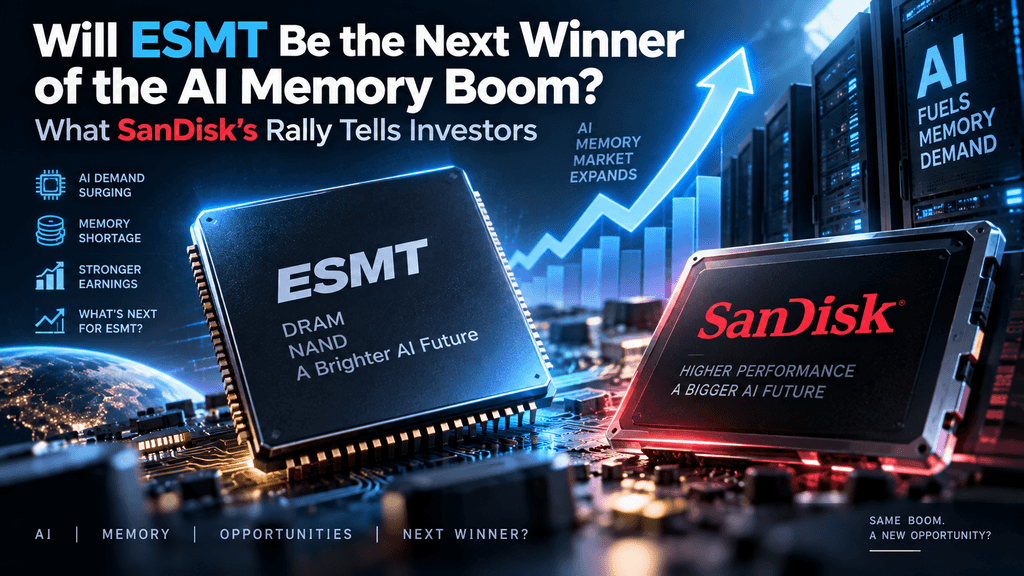
The AI memory boom is reshaping the global semiconductor industry as artificial intelligence infrastructure drives demand for faster, higher-capacity memory while tightening supply across other parts of the market. High-bandwidth memory, server DRAM and enterprise storage have become increasingly important to AI data centres, but the impact is spreading beyond the largest chipmakers. Specialty-memory suppliers are also attracting investor attention as limited capacity and higher prices create opportunities across conventional DRAM and Flash markets. Across digital assets, AI crypto markets provide a separate view of how the wider artificial intelligence investment theme is developing.
One company moving into focus is Elite Semiconductor Microelectronics Technology (ESMT, TWSE: 3006), a Taiwan-based fabless semiconductor company specialising in specialty memory. ESMT has recorded exceptionally strong growth in 2026 as tighter supply and rising memory prices strengthen its business, while its emerging aiPIM technology offers a longer-term connection to edge AI. At the same time, SanDisk’s roughly 632% stock rally in 2026 shows how dramatically investors can revalue memory companies when AI demand, pricing power and improving profitability converge. The comparison raises an important question for investors: could ESMT become one of the next major beneficiaries of the AI-driven memory cycle? The growing intersection between equities and blockchain markets can also be seen through tokenized securities, although these assets have different structures and risks.
Why Is ESMT Stock Surging as the AI Memory Boom Drives Record Revenue?
Elite Semiconductor Microelectronics Technology (ESMT, TWSE: 3006) has emerged as one of Taiwan’s fastest-growing memory-chip companies in 2026 as rising memory prices and tight semiconductor supply reshape the global market. ESMT reported NT$7.90 billion in consolidated August 2026 revenue, up 605.24% year over year, while cumulative revenue from January through August reached NT$35.90 billion, an increase of 324.38%. August also marked another record month for the company, extending a sharp acceleration that has made ESMT stock increasingly relevant to investors tracking the broader AI memory boom and semiconductor cycle.
The improvement is not limited to revenue. During the first half of 2026, ESMT generated NT$21.21 billion in revenue and NT$7.97 billion in net profit attributable to shareholders, producing basic EPS of NT$27.58. This represents a dramatic turnaround from the previous year and suggests that stronger memory pricing is flowing directly into profitability. Rising contract prices, constrained supply and stronger demand across specialty-memory markets have therefore become important factors behind ESMT’s earnings momentum and growing investor attention.
How the AI Memory Shortage Is Creating Pricing Power for ESMT
The broader AI memory shortage is helping create a favourable environment for ESMT, although the company benefits differently from major HBM producers such as SK hynix, Samsung and Micron. As large manufacturers dedicate more production capacity and capital to advanced memory used in AI servers, data centres and high-performance computing, supplies of conventional and specialty memory have tightened. That shift has reduced available capacity for mature products such as specialty DRAM and other legacy-memory categories where ESMT operates, allowing suppliers to negotiate stronger contract prices. Industry reports have also shown record revenue across several Taiwanese memory companies as customers compete for increasingly limited supply.
ESMT’s monthly revenue trend illustrates how quickly these market conditions have translated into business growth. Revenue increased from approximately NT$4.85 billion in June to NT$6.78 billion in July and NT$7.90 billion in August, showing continued acceleration as memory prices strengthened. For investors following ESMT stock, AI memory stocks and the 2026 semiconductor cycle, the key point is that ESMT does not need to manufacture leading-edge HBM to participate in the AI-driven memory boom. Tight capacity in other parts of the market, higher specialty-memory prices and rapidly improving earnings are already creating a powerful growth engine, while the durability of those conditions will help determine whether ESMT can achieve the kind of market re-rating already seen in larger memory names such as SanDisk.
How the AI Memory Shortage Is Boosting ESMT’s Specialty DRAM and Flash Business
The AI memory shortage is reshaping more than the market for HBM and advanced server memory. As Samsung, SK hynix, Micron and other major manufacturers direct more investment and production capacity toward HBM, DDR5 and high-performance AI memory, supply has become tighter across several conventional and specialty-memory categories. This shift is creating an important secondary benefit for companies such as ESMT, whose portfolio includes specialty DRAM, low-power DRAM, PSRAM, NOR Flash and NAND Flash used across industrial, automotive, networking and consumer applications.
Unlike the largest memory manufacturers, ESMT focuses heavily on specialized products and mature memory technologies rather than competing directly at the leading edge of HBM production. That positioning has become more valuable during the current memory cycle because customers still require older and application-specific memory even as global production priorities shift toward AI infrastructure. Limited manufacturing capacity, stronger contract pricing and resilient demand for specialty products are therefore helping ESMT participate in the broader AI-driven semiconductor upcycle without relying solely on direct AI data-centre sales.
-
Specialty DRAM Benefits as Major Suppliers Prioritise High-End AI Memory
One of the clearest effects of the AI boom is the growing pressure on legacy and specialty DRAM supply. Large memory producers can earn higher returns from HBM, DDR5 and other premium products used in AI servers, giving them an incentive to allocate more capacity and capital toward these categories. However, demand for DDR4, DDR3, DDR2 and other mature DRAM products has not disappeared. These chips remain embedded in industrial equipment, networking hardware, automotive electronics and a wide range of consumer devices, creating a supply-demand imbalance as fewer resources are devoted to producing them.
That imbalance can favour specialised suppliers such as ESMT. Industry reports indicate that mature-node memory capacity remains constrained, while customers continue competing for available supply. ESMT has reportedly indicated that available manufacturing capacity can satisfy only around 60–70% of customer demand, highlighting how tight conditions have become in some segments. For ESMT, this environment creates stronger pricing power, improved product mix and greater demand visibility, making specialty DRAM an increasingly important part of the company's exposure to the wider AI memory cycle.
-
Flash Memory Adds Another Layer to ESMT’s Supply-Shortage Opportunity
ESMT's exposure is not limited to DRAM. Its portfolio also includes NOR Flash, SLC NAND and other embedded-memory products, which serve applications requiring reliability, long product lifecycles and consistent supply. These characteristics make specialty Flash less interchangeable than high-volume commodity memory, particularly in industrial, automotive and embedded systems where customers may depend on specific product qualifications for many years.
The current AI-led reallocation of semiconductor investment can tighten these Flash markets as well. When major suppliers focus more heavily on advanced NAND, enterprise storage and AI-related products, mature Flash capacity can become relatively scarce. That supports firmer pricing for selected legacy and specialty products while giving smaller memory suppliers more room to capture unmet demand. For investors tracking ESMT stock and AI memory stocks, this broader product exposure matters because it means ESMT's opportunity extends beyond a single memory category. Specialty DRAM and Flash together provide multiple ways for the company to benefit from persistent supply constraints across the global memory market.
Why SanDisk’s 632% Rally Matters for ESMT and Other AI Memory Stocks
SanDisk’s approximately 632% rally in 2026 has become one of the clearest examples of how strongly investors are rewarding companies exposed to the AI-driven memory cycle. The surge has been supported by tighter NAND supply, rapidly improving pricing, expanding data-centre demand and stronger earnings visibility. In its fiscal 2026 results, SanDisk reported particularly strong growth in its enterprise and data-centre business as AI infrastructure increased demand for high-performance storage. For investors tracking ESMT stock and other AI memory stocks, the broader lesson is that memory companies can experience significant valuation re-ratings when supply constraints, higher selling prices and accelerating profitability appear at the same time. SanDisk therefore provides a useful benchmark for understanding how quickly market sentiment can change when memory fundamentals improve.
What SanDisk’s Re-Rating Could Signal for ESMT
The comparison does not mean ESMT will follow the same path or achieve a similar stock-market return. SanDisk is more directly exposed to enterprise NAND, AI data-centre storage and emerging technologies such as High Bandwidth Flash, while ESMT is positioned mainly across specialty DRAM, mature memory and embedded Flash markets. However, both companies illustrate a broader shift in which memory is becoming increasingly strategic to AI infrastructure. As manufacturers prioritise high-value AI products, constrained capacity elsewhere in the supply chain can create pricing opportunities for specialised suppliers that previously received less investor attention.
For ESMT, the important question is whether stronger memory-market conditions can translate into sustained earnings growth rather than a short-lived cyclical spike. SanDisk’s rally shows that investors are willing to assign higher valuations when rising prices are supported by structural AI demand, supply discipline and improving long-term visibility. If ESMT can maintain strong margins, secure sufficient manufacturing capacity and expand its role in specialty memory and emerging technologies such as processing-in-memory for edge AI, it could remain part of the wider search for the next beneficiaries of the AI memory boom. At the same time, SanDisk’s performance also highlights why investors should distinguish between temporary memory shortages and durable competitive advantages when evaluating AI memory stocks.
ESMT’s AI Memory Outlook: Key Catalysts, Risks and What Comes Next
ESMT’s position in the AI memory market now depends on whether it can turn favourable industry conditions into sustainable long-term growth. The company has already benefited from stronger memory pricing and constrained supply, but the next phase of the investment story will be shaped by product innovation, manufacturing access and its ability to expand into higher-value AI applications. For investors following ESMT stock, these longer-term factors may become increasingly important as the current memory cycle matures.
Edge AI and aiPIM Could Become a Longer-Term Growth Catalyst
One of ESMT’s most important emerging opportunities is its aiPIM technology, which is being developed for edge-AI workloads. By bringing computation closer to stored data, processing-in-memory could reduce data movement, improve power efficiency and support faster AI processing on devices. ESMT’s collaboration with Cadence, AP Memory and Taiwan’s Industrial Technology Research Institute (ITRI) adds technical credibility, but aiPIM is still an emerging opportunity rather than an established earnings driver. Commercialisation, customer adoption and deployment across edge-AI applications will therefore be important indicators of whether this technology can become a meaningful long-term growth engine.
Manufacturing Capacity and Memory Pricing Remain Critical
As a fabless semiconductor company, ESMT depends on external manufacturing partners, making wafer availability, foundry costs and production capacity important to its outlook. Tight supply can support pricing and profitability, but the memory industry remains highly cyclical, and conditions can change quickly if production expands or demand slows. Greater mature-node capacity, softer electronics demand or falling contract prices could reduce the benefits ESMT currently receives from constrained supply, making disciplined capacity planning and cost management important as the semiconductor cycle evolves.
What Investors Should Watch Next
For investors assessing the ESMT outlook, the most useful indicators will be gross margins, specialty-memory contract prices, customer demand, available manufacturing capacity and progress toward commercialising aiPIM. These metrics can help determine whether ESMT is building durable growth beyond the current memory upcycle. The company has several potential catalysts across specialty memory and edge AI, but long-term success will depend on maintaining profitability, executing new technology plans and navigating the volatility that remains a defining feature of the global memory-chip industry.
🔥 Beyond the Headlines: What KuCoin 5.0 Means for You
Market news moves fast — but where you act on it matters just as much. This October, KuCoin launches KuCoin 5.0, transforming KuCoin into a rebuilt platform. Here's what actually changes for you:
-
One account for everything. Older platforms split your money across separate "spot," "margin," and "futures" accounts and expected you to understand why. KuCoin 5.0's unified account removes that entirely — deposit once, and everything is simply there.
-
Stocks, indices, and commodities. KuCoin 5.0 expands beyond crypto into global markets. When crypto chops sideways and equities rally (or the reverse), you rotate in minutes instead of opening a brokerage account and waiting days for fiat rails.
-
Real-world assets (RWA). Tokenized exposure to traditional assets like commodities, right inside your crypto account. One of the fastest-growing segments in global finance is no longer reserved for institutions — you access it from the same balance you trade with.
-
Earn while you learn. Not ready to trade? KCUSD lets your stablecoins earn daily, auto-compounding interest. The lowest-stress way to put your idle deposit to work for 4% yield.
-
An AI assistant in plain language. Ask questions, get market context, understand what you're looking at — built into the platform, no jargon required.
-
An app that doesn't overwhelm. Faster, cleaner, and consistent — intuitive from the first tap, not after a tutorial.
-
Safety you can check, not just trust. A MiCAR-licensed EU entity, Proof of Reserves you can verify yourself, and internationally certified security (SOC 2 Type II, ISO 27001:2022).
Create your account in minutes — and start on the platform built for where crypto is going, not where it's been.
Conclusion
ESMT has become an increasingly important company to watch as the AI memory boom spreads beyond HBM and data-centre memory into specialty DRAM, Flash and mature semiconductor markets. Strong pricing conditions and constrained supply have strengthened its near-term position, while aiPIM gives the company a potentially more direct route into the growing edge AI memory market. These factors help explain why investors searching for emerging AI memory stocks are paying closer attention to ESMT.
However, SanDisk’s dramatic 2026 rally should be viewed as a reference point rather than a prediction of ESMT’s future performance. The longer-term ESMT stock outlook will depend on whether the company can convert favourable market conditions into sustainable earnings, secure sufficient manufacturing capacity and successfully commercialise new memory technologies. With AI continuing to reshape semiconductor demand and global memory investment, ESMT has a credible opportunity to participate in the next stage of the cycle, but memory pricing, execution and industry cyclicality remain important risks to watch. Across a different asset class, Bitcoin market cycles offer another reference for how quickly liquidity and investor sentiment can shift, although Bitcoin and semiconductor equities have fundamentally different market drivers.
FAQs
What does ESMT actually do?
Elite Semiconductor Microelectronics Technology (ESMT) is a Taiwan-based fabless semiconductor company focused primarily on specialty memory and mixed-signal IC products. Its memory portfolio includes specialty DRAM, low-power DRAM, PSRAM, NOR Flash and NAND Flash used across industrial, automotive, networking, consumer and embedded applications.
Is ESMT a pure AI memory stock?
No. ESMT has exposure to the AI memory boom, but it is not a pure-play AI memory company. Much of its current opportunity comes from specialty-memory markets, while projects such as aiPIM could provide more direct exposure to edge-AI computing over the longer term.
Does ESMT manufacture HBM for AI data centres?
ESMT is not currently positioned as a major HBM supplier comparable with SK hynix, Samsung or Micron. Its opportunity comes largely from specialty and mature memory products that can benefit when large manufacturers devote more resources to premium AI memory such as HBM and advanced server DRAM.
Why does older DRAM still matter during the AI boom?
Older memory standards remain widely used in industrial equipment, automobiles, networking devices and embedded electronics, where products often remain in service for many years. When manufacturers reduce investment in these mature technologies, continued customer demand can create shortages and support higher prices.
Which industries could support long-term demand for ESMT memory?
Beyond AI, ESMT can potentially benefit from demand across automotive electronics, industrial automation, networking equipment, IoT devices and consumer electronics. This diversified customer base means its growth prospects are not entirely dependent on spending by hyperscale AI data centres.
What would show that ESMT’s growth is becoming sustainable?
Investors can look beyond headline revenue growth and monitor gross margins, average selling prices, customer orders, inventory levels and available production capacity. Consistent profitability even after memory prices stabilize would provide stronger evidence that the business has developed lasting earnings power.
Disclaimer: This article is for informational purposes only and does not constitute investment advice. Market forecasts, company plans and technology adoption may change, so readers should conduct their own research before making financial decisions.