

The Empty Signature That Broke Bonzo Lend: A Post-Mortem of the $9M Hedera Exploit
2026/07/15 11:18:00
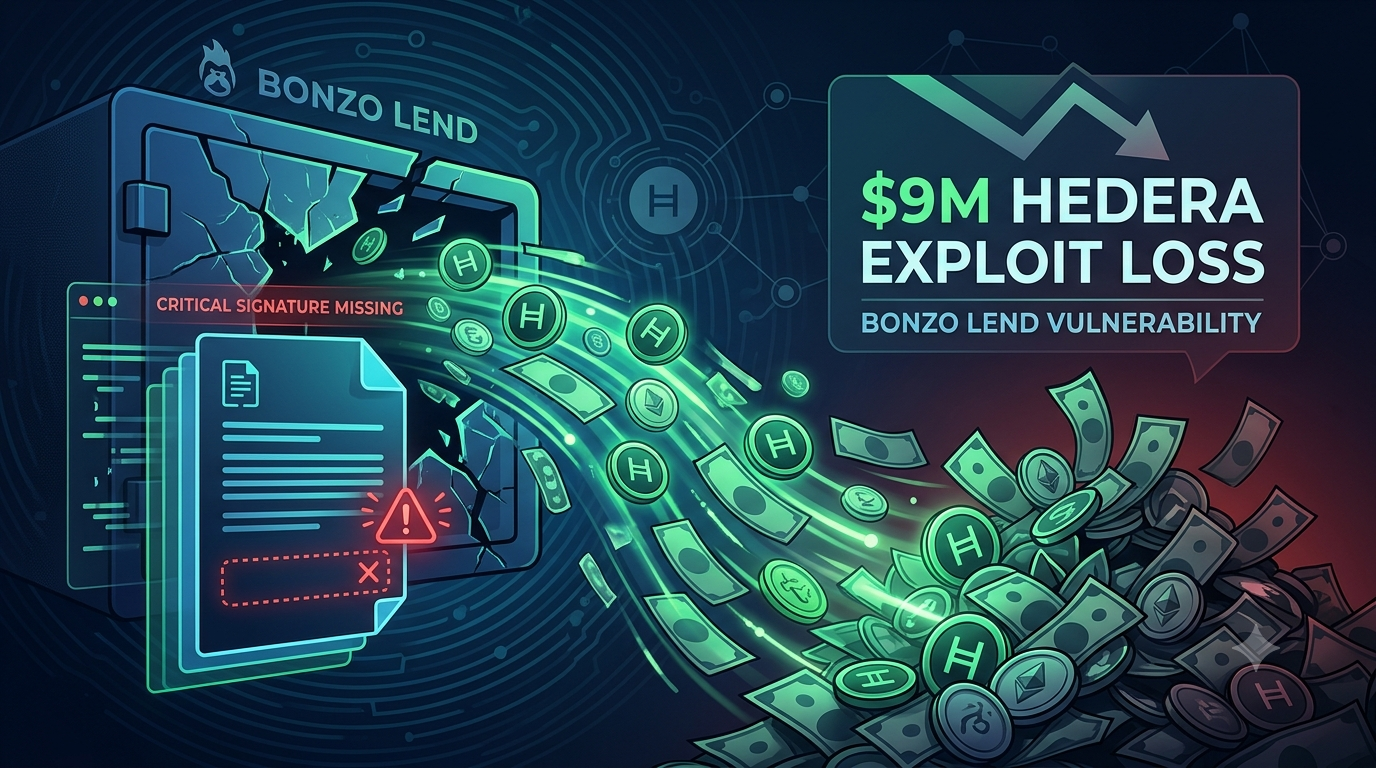
In mathematics and computer science, zero represents emptiness—the absolute absence of value. But in the fragile and hyper-connected ecosystem of Decentralized Finance (DeFi), an unchecked "zero" parameter recently became a digital master key. In a matter of minutes, this single unchecked empty value unlocked and drained over $9 million from a prominent lending platform.
The victim of this devastating exploit was Bonzo Lend, the largest lending protocol operating on the Hedera network. In July 2026, the protocol watched its Total Value Locked (TVL) plummet by a staggering 77% in a flash. As panic rippled through the Hedera community, observers scrambled to find the source of the leak.
Importantly, this catastrophe did not occur because Hedera’s underlying network consensus failed, nor did it happen because Bonzo Lend’s core lending calculations were incorrect. Instead, the disaster was born from a fatal integration vulnerability: a critical signature validation flaw within their third-party price feed provider, Supra Oracles. This is the post-mortem of how a tiny logical oversight regarding "nothing" brought down a DeFi giant.
Chronology of the Attack: From $5 to $9,000,000 in Seconds
The execution of the Bonzo Lend exploit was brilliant in its simplicity, requiring minimal starting capital and taking place in just a few transactional steps.
To initiate the heist, the attacker deposited a tiny, negligible amount of collateral into Bonzo Lend—specifically, 250 SAUCE tokens. At the time of the deposit, this collateral was worth only a few dollars, barely enough to buy a cup of coffee. Under normal protocol rules, this pocket change would allow the user to borrow only a fraction of its value in other digital assets.
Next, the attacker initiated the exploit by bypassing the verification checks of the price oracle. They crafted and submitted a forged price update transaction to the oracle’s validation contract. This transaction carried highly malicious data: it artificially inflated the price of the SAUCE token by an astronomical 12 orders of magnitude—effectively telling the protocol that a single SAUCE token was suddenly worth billions of dollars.
To push this forged price through, the system required a cryptographic signature from an authorized oracle node. Instead of attempting to break the complex cryptography or steal a private key, the attacker simply left the signature field completely blank, submitting a string of zeros in place of a cryptographic signature.
Because of a critical flaw in the validation logic, the contract accepted the blank signature as valid. Instantly, Bonzo's valuation system registered the attacker’s 250 SAUCE collateral as an asset of monumental value. Exploiting this sudden, artificial wealth, the hacker quickly withdrew 6.63 million USDC and 34.50 million wrapped HBAR (wHBAR) from Bonzo's liquidity pools, successfully draining the protocol before any alarm could be raised.
Demystifying the "Zero-Signature" Flaw: How the Code Failed
To understand how this exploit was possible, we must demystify the mathematics of digital signatures. In decentralized networks, cryptographic signatures act as digital wax seals. When an oracle node publishes a price update, it signs the data using a private key. The smart contract on the receiving end uses a verification algorithm to confirm that the signature matches the authorized public key of the oracle node.
Normally, if a user submits an invalid signature, the verification library tries to process the input and fails. When cryptographic verification libraries encounter malformed, empty, or completely zeroed-out inputs, they do not always throw an active error. Instead, many standard libraries are designed to output a default value when a signature cannot be parsed. In smart contracts, this default output is almost always a null address represented by a long string of zeros.
The fatal vulnerability in the oracle's validation contract lay in how it handled this default null address. The contract was programmed to check if the recovered signer matched an authorized oracle node address. However, the developers forgot to include a basic rule: rejecting any input where the signature length was zero or the recovered address returned a null value.
Furthermore, if the authorized signer state within the contract was uninitialized or configured in a way that permitted null checks, the contract compared the null address returned by the failed signature against its internal parameters and declared a match. Because the validation logic failed to distinguish between a "failed signature recovery" and a "valid authorized signer," the contract treated the empty signature as an absolute green light, approving the counterfeit price feed.
The Oracle Dilemma: Why DeFi Legos are Only as Strong as Their Weakest Link
DeFi is often celebrated for its "composability"—the ability of different protocols, tokens, and tools to connect like "Money Legos" to build complex financial applications. While composability enables rapid innovation, it also introduces systemic fragility. A single flaw in a fundamental building block can bring down the entire structural stack.
The Bonzo Lend exploit perfectly illustrates this vulnerability. Bonzo Lend itself was a well-structured lending protocol that had undergone safety audits. However, the protocol had to trust its external oracle dependency to provide accurate pricing. The moment the oracle’s validation system accepted the false price, Bonzo’s lending contracts executed exactly as they were written, allowing the heavily backed "wealthy" user to borrow assets.
The table below breaks down the distribution of structural responsibilities during the attack, illustrating where the defensive line collapsed:
| Component | Intended Systemic Role | Performance During Exploit | Structural Lesson |
| Hedera Consensus Layer | Keep the ledger state secure, order transactions, and maintain network uptime. | Performed perfectly with zero downtime or network-level exploits. | A secure network consensus layer does not guarantee application-level safety. |
| Supra Oracle | Deliver signed, cryptographically verified, and accurate asset price data. | Failed to reject a null signature, publishing a corrupted price. | Dependencies must be treated with zero-trust validation paradigms. |
| Bonzo Lend | Manage deposit assets, monitor loan health ratios, and process borrows. | Trusted the incoming price data blindly, failing to limit sudden price spikes. | Smart contracts must implement defensive logic to survive dependency failures. |
The White Hat Intervention: A $1 Million Race Against the Hacker
As the exploit unfolded on the public ledger, a dramatic secondary event took place. In public blockchains, transactions are visible in the "mempool" before they are finalized. This transparency allows other players, both malicious and ethical, to analyze ongoing attacks in real-time.
Shortly after the primary attacker began draining the protocol, an independent security researcher—commonly known as a "white hat" hacker—spotted the active exploit. Recognizing that the entire protocol was about to be emptied, the white hat quickly executed the exact same zero-signature vulnerability to withdraw approximately $1 million in assets.
This tactic, known as "front-running," is a common defensive maneuver in Web3 security. By taking the funds first, the white hat prevented the malicious actor from stealing that portion of the liquidity pool.
Following the successful withdrawal, the white hat immediately initiated contact with the Bonzo Lend team. After confirming their identity and intentions, the ethical hacker safely returned the entire $1 million to the protocol's recovery addresses. While the main attacker still escaped with the majority of the funds, this quick intervention preserved a vital portion of the community's assets and demonstrated the unique, collaborative nature of Web3 security.
Chasing the Millions: How the Stolen Funds Left the Hedera Ecosystem
Once the hacker successfully borrowed millions of dollars worth of USDC and wHBAR against their fake collateral, their primary objective shifted to escaping the Hedera ecosystem before the protocol could pause its contracts.
The attacker did not keep the stolen assets in their original form. Using SaucerSwap, a popular decentralized exchange on Hedera, the hacker quickly swapped the borrowed tokens into highly liquid stablecoins and native assets to avoid centralized freezing mechanisms.
Immediately after swapping the tokens, the attacker utilized cross-chain bridges, specifically routing the funds through LayerZero. By bridging the assets, the hacker moved more than $5 million in stolen funds directly onto the Ethereum mainnet.
Once assets cross over to a highly liquid, massive network like Ethereum, tracking and recovering them becomes exponentially more difficult. The funds can be split across hundreds of fresh addresses, deposited into decentralized privacy mixers, or swapped for non-custodial privacy coins. This rapid, automated escape route highlights why real-time monitoring and immediate emergency pauses are the only viable defenses against modern cross-chain exploits.
The Hard Lessons: How DeFi Protocols Can Shield Themselves from Oracle Disasters
The loss of $9 million is an incredibly expensive lesson, but it provides invaluable insights for smart contract developers looking to secure their applications against future integration errors.
To prevent zero-signature vulnerabilities, developers must adopt strict, defensive coding practices. Key structural improvements include:
-
Explicit Null Address Verification: Never assume a signature verification function succeeded. Every cryptographic validation routine must explicitly check that the signature length is greater than zero and verify that the output address does not resolve to a null value (
0x00...00). If a null value is returned, the transaction must instantly revert. -
Redundant Oracle Architectures: Relying on a single oracle provider creates a single point of failure. Robust DeFi protocols should fetch asset prices from multiple independent oracle networks (such as Chainlink, Pyth, and Supra simultaneously). If one feed deviates significantly from the median of the others, the protocol should flag the discrepancy and pause operations automatically.
-
On-Chain Price Circuit Breakers: Lending protocols must implement rate-limiting and price-deviation boundaries. Even if an oracle claims a token's value has increased a trillion-fold in a single block, the smart contract's internal circuit breaker should reject the update as an anomaly, halting any borrowing or liquidation actions until manual administrative verification occurs.
The Future of Smart Contract Audits: Why We Must Test the Boundaries
The Bonzo Lend exploit exposes a critical limitation in current Web3 auditing practices. Many security audits focus heavily on verifying that the business logic of a contract works under expected conditions—often referred to as "happy-path" testing.
However, real-world attackers do not follow the happy path. They search specifically for boundary conditions, uninitialized states, and unexpected inputs. The security industry must shift toward aggressive edge-case testing to uncover hidden flaws before code goes live on mainnet.
To achieve this, protocols must make advanced testing methodologies like fuzzing and formal verification a mandatory standard. Fuzzing involves using automated tools to flood smart contracts with millions of random, malformed, and empty inputs—including empty byte strings and null signatures. Had the verification contract been subjected to rigorous fuzzing, the zero-signature bypass would have been flagged instantly.
Ultimately, third-party oracle providers must also accept higher security standards. Because these data feeds serve as the foundation for hundreds of millions of dollars in economic activity, their verification code must be treated with the same level of scrutiny as the layer-one networks they support.
Conclusion: Restoring Trust in a Trustless Ecosystem
The Bonzo Lend exploit is a stark reminder of the unforgiving nature of smart contracts. In Web3, code is law, and the EVM does not care about your intentions. A minor logic gap regarding "nothing" can instantly wipe out years of development and millions of dollars in user trust.
In the wake of the attack, both Bonzo Lend and Supra Oracles worked quickly to patch the vulnerability and secure the remaining infrastructure. While the incident was painful, the lessons learned will inevitably lead to more secure integration standards across the entire DeFi landscape. For developers and investors alike, the ultimate takeaway is simple: never take integration security for granted, test the boundaries of your code, and always verify what happens when you feed nothing into your systems.
FAQs:
Q1: Does the "Zero-Signature" bug mean that blockchain cryptography itself is broken?
No. The mathematical principles behind digital signatures and public-key cryptography remain entirely secure. The exploit was caused by a logical programming flaw in the smart contract that handled the output of the cryptographic library. The library acted correctly by returning a null value when given a blank signature, but the contract incorrectly interpreted that null value as a successful verification.
Q2: Why did Bonzo Lend automatically trust such an absurdly inflated price for SAUCE?
Lending protocols are designed to be modular, meaning they offload the complex task of asset pricing to dedicated oracle networks. Because Bonzo Lend was built to accept the oracle’s price feed as the absolute truth without any independent, localized sanity checks or price-deviation limits, it accepted the artificial trillion-fold price increase and allowed the borrow transaction to proceed.
Q3: What can everyday DeFi users do to protect themselves from oracle-related hacks?
While users cannot control a protocol's code, they can manage their own risk. To protect your capital, diversify your assets across multiple independent platforms, avoid protocols that rely on a single oracle feed for niche assets, and look for platforms that have publicly integrated multi-source oracle systems and robust, on-chain emergency circuit breakers.
Disclaimer: This content is for informational purposes only and does not constitute investment advice. Cryptocurrency investments carry risk. Please do your own research (DYOR).