

Alphabet Raises $80 Billion in Biggest Equity Deal for AI Infrastructure
2026/06/03 17:58:00
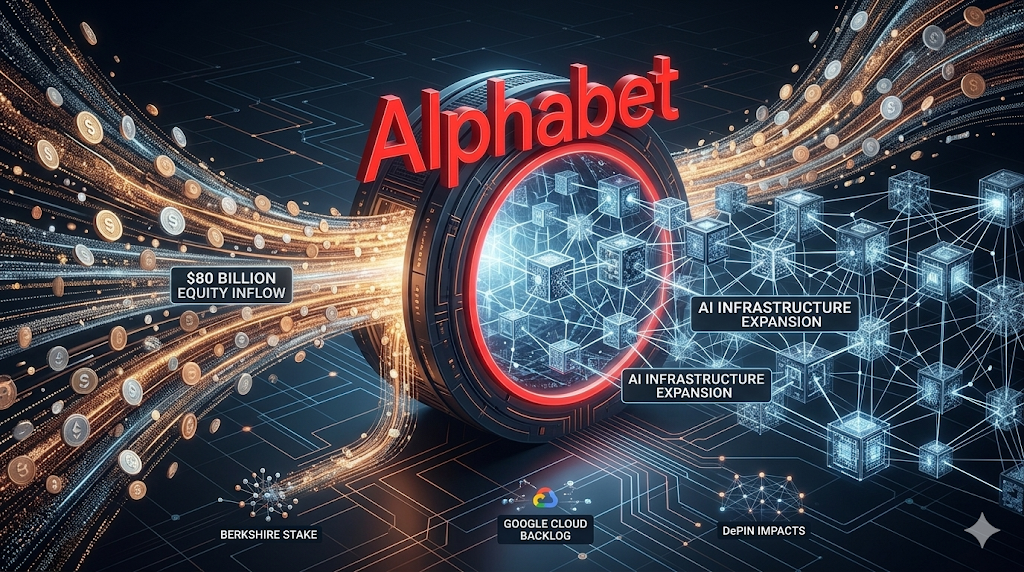
Did you know Alphabet announced the largest equity fundraising in modern history on June 1, 2026, targeting 80 billion dollars? The company executed this unprecedented stock sale to aggressively fund its massive artificial intelligence infrastructure expansion. Alphabet is scaling its global computing capacity because enterprise demand for AI solutions is currently exceeding available supply.
This historic pivot proves that even the most profitable technology giants cannot fund the generative AI arms race solely through internal cash flows.
The Alphabet 80 Billion Dollar Equity Capital Raise
Alphabet fundamentally altered its corporate financing strategy by launching an 80 billion dollar equity raise on June 1, 2026. The primary objective is aggressively expanding the company's artificial intelligence infrastructure and global compute capacity. Historically, Alphabet relied entirely on internal free cash flow and minimal debt to fund its operations. This massive share issuance indicates that the sheer scale of modern hardware requirements necessitates entirely new funding mechanisms to maintain long-term balance sheet health.
Berkshire Hathaway Private Placement
Warren Buffett's Berkshire Hathaway executed a 10 billion dollar private placement, officially endorsing Alphabet's long-term artificial intelligence strategy. Berkshire purchased 5 billion dollars in Class A common stock at 351.81 dollars per share and another 5 billion dollars in Class C stock at 348.20 dollars per share. According to Securities and Exchange Commission filings in June 2026, this massive investment cements Alphabet as one of the top five publicly traded holdings within the Berkshire portfolio.
Public Offerings and At-The-Market Program
The remaining 70 billion dollars will be raised through concurrent public offerings and a subsequent at-the-market program. Alphabet aims to raise 30 billion dollars immediately, split evenly between depositary shares tied to mandatory convertible preferred stock and standard common shares. Furthermore, the company will launch a 40 billion dollar at-the-market offering scheduled to begin in the third quarter of 2026. This staggered approach allows executives to systematically drip-feed new equity into the market over time.
Dilution and Shareholder Impact
While equity offerings inherently dilute existing shareholders, institutional analysts view this specific capital raise as highly accretive to long-term corporate value. The immediate market reaction was slightly negative, with shares dipping marginally in after-hours trading. However, issuing equity prevents the company from taking on dangerous levels of high-interest corporate debt. Investors generally accept short-term dilution when the incoming capital is strictly allocated toward securing dominance in the highly lucrative enterprise cloud computing sector.
Driving Forces Behind AI Infrastructure Expansion
The absolute necessity to deploy massive data centers is the primary driving force behind this historic equity deal. Alphabet explicitly stated in its June 2026 press release that current customer demand for artificial intelligence services drastically exceeds available hardware supply. To capture this unprecedented commercial opportunity, the company must build physical infrastructure faster than its competitors. Failing to expand capacity immediately would result in a catastrophic loss of institutional market share to rival technology conglomerates.
Skyrocketing Capital Expenditure Projections
Alphabet has officially raised its 2026 capital expenditure forecast to a staggering range of 180 billion to 190 billion dollars. According to financial statements released in April 2026, these expenditures represent a massive step up from previous historical averages. Corporate executives clearly warned that infrastructure spending will increase even further in 2027. This relentless financial commitment proves that the current phase of the technological revolution is the most capital-intensive industrial buildout in human history.
Custom Silicon and Google Cloud Backlog
Google Cloud operations are rapidly consuming these capital investments, driven by a massive surge in enterprise backlog orders. In the first quarter of 2026, Google Cloud revenue increased by an astonishing 63 percent year-over-year. The platform's revenue backlog nearly doubled to over 460 billion dollars, ensuring predictable, sustained cash flows for the next two years. Deploying custom silicon accelerators is entirely mandatory to process this massive backlog of highly complex enterprise data workloads efficiently.
Data Center Energy Requirements
Securing adequate electrical power remains the absolute most difficult logistical challenge when scaling global computational infrastructure. Modern neural networks require exponentially more electricity to train and execute queries than traditional search algorithms. Alphabet must utilize a significant portion of its newly raised capital to secure gigawatt-scale energy contracts and build localized cooling facilities. Physical energy constraints currently dictate the maximum speed at which technology giants can realistically deploy their newly purchased semiconductor components.
Financial Flexibility in the Generative Era
Maintaining maximum balance sheet flexibility is the core reason Alphabet chose to issue equity instead of utilizing internal cash reserves entirely. Although the company generated a massive 174 billion dollars in operating cash flow over the past twelve months, exhausting those reserves on data centers poses severe systemic risks. Issuing equity provides a necessary financial buffer against unexpected macroeconomic downturns. This conservative financial engineering ensures the company remains resilient during prolonged periods of market volatility.
Tax Obligations and Corporate Allocation
Alphabet intends to utilize approximately 30 billion dollars of the at-the-market offering proceeds specifically to cover impending corporate tax liabilities. These specific financial obligations stem directly from the vesting of extensive employee stock equity awards scheduled for late 2026. The remaining 50 billion dollars of the total equity deal is strictly earmarked for scaling artificial intelligence hardware. This clear capital allocation strategy prevents massive tax bills from interfering with the company's aggressive infrastructure deployment roadmap.
The Shift from Debt to Equity Financing
The strategic shift from corporate debt issuance to massive equity sales signals a fundamental change in Big Tech financial operations. Over the past year, Alphabet accumulated over 85 billion dollars in fresh debt across six major global currencies. Because the company already holds over 100 billion dollars in total debt, adding further leverage becomes mathematically inefficient due to elevated global interest rates. Equity sales currently provide the cheapest available capital for financing multi-year physical construction projects.
Surpassing Historical IPO Valuations
This 80 billion dollar secondary offering mathematically dwarfs the largest initial public offerings ever recorded in global financial history. According to a June 2026 analysis by Hargreaves Lansdown, this single equity raise is larger than the IPOs of Saudi Aramco, Alibaba, and SoftBank combined. The sheer magnitude of this financial maneuver highlights the unprecedented capital requirements of modern machine learning algorithms. Very few private or public entities possess the capacity to absorb this level of funding productively.
The Intersection of Big Tech AI and Blockchain Infrastructure
The severe hardware constraints crippling centralized technology giants actively supercharge the expansion of decentralized blockchain networks. As Alphabet consumes vast amounts of the global semiconductor supply, alternative software developers desperately turn to the cryptocurrency sector for computational resources. Decentralized physical infrastructure networks provide a vital, immediate alternative for startups locked out of traditional cloud computing environments. This symbiotic relationship permanently intertwines the macroeconomic trajectory of centralized artificial intelligence with the rapidly expanding Web3 digital ecosystem.
Decentralized Compute as a Relief Valve
Decentralized physical infrastructure networks operate as a critical relief valve for the severely overburdened global computing ecosystem. Blockchain protocols financially incentivize thousands of independent individuals to connect their consumer-grade graphics processing units to a shared global network. This permissionless architecture efficiently routes around the localized hardware bottlenecks completely dominated by corporations like Alphabet. By utilizing digital asset incentives, these decentralized networks routinely offer competitive processing power at a fraction of legacy cloud service costs.
AI Tokens and Web3 Synergies
Retail investors are actively utilizing artificial intelligence cryptocurrencies as liquid proxy investments to capture the immense value of this technological revolution. Because everyday traders cannot easily participate in multi-billion dollar private equity placements, they aggressively accumulate related digital infrastructure assets instead. Tokens powering decentralized data validation, automated algorithmic trading, and permissionless graphics rendering have experienced massive trading volume surges throughout early 2026. These blockchain assets successfully capture the intense speculative energy surrounding the broader machine learning industry.
Blockchain Verification for Algorithmic Outputs
Public blockchains provide the only mathematically reliable mechanism to verify the authenticity of outputs generated by massive language models. As automated content completely floods the modern internet, determining what is human versus machine-generated requires immutable, cryptographically secure ledgers. Smart contracts can securely timestamp the exact data sets utilized during neural network training, ensuring complete corporate transparency. This critical technological overlap absolutely guarantees that advanced AI models will heavily integrate with decentralized public blockchains in the near future.
Global Market Reaction and Sector Implications
The unprecedented scale of the Alphabet equity offering immediately sent shockwaves across the entire global technology and financial sectors. Institutional analysts recognize that this massive capital injection signals a brutal, prolonged capital expenditure war among the world's most valuable corporations. Based on May 2026 industry estimates, top technology conglomerates are projected to invest a staggering 725 billion dollars collectively into artificial intelligence this year. This aggressive spending forces all rival firms to drastically increase their own infrastructure budgets.
Semiconductor Supply Chain Pressures
This 80 billion dollar capital raise directly intensifies the severe pressures currently crippling the global semiconductor supply chain. Alphabet will rapidly deploy these funds to purchase massive quantities of advanced memory chips and proprietary application-specific integrated circuits. Consequently, smaller enterprise customers face devastating hardware shortages as top-tier fabrication plants dedicate all available capacity to filling Alphabet's massive orders. This unyielding institutional demand mathematically guarantees that premium silicon components will remain structurally scarce throughout the rest of the decade.
Assessing the Return on Investment Timeline
Institutional investors are increasingly demanding clear timelines regarding when these massive infrastructure investments will generate substantial corporate profits. While Alphabet boasts accelerating cloud revenues, the sheer size of the 2026 capital expenditure budget raises critical questions regarding long-term profit margins. Financial markets require concrete proof that enterprise software subscriptions can eventually offset the devastating costs of building gigawatt-scale data centers. If the return on investment heavily underperforms expectations, the entire technology sector faces a severe macroeconomic correction.
Competitive Pressures on Rival Tech Firms
Alphabet's aggressive fundraising forces rival technology firms to immediately reconsider their own balance sheet strategies to remain technologically competitive. Companies that previously relied on slow, steady internal cash flows must now seek massive external financing to match Alphabet's physical buildout. This intense financial pressure heavily penalizes smaller software companies that lack the market capitalization required to execute multi-billion dollar equity sales. The artificial intelligence arms race is actively transforming into a ruthless battle of pure financial attrition.
Assessing the Hardware Supply Chain Realities
The physical realities of semiconductor manufacturing dictate the absolute maximum speed at which Alphabet can successfully deploy its newly raised capital. Constructing advanced wafer fabrication facilities requires tens of billions of dollars and minimum lead times exceeding three to four years. Throwing an additional 80 billion dollars at the hardware problem cannot mathematically accelerate the strict chemical and physical processes required for lithography. Consequently, securing guaranteed delivery contracts remains more valuable than possessing raw unallocated financial capital.
Advanced Lithography Bottlenecks
Extreme ultraviolet lithography machines represent the single most critical bottleneck in the entire global artificial intelligence supply chain today. Only one European manufacturer successfully produces these massive, hyper-complex devices necessary to print the smallest, most advanced semiconductor nodes. International trade restrictions and strict physical manufacturing limits prevent this company from rapidly scaling its annual machine output. Therefore, Alphabet is heavily constrained by the strict delivery schedule of these specific machines, regardless of its massive available cash reserves.
High Bandwidth Memory Shortages
High bandwidth memory modules are entirely sold out through 2027, creating a severe operational hurdle for companies expanding their compute infrastructure. These advanced memory stacks are completely non-negotiable components required to operate modern graphics processing units without experiencing catastrophic thermal throttling. According to early 2026 supply chain analyses, major memory manufacturers prioritize bulk data center allocations over consumer electronics. Alphabet must utilize its newly raised capital to aggressively outbid competitors for these scarce, premium memory components globally.
The Role of Custom ASIC Deployment
Alphabet heavily prioritizes the aggressive deployment of custom application-specific integrated circuits to reduce its reliance on external hardware monopolies. The company continuously iterates upon its proprietary Tensor Processing Units, designing them specifically to run its own internal machine learning algorithms efficiently. This highly strategic vertical integration dramatically lowers long-term operational costs and reduces severe exposure to external semiconductor pricing volatility. Securing custom silicon perfectly guarantees that the company controls its own technological destiny throughout this aggressive expansionary phase.
The Broader Economic Impact of Big Tech Spending
The collective 725 billion dollar infrastructure spending spree executed by top technology companies profoundly impacts the broader global macroeconomy. This massive influx of corporate capital directly stimulates localized construction, commercial real estate, and heavy industrial manufacturing sectors worldwide. As technology giants rapidly build physical facilities, they aggressively hire specialized engineering firms, electricians, and advanced cooling technicians. This intense corporate spending effectively acts as a massive private stimulus package, significantly altering regional employment dynamics and economic growth metrics.
Inflationary Pressures from Capital Expenditures
Gigantic corporate capital expenditures inherently introduce localized inflationary pressures into specific industrial and raw material supply chains globally. When Alphabet demands thousands of tons of high-grade copper and structural steel for new data centers, global commodity prices surge immediately. This massive corporate consumption directly competes with traditional municipal infrastructure projects, forcing construction costs significantly higher for ordinary commercial developers. Central banks must carefully monitor this concentrated industrial spending when calculating aggregate national inflation data throughout 2026.
Institutional Pivot to Infrastructure
Global financial institutions are aggressively pivoting their long-term portfolios toward tangible physical infrastructure assets to support the digital economy. Venture capital firms that previously funded obscure consumer software applications are now financing power generation startups and specialized thermal management companies. This dramatic reallocation of global capital perfectly validates the thesis that the modern digital era relies entirely on massive physical infrastructure. Investors actively recognize that controlling the foundational hardware layer yields far greater returns than building easily replicated software interfaces.
Real Estate and Data Center Expansion
Commercial real estate markets are experiencing unprecedented structural shifts as technology conglomerates aggressively purchase massive tracts of industrial land. Suitable locations for modern data centers must feature immediate proximity to high-capacity electrical grids and robust fiber-optic communication networks. Finding real estate that satisfies these strict logistical requirements is incredibly difficult, driving severe bidding wars among the world's largest software companies. Consequently, specialized real estate investment trusts managing commercial data centers have become the most lucrative assets in traditional finance.
How to Trade AI Tokens on KuCoin
Since early-stage private equity allocations in tech conglomerates are often restricted to institutional entities, the cryptocurrency market provides an accessible alternative for individual participants to gain exposure to AI and decentralized physical infrastructure networks (DePIN). KuCoin lists a dedicated selection of machine learning and Web3 infrastructure digital assets, offering a liquid marketplace for interested traders.
To start trading, users must register an account and complete the Identity Verification (KYC) process to comply with standard financial and platform safety regulations. Once the account is funded via supported fiat gateways or digital stablecoins, traders can navigate directly to the Spot Market interface. From there, you can use the search feature to find specific infrastructure or decentralized computing pairs.
The platform equips traders with various tools to manage their portfolios, including automated Spot Grid trading bots, limit orders, and dollar-cost averaging (DCA) features. By utilizing these features, investors can systematically manage their market exposure at the intersection of blockchain innovation and artificial intelligence.
Conclusion
The historic 80 billion dollar equity raise executed by Alphabet redefines the financial requirements of modern corporate technology leadership. By issuing stock to fund its massive artificial intelligence infrastructure buildout, the company acknowledges that internal cash flows alone cannot sustain the pacing of the generative AI race. This unprecedented capital injection, anchored by Berkshire Hathaway's 10 billion dollar private placement, proves that institutions recognize the strategic necessity of expanding global compute capacity. Alphabet is moving aggressively to capture surging enterprise demand while systematically maintaining essential balance sheet flexibility.
Simultaneously, the sheer scale of this centralized infrastructure spending indirectly catalyzes interest in decentralized alternative networks globally. As technology giants heavily consume the world's available advanced semiconductor supply, alternative developers and smaller startups are increasingly exploring decentralized physical infrastructure networks (DePIN) for non-intensive computing power. This intersection of centralized hardware constraints and Web3 solutions forms a notable structural trend in 2026.
While the cryptocurrency market provides retail investors with a liquid mechanism to gain financial exposure to these digital infrastructure assets, participants must carefully evaluate the technological limitations and high volatility inherent in these early-stage blockchain protocols before allocating capital.
FAQs
Why is Alphabet raising 80 billion dollars in equity now?
Alphabet is raising 80 billion dollars in equity right now because the company must rapidly finance a massive expansion of its artificial intelligence data centers. In June 2026, the company explicitly stated that customer demand for its generative software solutions is vastly exceeding available hardware capacity. To aggressively capture this surging market share without taking on massive, high-interest corporate debt, Alphabet chose to utilize public and private equity markets to fund the necessary physical infrastructure buildout.
How is Berkshire Hathaway involved in this specific financial deal?
Berkshire Hathaway is involved in this deal by executing a massive 10 billion dollar private placement directly with the Alphabet corporation. The conglomerate purchased 5 billion dollars of Class A stock and 5 billion dollars of Class C stock at slight discounts to the public market price. This strategic transaction serves as a highly visible institutional endorsement of Alphabet's long-term artificial intelligence roadmap, immediately making the technology giant one of Berkshire's top five largest publicly traded holdings.
What is an at-the-market (ATM) stock offering program?
An at-the-market stock offering program allows a publicly traded company to gradually sell newly issued shares directly into the secondary trading market over time. Instead of selling a massive block of shares all at once on a single day, the company can intelligently drip-feed the equity based on favorable prevailing market prices. Alphabet plans to utilize a 40 billion dollar ATM program starting in the third quarter of 2026 to efficiently cover expected corporate tax obligations and general expenditures.
How does Big Tech AI spending impact the cryptocurrency market?
Big Tech artificial intelligence spending impacts the cryptocurrency market by completely exhausting the global supply of advanced semiconductor hardware and graphical processing units. Because smaller independent developers cannot physically acquire the necessary computing hardware, they are aggressively turning to decentralized physical infrastructure networks hosted on public blockchains. These cryptocurrency protocols financially incentivize individuals to share their idle hardware globally, heavily driving up the utility and absolute market valuation of specialized digital assets and infrastructure tokens.
Will this massive equity raise dilute current Alphabet shareholders?
Yes, this massive equity raise will mathematically dilute the ownership percentage of all current Alphabet shareholders because the company is issuing millions of brand new shares. However, institutional analysts frequently accept this short-term financial dilution if the newly raised capital generates significantly higher long-term corporate profits. Because the funds are strictly earmarked for highly lucrative enterprise cloud computing infrastructure, the market generally views strategic capital injection as structurally beneficial for the overall valuation of the technology conglomerate.
Disclaimer:This content is for informational purposes only and does not constitute investment advice. Cryptocurrency investments carry risk. Please do your own research (DYOR).