

THORChain RUNE Tokenomics Explained: Full Unlock, Supply Reduction, and Revenue Distribution
The cryptocurrency market has grown increasingly skeptical of tokens characterized by high inflation, low initial circulating supplies, and aggressive venture capital unlocking schedules. Modern investors are decisively pivoting away from these artificial, emission-based token architectures, aggressively seeking out sustainable ecosystems that offer verifiable real yield and genuine deflationary mechanics. Against this rapidly maturing financial backdrop, THORChain has solidified its position as the premier decentralized exchange for native cross-chain swaps, enabling global users to trade foundational assets like Bitcoin and Ethereum directly without relying on centralized intermediaries or fragile wrapped bridge tokens.
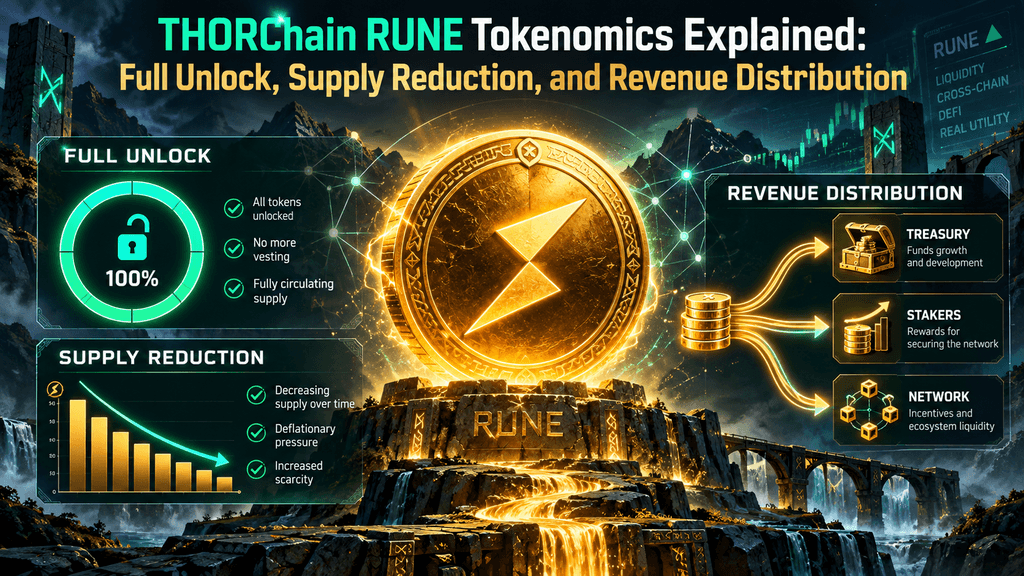
This article meticulously dissects the recent economic upgrades that have fundamentally transformed the value capture capabilities of the RUNE token. By thoroughly exploring its complete one-hundred-percent unlock schedule, its aggressive supply reduction strategies, and its highly transparent revenue distribution model, we will uncover how THORChain has engineered a deflationary ecosystem. This redesigned tokenomic structure is masterfully crafted to reward active participants, permanently reduce market sell pressure, and ensure the long-term protocol sustainability of the cross-chain swapping engine.
What Makes RUNE the Ultimate Utility Token?
The Heartbeat of Cross-Chain Swaps
Before diving into the intricacies of its recent economic upgrades, it is essential to understand the foundational utility that gives the RUNE token its inherent baseline value within the THORChain network. RUNE acts as the universal settlement asset for all liquidity pools across the protocol, meaning every single external asset paired on the decentralized exchange is fundamentally paired directly against RUNE. When a user requests a swap from native Bitcoin to native Ethereum, the protocol actually conducts two lightning-fast, invisible trades in the background: swapping the user's Bitcoin for RUNE, and then instantly swapping that RUNE for Ethereum, thereby maintaining deep liquidity and seamless execution across entirely disparate blockchain architectures.
Beyond its crucial role in routing liquidity, RUNE serves as the ultimate security mechanism protecting the decentralized infrastructure through a rigorous system of over-collateralization. Node operators, who are responsible for validating cross-chain transactions and securing the network's massive outbound asset vaults, are required to bond a substantial amount of RUNE that significantly exceeds the total value of the external assets they are securing. If a node operator attempts any malicious behavior or attempts to steal user funds, their bonded RUNE is immediately and irreversibly slashed to reimburse the affected liquidity pools, creating an impenetrable game-theoretic environment where operating honestly is strictly more profitable than attempting theft.
100% Fully Unlocked: Why Zero Vesting Matters to Investors
Escaping the "VC Dump" Trap
One of the most significant and pervasive risks plaguing modern cryptocurrency investments is the looming threat of cliff vesting and insider token unlocks, where early venture capitalists and founding teams suddenly flood the open market with previously restricted assets. THORChain has successfully bypassed this structural vulnerability entirely, as the RUNE token has officially reached a state of being one hundred percent fully unlocked, meaning there are absolutely no lingering vesting schedules for early investors, seed contributors, or development teams. This monumental milestone completely removes the anxiety of sudden, massive sell pressure originating from internal protocol entities, allowing the token to trade purely on the genuine merits of its open-market demand and network utility.
The total absence of a reserved team treasury or hidden insider allocations dictates that the current market capitalization of RUNE accurately and honestly reflects its fully diluted valuation, providing unprecedented transparency for both institutional fund managers and everyday retail investors. Unlike competitor protocols where the currently circulating supply might only represent a tiny fraction of the total eventual tokens destined to hit the market, THORChain’s fully unlocked status guarantees that all economic participants are operating on an even playing field. The network has definitively matured past its speculative launch phase into a robust financial primitive where the token supply is completely in the hands of the public.
A Circulation Driven by Network Activity
Because the total supply is now fully unlocked and distributed, the actual circulating availability of RUNE on secondary exchanges is dictated entirely by organic network dynamics rather than an arbitrary vesting calendar established years in the past. Millions of RUNE tokens are constantly being dynamically removed from active trading circulation as they are locked up in liquidity pools by yield-seeking users, or aggressively bonded by node operators seeking to earn high validation rewards. This organic, continuous locking mechanism creates a highly elastic circulating supply that naturally tightens and constricts exactly when network usage and cross-chain swapping volumes begin to surge.
This fundamental shift from timeline-driven circulation to activity-driven circulation drastically alters market psychology and permanently boosts investor confidence. Market participants clearly understand that any price appreciation is directly tied to the actual adoption and utilization of the decentralized exchange, rather than a desperate race to sell before the next scheduled team token dump. Consequently, the economic design brilliantly forces anyone who wishes to extract value from the network—including the original core developers and massive liquidity providers—to continuously participate in its security and daily operations, perfectly aligning the long-term financial incentives of all stakeholders.
Massive Supply Cuts: The Path to True Deflation
The Great Burn: From 1 Billion to 360 Million
The historical tokenomic journey of RUNE is defined by a series of aggressive and calculated supply reductions that have effectively transformed it from a moderately inflationary asset into a strictly deflationary powerhouse. Originally minted with a maximum theoretical supply cap of one billion tokens, the community quickly realized that such a massive figure was entirely unnecessary for the protocol's security architecture and voted early on to slash the maximum supply in half to five hundred million. This initial, massive reduction set a powerful precedent for a community-driven monetary policy focused intensely on creating deep scarcity and maximizing value accrual for long-term holders.
The unwavering commitment to supply reduction reached a historic milestone recently through the implementation of vital architecture decision records, specifically ADR-012 and ADR-023, which systematically targeted uncirculated reserve tokens for permanent destruction. Under ADR-012, the network successfully destroyed sixty million tokens from the standby reserve to optimize the lending protocol's collateral space, while the subsequent ADR-023 mandated the direct, immediate burning of an additional 64.4 million RUNE. Through these deliberate, governance-approved destruction events, the absolute maximum supply cap of RUNE has plummeted to approximately 360 million tokens.
| Historical Phase | Economic Action Taken | Resulting Maximum Supply Cap |
| Genesis Launch | Initial token generation event and distribution | 1,000,000,000 RUNE |
| Early Network Adjustment | Community vote to burn unnecessary excess issuance | 500,000,000 RUNE |
| ADR-012 Implementation | Standby reserve burned to optimize lending collateral | 440,000,000 RUNE |
| ADR-023 Implementation | Direct burn of remaining non-essential reserves | ~360,000,000 RUNE |
These monumental token burns were not mere marketing stunts designed to generate short-term hype, but rather calculated economic recalibrations designed to permanently increase the protocol's economic density. By completely destroying the excess standby reserves, THORChain eliminated structural dead weight from its balance sheet and drastically amplified the purchasing power and yield-bearing potential of every single remaining RUNE token currently held by node operators and liquidity providers.
The Continuous 1% Deflation Mechanism
While the massive, one-time token burns successfully recalibrated the macroeconomic ceiling of the entire protocol, THORChain also implemented an elegant, continuous destruction mechanism to ensure persistent and ongoing deflation. Within the architecture of the network's updated fee structure, exactly one percent of the real yield generated from cross-chain transaction fees is permanently burned and removed from circulation entirely. This brilliant mechanism means that every single time a user swaps Bitcoin, Ethereum, or any other supported asset across the network, a fractional amount of RUNE is destroyed forever, directly linking the scarcity of the token to the sheer volume of global network usage.
This continuous deflationary pressure operates silently in the background but compounds dramatically during periods of high cryptocurrency market volatility and elevated trading volumes. As decentralized finance adoption grows and THORChain processes billions of dollars in swap volume, this automated burn mechanism systematically chips away at the already vastly diminished maximum supply cap. Savvy investors view this structural feature as the ultimate hedge against monetary debasement, effectively transforming RUNE into a highly reactive asset that automatically becomes mathematically rarer precisely when the demand to use the network is at its highest.
Real Yield Generation: How THORChain Pays Its Ecosystem
The Incentive Pendulum: Balancing Security and Liquidity
THORChain aggressively differentiates itself in a highly crowded decentralized finance landscape by generating substantial daily revenue—routinely processing enough volume to yield tens of thousands of dollars a day—derived entirely from genuine cross-chain swapping fees rather than inflationary token printing. The distribution of this highly coveted real yield is governed by an automated, algorithmic system known as the Incentive Pendulum, which constantly monitors the ratio of bonded capital securing the network against the pooled capital facilitating the actual trades. The pendulum dynamic ensures that the absolute lion's share of network revenue, specifically fifty-nine percent, is perfectly optimized and distributed between the node validators and the liquidity providers based on the protocol's immediate structural needs.
When the network holds an abundance of liquidity but lacks sufficient bonded security to protect those specific assets, the Incentive Pendulum aggressively swings to allocate a much larger portion of the swapping fees directly to node operators, financially incentivizing more users to immediately bond RUNE and secure the vaults. Conversely, if the network is over-secured but suffering from shallow liquidity pools that are causing high trading slippage for users, the pendulum rapidly swings back to reward liquidity providers heavily, attracting fresh capital directly into the active trading pairs. This brilliant, self-correcting economic engine ensures that the protocol always pays top dollar for precisely what it needs to remain secure, functional, and highly competitive.
Funding the Future: POL and Ecosystem Growth
While the vast majority of the generated network yield goes directly to the active participants securing and facilitating trades, THORChain has meticulously engineered the remainder of its revenue distribution to ensure long-term protocol sustainability and historical debt management. A highly critical twenty percent allocation is channeled directly into Protocol Owned Liquidity (POL), a strategic treasury function where the network essentially utilizes its own revenues to act as its own liquidity provider over time. By continuously building its own permanent liquidity baseline, the protocol systematically reduces its reliance on external, mercenary capital and ensures that cross-chain swaps can always be executed seamlessly, regardless of broader macroeconomic market conditions.
The remaining distribution of real yield addresses vital historical obligations and ambitious future expansion, showcasing a highly mature and responsible approach to decentralized corporate governance. Ten percent of the revenue is allocated to holders of the TCY token, an innovative economic derivative created specifically to make whole the early creditors affected by historical system debts, successfully converting past liabilities into dedicated stakeholders aligned with future protocol growth. Finally, the last allocations guarantee that the protocol maintains a well-funded treasury for continuous technical iteration, top-tier security audits, and aggressive marketing expansion without ever needing to sell unvested tokens into the open market.
| Allocation Percentage | Receiving Entity / Strategic Purpose | Primary Functionality |
| 59% | Node Validators & Liquidity Providers (LPs) | Dynamically distributed via the Incentive Pendulum to ensure maximum network security and deep trading liquidity. |
| 20% | Protocol Owned Liquidity (POL) | Continuously builds permanent, un-withdrawable network liquidity to reduce reliance on external capital providers. |
| 10% | TCY Token Holders | Services historical protocol debt, compensating early affected users and aligning them with long-term network revenue generation. |
| 11% | Core Development & Marketing Initiatives | Funds continuous protocol upgrades, vital security audits, partnership integrations, and global user acquisition strategies. |
The Tokenomics Flywheel: What This Means for RUNE’s Future
The powerful synergy of a zero-inflation unlock schedule, a relentlessly shrinking total token supply, and the equitable distribution of massive real yield creates an undeniable economic flywheel for the entire THORChain ecosystem. Unlike legacy decentralized exchange governance tokens that offer their holders little more than highly speculative voting rights, RUNE is firmly positioned as a deeply productive asset where its inherent scarcity and yield potential are mathematically hardcoded to scale flawlessly alongside global cross-chain trading volume. As the decentralized finance sector continues to mature and evolve, protocols that prioritize organic revenue distribution over artificial token emissions will undoubtedly command the most institutional respect and sustained capital inflows.
Ultimately, the comprehensive recent tokenomics upgrades have completely transformed RUNE into one of the most rigorously tested, radically transparent, and economically sound assets in the digital space today. By intentionally forcing all value accrual back into the hands of the individuals actually building, securing, and providing essential liquidity to the network, THORChain has written the definitive, uncompromising blueprint for how decentralized protocols should effectively manage their native economies in a post-speculative era.
🔥 Beyond the Headlines: What KuCoin 5.0 Means for You
Market news moves fast — but where you act on it matters just as much. This October, KuCoin launches KuCoin 5.0, transforming KuCoin into a rebuilt platform. Here's what actually changes for you:
-
One account for everything. Older platforms split your money across separate "spot," "margin," and "futures" accounts and expected you to understand why. KuCoin 5.0's unified account removes that entirely — deposit once, and everything is simply there (only available to VIPs for now).
-
Stocks, indices, and commodities. KuCoin 5.0 expands beyond crypto into global markets. When crypto chops sideways and equities rally (or the reverse), you rotate in minutes instead of opening a brokerage account and waiting days for fiat rails.
-
Real-world assets (RWA). Tokenized exposure to traditional assets like commodities, right inside your crypto account. One of the fastest-growing segments in global finance is no longer reserved for institutions — you access it from the same balance you trade with.
-
Earn while you learn. Not ready to trade? KCUSD lets your stablecoins earn daily, auto-compounding interest. The lowest-stress way to put your idle deposit to work for 4% yield.
-
An AI assistant in plain language. Ask questions, get market context, understand what you're looking at — built into the platform, no jargon required.
-
An app that doesn't overwhelm. Faster, cleaner, and consistent — intuitive from the first tap, not after a tutorial.
-
Safety you can check, not just trust. A MiCAR-licensed EU entity, Proof of Reserves you can verify yourself, and internationally certified security (SOC 2 Type II, ISO 27001:2022).
Create your account in minutes — and start on the platform built for where crypto is going, not where it's been.
Frequently Asked Questions (FAQs)
Does "Fully Unlocked" mean no new RUNE will ever be minted or enter the market?
Being fully unlocked means that there are no hidden reserves, team allocations, or venture capital vesting schedules waiting to be dumped on the market. All tokens that will ever exist are already accounted for within the network's ecosystem. While the protocol does dynamically shift tokens between reserve modules, liquidity pools, and node bonds based on network activity, there is no new external issuance diluting the maximum capped supply. The overarching trajectory of the token is strictly deflationary.
Where does THORChain's daily revenue actually come from if not from token printing?
THORChain generates its revenue entirely through actual, organic network usage. When a user swaps an asset like Bitcoin for Ethereum, they pay a slip fee based on the size of their trade relative to the liquidity pool, alongside standard outbound network fees. These tangible fees, paid in native crypto assets, are aggregated by the protocol, autonomously converted, and seamlessly distributed to the network's participants. This is the exact definition of "Real Yield," as it is entirely separated from inflationary token mechanics.
What exactly is the TCY token mentioned in the revenue distribution model?
The TCY token is an innovative economic instrument created by the THORChain community to responsibly address historical liabilities. In its earlier developmental stages, the network accrued specific debts. Instead of ignoring these liabilities or endlessly printing RUNE to cover them, the protocol created TCY to represent this debt, and allocates a strict 10% of ongoing real network revenue to slowly and sustainably buy back and burn these tokens, ensuring creditors are made whole through the actual success and profitability of the network.
Can average users earn a share of this revenue without operating a complex validator node?
Absolutely. While operating a validator node provides significant rewards, everyday users can easily earn a share of the network's real yield by participating as Liquidity Providers (LPs). Users can deposit their assets (such as native Bitcoin, Ethereum, or stablecoins) into THORChain's liquidity pools. For users who prefer lower risk, the protocol also offers "Savers Vaults," which allow individuals to deposit single-sided native assets and earn yield directly from swapping fees without exposing themselves to the impermanent loss typically associated with dual-asset liquidity provision.
Disclaimer: This content is for informational purposes only and does not constitute investment advice. Investments carry risk. Please do your own research (DYOR).