

The Digital Ruble in Russia: What It Is, How It Works, and When It Becomes Mandatory
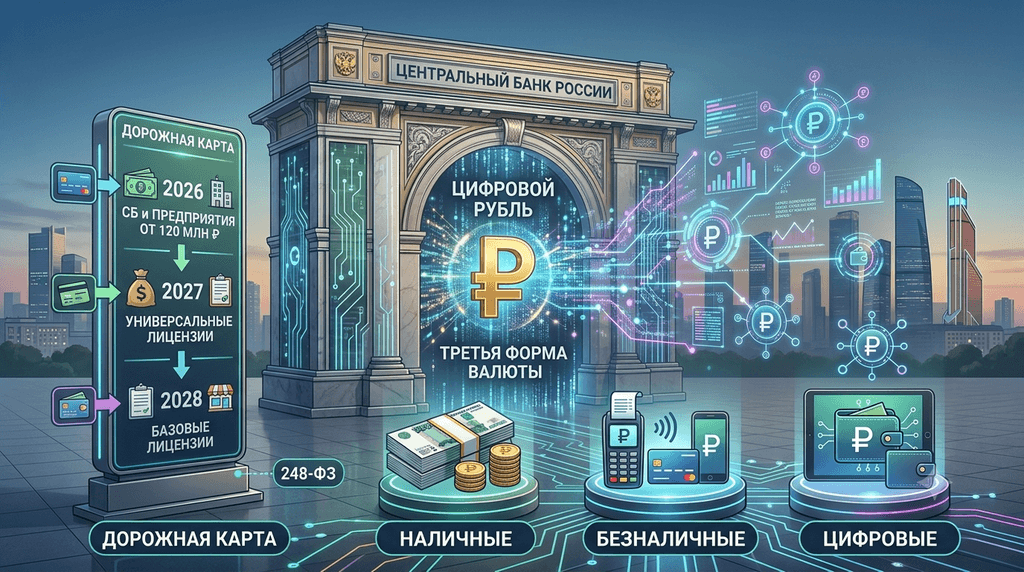
Starting September 1, 2026, systemically important banks are required to give customers access to the digital ruble, and merchants with revenue above 120 million rubles must accept it as payment. This isn't a pilot experiment or a distant future — it's a concrete legal deadline set by Federal Law No. 248-FZ. The digital ruble is the third form of Russia's national currency, alongside cash and the electronic money held in bank cards, issued and stored directly on the Bank of Russia's platform. For ordinary people, adoption is entirely voluntary: no one's salary or pension will be converted into digital rubles without their consent. Below is a detailed breakdown of how the system works, how it differs from money you already use, and what it means for crypto holders and traders.
What Is the Digital Ruble, and How Does It Differ from Cash and Non-Cash Money?
The digital ruble is the third form of Russia's national currency, alongside cash and the non-cash rubles held in accounts at commercial banks. All three forms carry the same face value and convert into one another at a one-to-one rate, with no exchange-rate difference between them.
The key distinction is where the money is stored. Ordinary non-cash rubles sit in accounts at commercial banks, such as Sberbank or T-Bank. The digital ruble instead lives in an electronic wallet opened directly on the Bank of Russia's platform, with the commercial bank acting only as a technical gateway for accessing that wallet through its mobile app.
For individuals, use of the digital ruble rests entirely on the principle of voluntary participation — there are no rules, planned or otherwise, that would automatically convert a salary, pension, or savings deposit into the new form of money. Businesses face a different logic: companies with large revenue are required to roll out acceptance of the digital ruble in stages, with the requirement gradually extending down to smaller market participants.
The project's legal foundation rests on two key documents. Federal Law No. 161-FZ of June 27, 2011, "On the National Payment System," defines the digital ruble as the third form of currency in Article 30.1, while Federal Law No. 248-FZ of July 23, 2025, spells out settlement procedures, introduces the phased mandatory-acceptance rollout, and establishes a universal payment QR code for merchants. The platform's own operation is additionally governed by Bank of Russia Regulation No. 820-P of August 3, 2023. This two-tier legal structure explains why the deadlines for banks and for businesses don't line up: the law governing the platform's infrastructure and the law governing mandatory acceptance were adopted — and take effect — on separate tracks.
Is Switching to the Digital Ruble Mandatory?
For individuals, switching to the digital ruble is entirely voluntary, while for large businesses it becomes mandatory in stages. No regulation provides for forcibly converting citizens' salaries, benefits, or savings into digital form — each person decides for themselves whether to open a wallet.
Legal entities operate under different rules. Under Federal Law No. 248-FZ of July 23, 2025, the obligation to accept digital-ruble payments is being phased in: the first businesses covered are trade and service companies with prior-year revenue above 120 million rubles that had signed a card-acquiring agreement with a systemically important bank before January 1, 2026. Later stages will gradually bring in medium and small businesses, for which connection deadlines have not yet been set.
Businesses that miss their mandatory connection deadline face administrative liability: according to expert commentary on the law, the fine for a first recorded violation ranges from 30,000 to 50,000 rubles, which gives companies in the covered category a strong incentive to upgrade their point-of-sale software and sign the necessary agreements with their servicing bank ahead of time.
In the foreseeable future, then, all three forms of money — cash, non-cash, and digital rubles — will continue to exist side by side, and the choice of payment form remains up to the user.
How Does the Digital Ruble Differ from a Regular Bank Card or Faster Payments System (SBP)?
The main difference between the digital ruble and a card or Russia's Faster Payments System (SBP) is the absence of interest and cashback, because the funds sit not at a commercial bank but directly at the Bank of Russia. On the surface, the difference may seem minor to users: both let you pay by scanning a QR code or send money to a friend within seconds.
The underlying mechanics, though, are fundamentally different. Ordinary electronic rubles sit in accounts at commercial banks such as Sberbank or Tinkoff, which lend out those funds and earn income, part of which they pass back to customers as interest on balances or cashback rewards. The digital ruble generates no such income — the Bank of Russia has explicitly established that digital-ruble wallets do not accrue interest and are not tied to any loyalty programs. The rule exists to avoid triggering a mass outflow of deposits from commercial banks.
Another distinction concerns SBP. While the user experience is similar, digital-ruble transfers move between wallets on a single central-bank platform and don't rely on the clearing capacity of individual commercial banks — which, in theory, makes settlement more resilient to disruptions at any single lender.
What Fees and Limits Apply to the Digital Ruble?
Fees for individuals are minimal or zero, while fees for businesses run far below standard card acquiring. According to the official platform-operator tariffs published on the Bank of Russia's website, through the end of 2026 transfers between individuals, as well as payments from an individual to a business, are charged at a rate of 0.0% of the transaction amount.
Starting January 1, 2027, a fee of 0.3% of the transfer amount (capped at 1,500 rubles per transaction) will apply to individual-to-business payments, except for utility bill payments, which carry a lower rate of 0.2%, capped at 10 rubles. By comparison, standard card acquiring typically costs merchants 1–2.5% of the payment amount, so even after 2027 the digital ruble remains noticeably cheaper for sellers.
A separate top-up limit applies: an individual can transfer no more than 300,000 rubles per month from a bank card into a digital-ruble wallet. Business-to-business (B2B) transfers are free through the end of 2026 and will cost 15 rubles per transaction starting in 2027. Paying wages through the digital ruble (B2C) is likewise free during the transition period, rising to 1 ruble per executed instruction (minimum 15 rubles per payment batch) from 2027 onward — and this transaction type is exempt from VAT.
Digital Ruble Transfer Fees
| Transaction Type | Fee through 12/31/2026 | Fee from 01/01/2027 |
| Individual-to-individual transfer (C2C) | 0.00% | 0.00% |
| Individual pays a business (C2B) | 0.00% | 0.3%, max 1,500 RUB |
| Individual pays utility bills (C2B) | 0.00% | 0.2%, max 10 RUB |
| Business-to-business transfer (B2B) | 0 RUB | 15 RUB per transfer |
| Wage payment (B2C) | 0 RUB | 1 RUB, min 15 RUB per batch |
Can the State Track Every Transaction, and Are Funds Safe?
Yes, the Bank of Russia is technically able to trace the movement of every digital ruble, and the funds themselves are shielded from the risk of a commercial bank's insolvency. The platform supports a mechanism known as "marked money" — a feature that lets the state tie a specific sum to a strictly defined purpose, such as a budget subsidy or public procurement funds, permitting it to be spent only on the stated goal. The tool is designed as a way to fight misuse of budget funds and corruption.
At the same time, from the standpoint of protecting personal savings, the digital ruble offers an added safeguard: since the wallet is opened directly on the Bank of Russia's platform, the bankruptcy of the servicing commercial bank doesn't result in the loss of these funds — unlike an ordinary deposit, part of which above the insurance limit set by the Deposit Insurance Agency could be at risk.
In the summer of 2026, the Bank of Russia also closed the public list of banks participating in the digital-ruble pilot; Deputy Governor Zulfiya Kakhrumanova attributed the decision to heightened sanctions risk, underscoring just how sensitive the system's transparency has become amid international pressure.
The marked-money feature, however, doesn't apply to ordinary consumer payments or transfers between citizens — it's reserved specifically for targeted government and corporate scenarios, such as earmarked social payments or spending under a state contract. For an everyday user, this means personal digital-ruble transactions are tracked to the same degree as ordinary bank transfers under anti-money-laundering law, not under some fundamentally stricter regime.
Is It a Cryptocurrency? Can You Pay Without an Internet Connection?
No, the digital ruble is not a cryptocurrency — it's a centralized state digital currency (CBDC) fully controlled by the Bank of Russia. Unlike bitcoin and other decentralized assets, the digital ruble offers no anonymity, no capped issuance, and no distributed ledger without a single issuer — every decision on issuance and regulation rests solely with the central bank.
As for offline functionality, the Bank of Russia originally announced plans for a wallet that would work without an internet connection via Bluetooth or NFC. However, the technical details and anti-tampering safeguards for such offline transactions are still being tested, and widespread rollout of this feature is a matter of the more distant future rather than the coming months.
The distinction from cryptocurrencies also matters from an investment standpoint. The price of bitcoin or ether is set by the market and can swing significantly, whereas the digital ruble, by definition, equals one ordinary ruble and isn't designed for speculative trading — it's a payment tool, not a growth asset. That's precisely why the arrival of a state digital currency doesn't compete directly with the crypto market; if anything, it introduces a broader audience to the basic idea of digital wallets and next-generation electronic settlement.
Which Banks Already Support the Digital Ruble, and When Will the Rest Connect?
As of mid-2026, systemically important banks are already piloting the digital ruble — among them Sberbank, VTB, Alfa-Bank, T-Bank, Rosselkhozbank, Gazprombank, Promsvyazbank, MKB, and Raiffeisenbank, along with a number of other market players, including Sovcombank, Bank Dom.RF, MTS Bank, and Ozon Bank. Opening a digital-ruble wallet through one of the participating banks' apps is already possible today.
The remaining credit institutions are set to connect to a legally established, staggered schedule.
Mandatory Bank Connection Timeline
| Bank Category | Mandatory Connection Deadline |
| Systemically important banks | September 1, 2026 |
| Banks with a universal license | September 1, 2027 |
| Banks with a basic license | September 1, 2028 |
The easiest way to check whether a specific bank already supports the digital ruble is through the "Digital Wallet" section of its mobile app, or by asking support directly — the central bank has restricted disclosure of the full pilot roster for security reasons tied to sanctions, so it's sometimes simplest to confirm a given bank's current status directly.
Should You Keep an Eye on Digital Assets and Trade on KuCoin in the Age of the Digital Ruble?
The launch of a state digital currency doesn't replace or diminish interest in independent digital assets like bitcoin, ether, or stablecoins — these are different tools built for different purposes. The digital ruble is a centralized settlement tool within Russia's domestic financial system, while cryptocurrencies traded on exchanges like KuCoin remain a way to diversify a portfolio, tap into global liquidity, and take part in decentralized finance.
If the broader theme of digital money and blockchain technology interests you, a reasonable next step is getting familiar with the crypto-asset market through an established platform. On KuCoin, you can open an account, complete verification, and start trading dozens of cryptocurrencies, explore staking and other products, and track the market through a mobile app whose convenience feels familiar if you're already used to banking apps. Registration takes just a few minutes, and analytics tools help you compare how different assets are performing before you make a decision.
Join KuCoin 9th Anniversary Trading Campaign
KuCoin is celebrating its 9th anniversary with a special platform campaign filled with exclusive rewards, trading activities, and limited-time offers. Don’t miss the chance to participate and enjoy the benefits as the exchange marks nine years of growth and innovation. Visit the official campaign page now:

Conclusion
The digital ruble is the third official form of Russia's currency, operating directly through the Bank of Russia's platform and exchanging with cash and non-cash money at a one-to-one rate with no loss in value. For individuals, adoption remains entirely voluntary, while large businesses must connect to the system in stages, starting with companies whose revenue exceeds 120 million rubles.
The main practical differences from money you already use are the absence of interest and cashback on balances, minimal fees for businesses compared with card acquiring, and the ability to "mark" budget funds to control how they're ultimately spent. At the same time, the digital ruble is not a cryptocurrency: it's fully centralized, and offline payments are still a work in progress.
By September 1, 2026, connecting to the platform becomes mandatory for systemically important banks, and by 2028 for nearly the entire banking system. Businesses covered by the law should check their category's deadline in advance and prepare their point-of-sale systems to avoid fines.
Anyone interested in digital finance more broadly than a state-run project may also want to look at the independent crypto market, with its own pricing logic and investment opportunities — for example, through the KuCoin trading platform, where you can explore different classes of digital assets alongside watching the digital ruble's rollout unfold.
Frequently Asked Questions
1. Can an employer pay wages in digital rubles without an employee's consent?
No — the employer must obtain the employee's consent to receive part or all of their salary in digital rubles; automatic conversion without such consent isn't permitted under current regulation.
2. What happens to regular bank cards once the digital ruble is widely rolled out?
Bank cards and non-cash accounts will keep working exactly as before — the digital ruble supplements rather than replaces existing forms of money, and all three forms will remain in circulation side by side.
3. How do you open a digital-ruble wallet for the first time?
Open the mobile app of a bank participating in the platform, find the "Digital Ruble" or "Digital Wallet" section, and follow the step-by-step instructions — opening a wallet is free and takes just a few minutes.
4. Can you pay with digital rubles abroad?
Currently, the digital ruble operates only within the Bank of Russia's national platform inside Russia and isn't designed for cross-border settlement in the system's current version.
During an outage, a user won't be able to complete a transaction through their digital wallet, but can keep using cash or a regular bank card, since those forms of money don't depend on the central bank platform being online.
Disclaimer : This material is provided for informational purposes only and does not constitute financial, investment, legal, or tax advice. Transactions involving cryptocurrencies and tokenized assets carry substantial risks — including price volatility, limited liquidity, counterparty exposure, and the potential for total loss of invested capital. Readers should conduct their own research and, where appropriate, consult a qualified professional before making any financial decisions.