

ZetaChain Approves L1 Shutdown Plan: ZETA Token Will Convert 1:1 to Solana SPL
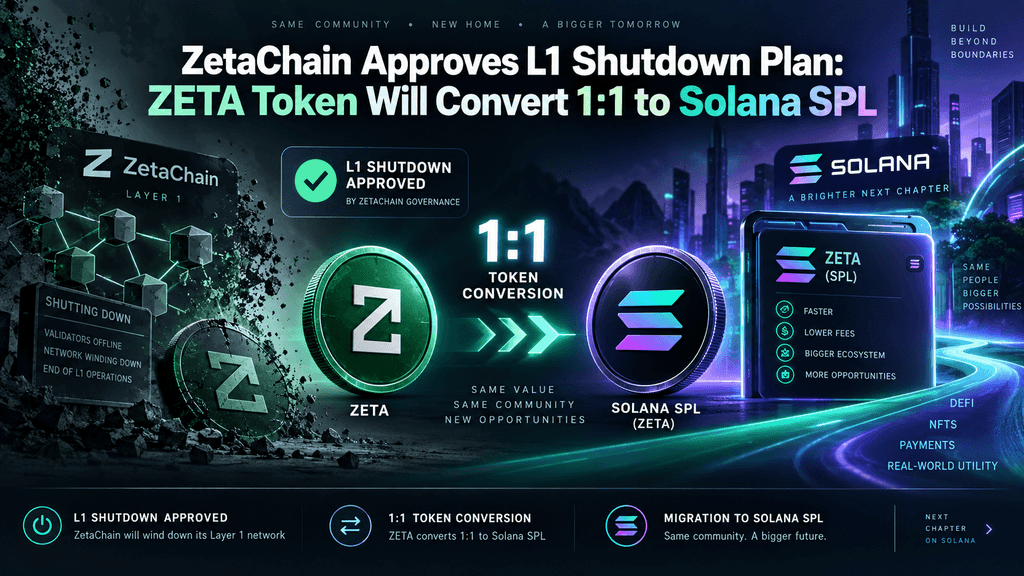
ZetaChain is preparing for one of the biggest changes in its history after token holders approved a plan to wind down the project's standalone Layer 1 blockchain and migrate native ZETA to Solana as an SPL token. Governance Proposal 68 passed on September 20, 2026, with about 99.4% support and 58% participation, exceeding the network's 40% quorum requirement. The approved framework calls for a 1:1 ZETA-to-Solana conversion, while the ZETA ticker, total token supply and existing vesting schedules will remain unchanged. However, the migration has not started and the ZetaChain L1 remains operational because a second governance proposal must establish the snapshot height, shutdown block, claims process and exchange conversion timeline.
The move also marks a broader shift in ZetaChain's strategy. Instead of directing resources toward maintaining an independent Cosmos-based blockchain, the project plans to focus more heavily on Anuma, its private multi-model AI application, and the Private Memory Layer behind it. ZetaChain reported that more than 300,000 people had joined Anuma since February 2026, while the platform had processed more than one million requests across 35 AI models by the time the migration proposal was announced. The Solana move therefore represents both a blockchain migration and a strategic shift toward AI applications, user-controlled memory and token-based access to AI services.
ZetaChain L1 Shutdown Plan Approved What Proposal 68 Means for ZETA Holders
ZetaChain has moved closer to retiring its standalone Layer 1 blockchain after Proposal 68 passed with 99.4% support, approving the direction and framework for migrating native ZETA to Solana. The governance vote closed on September 20, 2026, with approximately 58% participation, comfortably above the required 40% quorum. The result does not mean the ZetaChain L1 has already shut down. The blockchain continues operating, validators remain active, staking continues and existing balances are unchanged while contributors prepare the next stage of the transition. For ZETA holders, this means the migration process has been approved in principle, but the technical execution and final shutdown timeline are still pending.
The approval is significant because it sets the foundation for one of the biggest structural changes in ZetaChain's history. Instead of continuing to maintain its own Layer 1 indefinitely, the project plans to move native ZETA into the Solana ecosystem while gradually winding down the existing network. That makes Proposal 68 important not only for validators and developers but also for users holding ZETA in wallets, staking positions or exchange accounts.
What ZetaChain Proposal 68 Approved for the ZETA Migration
Proposal 68 approved moving native ZETA from ZetaChain to Solana as an SPL token and eventually winding down the existing Layer 1 network once holders and connected-chain assets have migrated. Under the approved framework, eligible native ZETA will convert at a 1:1 ratio, meaning one ZETA on the current network corresponds to one ZETA on Solana. The ticker and total supply remain unchanged, no additional ZETA will be created through the migration, and existing vesting schedules continue on their original dates. This preserves the core token structure while changing the blockchain environment in which native ZETA operates.
The migration is therefore primarily an infrastructure transition rather than a token redenomination or the launch of an unrelated new asset. Once the process is completed, the Solana version will become the canonical native ZETA token, replacing ZETA on the Layer 1 being retired. The surrounding infrastructure will also change because ZETA will operate within Solana's wallet, token and application ecosystem rather than relying on ZetaChain's independent validator network. This transition is expected to align ZETA more closely with Anuma and the broader private AI application layer ZetaChain is developing, while also giving the token access to Solana-based wallets, applications and liquidity infrastructure where supported.
What ZETA Holders Should Expect Before the ZetaChain Shutdown
For most ZETA holders, no immediate migration action is required. Proposal 68 approved the direction of the transition but explicitly did not halt the network, take a balance snapshot or move existing tokens. A second proposal must define the final snapshot height, network halt, Solana claim process, withdrawal window for connected-chain assets and holder protections. Until that stage is approved, native ZETA remains on the existing network and staking continues normally. Holders should therefore avoid assuming that the token migration has started or that a final deadline has already been established.
Another important distinction concerns ZETA already circulating outside the native network. ZETA on Ethereum and BNB Smart Chain is outside the scope of Proposal 68, according to ZetaChain's official migration announcement. Native balances, including locked and staked positions, are covered by the migration plan. Exchange-held ZETA will depend on arrangements confirmed by individual trading platforms, making official exchange announcements important once the second phase approaches. Users should also pay close attention to future instructions about deposits, withdrawals and supported networks to avoid sending tokens through the wrong chain during the migration period.
How the 1:1 ZETA-to-Solana SPL Token Migration Will Work
The approved migration framework is designed to move native ZETA from ZetaChain to Solana while preserving the number of eligible tokens assigned to holders. The central mechanism is a 1:1 conversion, meaning each eligible native ZETA will correspond to one ZETA SPL token on Solana. The migration will not happen immediately. Exchange coordination, technical preparation and another governance vote must take place before the final snapshot and network shutdown can occur. This staged process gives holders, validators, exchanges and infrastructure providers time to prepare for the transition.
The migration also separates the economic value of ZETA from the blockchain infrastructure that currently supports it. Holders are not being asked to accept a different conversion rate or a new token supply model. Instead, the project is moving the native token from its current Layer 1 environment into Solana's token system while trying to preserve balances, vesting schedules and overall supply continuity.
ZETA Will Convert 1:1 Into a Solana SPL Token
Under the approved framework, 1 native ZETA will convert into 1 ZETA on Solana. The existing ticker remains ZETA, while total supply and previously established vesting schedules remain unchanged. Rather than introducing a separate token with different economics, the migration transfers native ZETA from ZetaChain's blockchain to Solana's SPL token infrastructure. Solana's Token Program provides the underlying framework for creating token mints, token accounts and transferring assets across the network. This technical shift allows ZETA to operate directly within Solana's ecosystem without changing the basic one-token-for-one-token conversion.
Once the migration is completed, Solana will become the canonical home of native ZETA and the existing ZetaChain Layer 1 will move toward its final shutdown. ZETA will therefore no longer depend on ZetaChain's independent validator set after the L1 is retired. Instead, the token will operate within Solana's network environment, where integrations with wallets, decentralized applications, liquidity venues and payment systems will depend on the services that choose to support it. This could expand the number of platforms able to interact with ZETA, although actual adoption will depend on developer and exchange support after the migration.
ZETA Token Decimals Will Change From 18 to 9
One important technical detail is the planned conversion from 18 decimal places to 9 decimals. Proposal 68 explicitly states that native ZETA balances will move from 18-decimal precision to nine decimals during the Solana migration. Amounts that cannot be represented at the new nine-decimal precision will be rounded down. For ordinary balances, this affects only extremely small fractional amounts rather than the number of whole ZETA tokens held by a user. The change is mainly about technical compatibility with the new token format rather than altering the economic value of normal ZETA holdings.
The decimal adjustment does not alter the approved 1:1 migration ratio or increase the supply of ZETA. It changes the technical precision used to represent balances on the new network. The proposal also requires the migration snapshot and its checksum to be published so the resulting balances can be independently checked, while any migration contracts or programs holding users' ZETA are expected to undergo audits before being used. These measures are intended to make the migration process more transparent and give holders a clearer way to verify that balances were transferred correctly.
Exchanges, Wallets and Staked ZETA Will Follow the Final Migration Process
How holders experience the ZETA-to-Solana migration will partly depend on where their tokens are stored. Self-custody users will need to follow the final claim and migration procedures once those details are approved and published. For exchange-held balances, the conversion process will depend on each platform confirming support. Proposal 68 specifically states that the second proposal will be submitted only after exchanges listing ZETA have confirmed their swap procedures. That makes exchange coordination one of the most important practical steps before the ZetaChain L1 can move toward its final shutdown.
Staking, delegation and validator operations continue on the existing Layer 1 for now. Proposal 68 states that staking rewards will continue until the shutdown time specified in the second proposal. ZetaChain has also said that the future form of staking and rewards on Solana is still being explored. Holders should therefore distinguish between the migration framework already approved and unresolved details such as the exact snapshot date, staking transition, claim process and exchange-specific conversion arrangements. Until those details are published, users should rely on official ZetaChain and exchange announcements rather than unofficial migration links or assumptions about how balances will be handled.
ZetaChain Shutdown Timeline, Solana Migration and the Anuma AI Strategy
ZetaChain has approved the direction of its move to Solana, but no final Layer 1 shutdown date has been announced. The next governance proposal is expected to turn Proposal 68 into a detailed migration plan by defining the withdrawal period, snapshot height, network halt, Solana claim process and exchange conversion window. At the same time, the transition reflects a broader strategic shift toward Anuma, ZetaChain's Private Memory Layer and AI-focused applications, making the move more significant than a simple blockchain migration. ZetaChain is increasingly positioning ZETA around application utility, AI services and user-controlled data rather than maintaining an independent Layer 1 network as the center of the ecosystem.
ZetaChain Shutdown Date and Migration Timeline
The exact ZetaChain shutdown date remains unconfirmed as of September 22, 2026. Proposal 68 approved the migration framework but did not trigger an immediate halt, snapshot or token conversion. The ZetaChain governance process will require another proposal to establish the snapshot height, final L1 halt, Solana claim process, connected-chain withdrawal period and full migration schedule. Exchange coordination is also an important part of the timeline because participating platforms need to confirm how they will handle ZETA balances and token conversions before the transition is completed. Until those details are finalized, the existing ZetaChain network remains operational and holders do not have a confirmed deadline for moving native ZETA.
What Happens to ZETA Staking
ZETA staking and delegation continue while the current Layer 1 remains active, with validators still securing the network and staking rewards continuing during the transition period. The eventual second governance proposal is expected to establish the point at which those Layer 1 staking operations end, but the post-migration staking model has not yet been finalized. ZetaChain has said it is still exploring how staking and rewards could work once ZETA becomes a native Solana SPL token, so the current validator-based model should not be assumed to continue unchanged. This makes staking one of the key areas holders will need to watch as the migration moves from governance approval to technical execution.
Exchange Support for the ZETA Migration
Centralized exchanges will play a major role in the ZETA-to-Solana migration because many users hold ZETA on trading platforms rather than in self-custody wallets. Proposal 68 makes exchange coordination part of the migration process, and participating platforms are expected to publish their own instructions covering deposits, withdrawals and balance conversions before the final network shutdown. As of September 22, 2026, KuCoin continues to list ZETA through its spot market, but the KuCoin material reviewed for this article does not yet include a dedicated announcement explaining how the platform will handle the 1:1 ZETA-to-Solana SPL conversion. Users should therefore wait for an official exchange-specific migration notice rather than assuming that their balances will automatically convert without any platform guidance.
Why ZetaChain Is Moving to Solana
ZetaChain's migration proposal argues that maintaining an independent Cosmos SDK-based Layer 1 requires ongoing resources for validator coordination, infrastructure, security updates and network upgrades that no longer align as closely with the project's main development priorities. By moving ZETA to Solana, the project can rely on an established blockchain environment while directing more engineering and operational resources toward Anuma, the Private Memory Layer and AI-focused products. ZetaChain has also highlighted Solana's transaction speed, low-cost settlement, wallet ecosystem and growing infrastructure for payments and AI agents as reasons for choosing the network. The shift therefore reflects both an infrastructure decision and a broader attempt to simplify the project's technical stack around its emerging application strategy.
How Anuma AI Fits Into ZetaChain's New Strategy
Anuma has become one of the central products behind ZetaChain's new direction. According to the project's September 17 announcement, more than 300,000 people had joined Anuma since February 2026, while the private multi-model AI app had processed more than one million requests across 35 models. Its Private Memory Layer is designed to give users encrypted, portable memory that can work across different AI models, apps and agents while limiting how much personal context is shared with individual providers. Every Anuma account also includes a wallet, creating a direct connection between AI activity and ZetaChain's token infrastructure. This combination of AI, identity, payments and user-controlled memory helps explain why the project now sees its application layer as more strategically important than maintaining its own general-purpose blockchain.
What the Solana Move Could Mean for ZETA's Future
After the migration, ZETA's role is expected to become more closely tied to AI applications, payments, credits and token-based access rather than primarily serving as the gas and staking asset of an independent Layer 1. Moving to Solana could place ZETA within a broader ecosystem of wallets, decentralized applications, liquidity venues and payment tools, but the blockchain migration alone does not guarantee stronger demand or adoption. The longer-term outcome will depend on whether Anuma attracts sustained usage, whether third-party developers adopt the Private Memory Layer and whether ZETA gains meaningful utility across additional applications and agents. The second governance proposal will therefore be important not only for the shutdown timeline but also for clarifying staking, claims, exchange handling and the practical role of ZETA after the transition.
Conclusion
ZetaChain's approval of Proposal 68 puts the project on a path toward winding down its standalone Layer 1 and migrating native ZETA 1:1 to Solana as an SPL token. The vote establishes the direction and framework of the transition, but it does not complete the migration. The existing network remains active, staking continues and no final shutdown date has been announced. A second proposal must still establish the snapshot height, chain halt, claims process, exchange conversion window and other holder protections. The bigger change is strategic. ZetaChain is shifting resources away from operating its own blockchain and toward Anuma, the Private Memory Layer and an AI application ecosystem built on Solana. For ZETA holders, the key developments to watch are the second governance proposal, participating exchange announcements and the final staking and migration procedures. Until those details are published, holders generally do not need to take migration action and should rely on official ZetaChain and exchange communications rather than unsolicited token-swap links.
FAQs
Has ZetaChain already shut down its Layer 1 blockchain?
No. Proposal 68 approved the direction and framework for winding down the ZetaChain Layer 1, but it did not immediately stop the blockchain. Validators continue validating, staking remains active and existing balances have not changed. A second governance proposal must establish the final snapshot and shutdown details.
When will ZETA migrate to Solana?
There is no confirmed ZETA-to-Solana migration date yet. Proposal 68 states that the timeline depends on exchanges confirming their swap procedures. After that coordination is completed, a second proposal is expected to provide the snapshot, halt, claim and exchange-conversion schedule.
Will one ZETA still equal one ZETA after the migration?
Yes. The approved framework provides for a 1:1 conversion, meaning one eligible native ZETA will correspond to one ZETA SPL token on Solana. The ZETA ticker and total supply remain unchanged, and no new tokens are created through the migration.
Do ZETA holders need to swap their tokens now?
No. Proposal 68 explicitly states that no action is required now. The final migration procedure has not yet begun, and holders should wait for official instructions. ZetaChain also warns users that it will never ask for a seed phrase and recommends trusting only links distributed through its official channels.
What happens to ZETA on Ethereum and BNB Smart Chain?
ZETA already issued on Ethereum and BNB Smart Chain is outside the scope of Proposal 68. The approved migration specifically concerns native ZETA on the ZetaChain Layer 1, which is planned to move to Solana.
Will ZETA still have staking after moving to Solana?
The post-migration staking model has not yet been finalized. Current staking, delegation and rewards continue until the ZetaChain L1 shutdown time established by the second proposal. ZetaChain says the future form of staking and rewards on Solana remains under exploration.
Disclaimer: This article is for informational purposes only and does not constitute investment advice. Crypto assets can be highly volatile, and market conditions, token liquidity and project developments may change rapidly. Readers should conduct their own research and assess their risk tolerance before making financial decisions.