

Why Prediction Markets Are Crypto's Next Big Business Line
Key Takeaways
-
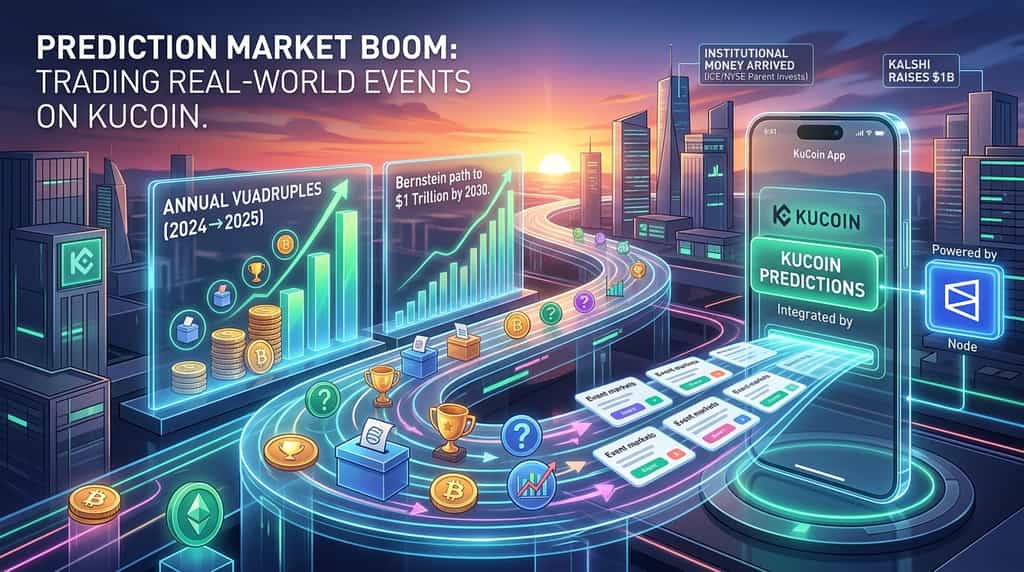
Prediction markets quadrupled in a year: notional volume grew from $15.8 billion in 2024 to $63.5 billion in 2025, per CoinGecko's annual industry report.
-
Growth is accelerating in 2026 — the sector surpassed $50 billion in monthly notional volume in June 2026, and Bernstein projects roughly $240 billion for 2026 and a path to $1 trillion annually by 2030.
-
Institutional money has arrived: NYSE parent ICE invested up to $2 billion in Polymarket, and Kalshi raised $1 billion at a $22 billion valuation.
-
KuCoin is joining the trend: KuCoin Predictions, powered by an integration with Polymarket, launches on October 12, bringing event markets directly into the KuCoin App.
-
This article is for crypto users who want the market context behind KuCoin's new business line before trying it.
Something unusual happened in financial markets over the past two years: trading on real-world event outcomes went from a curiosity to one of the fastest-growing segments in trading. Prediction market volume has multiplied, institutional capital has arrived, and major exchanges — crypto and traditional alike — are racing to add event contracts to their product lines. KuCoin is the latest: on October 12, KuCoin Predictions goes live, giving users in-app access to supported Polymarket event markets. Here's the trend behind the launch, and what it means for traders.
The Numbers: From $15.8 Billion to a Projected $1 Trillion
The trajectory is best told in a few data points:
-
2024 → 2025: volume quadrupled. Prediction market notional volume grew from $15.8 billion in 2024 to $63.5 billion in 2025, a +302.7% increase, according to CoinGecko's 2025 Annual Crypto Industry Report. The same report notes a changing of the guard: Polymarket started 2025 with an 85.6% market share in Q1, but was overtaken by Kalshi in Q4.
-
2026: the acceleration continues. Combined monthly trading volume across the largest platforms rose from under $5 billion in September 2025 to approximately $25.7 billion in May 2026 — and in June 2026 the sector surpassed $50 billion in monthly notional volume for the first time, driven by the 2026 FIFA World Cup and NBA Finals.
-
The forward view is bigger still. Wall Street research firm Bernstein estimates total prediction market volume will reach approximately $240 billion in 2026 and could scale to roughly $1 trillion annually by 2030 — an estimated 80% compound annual growth rate.
Why Now? Three Forces Behind the Boom
-
The scope expanded beyond elections. Prediction markets initially drew attention around political elections, but they've since broadened to sports, crypto prices, interest rates, inflation, and economic data — outcomes that directly affect financial markets. What started as an election-night novelty has become a year-round trading category.
-
Institutional capital and infrastructure arrived. In October 2025, Intercontinental Exchange (ICE) — the parent company of the New York Stock Exchange — announced a strategic investment of up to $2 billion in Polymarket, reflecting a valuation of approximately $8 billion pre-investment, and became a global distributor of Polymarket's event-driven data to institutional investors. Rival Kalshi raised $1 billion at a $22 billion valuation in May 2026, in a round led by Coatue with participation from Sequoia Capital, Andreessen Horowitz, Morgan Stanley, and ARK Invest; the company said its annualized trading volume had more than tripled from $52 billion to $178 billion over the preceding six months.
-
Everyone is building. Retail brokers like Robinhood — which reported more than 12 billion event contracts traded on its platform in 2025 — and crypto platforms like Coinbase, which lists prediction markets as part of its "Everything Exchange" strategy, are investing in the category. When competitors this diverse converge on the same product, it's usually a signal the category is real.
Event Contracts: A New Way to Trade What You Know
The product logic behind the boom is simple. Traditional trading asks, "Will this asset's price go up or down?" Event contracts ask, "Will this happen?" — and turn the answer into a tradable Yes/No position priced between $0 and $1, where the price doubles as the market's implied probability.
For crypto users, this is a natural extension. Crypto traders already follow macro data, elections, and sports; they already think in probabilities and manage risk on volatile instruments. A prediction market lets them express a view on the events themselves — not just on how those events move token prices. That's why exchanges increasingly treat event contracts not as a side feature, but as a new business line: a distinct asset category that can complement spot, futures, and options.
KuCoin Joins the Trend: KuCoin Predictions Launches October 12
Against this backdrop, KuCoin is bringing prediction markets to its users. KuCoin Predictions launches on October 12, powered by KuCoin's integration with Polymarket — one of the two platforms driving the industry's record growth.
Here's what the launch means in practice:
-
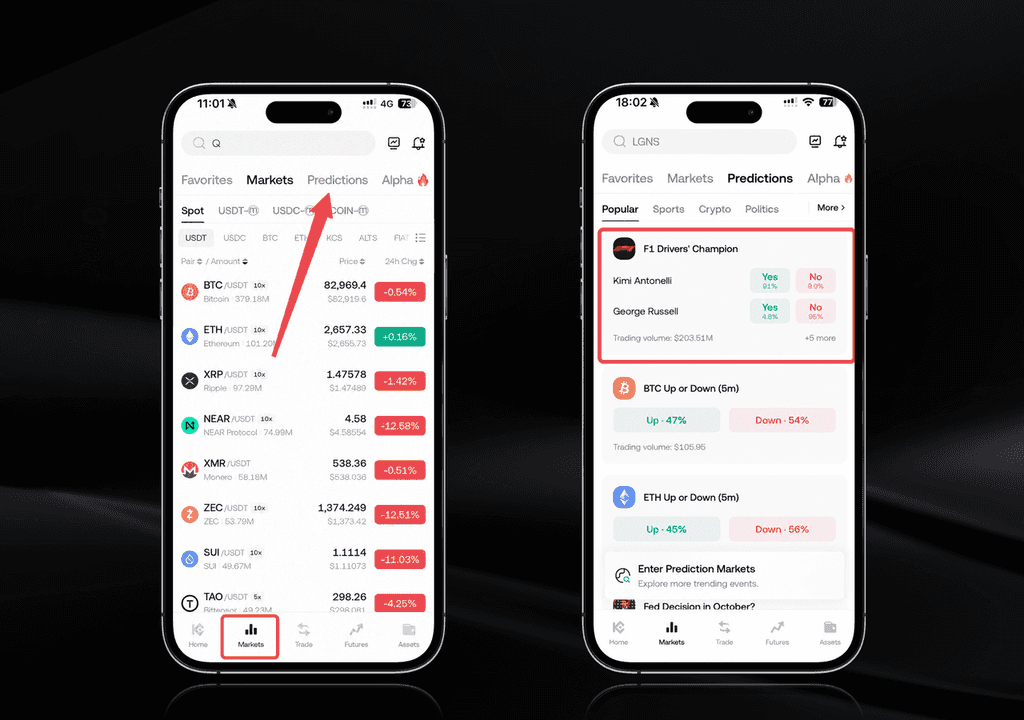
In-app access: Users can browse and trade supported Polymarket event markets — covering popular events, crypto, sports, and politics — directly in the KuCoin App, without moving funds to an external platform;
-
USDT settlement: Trades are funded with USDT from your Funding Account; if you select your Financial Account or Trading Account as the source, the required USDT is transferred automatically;
-
Clear division of roles: KuCoin provides the in-app interface, technical integration, and related account functions; the specific markets, prices, liquidity, order execution, and result determination are provided by Polymarket and are not independently determined by KuCoin;
-
Automatic settlement: After a market's result is finalized under its published rules, winning shares settle at $1 and losing shares at $0, with proceeds credited automatically to your Funding Account — no manual on-chain redemption required.
Getting started takes four steps: open the KuCoin App, go to Markets > Predictions, pick a market, and review its rules before placing your first order.
What to Keep in Mind Before You Trade
Prediction markets are genuinely new territory for most users, and the same features that make them exciting carry real risks:
-
Prices are market signals, not promises — they reflect current participant expectations, not KuCoin's prediction or a guaranteed outcome;
-
Principal loss is possible — if the market resolves against your position, your shares settle at $0;
-
Execution is market-order based — displayed prices are estimates, and fills may differ depending on liquidity and price-protection limits;
-
Rules decide results — always read the full market question, outcome definitions, deadline, and resolution criteria, not just the title or headline probability.
Availability is subject to regional and account eligibility, and supported markets, fees, and trading rules are those displayed on the product page at the time of use.
Conclusion
Prediction markets have crossed the threshold from experiment to industry: volume quadrupled in 2025, monthly records kept falling through 2026, and Wall Street projects a path to $1 trillion in annual volume by 2030. The logic is straightforward — people want to trade what they know about the world, not just charts. KuCoin's entry into this space is part of that broader shift.
KuCoin Predictions launches October 12: open the KuCoin App, head to Markets > Predictions, and see for yourself what trading outcomes feels like — starting small, and reading each market's rules first.
FAQs
How big is the prediction market industry?
Prediction market notional volume reached $63.5 billion in 2025, up 302.7% from $15.8 billion in 2024, according to CoinGecko. In June 2026 the sector surpassed $50 billion in monthly volume, and Bernstein projects roughly $240 billion for 2026 and up to $1 trillion annually by 2030.
Why are crypto exchanges adding prediction markets?
Event contracts let users trade on real-world outcomes — elections, sports, crypto prices, economic data — rather than asset price movements alone. Exchanges treat them as a new business line that complements spot, futures, and options, and as a way to serve users' existing interest in these events.
What is KuCoin Predictions?
KuCoin Predictions is a new KuCoin App feature, launching October 12, that gives users in-app access to supported Polymarket event markets. KuCoin provides the interface and account functions; the markets themselves, including prices and results, are provided by Polymarket.
When does KuCoin Predictions launch?
KuCoin Predictions launches on October 12. Once live, users can find it in the KuCoin App under Markets > Predictions, browse supported markets, and trade with USDT from their Funding Account.
What can I trade on KuCoin Predictions?
Supported markets cover popular events, crypto, sports, and politics, sourced from Polymarket. The exact markets, payment assets, and trading rules available to you are those displayed on the relevant product and market pages at the time of use.