

What Is PYTHIA and How to Buy $PYTHIA on KuCoin Alpha?
Introduction
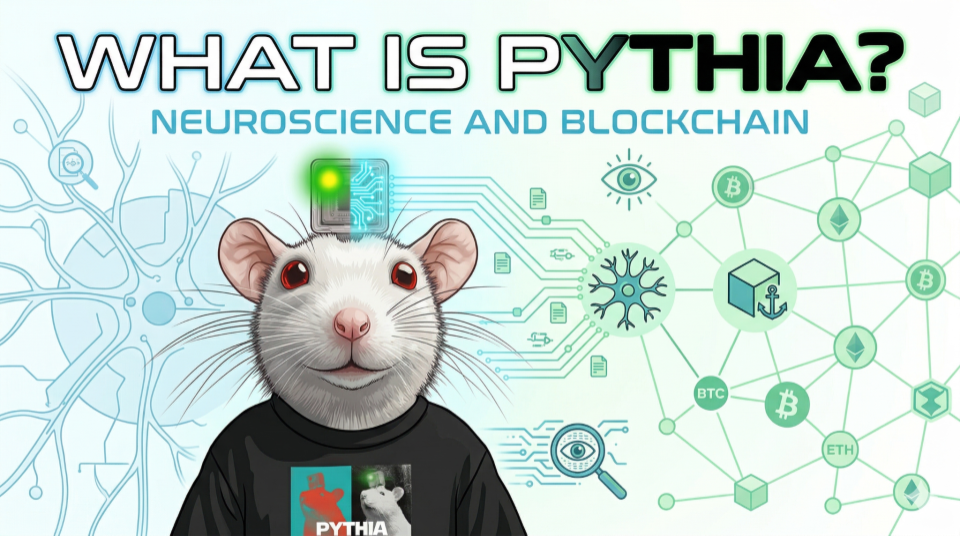
The boundary between biological intelligence and artificial intelligence has long been debated. PYTHIA turns that question into a real-world experiment with market exposure. At its core, the project centers on a live rat connected to a neural interface, with research developed in a Russian biotech lab and funded through blockchain participation. This unusual combination of neuroscience and crypto places PYTHIA among the more unconventional experiments emerging from the Decentralized Science (DeSci) space.
Following its recent listing on KuCoin Alpha, the project has drawn increased attention across both crypto and research communities. Against this backdrop, it becomes important to examine what PYTHIA is, how it functions, and why it has attracted interest.
This article explores the project’s origins, its ecosystem, its token structure, and the mechanisms through which participants can access it.
What Is PYTHIA Crypto and How Does It Work
PYTHIA is a decentralized science project that combines neuroscience research with blockchain-based funding. It connects a real-world neural experiment to a crypto asset, placing it within the emerging DeSci token category.
The Neural Interface Experiment
PYTHIA is built around a neuroscience experiment conducted by the Neiry biotech lab. Researchers implanted electrodes into the somatosensory regions of a rat’s brain, creating a neural interface that links biological signals to an artificial intelligence system.
This setup allows the subject to receive structured inputs and produce responses that go beyond typical animal behavior, including guided navigation and interaction with external systems. The experiment reflects ongoing research into brain computer interfaces and hybrid intelligence systems. All procedures are reported to follow established legal and ethical research standards.
How PYTHIA Became a Crypto Token
Interest in the Pythia neural interface experiment quickly spread beyond research circles into crypto communities. As attention grew, multiple tokens using the PYTHIA name appeared, reflecting a common pattern where viral scientific or cultural moments are tokenized.
One version gained relevance after a portion of its supply was allocated to the Neiry biotech lab. This created a direct link between the token and an active research initiative. Neiry later acknowledged the token, establishing a clearer connection between market activity and ongoing experimentation.
To support this model, the lab deposited its PYTHIA holdings alongside SOL into a decentralized liquidity pool. Trading fees generated from this pool are directed back into neuroscience research, introducing a funding structure where market participation contributes to real-world experiments.
This shift marked the transition of PYTHIA from a purely speculative asset to a token connected to a defined scientific use case, even though its long-term viability still depends on sustained participation.
The Role of PYTHIA in the DeSci Ecosystem
Within the decentralized science landscape, PYTHIA functions as a funding and coordination layer for research. It enables contributors to support experiments through market activity while introducing elements of governance and community participation.
Compared to traditional research funding, this model operates with fewer institutional barriers. Capital can flow continuously through liquidity pools, without relying on grant cycles or geographic limitations. This structure reflects a broader DeSci objective of making research funding more open and accessible.
At the same time, the model introduces trade-offs. Funding depends on trading activity, which can be volatile, and community-driven governance may not always align with scientific priorities. These challenges are common across DeSci projects.
What differentiates PYTHIA is its connection to an ongoing lab experiment. This linkage provides a more tangible foundation than many tokenized research initiatives, although questions around scalability and long-term sustainability remain.
Transition From Neiry to Orama Labs
The project expanded beyond its initial experiment in August 2025, when Neiry Biotech introduced Orama Labs as a dedicated platform for scaling decentralized science. This marked a shift from a single research initiative to a broader system designed to support multiple experiments.
Orama Labs positions itself as a tokenized science economy built on Solana, focused on accelerating research in DeSci and artificial intelligence. Its core model connects on-chain funding directly to scientific work, allowing contributors to support experiments without traditional intermediaries.
Within this structure, PYTHIA functions as the platform’s governance and coordination layer. It is used to incentivize participation, fund research initiatives, and support decision-making across the ecosystem.
A key component of the platform is its funding mechanism. Capital is pooled on-chain and directed to researchers, with token-based incentives encouraging collaboration and continued development. This model aims to improve transparency while reducing the friction typically associated with institutional funding.
Orama Labs also introduces a system for managing intellectual property through on-chain registration. Research outputs can be recorded as tokenized assets, enabling verifiable ownership and allowing contributors to capture value from their work over time.
The platform’s LaunchPad (Oramapad) reflects this structure in practice. Early participation required users to stake PYTHIA tokens to access new projects, with initial activity attracting several million dollars in committed capital. At the same time, token supply dynamics were introduced through buybacks and burns tied to platform usage.
This transition moves PYTHIA beyond its origin as a single experiment. It now operates within a broader framework aimed at funding, coordinating, and commercializing scientific research on-chain, while still facing open questions around long-term adoption and sustainability.
Key Features of the PYTHIA Ecosystem
The PYTHIA ecosystem combines scientific research, blockchain-based funding, and on-chain coordination into a single framework. The features below highlight the core components that define how the system operates.
-
Neural Interface Experiment: A live neuroscience experiment connects a rat’s brain to an AI system, serving as the foundation of the entire PYTHIA project.
-
Decentralized Research Funding: Trading activity contributes to funding, with fees from liquidity pools directed toward ongoing scientific experiments.
-
On-Chain Research Platform: Through Orama Labs, scientific projects can be launched, funded, and governed on-chain by the community.
-
Tokenized Intellectual Property: Research outputs are registered on-chain, enabling verifiable ownership and potential value capture for contributors.
-
Real-World Utility and Expansion: The ecosystem extends beyond research with tools like the Mind Tracker and a roadmap focused on AI and human interaction.
Together, these features show how PYTHIA integrates experimentation, funding, and governance into a unified DeSci framework that connects real-world research with blockchain infrastructure.
PYTHIA Tokenomics
Token Supply and Distribution
PYTHIA has a total supply of 998M tokens and a maximum supply of 1B tokens. With nearly the entire supply already in circulation, the token has minimal remaining inflation, which reduces the impact of future token emissions on supply dynamics.
The token operates on the Solana blockchain, with a contract address deployed for on-chain interaction. At the time of its KuCoin Alpha listing, PYTHIA had an estimated market capitalization of about $60.73 million and was trading at approximately $0.06100 per token.
|
Total Supply |
998,160,851 PYTHIA |
|
Circulation Supply |
998,160,851 PYTHIA |
|
Max Supply |
1,000,000,000 PYTHIA |
|
Market Capitalization |
~ $60.73 million |
|
Exchange Availability |
KuCoin Alpha |
|
Blockchain |
Solana |
Figures reflect market data as of March 2026 and may change over time.
PYTHIA Utility and Value Drivers
-
Liquidity pool funding for neuroscience research
-
Governance participation within Orama Labs
-
Incentives and rewards for ecosystem contributors
-
Access and participation in LaunchPad research projects
-
Integration with real-world products like the Brain data mining
-
Ecosystem coordination and value exchange across participants
How to Buy $PYTHIA on KuCoin Alpha
-
Create or log in to your KuCoin account: Visit kucoin.com and sign up for a new account or log in if you already have one.
-
Complete identity verification (KYC): Follow the verification process in your account settings. You will need a valid government-issued ID to proceed.
-
Deposit funds: Go to the Assets section and deposit USDT or another supported cryptocurrency into your account. You can fund your account using a bank transfer, card payment, or by transferring crypto from another wallet or exchange.
-
Access the KuCoin Alpha section: From the main interface, navigate to the market and then to Alpha. This section lists early-stage tokens available for trading.
-
Search for PYTHIA/USDT: Locate the PYTHIA/USDT trading pair within the Alpha zone.
-
Place your order: Enter the amount you want to purchase in USDT or PYTHIA, then confirm your trade.
KuCoin Alpha tokens carry inherent risks, including significant price volatility and the potential for capital loss. Users are encouraged to conduct independent research before participating. KuCoin reserves the right to delist any token that no longer meets its Alpha listing criteria.
Conclusion
PYTHIA sits at the intersection of neuroscience research and blockchain-based coordination, bringing a real-world experiment into the decentralized science ecosystem. Its model connects a neural interface experiment with on-chain funding, allowing market activity to support ongoing research while enabling wider participation through simple governance tools.
As it develops into Orama Labs, it grows from a single experiment into a broader system for funding and managing scientific projects, introducing ideas like tokenized intellectual property and on-chain participation.
Its long-term success will depend on steady participation, continued development, and how well it can turn its ideas into real-world adoption.
TL;DR
-
PYTHIA is a DeSci project that combines neuroscience research with blockchain technology.
-
It is built around a live rat connected to an AI system through a neural interface experiment.
-
The project uses on-chain liquidity pools where trading activity helps fund scientific research.
-
Orama Labs expands PYTHIA into a broader platform for funding, governing, and managing research projects on-chain.
-
PYTHIA has nearly its full supply in circulation and operates on the Solana blockchain.
-
It is listed on KuCoin Alpha, where users can trade the PYTHIA/USDT pair after completing account setup and KYC.