

US PPI Inflation Hits 6.3% in September 2026 as Bitcoin Falls Below $81,000
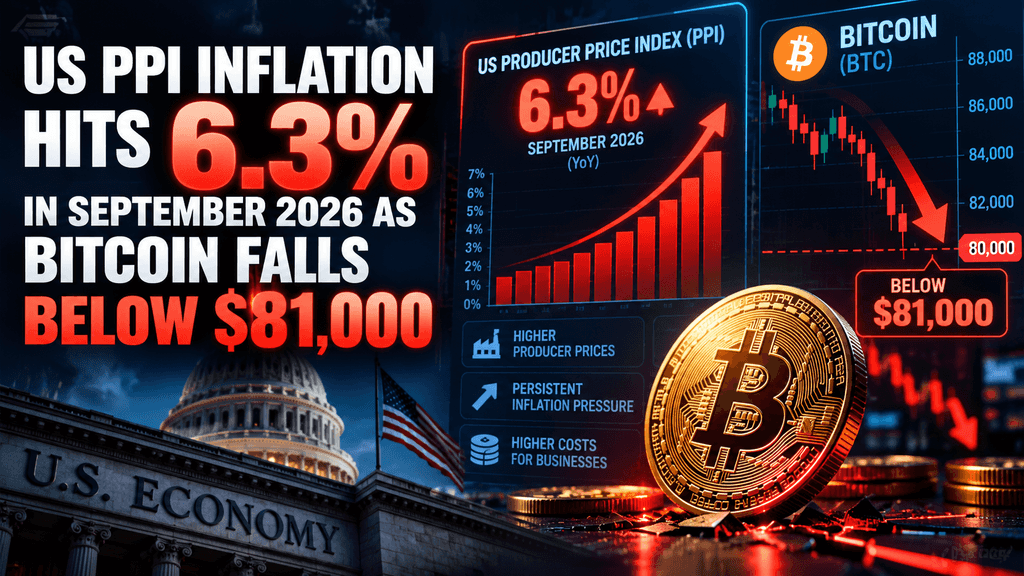
Can a single inflation report change the outlook for Bitcoin and the Federal Reserve within hours? That is what happened after U.S. producer inflation surged in September 2026. The Producer Price Index (PPI) rose 1.3% month over month and 6.3% year over year, marking its largest monthly increase since March 2022 and its highest annual increase since December 2022. The hotter-than-expected data initially pushed Bitcoin below $81,000 and briefly under $80,000 as traders revived bets on another Federal Reserve rate hike.
The inflation shock came one day after September consumer inflation also exceeded expectations, creating a rare one-two punch for risk assets. Yet the market reaction was more complicated than a simple “hot inflation equals higher yields” trade. Treasury yields subsequently fell, the dollar weakened, and gold gained, while Bitcoin recovered toward $82,000. The result is a more complicated macro setup involving inflation, energy prices, Federal Reserve policy, ETF flows, leverage and growing concerns about economic growth.
Key Takeaways
-
U.S. PPI jumped 1.3% in September and 6.3% year over year, significantly exceeding expectations.
-
Energy was the biggest contributor, with final-demand energy prices rising 10.8% and gasoline prices increasing 20.3%.
-
The inflation report followed a hotter-than-expected September CPI reading, intensifying concerns about the Federal Reserve's policy path.
-
Bitcoin briefly fell below $80,000 before recovering toward the $82,000 area.
-
Nearly $950 million of crypto positions were liquidated within 24 hours, with long positions accounting for most of the forced selling.
-
U.S. spot Bitcoin ETFs recorded about $261.4 million in net outflows on October 14, adding another source of market pressure.
-
Despite the hot PPI, markets did not fully price an October Fed hike as the base case.
-
The next major Bitcoin catalysts are Federal Reserve policy signals, Treasury yields, ETF flows and additional inflation data.
September PPI Surges to 6.3%
The central economic development is straightforward: U.S. wholesale inflation accelerated sharply in September, with the PPI rising 1.3% from August and 6.3% from a year earlier. The monthly increase was the largest since March 2022, while the annual increase was the strongest since December 2022. The figures were substantially stronger than economists had expected and immediately became a major focus for financial markets.
The monthly increase also represented a significant acceleration from August's revised 0.5% gain. The Bureau of Labor Statistics reported that final-demand goods prices increased 2.6% in September, while final-demand services rose 0.8%. The magnitude of the move showed that September's inflation pressure was not confined to a single narrow component of the producer-price basket.
| September 2026 PPI indicator | Result |
| Headline PPI, monthly | 0.013 |
| Headline PPI, annual | 0.063 |
| Final-demand goods | 0.026 |
| Final-demand services | 0.008 |
| Energy prices | 0.108 |
| PPI excluding food, energy and trade services, annual | 0.05 |
The data therefore delivered a clear message to investors: price pressures at the producer level remain elevated, and the September acceleration was considerably stronger than the market had anticipated.
Energy Prices Were the Biggest Inflation Driver
The September PPI surge was primarily an energy story, but the underlying figures also show why investors cannot dismiss the report as merely an oil-price shock. More than 80% of the increase in final-demand goods prices came from energy, where prices jumped 10.8% during the month. Gasoline prices increased 20.3%, while diesel, jet fuel, electricity and crude petroleum also recorded significant increases.
Energy matters because it can influence prices well beyond the gasoline station. Higher fuel costs increase transportation and logistics expenses, raising the cost of moving raw materials, intermediate goods and finished products. Reuters reported that transportation, legal services and hospitality also contributed to September's producer-price increase, suggesting that price pressure extended into services as well.
The key question for markets is therefore whether September's energy shock remains temporary or begins feeding into broader inflation expectations. If energy costs stabilize, headline PPI could moderate. If elevated energy prices continue to influence transportation, production and services, the Federal Reserve could face a more difficult policy environment.
Underlying Producer Inflation Also Remains Elevated
The headline 6.3% figure attracts the most attention, but the underlying PPI measures are arguably more important for monetary policy. Prices for final demand excluding food, energy and trade services increased 0.5% in September and were up 5.0% over the previous 12 months. That suggests that inflationary pressure cannot be explained entirely by energy.
Services were another important part of the September report. Final-demand services increased 0.8%, while trade-service margins and transportation-related services contributed to the increase. This matters because service inflation can be more persistent than short-term movements in commodity prices, making it more relevant to the Federal Reserve's assessment of whether inflation is becoming entrenched.
For crypto markets, the distinction is critical. If inflation is overwhelmingly driven by a temporary energy shock, traders may eventually look through the headline number. If broader producer costs remain elevated, however, investors may continue to price a more restrictive Federal Reserve, keeping pressure on liquidity-sensitive assets such as Bitcoin.
Bitcoin Falls Below $81,000 After the PPI Report
Bitcoin reacted quickly to the inflation data. After trading in the low-$80,000s, BTC fell below $81,000 and briefly broke under $80,000 as traders responded to renewed concerns about U.S. monetary policy. Crypto.news reported that Bitcoin reached a 24-hour low around $80,443, while other market reports placed the intraday low close to $79,800.
The decline extended weakness that had already emerged after Wednesday's hotter-than-expected CPI report. Bitcoin had recently approached $84,000 but failed to sustain the move above that area. The PPI release therefore arrived when the market was already vulnerable, turning an economic-data surprise into a larger risk-off move.
Bitcoin subsequently recovered toward $82,000, showing that buyers remained active around the $80,000 area. That rebound is important because it means the PPI shock did not produce a sustained collapse below the psychological $80,000 threshold. However, the volatility demonstrated how sensitive BTC remains to changes in macroeconomic expectations.
Why Hot Inflation Pressures Bitcoin
The connection between PPI and Bitcoin runs primarily through monetary policy and liquidity. When inflation rises more rapidly than expected, investors may conclude that the Federal Reserve has less room to ease financial conditions. Higher-for-longer interest rates can increase the relative attractiveness of yield-generating assets while reducing investors' willingness to hold volatile assets.
The transmission mechanism can be summarized as:
Higher PPI → stronger inflation concerns → higher expected policy rates → tighter financial conditions → weaker risk appetite → pressure on Bitcoin.
This does not mean Bitcoin mechanically falls every time PPI rises. Crypto prices also depend on ETF flows, positioning, leverage, dollar liquidity, equity markets and expectations that may already be reflected in prices. In this case, the PPI report reinforced an existing macro concern rather than creating the entire selloff by itself.
September CPI Had Already Revived Fed Rate-Hike Bets
The PPI report arrived just one day after September consumer inflation also surprised to the upside. September CPI increased 3.7% year over year, while core CPI rose 2.6%, according to recent market coverage. The stronger CPI reading had already increased the probability assigned to another Federal Reserve rate hike in October.
The sequence therefore matters. Traders first received a hotter consumer-inflation report and then a much stronger producer-inflation report. Together, the two releases created a stronger argument for caution among investors who had expected monetary policy to become less restrictive.
However, the market did not ultimately treat an October hike as certain. After the initial jump in rate-hike expectations following the CPI report, pricing moderated. The conflicting signals show why investors are watching not only inflation but also Fed officials' interpretation of that inflation.
October Fed Rate-Hike Odds Remain Uncertain
The September PPI report revived expectations for another Federal Reserve rate increase, but an October hike is still not the market's clear base case. Recent CME FedWatch pricing cited by Barron's placed the probability of a quarter-point October increase at about 33.8%, with the probability of rates remaining unchanged around two-thirds.
The policy outlook became even more complicated on October 16 when Federal Reserve Chair Kevin Warsh spoke at the IMF and World Bank meetings in Bangkok. Warsh emphasized the resilience of the U.S. and global economies but did not provide specific guidance about the October decision. He also highlighted the inflationary effects of an investment surge, particularly investment associated with artificial intelligence.
That means investors should distinguish between renewed rate-hike bets and an imminent rate hike. The former is clearly happening; the latter remains uncertain. For Bitcoin, this distinction matters because even a modest reduction in hike expectations can ease pressure on risk assets.
Why the Market Reaction Was More Complicated Than Expected
One of the most unusual features of the September PPI reaction was that Treasury yields did not simply surge and remain higher. Reuters reported that the dollar weakened and government bonds rallied even as producer inflation reached a multi-year high.
This suggests that investors were looking beyond the immediate inflation shock. Higher energy prices can create inflation, but they can also weaken consumers and businesses by increasing costs. If investors begin to believe that energy inflation could damage economic growth, the market can shift from a straightforward “higher rates” trade toward a more complicated stagflationary scenario.
That distinction is highly relevant for Bitcoin. A pure rate shock can pressure BTC through higher yields and tighter liquidity. A growth shock can produce broader risk aversion across equities, commodities and crypto. The current environment contains elements of both, making Bitcoin's short-term reaction particularly sensitive to changes in expectations.
Crypto Liquidations Amplified the Bitcoin Decline
The PPI-driven move became more severe because the crypto derivatives market was heavily leveraged. Decrypt reported that approximately $948 million in crypto positions were liquidated over 24 hours, involving more than 177,000 traders. Long positions accounted for about 90.6% of the liquidations.
Bitcoin itself accounted for more than $200 million of liquidations, while Ethereum recorded roughly $282 million. Once highly leveraged long positions are automatically closed, forced selling can push prices lower and trigger additional liquidations. This creates a feedback loop in which a relatively modest macroeconomic shock can produce a disproportionately large move in crypto.
This explains why Bitcoin's move below $80,000 was sharper than the immediate change in traditional markets might suggest. The macroeconomic catalyst interacted with positioning, creating additional mechanical selling pressure.
Bitcoin ETF Outflows Added Another Headwind
Institutional flows were another important part of the picture. U.S. spot Bitcoin ETFs recorded approximately $261.4 million in net outflows on October 14, reversing the previous session's inflow. Fidelity's FBTC accounted for roughly $152.7 million of withdrawals, while BlackRock's IBIT recorded about $110.9 million of outflows.
The ETF outflows matter because these products have become an important channel through which traditional investors obtain Bitcoin exposure. Persistent outflows can therefore reinforce weakness when macroeconomic conditions are already deteriorating. At the same time, a single day's $261 million withdrawal should not automatically be interpreted as a structural abandonment of Bitcoin by institutional investors.
The more important signal is whether flows remain negative over multiple sessions. If ETF demand returns while Bitcoin holds the $80,000 area, it could indicate that investors view the decline as an opportunity rather than the beginning of a deeper trend.
Why $80,000 Has Become a Critical Bitcoin Level
The $80,000 area has become one of the most closely watched levels in the current Bitcoin market. BTC briefly moved below it after the PPI report but subsequently recovered, suggesting that buyers were willing to defend the zone.
Technical analysts cited by recent market coverage have identified approximately $80,000–$81,500 as an important support region. A sustained recovery above $81,000–$82,000 would improve the short-term technical picture, while a decisive breakdown could expose Bitcoin to lower support levels.
Investors should nevertheless avoid treating individual technical levels as guaranteed floors. Macro news can overwhelm technical support, particularly when leverage is elevated. The more useful signal is whether Bitcoin can maintain higher lows while ETF flows and broader risk sentiment stabilize.
What the PPI Report Means for the Broader Crypto Market
The impact was not limited to Bitcoin. Ethereum, XRP and other major crypto assets also declined during the inflation-driven volatility, while Ethereum experienced particularly heavy liquidation activity. The broad weakness indicates that the event was primarily a market-wide risk-off episode rather than a Bitcoin-specific problem.
For altcoins, the environment is potentially more challenging because smaller-cap assets typically have higher volatility and thinner liquidity than Bitcoin. When traders reduce leverage and move toward cash or more liquid assets, altcoins can experience larger percentage declines.
The result is a market where Bitcoin's ability to stabilize becomes important for the rest of crypto. If BTC successfully absorbs the macro shock, broader crypto assets may eventually recover. If BTC loses major support and ETF outflows persist, pressure could spread further across the altcoin market.
What Crypto Investors Should Watch Next
The next major catalyst is the Federal Reserve's October 27–28 policy meeting. Investors will be watching whether policymakers interpret the recent inflation data as a reason to raise rates again or whether they prefer to wait for additional evidence.
Treasury yields are equally important. If yields rise sharply alongside continued hot inflation, the environment would remain challenging for Bitcoin. If yields decline despite elevated inflation, it could indicate that markets are becoming more concerned about economic growth than additional monetary tightening. Recent trading already showed this unusual divergence between inflation data and bond-market reaction.
Crypto-specific indicators also deserve attention. ETF flows, derivatives liquidations and Bitcoin's ability to remain above the $80,000 area will help determine whether the latest decline represents a temporary macro-driven correction or a deeper deterioration in market structure.
Bull Case: Bitcoin Absorbs the Inflation Shock
The bullish scenario is that the September PPI report proves to be a temporary energy-driven shock rather than the beginning of a new inflation cycle. If energy prices stabilize, producer inflation could moderate, while a Federal Reserve decision to hold rates steady could reduce the pressure created by renewed rate-hike expectations.
Bitcoin's recovery toward $82,000 after briefly falling below $80,000 provides an early indication that buyers remain willing to step in. If ETF inflows turn consistently positive and leverage is rebuilt more cautiously, BTC could regain momentum after the macro shock has been absorbed.
Under this scenario, the market would gradually shift its focus away from the September inflation data and toward liquidity, institutional demand and the broader economic outlook.
Bear Case: Inflation Remains Persistent
The bearish scenario is that September's PPI is not merely a temporary energy spike. If high energy costs continue feeding into transportation, services and broader producer prices, the Federal Reserve could face pressure to maintain or increase restrictive policy.
A combination of persistent inflation, elevated yields, weak ETF flows and continued deleveraging would create a difficult environment for Bitcoin. Losing the $80,000 region decisively could increase liquidation pressure and encourage traders to reassess the broader uptrend.
The biggest risk would therefore not be the 6.3% PPI number itself, but evidence that inflation remains broad and persistent enough to keep monetary policy restrictive for longer than investors currently expect.
Conclusion
The September 2026 U.S. PPI report delivered a major inflation surprise, with producer prices rising 1.3% month over month and 6.3% annually. Energy was the largest contributor, but the increase in prices excluding food, energy and trade services also showed that underlying producer inflation remained elevated. The report arrived immediately after hotter-than-expected September CPI data, reviving concerns about another Federal Reserve rate hike and contributing to a sharp risk-off move in crypto.
Bitcoin fell below $81,000 and briefly under $80,000 before recovering toward $82,000. Nearly $950 million in crypto positions were liquidated, while U.S. spot Bitcoin ETFs had recorded about $261 million of net outflows the previous day, adding to the market's vulnerability.
Yet the broader market reaction remains more complicated than a simple rate-hike story. Treasury yields and the dollar weakened after the initial inflation shock, while Fed officials have not committed to an October increase. The key question for Bitcoin now is whether inflation proves temporary or persistent. ETF flows, Treasury yields, Federal Reserve policy signals and the $80,000 Bitcoin support zone will be the most important indicators for determining whether the latest decline becomes a deeper correction or merely another macro-driven bout of volatility.
🔥 Beyond the Headlines: What KuCoin 5.0 Means for You
Market news moves fast — but where you act on it matters just as much. This October, KuCoin launches KuCoin 5.0, transforming KuCoin into a rebuilt platform. Here's what actually changes for you:
-
One account for everything. Older platforms split your money across separate "spot," "margin," and "futures" accounts and expected you to understand why. KuCoin 5.0's unified account removes that entirely — deposit once, and everything is simply there (only available to VIPs for now).
-
Stocks, indices, and commodities. KuCoin 5.0 expands beyond crypto into global markets. When crypto chops sideways and equities rally (or the reverse), you rotate in minutes instead of opening a brokerage account and waiting days for fiat rails.
-
Real-world assets (RWA). Tokenized exposure to traditional assets like commodities, right inside your crypto account. One of the fastest-growing segments in global finance is no longer reserved for institutions — you access it from the same balance you trade with.
-
Earn while you learn. Not ready to trade? KCUSD lets your stablecoins earn daily, auto-compounding interest. The lowest-stress way to put your idle deposit to work for 4% yield.
-
An AI assistant in plain language. Ask questions, get market context, understand what you're looking at — built into the platform, no jargon required.
-
An app that doesn't overwhelm. Faster, cleaner, and consistent — intuitive from the first tap, not after a tutorial.
-
Safety you can check, not just trust. A MiCAR-licensed EU entity, Proof of Reserves you can verify yourself, and internationally certified security (SOC 2 Type II, ISO 27001:2022).
Create your account in minutes — and start on the platform built for where crypto is going, not where it's been.
FAQs
What is the difference between PPI and CPI?
PPI measures price changes from the perspective of producers and sellers, while CPI measures prices paid by consumers for a basket of goods and services. PPI is therefore often viewed as an indicator of upstream price pressure that can eventually influence consumer prices, although changes in producer costs do not always pass directly to consumers.
Does a higher PPI always mean Bitcoin will fall?
No. Bitcoin does not have a fixed one-to-one relationship with PPI. The market reaction depends on what the data means for Federal Reserve policy, Treasury yields, liquidity, the U.S. dollar and investor risk appetite. A high PPI reading can sometimes have a limited impact if investors believe the increase is temporary or already priced into markets.
Why are energy prices so important to Bitcoin traders?
Energy prices influence Bitcoin indirectly through inflation and monetary policy. Higher oil and fuel prices can increase production and transportation costs, potentially keeping inflation elevated. If markets expect the Federal Reserve to respond with tighter policy, risk-sensitive assets such as Bitcoin can come under pressure.
Could Bitcoin benefit if inflation eventually falls?
Yes. Falling inflation could support Bitcoin if it allows the Federal Reserve to adopt a less restrictive monetary policy. Lower expected interest rates can improve liquidity conditions and reduce the relative attractiveness of cash and bonds, potentially encouraging investors to increase exposure to risk assets.
What is the next major macro event for Bitcoin?
The Federal Reserve's October 27–28 policy meeting is one of the most important upcoming catalysts. Investors will also monitor Treasury yields, subsequent inflation indicators, labor-market data and U.S. spot Bitcoin ETF flows to determine whether the recent inflation shock is fading or becoming a more persistent macroeconomic problem.
Disclaimer: This article is for informational purposes only and does not constitute financial or investment advice. Cryptocurrency investments carry significant risk. Always conduct your own research before trading.