

US-Iran Agreement Reached: Why Bitcoin is Rallying on the Strait of Hormuz Reopening
2026/06/19 12:00:00
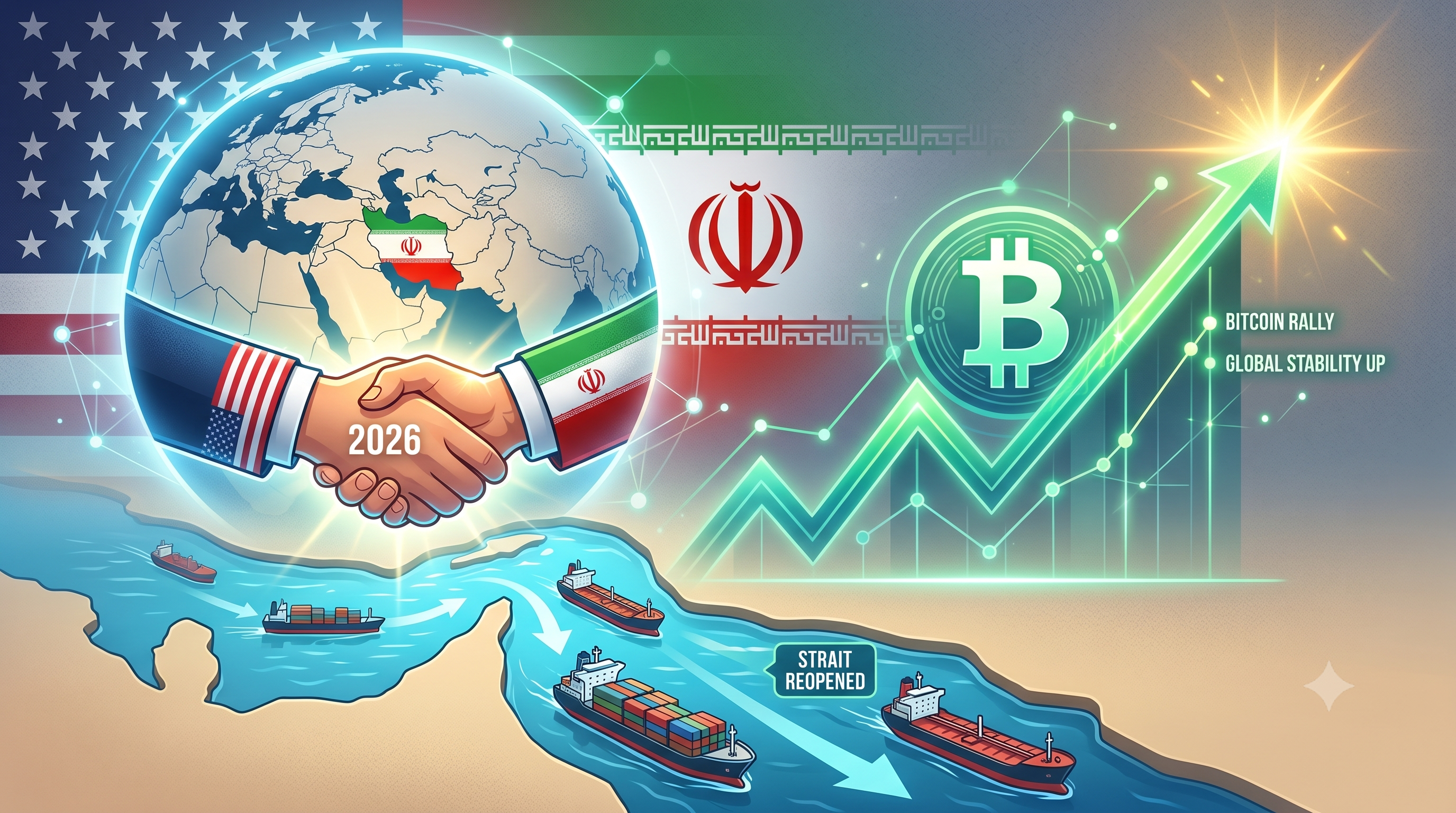
The global financial landscape experienced a seismic shift on June 14, 2026. Following the historic announcement of a comprehensive peace agreement between the United States and Iran, the multi-front geopolitical conflict that gripped the Middle East—and paralyzed global supply chains for 15 grueling weeks—has officially come to an end.
But while traditional equity traders waited anxiously for the Monday opening bell to react, the 24/7 cryptocurrency ecosystem was already aggressively pricing in the new world order. Bitcoin (BTC) surged violently past key resistance levels over the weekend, igniting a massive relief rally that pushed prices back toward the $66,000 mark. To the untrained eye, it might seem strange that a decentralized digital currency is reacting so strongly to a Middle Eastern diplomatic breakthrough. However, for astute macro traders, the connection is crystal clear: the immediate reopening of the Strait of Hormuz is the ultimate catalyst for a massive injection of global liquidity.
Here is exactly why the end of the US-Iran conflict is acting as rocket fuel for the crypto markets.
Key Takeaways
-
The Catalyst: The landmark US-Iran peace agreement has officially ended the 2026 geopolitical standoff, lifting the US naval blockade and reopening the Strait of Hormuz—the world's most vital energy transit chokepoint.
-
The Market Reaction: Bitcoin is experiencing a sharp upside breakout as institutional and retail capital rapidly pivots from "risk-off" wartime panic back to "risk-on" optimism.
-
The Macro Math: Normalized oil supplies mean cheaper crude, which directly leads to a structural drop in global inflation (CPI). This gives the Federal Reserve the ultimate green light to aggressively cut interest rates, flooding high-beta risk assets like Bitcoin with bullish liquidity.
The Breaking News: Bitcoin Surges on US-Iran Peace Deal
The foundation for the current cryptocurrency rally was laid on Sunday, June 14, 2026, when U.S. President Donald Trump took to social media to announce that the deal with the Islamic Republic of Iran was "now complete." Marking the end of a devastating 15-week war that began in late February, the announcement triggered an immediate and profound repricing of assets across the globe. Iranian Deputy Foreign Minister Kazem Gharibabadi quickly confirmed on state television that military operations on all fronts, including the proxy conflicts in Lebanon, would terminate immediately. The formal signing of the memorandum of understanding, heavily mediated by Pakistani Prime Minister Shehbaz Sharif and Qatari diplomats, is scheduled for Friday, June 19, in Geneva, Switzerland.
For the cryptocurrency markets, which never sleep, the reaction was instantaneous. While traditional stock exchanges were closed for the weekend, Bitcoin absorbed the entirety of the macroeconomic shockwave. Within hours of the announcement, Bitcoin bounded upward, climbing over 3% to shatter local resistance levels and reclaim the $65,800 to $66,000 trading zone. Ethereum (ETH) followed suit, pushing past $1,720 in a broad market rally.
This violent upward price action was driven by a classic short squeeze. Throughout the intense maritime standoff of April and May, speculative traders had heavily shorted risk assets, betting that a prolonged closure of the Strait of Hormuz would trigger a global recession. When the peace deal was confirmed, these over-leveraged short positions were liquidated en masse. Trading volume across major centralized exchanges spiked exponentially as algorithmic trading bots parsed the headlines, triggering automated buy orders.
The sentiment shift within the digital asset ecosystem flipped from extreme fear to undeniable optimism in a matter of minutes. Crypto traders recognized immediately that the macroeconomic dark cloud that had suppressed valuations for the entire second quarter had just evaporated. The 24/7 nature of the crypto market allowed it to front-run traditional finance (TradFi), providing a real-time barometer for how Wall Street would react once the opening bell rang on Monday morning.
Unlocking the Strait of Hormuz: The Oil Supply Shock Reverses
To truly understand why Bitcoin is rallying, one must first understand the physical realities of the Strait of Hormuz and why its closure held the global economy hostage. The Strait is a narrow maritime chokepoint nestled between the Persian Gulf and the Gulf of Oman. Under normal macroeconomic conditions, it is the undisputed most critical energy artery on the planet, facilitating the daily transit of over 20 million barrels of crude oil and massive quantities of Liquefied Natural Gas (LNG)—representing roughly 20% of global petroleum liquids consumption.
When the conflict escalated in early 2026, the Strait was effectively shut down. The United States Central Command imposed a stringent naval blockade on major Iranian ports, while regional hostilities made the waters unnavigable for commercial shipping. War-risk insurance premiums for Very Large Crude Carriers (VLCCs) soared to commercially unviable levels, forcing global shipping fleets to undertake massive, costly detours around the Cape of Good Hope. This bottleneck created a massive "war premium" on energy commodities, threatening to plunge Europe and Asia into an energy crisis.
The June 14 peace agreement completely reverses this catastrophic supply shock. President Trump's declaration to "Let the oil flow!" and his authorization of the immediate removal of the US naval blockade signals a rapid return to normalized maritime logistics.
The commodities markets reacted with extreme prejudice. By Monday morning, June 15, crude oil prices had plummeted by over 4%. Brent crude futures dropped back under $84 per barrel, while West Texas Intermediate (WTI) hovered near $81—their lowest levels since the initial strikes in early March.() European natural gas prices also experienced a dramatic cool-down, with the Dutch TTF benchmark falling below $44 per megawatt-hour.
The immediate reopening of the Strait, accompanied by a 60-day ceasefire window where Iran has reportedly agreed to waive transit fees (though the exact terms of a "toll-free" permanent route remain a point of technical negotiation), acts as a massive pressure release valve for the physical economy. Millions of barrels of stranded Iranian crude, alongside normalized transit for Saudi and Emirati exports, are now flooding back into the open market.
The Macro Math: How Cheaper Oil Leads to Fed Rate Cuts
The physical reopening of the Strait of Hormuz is a logistical triumph, but its translation into macroeconomic indicators is what directly fuels Bitcoin's price appreciation. The core logic bridging the Middle East peace deal to the crypto markets lies in the undeniable mathematical pipeline connecting crude oil, inflation, and central bank monetary policy.
For the past several years, central banks, led primarily by the US Federal Reserve, have been locked in a grueling battle against sticky inflation. As traditionally tracked by the Bureau of Labor Statistics, energy costs are a foundational, heavily weighted component of the Consumer Price Index (CPI). Supply-side energy shocks do not merely result in more expensive gasoline at the pump; they cascade into every facet of the global economy. Higher oil prices mean elevated maritime logistics costs, increased airline freight charges, and surging manufacturing overhead. This ultimately results in higher headline inflation for everyday consumer goods.
During the 15-week war, the threat of an extended closure of the Strait of Hormuz terrified central bankers. The resulting energy price spike raised the specter of "stagflation"—a toxic economic environment characterized by slowing growth and rising prices. Under those conditions, the Federal Reserve was entirely handcuffed, unable to cut interest rates without risking a secondary explosion in inflation.
By rapidly suppressing global crude oil prices, the US-Iran peace deal effectively acts as a massive, synchronized economic stimulus for the global consumer. As energy inputs become substantially cheaper, headline inflation data is mathematically guaranteed to cool aggressively in the coming quarters due to favorable base effects. This dynamic fundamentally alters the playbook for the Federal Reserve and its global counterparts.
With inflation expectations now firmly anchored by falling oil prices, the Fed, the European Central Bank (ECB), and the Bank of England (BoE) finally possess the necessary macroeconomic runway to implement sustained, aggressive rate cuts. Market pricing data from June 15 clearly reflects this dovish shift; the market-implied probability of further rate hikes has plummeted, while global bond yields have dropped by 1 to 1.5%.
In the financial world, this transition is known as a "liquidity injection via policy anticipation." Bitcoin, as a non-sovereign, fixed-supply asset, is hyper-sensitive to the global M2 money supply and the cost of borrowing. When the market anticipates lower interest rates, fiat currency yields become less attractive, and liquidity flows like a river into high-beta risk assets. This chain reaction—from physical oil unblocked, to inflation cooling, to central bank easing—is the primary macroeconomic engine driving Bitcoin's current rally.
From Safe Haven to Risk-On: Bitcoin’s Bullish Pivot
The immediate macroeconomic consequences of the peace deal—cheaper energy and the imminent prospect of looser monetary policy—are driving a systemic reallocation of institutional capital. To fully grasp Bitcoin's current price action, it is essential to analyze how capital flows shifted during the crisis versus how they are behaving now.
During the absolute peak of the US-Iran conflict in March and April 2026, global markets exhibited textbook "risk-off" behavior. Terrified of a systemic geopolitical meltdown, capital aggressively fled toward traditional safe-haven assets. Physical gold surged, the US Dollar Index (DXY) strengthened as a flight to cash, and investors piled into short-term US Treasuries, prioritizing pure capital preservation over yield generation or growth. Interestingly, Bitcoin also saw brief periods of safe-haven bidding during the initial shock, as citizens in conflict zones utilized it as an unseizable, borderless store of value. However, the broader macro pressure of high-interest rates eventually weighed on its price.
The Sunday peace announcement violently reversed this entrenched market psychology. We are now witnessing a powerful "risk-on" resurgence across all major global asset classes. As the fear of a systemic geopolitical shock completely dissipates, portfolio managers, hedge funds, and algorithmic trading desks are rapidly unwinding their defensive macro hedges. The capital exiting these safe-haven trades requires a new destination, and it is aggressively hunting for beta—assets that offer high growth potential in a liquid, low-interest-rate environment.
This risk-on appetite was glaringly evident in traditional markets when the Asian trading session opened on Monday, June 15. The Japanese Nikkei 225 index surged an astonishing 5.4%, hitting a record intraday high above 69,000, while the South Korean KOSPI jumped by 4.7%.() Emerging market currencies also rallied strongly against the US Dollar.
Bitcoin is the ultimate beneficiary of this pivot. It is transitioning away from being a niche wartime hedge and is reclaiming its throne as the world's premier "liquidity sponge." When global investors feel secure enough to take on risk, and when borrowing costs are projected to fall, Bitcoin historically outperforms almost every other asset class. The current rally is the market front-running the inevitable wave of capital that will rotate out of bonds and cash and into the digital economy over the remainder of 2026.
TradFi and Institutional Inflows: Wall Street Reacts
The geopolitical thaw does not merely affect sentiment; it alters the fundamental mechanics of institutional capital deployment, particularly within Wall Street's Traditional Finance (TradFi) sector. The introduction of Spot Bitcoin Exchange-Traded Funds (ETFs) in the US market fundamentally bridged the gap between legacy capital and digital assets. However, institutional allocators are notoriously risk-averse when it comes to systemic macro shocks.
During the height of the US-Iran conflict, many registered investment advisors (RIAs), pension funds, and family offices paused their planned allocations to Bitcoin ETFs. The perceived risk of World War III, combined with the volatility of the crypto markets, made it difficult for fiduciary managers to justify stepping into high-beta assets. They opted to sit on their hands, holding record levels of cash in money market funds yielding over 5%.
The signing of the June 19 memorandum in Geneva will effectively signal the "all-clear" for these institutional allocators. With the tail risk of a global energy crisis removed from the board, Wall Street is aggressively recalculating its risk models. The billions of dollars sitting on the sidelines in money market funds will begin seeking higher returns as central banks cut rates. Bitcoin Spot ETFs offer the most frictionless vehicle for Wall Street to gain exposure to the impending liquidity cycle.
Furthermore, the peace deal resolves a major point of friction for institutional sentiment. A stable Middle East ensures that global supply chains, including the semiconductor shipments vital for Bitcoin mining hardware, remain uninterrupted. It also allows large-scale publicly traded mining companies to forecast their energy costs with greater accuracy, improving the fundamental health of the Bitcoin network. As traditional equities like the Nasdaq 100 flash green in pre-market trading, algorithmic trading algorithms that correlate BTC to tech equities will automatically increase their buying pressure, creating a feedback loop of institutional demand.
What’s Next for BTC? Key Price Levels and Data to Watch
While the immediate market reaction has been overwhelmingly bullish, seasoned traders know that geopolitical agreements often face technical hurdles during their implementation phase. As Bitcoin attempts to consolidate its gains above $65,000 and push toward the psychological $70,000 threshold, several key data points and events will dictate its next major move.
First, the market will be hyper-focused on the actual signing of the memorandum in Geneva on Friday, June 19. The framework of the deal establishes a 60-day window for intensive technical talks, primarily focused on Iran's nuclear program. Reports indicate that Iran must dilute its stockpiles of highly enriched uranium—currently exceeding 9,000 kg. If these technical negotiations proceed smoothly, Bitcoin will likely continue to grind higher on the back of sustained macro optimism. However, any headlines suggesting diplomatic friction or delays in the nuclear concessions could trigger brief periods of volatility and long-squeeze liquidations.
Second, the exact nature of the Strait of Hormuz's "toll-free" status remains a potential flashpoint. While President Trump has authorized a toll-free opening, Iranian officials have previously insisted that the strait operates under Iranian arrangements, hinting at potential transit fees. If shipping conglomerates face unexpected bureaucratic hurdles or renewed harassment, the "war premium" on oil could temporarily spike, briefly stalling the dovish Fed narrative and causing BTC to retest lower support levels.
Finally, crypto traders must shift their focus back to traditional macroeconomic data. The peace deal sets the stage for falling inflation, but the market needs empirical proof. Upcoming releases of the US Personal Consumption Expenditures (PCE) price index and the next batch of CPI data will be critical. If these reports show the expected sharp decline in energy-driven inflation, it will cement the Federal Reserve's path to rate cuts. A confirmed dovish pivot by Fed Chair Jerome Powell later this summer would likely act as the final catalyst needed to push Bitcoin into a full-blown parabolic bull market, potentially establishing new all-time highs before the end of 2026.
FAQs
Why is the Strait of Hormuz reopening causing Bitcoin to rally?
The reopening drops global oil prices, which lowers inflation. This allows the Federal Reserve to cut interest rates, flooding markets with liquidity that flows directly into high-growth assets like Bitcoin.
How does crude oil price affect the cryptocurrency market?
Crude oil is a major driver of inflation (CPI). When oil prices plunge, inflation cools down, giving central banks the economic justification to lower interest rates and boost market liquidity.
What does "risk-on" resurgence mean for Bitcoin?
It means investors are no longer panicked by geopolitical crises. They are moving capital out of safe havens (like gold and the US Dollar) and rotating it back into high-yield, high-beta assets like crypto.
Why did the crypto market react to the peace deal over the weekend?
Because crypto markets operate 24/7 without opening bells or holidays. This allowed digital assets to absorb the macroeconomic news and front-run traditional stock exchanges before Monday morning.
How will Wall Street institutions react to this agreement?
The resolution of the conflict removes a major geopolitical risk. Institutional allocators who were holding cash on the sidelines are now expected to safely resume capital deployment into Bitcoin Spot ETFs.
Disclaim: This article is for informational purposes only and does not constitute financial or investment advice. Cryptocurrency investments carry significant risk. Always conduct your own research before trading.