

SpaceX Stock Is Back Above Its $135 IPO Price — Will SPCX Drop Below $100 in 2026?
Introduction
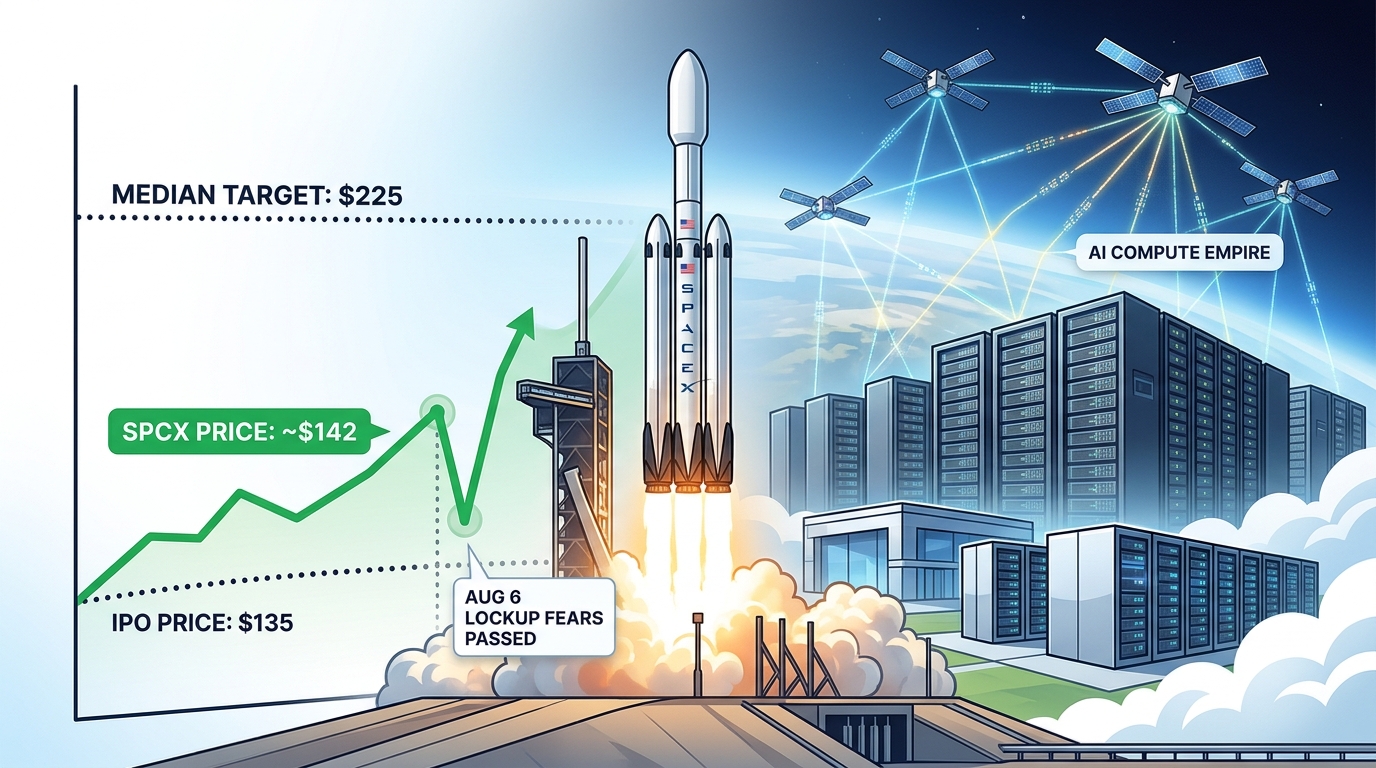
Roughly $123 billion worth of insider shares became eligible to sell on August 6, 2026 — and SpaceX stock went up, not down. With SPCX now trading near $142, back above its $135 IPO price, the short answer to the big question is this: a drop below $100 this year is unlikely, though not impossible. The feared post-lockup selloff never materialized, Wall Street's median price target sits at $225, and the company's AI compute ambitions are increasingly being priced as a core fundamental rather than a side story.
That said, a rolling unlock schedule running through December 8, 2026 means the supply overhang is not fully gone — it is just shrinking. Here is what the data says about whether SpaceX can revisit triple-digit territory, or even slip under $100, before the year ends.
Where Does SpaceX (SPCX) Stock Stand Right Now?
SpaceX stock is trading around $142 per share as of early September 2026 — roughly 5% above its $135 IPO price and about 35% above its August lows. The round trip has been dramatic. SpaceX priced its initial public offering at $135 per share on June 11, 2026, selling more than 555 million shares and raising a record $75 billion at a valuation of roughly $1.75 trillion, nearly three times the previous record set by Saudi Aramco in 2019.
The stock opened at $150 on June 12 and surged as high as $225.64 within its first days of trading, before a steady slide took it below the IPO price in July and down to a 52-week low of $104.83 in early August, based on market data from Motley Fool. Since then, SPCX has reclaimed the $135 level and pushed toward $142, putting its market capitalization back near $2 trillion.
In other words, the market has already stress-tested the sub-IPO scenario — and buyers showed up well above $100.
What Actually Happened After the August 6 Lockup Expiry?
The mass insider selling that many feared simply did not happen. On August 6, 2026, up to 911.5 million shares held by employees and early investors became eligible to trade — a tranche worth roughly $123 billion, about 64% larger than the IPO itself and 68 times the typical large-cap unlock. Instead of collapsing, SPCX rose about 6% on the day off its all-time lows, based on lockup tracking data.
Several structural factors explain the calm:
-
Unlock is not the same as selling. Being allowed to sell is not the same as wanting to. For companies with strong long-term narratives, insiders often hold — especially when they believe the stock is undervalued.
-
The biggest believers are locked in anyway. Elon Musk's roughly 6.4 billion shares sit under a 366-day hard lock until June 2027, with no early-release provisions. Early venture backers such as Sequoia and a16z are widely viewed as long-horizon "conviction capital."
-
Passive demand absorbs supply. SpaceX joined the Nasdaq-100 Index on July 7, 2026, opening the stock to buying from index funds and ETFs commanding more than $800 billion in assets globally, according to Yahoo Finance.
The Q2 2026 earnings report, released on August 4 just before the unlock, added fuel to the rebound. According to BingX's earnings coverage, revenue grew roughly 92% year over year, reinforcing the case that fundamentals — not just scarcity — are driving the stock. Morgan Stanley analyst Adam Jonas had argued ahead of the expiry that if SPCX crashed to $100, the market would be pricing in little or no value for its AI business while also undervaluing launch and connectivity. With the uncertainty of the first unlock now removed, that overhang disappearing is itself a bullish signal — and the stock's behavior since suggests the market agrees.
Is SpaceX's AI Compute Empire Still Undervalued?
The AI infrastructure story may be the single most underappreciated driver of SpaceX's valuation. While most coverage fixates on rockets and Starlink, recent disclosures show SpaceX building what could become one of the world's largest AI compute businesses.
How Big Is the AI Compute Opportunity?
The numbers are striking. According to analysis from SemiAnalysis and Michael Parekh's AI-RTZ newsletter in August 2026, Musk said on SpaceX's first public earnings call that the company "conservatively" aims to deliver an incremental 6 to 8 gigawatts of AI compute capacity in 2027 alone, with potential above 10 GW. At current market pricing of roughly $50 billion per gigawatt, that implies $300 billion to $400 billion in potential value — and if 8 GW comes online within the next 12 to 24 months, selling AI compute alone could generate hundreds of billions of dollars in revenue. For context, Tesla's annual revenue is around $100 billion, meaning SpaceX's compute business could theoretically rival several Teslas in annual sales.
The commercial traction is already real. On May 6, 2026, Anthropic signed a deal to use all compute capacity at the Colossus 1 data center in Memphis — over 300 megawatts across more than 220,000 NVIDIA GPUs — paying $1.25 billion per month through May 2029, a contract worth more than $40 billion to SpaceX, according to the company's S-1 filing as reported by WisdomTree.
What About Orbital Compute?
Orbital compute is moving from science fiction to engineering roadmap — and launching satellites is precisely SpaceX's home turf. The company's January 2026 FCC filing envisions a constellation of up to one million satellites carrying AI compute into low Earth orbit, with a long-term goal of launching 100 gigawatts of compute to space each year, according to the S-1 filing cited by SemiAnalysis. To support this, SpaceX unveiled the 11-million-square-foot Gigasat factory in June 2026, targeting 1 GW per year of space-based AI compute by late 2027 via its AI1 satellites, according to Tom's Hardware. Musk has predicted that within five years, more AI compute will launch to orbit annually than the cumulative total on Earth.
Starlink remains the cash engine in the meantime. With about 10,500 active satellites as of June 2026, according to Tom's Hardware, the constellation gives SpaceX both a proven revenue base and the deployment experience that orbital compute will build on.
What Do Wall Street Analysts Say About SpaceX?
Wall Street is overwhelmingly bullish, with a median price target of $225 — roughly 58% above current levels. According to Fortune's July 2026 roundup, 17 of 23 underwriting banks issued specific 12-to-18-month targets, ranging from Stifel's $190 at the low end to Raymond James' $800 at the high end:
| Firm | Price Target | Implied Upside from ~$142 |
| Stifel | $190 | ~34% |
| Goldman Sachs | $205 | ~44% |
| JPMorgan | $225 | ~58% |
| Deutsche Bank | $255 | ~80% |
| Morgan Stanley | $300 | ~111% |
| Raymond James | $800 | ~463% |
Roughly two-thirds of analyst recommendations were buy or strong buy, per LSEG data cited by CNBC. Deutsche Bank called SpaceX the "apex of civilizational ambition," while Raymond James framed it as one of the defining industrial infrastructure companies of the 21st century.
Skepticism is worth noting, though. IPO expert Jay Ritter of the University of Florida has called the clustered targets "copycat" behavior, pointing out that SpaceX lost $4.94 billion on $18.67 billion of revenue in 2025 — a valuation above 100x sales even then. Still, as analyst coverage, valuation models, liquidity, and index inclusion mature, SpaceX is rapidly becoming a security that institutions must benchmark against Nvidia, Microsoft, Amazon, and Google in portfolio allocation decisions.
Could SpaceX Still Fall Below $100 in 2026?
A drop below $100 is possible but would likely require several bearish factors to align at once. The current valuation already embeds high growth expectations for Starlink, Starship, AI infrastructure, and orbital compute — so disappointment on execution, not just supply, is the real risk.
The remaining supply schedule is the most concrete near-term pressure. Based on lockup tracking data, key upcoming unlocks include:
| Date (2026) | Unlock Event | Approx. Size |
| September 9 | Employee tranche (day 90) | 319 million shares |
| September 24-25 | Employee tranche; float expands toward ~6x IPO level | ~328 million shares |
| October-November | Rolling employee tranches; post-Q3 unlock of ~28% | up to ~1.3 billion shares |
| December 8 | Full 180-day expiry; float reaches ~66% | Remaining employee block |
As float expands from just 4.9% at IPO toward 66% by December, the "scarcity premium" embedded in SPCX's price will naturally fade. Whether the stock holds up will depend increasingly on fundamentals — revenue delivery from compute contracts, Starship progress — and on whether institutional demand keeps absorbing new supply.
Trade the Setup on KuCoin and Enter the Prize Pool
When a market narrative is in motion, the next step is not only to decide the view, but to place it where liquidity, tools, and extra incentives line up. KuCoin’s KuLeague (Fall Season 2026) futures trading competition runs from August 31 to September 21, 2026 (UTC+8) and offers a 400,000 USDT prize pool, split across a Team Battle (100,000 USDT), a Solo PnL Contest (60,000 USDT), and a Grand Lucky Draw (240,000 USDT).
Trade $500 in a day to unlock a daily spin with a 100% prize rate. Use the same positions you would take for the story above — and compete for rewards at the same time:

Conclusion
SpaceX stock has reclaimed its $135 IPO price and trades near $142, and the evidence suggests a return below $100 in 2026 is unlikely. The August 6 lockup — the single largest supply shock on the calendar — passed without mass selling, Elon Musk's shares remain locked until June 2027, and Nasdaq-100 inclusion provides steady passive demand. Fundamentally, the AI compute story is accelerating: the Anthropic contract alone is worth over $40 billion, and management is targeting 6 to 8 GW of incremental AI compute capacity in 2027, with orbital compute as a longer-term option. Wall Street's median target of $225 reflects that institutional embrace.
Risks remain real: rolling unlocks through December 8 will expand the float toward 66%, the scarcity premium will dilute, and a valuation above 100x trailing sales leaves no room for execution stumbles. The $104.83 August low is the line in the sand. Unless that breaks with heavy volume, the base case is consolidation and gradual absorption — not a trip back under $100.
FAQs
What was SpaceX's IPO price and when did it go public?
SpaceX priced its IPO at $135 per share on June 11, 2026, and began trading on Nasdaq under the ticker SPCX on June 12, 2026, raising a record $75 billion at a valuation of roughly $1.75 trillion.
What is SpaceX stock's 52-week low?
SpaceX stock's 52-week low is $104.83, reached in early August 2026 ahead of the first lockup expiry, according to Motley Fool market data.
When do the remaining SpaceX share lockups expire?
Lockups expire in rolling tranches through December 8, 2026 — including employee unlocks on September 9 and September 24 — with the full 180-day block releasing on December 8 and Elon Musk's shares unlocking on June 12, 2027.
Disclaimer: This article is for informational purposes only and does not constitute financial, legal, or investment advice. Always conduct your own research before interacting with digital assets.