

Solana Tokenized-Asset Trading Volume Hits Record $5.8 Billion in Q2, Surging 114% QoQ
2026/07/25 12:00:00
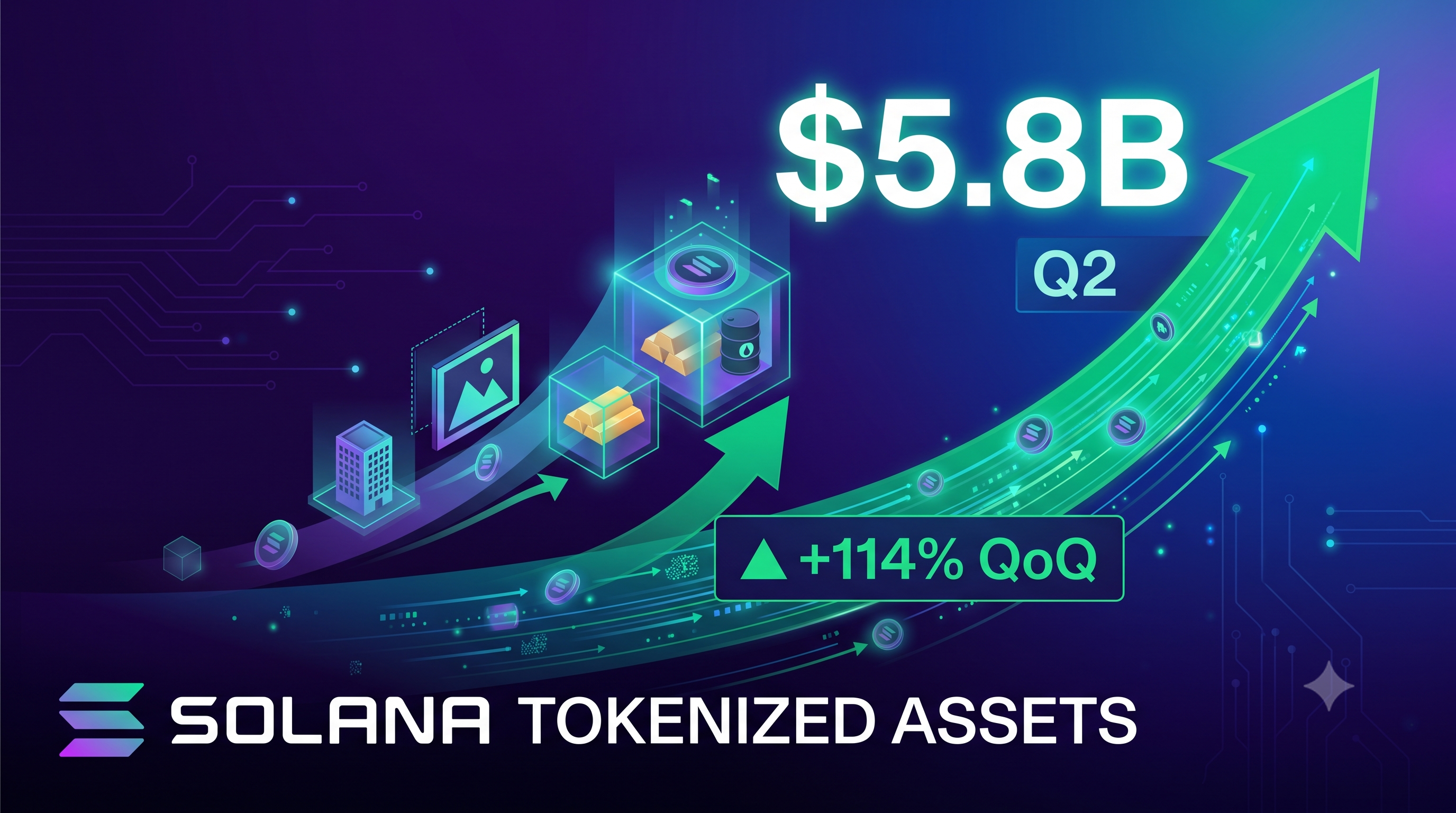
Solana’s tokenized-asset trading volume reached a record $5.8 billion in Q2 2026, climbing 114% from the previous quarter as demand for tokenized stocks and other real-world assets accelerated. Tokenized equities generated approximately $4.8 billion of the total, helping Solana capture an estimated 97% of tokenized-equity trading across supported blockchain networks.The milestone reflects Solana’s growing role in on-chain capital markets, supported by low transaction costs, fast settlement and expanding products from platforms such as Ondo Finance and Backed’s xStocks. However, the $5.8 billion figure represents quarterly trading volume, not the total value of tokenized assets held on Solana. This article examines what drove the Q2 surge, how tokenized equities became its main source of growth and what Solana’s expanding RWA market means for investors.
Tokenized Equities Drive Solana’s Record $5.8 Billion Trading Volume
Tokenized equities emerged as the main driver of Solana’s real-world asset growth in Q2 2026. Trading activity increased rapidly as platforms expanded access to blockchain-based stocks and exchange-traded funds, helping Solana strengthen its position in on-chain capital markets. The growth also suggests that the network is attracting demand beyond memecoins and other highly speculative crypto assets.
Tokenized Stocks Account for $4.8 Billion of Solana’s Q2 Volume
According to the Blockworks Solana Q2 2026 Token Holder Report, decentralized exchanges on Solana processed approximately $5.8 billion in tokenized-asset trading volume during the quarter. This represented a 114% increase from Q1 and marked the sixth consecutive quarterly record. Tokenized equities generated around $4.8 billion of the total, accounting for approximately 84% of all tokenized-asset volume on the network. Their quarterly activity was also more than four times the previous record, showing how quickly demand for tokenized stocks on Solana expanded during the period.
The $5.8 billion figure refers to trading volume, not the market capitalization or total value locked in Solana tokenized assets. Because the same token can change hands several times, each transaction contributes to the quarterly total. Solana also reportedly handled approximately 97% of tokenized-equity trading across supported blockchain networks. That percentage represents Solana’s share of the broader cross-chain market, while the 84% figure measures how much of Solana’s own tokenized-asset volume came from equities.
Solana Tokenized-Stock Volume Surpasses $10 Billion
Solana’s tokenized-stock market accelerated toward the end of Q2. According to the Solana Foundation’s June 2026 ecosystem report, cumulative tokenized-stock volume surpassed $10 billion after rising approximately 180% during the month. Daily tokenized-stock trading volume also reached a record $683 million, while the value of real-world assets on Solana crossed $3 billion for the first time. Together, these milestones show that the Q2 increase was supported by both active trading and a larger base of tokenized financial products.
This growth stood out because several other Solana market indicators weakened during the same quarter. Total spot DEX volume declined to approximately $160.8 billion, while the network’s Real Economic Value revenue fell about 43% quarter over quarter to $51 million as memecoin activity cooled. Tokenized-asset volume moved in the opposite direction and more than doubled. This divergence indicates that Solana’s RWA ecosystem is beginning to develop into an independent source of network activity rather than simply following speculative crypto-market trends.
Ondo Finance and xStocks Expand Tokenized Equity Access
Ondo Finance and Backed’s xStocks have helped broaden access to tokenized stocks on Solana. As of July 2026, Ondo reported more than 440 tokenized assets and approximately $1.02 billion in total value locked across its supported networks. In June, the platform introduced 24/7 minting and redemption for selected tokenized stocks and ETFs on Solana, Ethereum and BNB Chain. The initial selection included products linked to Nvidia, Tesla, Alphabet, Circle, the S&P 500 and the Nasdaq-100. Eligible users can now create and redeem these supported products outside conventional US market hours, rather than only transferring existing tokens between wallets.
Backed has also brought more than 60 xStocks products to Solana, including tokenized exposure to Apple, Amazon, Microsoft, Coinbase and Strategy. The company describes xStocks as certificates collateralized 1:1 by their corresponding underlying securities. These tokens can move through compatible wallets, exchanges and decentralized finance applications, improving their potential liquidity and on-chain utility. However, tokenized equities may not provide the same ownership, voting or legal rights as directly registered company shares. Availability, custody arrangements and redemption terms also vary by product and jurisdiction, making issuer documentation an essential part of any investment assessment.
Why Tokenized-Asset Activity on Solana Surged 114% in Q2
Solana tokenized-asset trading volume surged 114% quarter over quarter in Q2 2026 because tokenized equities moved from a developing niche into one of the network’s most active markets. According to the Blockworks Solana Q2 2026 Token Holder Report, total tokenized-asset DEX volume reached a record $5.8 billion, compared with an implied $2.71 billion in Q1. Tokenized stocks generated approximately $4.8 billion of the Q2 total and more than quadrupled their previous quarterly record. This growth was supported by a wider range of blockchain-based stocks and ETFs from platforms such as Ondo Finance and Backed’s xStocks. These platforms expanded access to products linked to major companies and market indexes, giving eligible users more opportunities to trade traditional financial exposure through crypto wallets and decentralized exchanges. Solana also reportedly handled about 97% of tokenized-equity trading across supported blockchain networks, helping liquidity and market activity become increasingly concentrated within its ecosystem.
Solana’s low transaction costs, fast settlement and high throughput also made the network attractive for frequent tokenized-asset transactions. Traders can move supported assets between wallets, exchanges and decentralized finance applications without relying entirely on traditional market infrastructure. The introduction of continuous minting and redemption for selected Ondo tokenized stocks further improved access outside conventional US trading hours, while xStocks expanded the number of transferable equity-linked products available on Solana. By June 2026, cumulative tokenized-stock volume on the network had surpassed $10 billion, daily volume had reached a record $683 million, and total Solana RWA value had crossed $3 billion. These gains occurred even as broader spot DEX volume and memecoin-related revenue weakened, suggesting that Solana’s tokenized-asset growth was driven by expanding real-world asset adoption rather than a general increase in speculative crypto trading.
What Solana’s RWA Growth Means for Investors and On-Chain Markets
Solana’s expanding real-world asset ecosystem could reshape how investors access, transfer and use traditional financial products. Instead of remaining isolated inside brokerage and settlement systems, tokenized stocks, funds, government securities and commodities can move through compatible blockchain wallets and interact with other on-chain applications. This creates new possibilities for faster settlement, fractional access and more efficient capital deployment, while giving the Solana ecosystem a source of financial activity linked to established assets rather than purely speculative crypto tokens.
How Solana Real-World Assets Could Improve Investor Access
Real-world asset tokenization can make conventional investments more accessible to eligible users in supported jurisdictions. Investors may be able to purchase fractional exposure, transfer assets between compatible platforms and manage crypto and traditional market positions through the same wallet infrastructure. Tokenized securities can also reduce some operational friction associated with intermediaries, settlement delays and disconnected financial systems. For investors who lack convenient access to international brokerage services, Solana RWAs could provide another route to economic exposure to global stocks, ETFs, Treasury products and other financial assets.
The connection between tokenized assets and Solana DeFi creates an additional opportunity. Supported RWAs could be used as collateral, deposited into lending protocols or exchanged for other assets without leaving the network. This interoperability may improve capital efficiency and encourage asset managers, custodians, market makers and financial technology companies to build more institutional infrastructure on Solana. If adoption continues, tokenized real-world assets could help transform the network from a crypto trading venue into a broader settlement and liquidity layer for on-chain capital markets.
Investor Protection and Liquidity Will Determine Long-Term RWA Growth
Tokenized assets do not automatically provide the same protections or rights as assets purchased through a conventional brokerage account. Some tokenized equities are structured as certificates or total-return products that track the performance of an underlying security rather than registering the token holder as a direct shareholder. Voting rights, dividend payments, redemption procedures, custody arrangements and legal claims can differ between issuers. Many products also have geographic restrictions or identity-verification requirements, which means availability on a public blockchain does not guarantee unrestricted access.
Sustainable Solana RWA growth will depend on more than headline trading volume. Investors and analysts should examine liquidity depth, bid-ask spreads, holder concentration, reserve transparency, redemption activity and the reliability of price data. Smart-contract vulnerabilities, custodian failure, issuer risk and price differences outside traditional market hours also require careful consideration. If Solana’s tokenized-asset market develops transparent backing, dependable liquidity and clear legal protections, the network could become an important part of global on-chain finance. If those safeguards fail to keep pace with adoption, institutional and retail demand may weaken despite rapid early growth.
How Tokenized Assets Move From Traditional Markets to Solana
Understanding how tokenized assets work on Solana requires looking beyond the blockchain token itself. A tokenized stock or ETF normally connects several components, including an issuer, legal structure, custodian, smart contract, price-data provider, trading venue and redemption process. Each component helps connect a traditional financial asset with Solana’s on-chain infrastructure.
-
Issuers Establish the Legal Structure. The process begins when an issuer defines what the token legally represents. Depending on the product, it may be structured as a certificate, contractual claim, total-return tracker or regulated security linked to an underlying stock, ETF or fund. The legal documents determine whether token holders receive direct ownership rights or only economic exposure to the asset’s price performance. They also explain investor eligibility, geographic restrictions, redemption conditions and how insolvency would affect token holders.
-
Underlying Assets Are Purchased and Held in Custody. After establishing the product structure, the issuer or an appointed entity purchases the underlying securities. These assets are normally held with a third-party custodian or regulated financial institution rather than stored directly on the blockchain. For a product described as fully collateralized, the issuer should maintain sufficient underlying assets to support the circulating token supply. Reserve reporting, independent verification and asset segregation can help investors confirm whether the stated backing matches the number of tokens issued.
-
Tokenized Assets Are Minted on Solana. Once the required collateral and investor conditions are satisfied, the issuer mints a blockchain token on Solana. The token records ownership or economic exposure within the product’s legal structure and can be transferred through compatible wallets and platforms. Some issuers mint tokens only after receiving a verified purchase request, while others maintain an existing supply to support secondary-market liquidity. Smart contracts manage token creation, transfers and burning, but the exact process varies between tokenized-asset platforms.
-
Price Oracles and Market Makers Support Price Tracking. Tokenized stocks need reliable market data to track their underlying securities. Blockchain oracles provide applications with reference prices collected from approved financial data sources. However, an oracle does not guarantee that a token will always trade at the same price as the underlying stock. Market makers, arbitrage traders and issuer redemption mechanisms also help reduce price differences. Premiums or discounts may still appear when liquidity is limited, traditional exchanges are closed or minting and redemption are temporarily unavailable.
-
Tokens Trade Through Solana Wallets, DEXs and DeFi Protocols. After issuance, supported tokenized assets can move between Solana wallets and trade through compatible exchanges or decentralized applications. Investors may swap them for stablecoins, provide liquidity or use approved assets as collateral in certain DeFi protocols. This interoperability allows traditional market exposure to interact with blockchain-based financial services. Support differs by product, and a token available in one wallet or exchange may not be accepted by every lending market or liquidity protocol.
-
Redemption and Corporate Actions Complete the Process. Eligible token holders may be able to redeem their assets through the issuer or an authorized platform. During redemption, the tokens are normally returned and burned while the holder receives cash, stablecoins or another form of settlement based on the product’s terms. Issuers must also account for dividends, stock splits, mergers and other corporate actions affecting the underlying securities. These events may be handled through cash distributions, token-balance adjustments or changes to the token’s reference value, making the issuer’s corporate-action policy an important part of understanding how a tokenized asset works.
Conclusion
Solana’s record tokenized-asset trading volume signals that real-world assets are becoming a meaningful part of its on-chain economy. Tokenized equities led the Q2 2026 expansion, while broader product availability, faster settlement and integration with decentralized finance helped attract more activity to the network. The growth also gives Solana a stronger capital-markets narrative as demand moves beyond memecoins and other speculative crypto sectors.
The next phase will depend on whether Solana can convert rising RWA activity into sustainable liquidity and long-term investor participation. Transparent reserves, reliable custody, clear redemption terms and stronger investor protections will be essential as tokenized stocks and other traditional assets move on-chain. If issuers and platforms can meet those standards, Solana could strengthen its position as a major settlement and trading network for global tokenized markets.
Frequently Asked Questions About Solana Tokenized Assets
-
What qualifies as a real-world asset on Solana?
A Solana real-world asset is a blockchain token linked to an off-chain asset or financial claim. Examples include tokenized stocks, ETFs, government securities, commodities, private credit and investment funds. The legal structure and rights attached to each token depend on its issuer.
-
Do Solana tokenized stocks provide voting rights and dividends?
Not necessarily. Some tokenized stocks track the economic performance of an underlying share without making the token holder a registered shareholder. Dividend treatment, voting rights and participation in corporate actions vary by product, so investors should review the issuer’s legal documents before purchasing.
-
How can investors verify whether a tokenized asset is fully backed?
Investors should check the issuer’s reserve reports, custody arrangements, product prospectus and redemption terms. They should also confirm the official token contract address and determine whether reserves are independently audited or verified by a regulated third party.
-
Are Solana tokenized equities available to US investors?
Many tokenized equity products are not offered to US persons because they may fall under securities regulations. Availability depends on the issuer, the investor’s location and applicable eligibility requirements. A token being transferable on a public blockchain does not automatically make it legally available in every country.
-
What happens to tokenized-stock prices when traditional markets are closed?
Tokenized stocks may continue trading while the underlying exchange is closed, but lower liquidity and limited price discovery can create temporary premiums or discounts. Prices may move closer to the underlying share value when traditional markets reopen or when minting and redemption resume.
Disclaimer: This article is for informational purposes only and does not constitute financial, legal or investment advice. Tokenized assets involve market, regulatory, custody and smart-contract risks. Always conduct your own research.