

RLUSD Hits $2.37 Billion as XRPL Supply Passes Ethereum
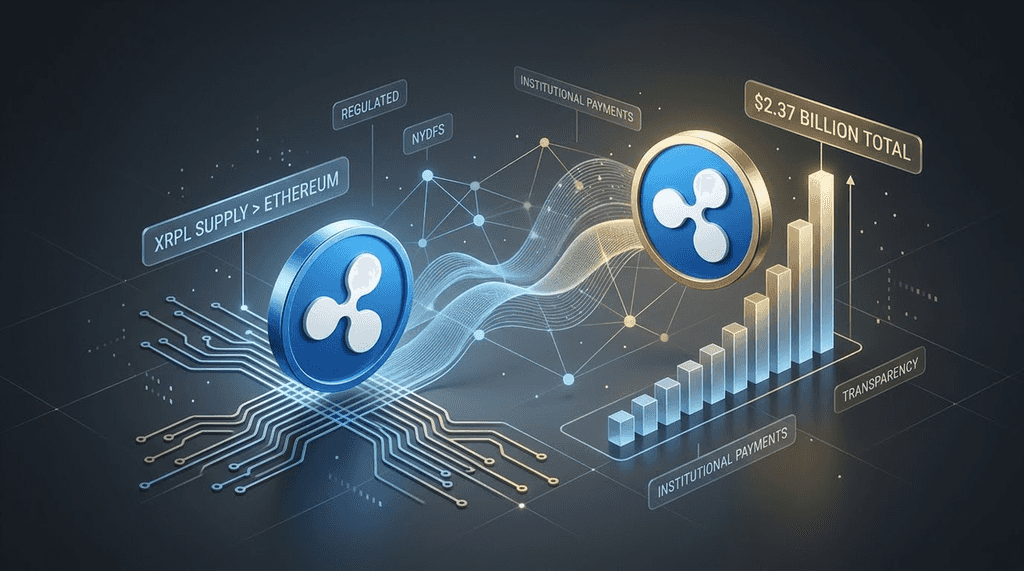
In the digital asset sector, market depth, capital allocation, and on-chain issuance patterns provide concrete data regarding how institutional market participants utilize liquidity. Ripple USD (RLUSD), the regulated US dollar-backed stablecoin issued by Ripple, recently reached a circulating supply of approximately $2.37 billion. Alongside this valuation milestone, on-chain metrics reveal a highly competitive distribution dynamic: the circulating volume of RLUSD on the XRP Ledger (XRPL) has rivaled and periodically surpassed its circulating volume on the Ethereum network.
Throughout its phased rollout, RLUSD experienced shifting distribution patterns, with initial liquidity distributed between Ethereum’s established decentralized finance protocols and the native payment infrastructure of the XRP Ledger. The ongoing tug-of-war in token volume between the two networks indicates that enterprise settlement demand and native ledger integration are maturing, directly competing for capital with general-purpose decentralized liquidity pools. For corporate treasurers, institutional trading desks, and fintech developers, this supply distribution demonstrates differing structural preferences in cross-border settlement, liquidity routing, and blockchain-based cash management.
This article examines the mechanics behind the $2.37 billion RLUSD market cap, the regulatory framework governing the asset, the operational distinctions driving capital allocation between XRPL and Ethereum, and the broader competitive dynamics across the institutional stablecoin landscape.
What Is RLUSD and How Does It Work?
Ripple USD (RLUSD) is an enterprise-grade stablecoin pegged at a 1:1 ratio to the United States dollar. Designed primarily for cross-border settlement, corporate treasury management, and institutional payment rails, the asset operates under a regulatory framework supervised by the New York State Department of Financial Services (NYDFS). Ripple issues the token via a specialized New York trust company charter, which requires adherence to strict capital reserve mandates, comprehensive risk management protocols, and regular supervisory audits.
Unlike purely retail-oriented digital assets, RLUSD is structured to serve as a compliant bridge between traditional banking infrastructure and distributed ledger technology. It functions as a digital dollar that financial institutions can incorporate into their operations while navigating domestic anti-money laundering (AML) and know-your-customer (KYC) requirements.
Reserve Composition and Solvency Verification
To maintain its 1:1 dollar peg, each unit of RLUSD is backed by a dedicated reserve portfolio consisting exclusively of conservative, highly liquid dollar assets:
-
Cash Deposits: Direct liquid balances maintained across regulated US commercial banking institutions.
-
Short-Term US Treasuries: Short-maturity government obligations designed to minimize duration risk and yield fluctuations.
-
Overnight Reverse Repurchase Agreements (Repos): Fully collateralized short-term lending facilities backed by US government debt to maintain overnight liquidity.
Independent public accounting firms conduct regular third-party attestations of the reserve pool. Official transparency reporting indicates that the underlying reserves supporting RLUSD stand at approximately $2.53 billion in qualifying assets. This represents an over-collateralized reserve cushion of roughly 5% relative to the active circulating token liabilities. These segregated accounts are legally isolated from Ripple’s corporate operational capital, protecting token holders from enterprise counterparty risk in compliance with NYDFS regulatory standards.
XRPL vs. Ethereum: The Mechanics Behind the Supply Shift
The architecture of RLUSD utilizes a dual-chain issuance model. Ripple deployed RLUSD natively on both the XRP Ledger and the Ethereum network as an ERC-20 token. The dynamic fluctuation in supply between these two environments illustrates their differing operational functions in the broader market.
| Operational Metric | XRP Ledger (XRPL) | Ethereum (ERC-20) |
| On-Chain Settlement Time | 3 to 5 seconds | ~12 to 15 seconds (Layer-1) |
| Base Network Fee | Predictable, fractions of a cent (<$0.01) | Variable ($0.50 to $20.00+ based on gas) |
| Primary Market Function | B2B Payments, FX & Treasury Clearing | Collateral, Lending Protocols & DeFi |
| Native Asset Handling | Native Ledger-Level Trustlines | Smart Contract Execution |
| Consensus Mechanism | Federated Byzantine Agreement (FBA) | Proof of Stake (PoS) |
Network Friction and Settlement Finality
When RLUSD was deployed, the Ethereum issuance captured early volume due to immediate integration across established decentralized exchanges, custodial platforms, and automated market makers. However, Ethereum’s Layer-1 execution environment introduces variable gas costs and block settlement intervals that fluctuate according to global network congestion.
For high-volume institutional payments, variable transaction costs present an operational friction point. The XRP Ledger resolves transactions using a Federated Byzantine Agreement consensus protocol, confirming on-chain settlement within 3 to 5 seconds. Network fees on XRPL are predictable, consistently costing fractions of a cent per transfer, offering a low-cost environment for entities executing high-frequency transfers.
Dual-Chain Minting and Redemption Arbitrage
The shift in supply balance is governed by direct institutional minting and burning mechanisms rather than cross-chain bridges. Authorized participants holding accounts with the issuer can deposit fiat to mint RLUSD on either network, or submit digital tokens to be burned in exchange for underlying bank deposits.
When commercial liquidity demand increases within XRPL payment corridors, market makers mint tokens directly onto the XRP Ledger. Conversely, when Ethereum DeFi yields are highly attractive, institutional holders may shift capital to ERC-20 RLUSD. The recent parity and occasional XRPL supply dominance highlight that institutional demand for payment clearing on XRPL is now robust enough to rival the deep liquidity demands of Ethereum’s DeFi ecosystem.
Integrated Protocol Architecture
The XRP Ledger incorporates native financial primitives directly into its core protocol layer. RLUSD on XRPL interacts with the ledger's built-in Decentralized Exchange (DEX) and compliance-oriented Trustlines. Authorized counterparties can establish precise transaction limits and address authorizations without deploying third-party smart contract code, minimizing certain smart contract vulnerabilities often associated with EVM-based tokens.
Enterprise Use Cases and Operational Realities
Stablecoins are increasingly functioning as transactional rails rather than just passive stores of value or trading collateral.
Optimizing Cross-Border Commercial Payments
Traditional cross-border settlement relies on correspondent banking relationships, requiring multinational businesses to hold pre-funded accounts (nostro and vostro) in destination jurisdictions.
By integrating RLUSD within institutional payment networks, participating entities can transmit digital value across the XRP Ledger in seconds. However, it is important to note that while the on-chain transmission is near-instant, the end-to-end settlement is still bound by traditional banking friction. Converting local currency to RLUSD on the sending side, and redeeming RLUSD into fiat on the receiving side, remains subject to commercial bank operating hours, local FX spreads, and domestic clearing rails (like ACH or SEPA).
Corporate Treasury and Liquidity Operations
Conventional commercial banking systems restrict internal corporate fund flows to standard business hours, leaving treasuries illiquid over weekends and international holidays. Operating on a continuous 24/7/365 basis, the XRP Ledger enables corporate treasuries to execute low-latency intercompany transfers of digital dollars at any time. While final fiat withdrawal still waits for Monday banking hours, the ability to settle collateral and digital balances on-ledger over the weekend improves liquidity management.
Comparative Analysis: RLUSD, USDC, USDT, and NYDFS Peers
To evaluate RLUSD's market position, it must be contextualized alongside dominant dollar-backed stablecoins like Tether (USDT) and Circle USD (USDC), as well as other NYDFS-regulated peers.
While USDT (focusing on offshore liquidity) and USDC (dominating onshore DeFi) account for the vast majority of stablecoin market cap, RLUSD targets a distinct segment: regulated financial institutions requiring NYDFS oversight. It is worth noting that RLUSD is not the only asset in this regulatory category; it shares its NYDFS trust company structural profile with stablecoins like Pax Dollar (USDP), Gemini Dollar (GUSD), and PayPal USD (PYUSD). However, while PYUSD leans toward consumer retail and USDP serves diverse fintech integrations, RLUSD’s architecture is specifically optimized to facilitate enterprise B2B transactions directly on the XRP Ledger.
Conclusion
The $2.37 billion expansion of RLUSD and its dynamic supply fluctuations between the XRP Ledger and Ethereum highlight a maturing institutional stablecoin market. While XRPL offers distinct on-chain speed and cost advantages for cross-border B2B payments, true end-to-end settlement remains constrained by traditional fiat banking friction. Ultimately, RLUSD’s strict NYDFS-regulated architecture positions it as a specialized, compliant tool for corporate treasuries navigating the intersection of legacy finance and blockchain infrastructure.
🔥 Beyond the Headlines: What KuCoin 5.0 Means for You
Market news moves fast — but where you act on it matters just as much. This October, KuCoin launches KuCoin 5.0, transforming KuCoin into a rebuilt platform. Here's what actually changes for you:
-
One account for everything. Older platforms split your money across separate "spot," "margin," and "futures" accounts and expected you to understand why. KuCoin 5.0's unified account removes that entirely — deposit once, and everything is simply there (only available to VIPs for now).
-
Stocks, indices, and commodities. KuCoin 5.0 expands beyond crypto into global markets. When crypto chops sideways and equities rally (or the reverse), you rotate in minutes instead of opening a brokerage account and waiting days for fiat rails.
-
Real-world assets (RWA). Tokenized exposure to traditional assets like commodities, right inside your crypto account. One of the fastest-growing segments in global finance is no longer reserved for institutions — you access it from the same balance you trade with.
-
Earn while you learn. Not ready to trade? KCUSD lets your stablecoins earn daily, auto-compounding interest. The lowest-stress way to put your idle deposit to work for 4% yield.
-
An AI assistant in plain language. Ask questions, get market context, understand what you're looking at — built into the platform, no jargon required.
-
An app that doesn't overwhelm. Faster, cleaner, and consistent — intuitive from the first tap, not after a tutorial.
-
Safety you can check, not just trust. A MiCAR-licensed EU entity, Proof of Reserves you can verify yourself, and internationally certified security (SOC 2 Type II, ISO 27001:2022).
Create your account in minutes — and start on the platform built for where crypto is going, not where it's been.
FAQs
What is RLUSD and how does it work?
Ripple USD (RLUSD) is a regulated US dollar-backed stablecoin issued by Ripple under a New York trust company charter supervised by the NYDFS. Operating on both the XRP Ledger and Ethereum networks, it maintains parity with the US dollar through a 1:1 backing of cash deposits, short-term US Treasury bills, and overnight reverse repurchase agreements.
Why does RLUSD supply fluctuate between Ethereum and the XRP Ledger?
The token's distribution acts as a barometer for market demand. Ethereum captures volume driven by decentralized finance (DeFi) protocols and collateral lending, while the XRP Ledger captures volume driven by institutional cross-border payment settlement, utilizing its low network fees and 3-to-5-second on-chain settlement times.
Is Ripple USD fully backed and transparent?
Yes. According to the latest transparency reports, RLUSD is supported by an over-collateralized reserve pool exceeding $2.63 billion against approximately $2.50 billion in active circulating liabilities. These backing assets consist entirely of US dollar cash deposits, short-term US government treasuries, and government money market funds held in segregated accounts at premium institutions like BNY. The pool is subject to strict monthly third-party CPA attestations under NYDFS supervision.
How does RLUSD differ from USDT, USDC, and PYUSD?
While USDT dominates offshore exchange liquidity and USDC serves as the regulated backbone for multi-chain DeFi under state money transmitter licenses, RLUSD targets a strict institutional niche. It shares the elite NYDFS limited-purpose trust company framework with peers like PayPal USD (PYUSD), but differentiates itself by optimizing its infrastructure for institutional B2B cross-border clearing and corporate treasury management directly via Ripple Payments and the XRP Ledger.
Disclaimer
The information provided on this page may originate from third-party sources and does not necessarily represent the views or opinions of KuCoin. This content is intended solely for general informational purposes and should not be considered financial, investment, or professional advice. KuCoin does not guarantee the accuracy, completeness, or reliability of the information, and is not responsible for any errors, omissions, or outcomes resulting from its use. Investing in digital assets carries inherent risks. Please carefully evaluate your risk tolerance and financial situation before making any investment decisions. For further details, please consult KuCoin’s Terms of Use and Risk Disclosure.