

Ramp Raises $1.85 Billion at a $60 Billion Valuation as It Expands Into AI Spending Management
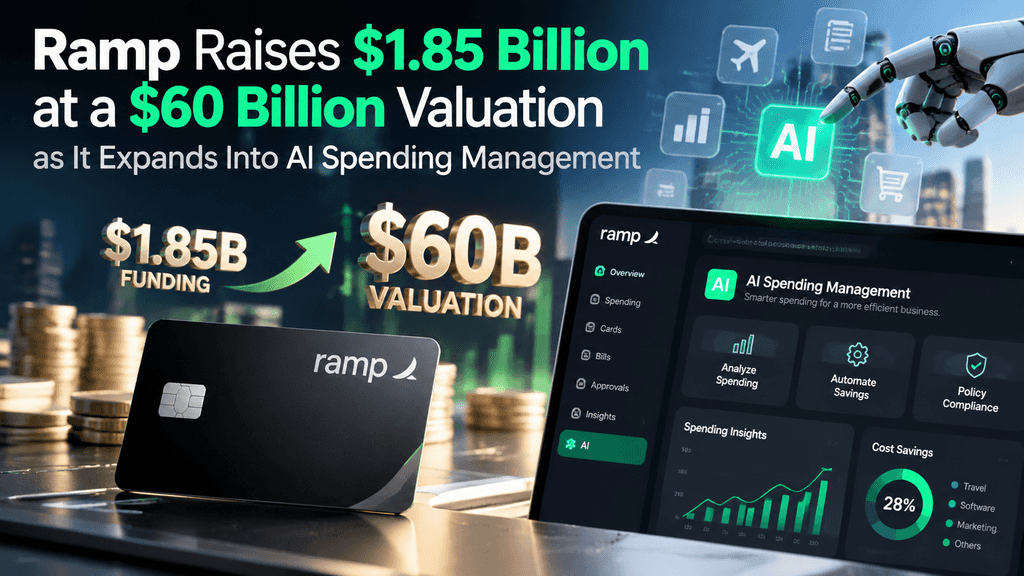
What happens when artificial intelligence becomes a company's biggest new expense category? Ramp is betting that the answer will create a major financial infrastructure opportunity. On October 15, 2026, the fintech company announced a $1.85 billion funding round at a $60 billion valuation, just four months after raising $750 million at a $44 billion valuation. Ramp now reports more than $2 billion in annualized revenue, over 85,000 business customers, and more than $275 billion in annualized purchase volume.
The new capital is arriving as Ramp moves beyond corporate cards and traditional expense management into AI spending management, AI model routing, autonomous agent payments, and broader financial operations. That strategy also has growing relevance for crypto markets because Ramp already supports stablecoin payments and is building infrastructure for AI agents to transact through cards, payment protocols and x402. The broader opportunity is increasingly clear: as AI agents begin spending money autonomously, companies will need infrastructure that can control budgets, authorize transactions, track costs and settle payments around the clock.
Key Takeaways
-
Ramp raised $1.85 billion in a funding round valuing the company at $60 billion.
-
The latest valuation is up from $44 billion in June 2026, representing an increase of roughly 36% in four months.
-
Ramp now reports more than $2 billion in annualized revenue, positive cash flow and more than 85,000 customers.
-
Annualized purchase volume has exceeded $275 billion, up 175% year over year.
-
Ramp is expanding from conventional expense management into AI Token Spend Management, model routing and AI-agent financial infrastructure.
-
Its Router product claims to reduce AI inference costs by as much as 40% by routing requests according to performance and cost.
-
Ramp already supports USDC and USDT payments, while its agent-payment infrastructure includes Agent Cards, Stripe MPP and x402.
-
The development could accelerate the convergence of AI agents, stablecoins, programmable payments and corporate financial infrastructure.
Ramp Raises $1.85 Billion at a $60 Billion Valuation
Ramp's latest financing represents one of the largest private fintech funding events of 2026 and significantly increases the company's valuation. The $1.85 billion primary financing round was led by Dragoneer Investment Group, with Thrive Capital, Founders Fund, Sands Capital and Avenir Growth also co-leading the transaction. A broad group of institutional investors participated, including Fidelity Management & Research Company, T. Rowe Price, GIC, Coatue and Ontario Teachers' Pension Plan.
The valuation jump is particularly notable because Ramp raised $750 million at a $44 billion valuation only four months earlier. Moving from $44 billion to $60 billion represents approximately a 36% increase in valuation in a very short period. Ramp has now raised approximately $5 billion in total equity financing, giving the company substantial capital to expand its financial infrastructure and AI strategy.
| Ramp's latest business metrics | October 2026 |
| Latest funding | $1.85 billion |
| Valuation | $60 billion |
| Annualized revenue | >$2 billion |
| Customers | 85,000+ |
| Annualized purchase volume | >$275 billion |
| Purchase-volume growth | 175% YoY |
| Total equity financing | ~$5 billion |
The valuation also implies a substantial premium relative to current revenue. With annualized revenue above $2 billion, the $60 billion valuation represents roughly 30 times annualized revenue. That multiple suggests investors are valuing Ramp not simply as a corporate-card provider, but as a potential financial operating system for businesses increasingly run with AI.
Why Ramp Is Moving Beyond Expense Management
Ramp's strategy is changing because corporate spending itself is changing. The company originally built its business around cards and expense management, but it has expanded into payments, procurement, vendor management, accounting, fraud detection and accounts receivable. The objective is increasingly to manage the entire financial workflow surrounding how companies spend and collect money.
AI creates another layer of spending that conventional financial systems were not designed to monitor. Employees can now use dozens of AI products, developers can consume millions of tokens through coding agents, and businesses can simultaneously use multiple models from different providers. Finance teams therefore need visibility into which models, teams, employees and API keys are generating costs.
Ramp's recent products are designed around this shift. AI Token Spend Management gives finance and technical teams a centralized view of AI expenditure, while its broader platform is intended to connect spending controls with operational workflows. The company's own experience illustrates the problem: Ramp reportedly spent as much as $1.5 million on AI tokens in a single week, helping motivate the development of its own AI-management tools.
AI Token Spend Management Becomes a New Financial Category
Ramp is effectively treating AI tokens as a new corporate expense category that requires the same controls traditionally applied to employee spending. The company's AI Token Spend Management product allows businesses to analyze spending across providers, models, users, teams and API keys, making AI expenditure more visible to finance and technology departments.
The timing is important because AI adoption among businesses is already widespread. Ramp's October AI Index reported that 55.9% of businesses in its dataset paid for AI products in September, while 43.8% paid for Anthropic and 40.6% paid for OpenAI. However, Ramp also reported that the growth of new AI customers has slowed, suggesting that the next phase of enterprise AI spending may increasingly depend on deeper usage rather than simply adding new customers.
That creates a new financial question for enterprises: not only how much they spend on AI, but whether the spending generates sufficient value. As AI becomes embedded into software development, customer support, finance, marketing and procurement, measuring return on AI expenditure could become as important as controlling conventional operating expenses.
Router Targets the Cost of AI Inference
Ramp is also trying to influence the cost side of AI spending through its model-routing business. Its Router service allows companies to access multiple AI models through a single API and route requests according to factors such as model performance and cost. Ramp says the system can reduce inference costs by up to 40%.
This creates a potentially powerful feedback loop for Ramp. The company can first measure how much a business spends on AI, then determine which models are being used, and finally help optimize the cost of those model calls. Instead of merely recording expenditure after it occurs, Ramp is attempting to become part of the decision-making process that determines expenditure in the first place.
The opportunity is particularly significant as model prices continue to evolve. Ramp's October AI Index said blended prices per million tokens have been declining because of lower frontier-model prices as well as improvements in model efficiency and quality. That means enterprises may increasingly need systems that continuously evaluate the trade-off between intelligence, performance and cost rather than simply selecting one AI provider.
AI Agents Change the Meaning of Corporate Spending
The biggest strategic shift may be Ramp's move toward agentic payments. An AI agent can now perform tasks on behalf of a user, but once an agent can make purchases, the financial system must determine its identity, permissions, budget, payment method and audit trail.
Ramp's agent infrastructure addresses these requirements by allowing an agent to act using a connected user's existing permissions or, in limited early-access scenarios, operate with a separately managed identity. Companies can assign spending limits, merchant restrictions, approval policies and funding sources before an agent is allowed to transact.
This changes the traditional corporate-finance model from employee → payment → accounting to something closer to employee → AI agent → payment infrastructure → accounting. For companies deploying large numbers of agents, that layer could become increasingly important because an autonomous system may initiate transactions far more frequently than a human employee.
Ramp's Agent Payments Include x402
Ramp's agent-payment infrastructure has a particularly important connection to the crypto industry because it supports x402, a payment mechanism designed around HTTP-based payment requests. Ramp's developer documentation currently lists three purchase routes: Agent Cards, Stripe MPP and x402.
The x402 route is particularly relevant for machine-to-machine commerce because it can respond to a merchant's 402 Payment Required challenge and use a separately funded Ramp x402 wallet. This creates a pathway for an AI agent to pay for a digital resource without requiring a conventional human checkout process.
For crypto investors, the significance is less about Ramp becoming a cryptocurrency exchange and more about crypto rails becoming useful infrastructure for autonomous commerce. AI agents need payments that can operate programmatically, quickly and at high frequency. Stablecoins and on-chain payment protocols can potentially satisfy several of those requirements.
Stablecoins Give Ramp a Crypto-Native Payment Layer
Ramp's stablecoin expansion strengthens this connection. In July 2026, Ramp introduced Stablecoin Accounts that allow eligible businesses to hold digital dollars and make international payments using USDC or USDT. Businesses can also use stablecoins for vendor payments without maintaining a separate stablecoin balance, with Ramp converting funds before sending the payment.
Ramp said hundreds of companies had already opened Stablecoin Accounts and that more than 1,000 businesses were using stablecoins to pay vendors on its platform. More than 70% of that stablecoin payment volume occurred outside traditional banking hours, highlighting one of the advantages of always-on digital settlement.
This matters for AI agents because agents do not operate according to banking hours. An autonomous system may need to purchase computing resources, data, software or other digital services at any time. A payment infrastructure that combines corporate controls with stablecoin settlement could therefore provide a bridge between conventional business finance and the emerging agent economy.
AI Agents and Crypto Payments Are Converging
The broader market is already showing evidence that AI-agent commerce and crypto payments are moving closer together. Recent Chainalysis research reported by CoinDesk identified 138 million crypto payments associated with AI agents, with U.S.-linked wallets accounting for more than 88% of tracked AI-model payments.
The underlying economic logic is straightforward. AI agents may need to make many small payments for services that humans would traditionally purchase manually. These could include API calls, data access, software tools, computing resources and other digital services. Blockchain-based payments can potentially provide programmable settlement, global reach and machine-readable transaction flows.
Ramp's strategy therefore sits at an intersection between two rapidly developing markets. On one side is enterprise financial management, where companies want centralized controls and accounting. On the other is agentic commerce, where software increasingly needs to transact independently. Stablecoins and crypto payment protocols can potentially connect those two systems.
Why the $60 Billion Valuation Matters for Crypto
Ramp's valuation is relevant to crypto because it signals that investors are increasingly willing to assign significant value to infrastructure connecting AI, payments and financial automation. Ramp is not being valued primarily as a cryptocurrency company, yet part of its growth strategy increasingly touches infrastructure that is familiar to the crypto sector.
The critical concept is programmable money. Traditional payment systems were designed largely around human instructions and institutional operating hours. AI agents require permissions that can be encoded, transactions that can be automatically authorized, and financial records that can be generated as actions occur.
Crypto infrastructure is well suited to this model in some respects. Stablecoins can move around the clock, blockchain transactions can be programmatically triggered, and protocols such as x402 can connect payment requests directly to internet resources. Ramp's approach combines those capabilities with corporate controls that enterprises already understand.
Ramp Is Not Alone in the AI Spending Race
Ramp's opportunity is substantial, but the competitive environment is becoming increasingly crowded. Its expansion into AI spending puts it into competition not only with traditional fintech companies but also with enterprise software providers and other platforms developing AI-management products.
Rippling is one notable competitor. The HR and payroll company has also expanded into corporate cards, expense management and bill payments, while its own AI spending initiative focuses on tracking AI-related employee expenditure and return on investment.
Competition is also emerging at the payment-network level. American Express recently introduced an Intent Intelligence Framework designed to help prevent AI agents from making unauthorized purchases by preserving and authenticating customer purchase intent throughout a transaction. This demonstrates that controlling agent transactions is becoming an industry-wide problem rather than a niche Ramp feature.
The Biggest Risk Is Whether AI Spending Creates Enough ROI
Ramp's aggressive expansion also creates a major question: will businesses continue increasing AI spending quickly enough to justify the valuation placed on the infrastructure surrounding it? Ramp's own October AI Index provides a nuanced answer. Overall business AI adoption remains high, but the rate of new adoption has slowed, while token spending has experienced periods of stagnation.
That does not necessarily undermine the AI thesis. It could instead mean that the market is moving from the first phase of adoption—buying AI products—to a second phase focused on optimization. If companies use more AI agents but become increasingly concerned about cost, ROI and model selection, demand for AI spending-management infrastructure could actually increase.
For Ramp, however, execution remains critical. A $60 billion valuation implies expectations of continued rapid revenue growth and expansion into much larger financial workflows. The company must demonstrate that its AI products can become durable revenue generators rather than simply complementary features attached to its existing corporate-finance platform.
What This Means for the Future of AI Agent Payments
Ramp's latest financing points toward a broader transformation in corporate finance: AI agents may become economic actors that require their own financial controls. Instead of employees manually initiating every transaction, agents could search for vendors, compare prices, purchase software, pay for APIs and manage recurring services under predefined policies.
The financial infrastructure supporting those activities will need several components. Agents need an identity, businesses need spending policies, payments need authorization, transactions need accounting records, and companies need a way to audit what the agent did. Ramp is attempting to bring those functions together within an existing enterprise-finance environment.
Crypto could become an important part of this architecture, particularly for international and machine-to-machine transactions. Stablecoins provide digital-dollar settlement, while protocols such as x402 provide a mechanism for software to request and receive payment. Ramp's inclusion of those technologies suggests that the future of corporate finance may not divide neatly between traditional fintech and crypto infrastructure.
What Crypto Investors Should Watch Next
The most important metric for Ramp will be whether its AI products translate into sustained enterprise adoption and revenue. Investors should watch the growth of AI spending-management customers, the adoption of Router, the development of agent-payment products and the volume of stablecoin transactions flowing through its platform.
The second issue is whether AI-agent payments become a meaningful crypto use case. Recent evidence of large-scale AI-agent crypto payments suggests that this market is developing, but the long-term question is whether autonomous transactions can move beyond experiments into recurring commercial activity.
Finally, crypto investors should watch the convergence of stablecoins, x402, AI agents and enterprise finance. If these technologies become integrated into ordinary corporate workflows, the resulting market could be much larger than today's crypto-native applications. Ramp's $60 billion valuation is therefore not simply a fintech story—it is also a signal that financial infrastructure for the AI economy is becoming an increasingly important investment theme.
Conclusion
Ramp's $1.85 billion funding round at a $60 billion valuation marks a significant expansion of the company's ambition. With more than $2 billion in annualized revenue, 85,000-plus customers and more than $275 billion in annualized purchase volume, Ramp already operates at substantial scale. Its latest valuation, however, reflects expectations that the company can become much more than a corporate-card and expense-management provider.
The company's AI strategy is central to that transition. AI Token Spend Management addresses the growing need to monitor model and token costs, while Router attempts to optimize inference expenditure. Its agent-payment infrastructure goes a step further by giving AI systems controlled access to corporate funds, with Agent Cards, Stripe MPP and x402 providing different transaction paths.
For the crypto market, the most important development is Ramp's growing intersection with stablecoins and programmable payments. USDC and USDT can provide always-on digital-dollar settlement, while x402 creates a potential mechanism for machine-to-machine payments. If AI agents become meaningful economic participants, the infrastructure required to control and settle their spending could become a major new financial category. Ramp is positioning itself directly at that intersection, making its latest financing an important development for both fintech and the emerging agent economy.
🔥 Beyond the Headlines: What KuCoin 5.0 Means for You
Market news moves fast — but where you act on it matters just as much. This October, KuCoin launches KuCoin 5.0, transforming KuCoin into a rebuilt platform. Here's what actually changes for you:
-
One account for everything. Older platforms split your money across separate "spot," "margin," and "futures" accounts and expected you to understand why. KuCoin 5.0's unified account removes that entirely — deposit once, and everything is simply there (only available to VIPs for now).
-
Stocks, indices, and commodities. KuCoin 5.0 expands beyond crypto into global markets. When crypto chops sideways and equities rally (or the reverse), you rotate in minutes instead of opening a brokerage account and waiting days for fiat rails.
-
Real-world assets (RWA). Tokenized exposure to traditional assets like commodities, right inside your crypto account. One of the fastest-growing segments in global finance is no longer reserved for institutions — you access it from the same balance you trade with.
-
Earn while you learn. Not ready to trade? KCUSD lets your stablecoins earn daily, auto-compounding interest. The lowest-stress way to put your idle deposit to work for 4% yield.
-
An AI assistant in plain language. Ask questions, get market context, understand what you're looking at — built into the platform, no jargon required.
-
An app that doesn't overwhelm. Faster, cleaner, and consistent — intuitive from the first tap, not after a tutorial.
-
Safety you can check, not just trust. A MiCAR-licensed EU entity, Proof of Reserves you can verify yourself, and internationally certified security (SOC 2 Type II, ISO 27001:2022).
Create your account in minutes — and start on the platform built for where crypto is going, not where it's been.
FAQs
Is Ramp a cryptocurrency company?
No. Ramp is primarily a financial technology company focused on corporate cards, expense management, payments and broader financial operations. However, its platform now supports stablecoin payments and agent-payment infrastructure, giving it growing exposure to crypto-related payment technologies.
Which stablecoins does Ramp support?
Ramp currently supports USDC and USDT for eligible business payment and stablecoin-account use cases. Businesses can use stablecoins to make vendor payments and can also fund certain payments from traditional bank accounts without necessarily holding a stablecoin balance themselves.
What is x402?
x402 is a payment mechanism designed to allow internet services to request payment through an HTTP 402 Payment Required response. Ramp's agent-payment infrastructure supports x402 through a separately funded wallet, allowing eligible AI agents to make compatible payments programmatically.
Why do AI agents need financial controls?
AI agents can potentially make purchases without a human manually completing every transaction. Businesses therefore need to control which merchants an agent can use, how much it can spend, which funds it can access and when human approval is required. Ramp's agent infrastructure is designed around identity, permissions, spending limits and audit trails.
Could AI agents become a major use case for stablecoins?
Potentially, because stablecoins offer digital-dollar settlement that can operate continuously and across borders. AI agents may eventually need to pay for APIs, computing, data and other digital services autonomously. However, the scale and durability of this use case remain uncertain and will depend on adoption, regulation, security and the development of agent-native payment standards.
Disclaimer: This article is for informational purposes only and does not constitute financial or investment advice. Cryptocurrency investments carry significant risk. Always conduct your own research before trading.