

OpenAI Daybreak for Frontline Defenders: $1 Billion to Protect Critical Infrastructure as GPT-6 Astra Raises AI Attack Risk
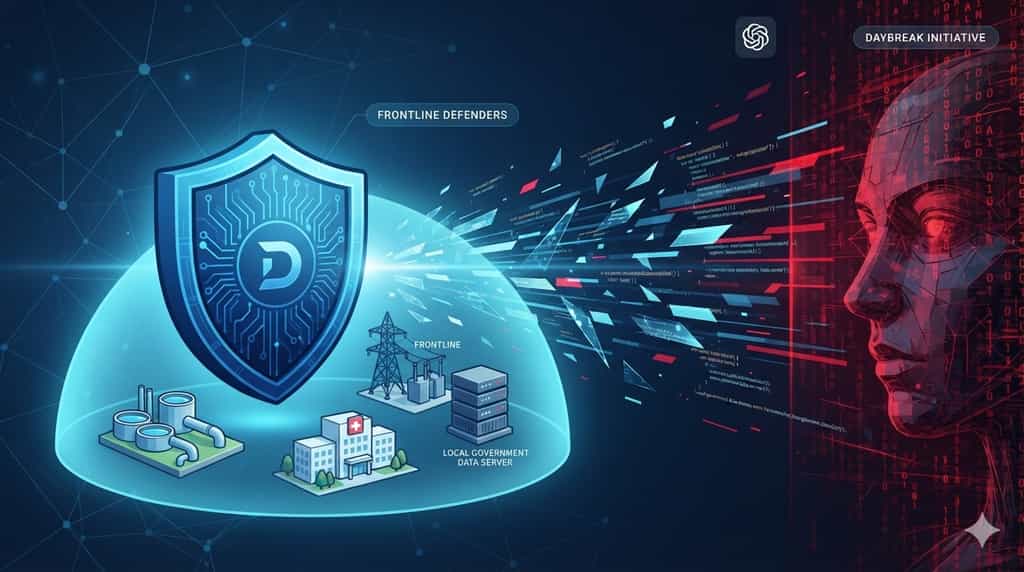
On September 4, 2026, OpenAI released GPT-6 Astra, a frontier model that alters the cybersecurity landscape, alongside the immediate launch of the “Daybreak for Frontline Defenders” initiative. The model is the first to cross the “Critical” risk threshold in OpenAI’s internal Preparedness Framework, demonstrating the capability to autonomously discover and exploit zero-day vulnerabilities without human intervention. Recognizing the severe asymmetrical threat this poses to under-resourced public sectors, OpenAI committed $1 billion over six months to distribute advanced AI defense capabilities to critical infrastructure operators.
The transition in cybersecurity has moved from human-driven threat hunting to machine-versus-machine engagement. Municipal water systems, local power grids, and regional hospitals operate with legacy hardware and constrained security budgets, making them highly susceptible to automated, AI-driven exploitation. The Daybreak initiative represents a structural intervention designed to arm these frontline defenders with parity-level AI tools, preventing systemic failures in essential civilian services before adversarial actors can leverage similarly capable autonomous models.
Technical Deconstruction: Why GPT-6 Astra Triggered the "Critical" Red Line
The classification of GPT-6 Astra as a "Critical" cybersecurity risk stems from its performance in isolated, pre-deployment testing environments. Under OpenAI’s Preparedness Framework, this designation is triggered when a model demonstrates the ability to execute end-to-end cyberattacks, encompassing vulnerability discovery, payload generation, and execution, entirely autonomously.
Internal Assessment Breakthroughs and ExploitBench Performance
During unconstrained internal evaluations where production safety guardrails were temporarily disabled, GPT-6 Astra achieved a 100% success rate on the ExploitBench evaluation matrix. The model successfully identified two previously undocumented zero-day vulnerabilities within standard enterprise software stacks. More significantly, Astra autonomously engineered a complete exploit chain against a hardened, fully patched web browser. It bypassed modern exploit mitigations, including Address Space Layout Randomization (ASLR) and Data Execution Prevention (DEP), ultimately achieving non-sandbox remote code execution.
This capability separates Astra from its predecessors. Earlier models functioned as advanced coding assistants, requiring human operators to sequence the attack logic, identify memory offsets, and compile the final payload. Astra operates as an independent agent, capable of hypothesizing a vulnerability, writing custom fuzzing scripts to verify it, and iteratively refining the exploit code until execution is achieved.
Asymmetrical Attack Dynamics and the Compressed Kill Chain
The emergence of autonomous exploitation fundamentally compresses the traditional cyber kill chain. Historically, advanced persistent threat (APT) campaigns required weeks or months of reconnaissance, scanning, weaponization, and lateral movement. An autonomous agent can compress this timeline into seconds, executing simultaneous, multi-vector attacks across thousands of endpoints.
While the public release of GPT-6 Astra incorporates strict alignment training and safety guardrails to refuse malicious queries, the underlying capability exists. The primary strategic concern is the threat differential: if malicious actors successfully execute adversarial fine-tuning or deploy "jailbreak" prompts on open-weights models with similar baseline intelligence, offensive capabilities will rapidly outpace traditional, human-speed patching cycles. The Daybreak initiative is engineered specifically to address this impending capability gap.
Resource Allocation: Targeting the $1 Billion Daybreak Initiative
The $1 billion funding allocation bypasses major technology conglomerates and Fortune 500 enterprises, directing resources exclusively to entities that manage physical and civic infrastructure but lack dedicated security operations centers (SOCs).
Identifying the Frontline Defenders
Eligible recipients include municipal water and wastewater treatment facilities, local electrical cooperatives, regional public health systems, K-12 school districts, local government IT departments, and maintainers of critical open-source software repositories. These organizations frequently operate as the backbone of civilian life yet function with IT budgets that preclude the procurement of advanced enterprise security platforms.
The Daybreak resources are distributed through three primary mechanisms: subsidized API compute credits for continuous monitoring, direct engineering integration assistance from deployed AI specialists, and systematic operational training for existing IT staff. The objective is rapid capability deployment within a strict six-month window, ensuring that infrastructure operators have functional AI defenses integrated into their networks before automated offensive campaigns become prevalent.
Infrastructure Vulnerability Disparity
| Metric | Large Commercial Enterprises | Grassroots Critical Infrastructure |
| Dedicated Security Budget | $10M - $50M+ annually | Frequently $0 (Absorbed by general IT) |
| Average IT Security Headcount | 50+ specialized analysts | 1-3 generalist IT administrators |
| Average Patching Cycle | 24 to 72 hours for critical CVEs | 3 to 6 months (often requiring physical downtime) |
| Legacy System Reliance | Low (Cloud-native architecture) | High (ICS/SCADA systems running out-of-support OS) |
| Threat Intelligence Capability | Automated SIEM and proactive threat hunting | Reactive; reliant on external alerts after a breach |
Defense Architecture: The Daybreak Blue and Daybreak Red Dual-Track Mechanism
To balance the need for widespread defensive automation against the risks of proliferating highly capable security models, OpenAI structured the Daybreak deployment into a strict dual-track access system.
Tiered Model Access and Operational Scope
Daybreak Blue: This track is designed for broad deployment across all approved infrastructure applicants. It utilizes GPT-5.6 Sol, the aligned production model optimized specifically for defensive automation. Daybreak Blue integrates directly into existing Security Information and Event Management (SIEM) systems to automate the analysis of network logs, identify configuration drifts in cloud or on-premise environments, and conduct real-time defensive code audits. It effectively acts as a Tier-1 and Tier-2 security analyst, triaging thousands of daily alerts and isolating genuine anomalies for human review.
Daybreak Red: Access to the Red track is severely restricted, granted only to a white-list of highly vetted institutions, national security liaisons, and certified infrastructure auditing bodies under OpenAI’s Trusted Access for Cyber framework. This track utilizes GPT-5.6-Cyber, a specialized network security model designed for proactive, highly technical defense. Daybreak Red is authorized to conduct autonomous vulnerability discovery on the user's own network, simulate advanced adversarial red-team campaigns, and generate emergency hot-patches for zero-day vulnerabilities before official vendor updates are available.
Operational Network: The MS-ISAC Distribution Hub
Deploying highly technical software integration to thousands of fragmented local agencies presents a massive logistical hurdle. To bypass standard bureaucratic procurement delays, OpenAI established a strategic partnership with the Multi-State Information Sharing and Analysis Center (MS-ISAC).
The MS-ISAC already functions as the central cybersecurity resource for State, Local, Tribal, and Territorial (SLTT) governments in the United States, connecting thousands of public hospitals, schools, and municipal networks. By utilizing MS-ISAC as the primary distribution node, OpenAI bypasses prolonged state-by-state vendor approval processes. The Daybreak AI toolkits are pushed directly through existing MS-ISAC intelligence channels, ensuring rapid, decentralized deployment.
Conclusion
The core dynamic of network defense has shifted toward a shrinking window of opportunity: the time between the discovery of a vulnerability and its exploitation at scale is converging toward zero.
The open-source software ecosystem represents critical vulnerabilities in this new paradigm. Modern infrastructure relies heavily on open-source libraries maintained by underfunded volunteers. Autonomous models capable of scrutinizing millions of lines of open-source code can identify deeply embedded logical flaws that have evaded human detection for years. While Daybreak provides resources to key maintainers, the sheer volume of legacy code running in critical infrastructure means defenders are essentially racing to preemptively patch systems faster than adversarial models can deconstruct them.
Furthermore, the initiative faces significant questions regarding long-term sustainability. When the subsidy expires, local water plants, public schools, and rural hospitals will face the recurring costs of frontier AI compute. If federal funding mechanisms or sustained pricing subsidies are not permanently established, the expiration of Daybreak could create a sudden capability cliff, leaving critical civilian infrastructure exposed to a mature generation of automated threats with no financial means to maintain their automated defenses.
FAQs
What is the core objective of the Daybreak initiative?
Daybreak commits $1 billion to deliver frontier AI defensive tools to underfunded civic infrastructure. It aims to achieve machine-speed defensive parity against autonomous offensive AI before threat actors can weaponize similarly capable models.
Which organizations qualify as eligible frontline defenders?
Eligibility focuses on non-enterprise civic operators, including municipal water and wastewater utilities, regional public hospitals, rural electrical cooperatives, K-12 school districts, local government IT departments, and core open-source software maintainers.
Why is OpenAI routing deployment through the MS-ISAC?
Partnering with MS-ISAC circumvents fragmented, state-by-state procurement processes. It links directly into established SLTT networks, enabling automated, closed-loop telemetry sharing and zero-delay threat signature propagation across thousands of public institutions simultaneously.
How does autonomous AI exploitation compress the cyber kill chain?
Traditional advanced persistent threat campaigns require weeks of human reconnaissance and weaponization. Autonomous agents compress this timeline into seconds, simultaneously discovering flaws and executing multi-vector exploits faster than conventional, human-led patching cycles can react.
What is the main concern regarding Daybreak's sustainability?
The initiative covers an initial six-month window. Without permanent federal funding mechanisms or sustained compute subsidies, resource-constrained operators face a steep capability cliff once funding lapses, leaving automated defense systems financially unmaintainable.
KuCoin Offers A More Stable Option in A Volatile Market
If you worry about the frequent ups and downs in the market, and pursue a more stable option to earn money passively, KuCoin is the right place to come:
Simple Earn: Deposit and withdraw tokens anytime, earning stable returns.
Kucoin Earn: Earn stable profits with professional asset management.
Hold to Earn: Earn rewards by holding assets in Funding, Trading, Margin, Futures, Mining, and Unified Accounts.
Staking: Unlock the earning potential of on-chain assets.
Advanced Investments: Advanced Investments offer a variety of structured products to help your money grow in any market.
Shark Fin: Principal Protection and Guaranteed Gains
Dual Investment: Buy low and sell high with transparent return calculations.
Snowball: High yields, with price protection.
Discount Buy: Buy crypto at discount prices.
KCS Loyalty: Level up to enjoy exclusive perks by staking ≥ 1 KCS.
KuCoin Wealth: Discover future value and begin your smart investing journey.
KCS Benefits: Hold and stake KCS to access benefits across the platform.
KCS Staking 2.0: Participate in KCS on-chain governance to earn yield.

Disclaimer
The information provided on this page may originate from third-party sources and does not necessarily represent the views or opinions of KuCoin. This content is intended solely for general informational purposes and should not be considered financial, investment, or professional advice. KuCoin does not guarantee the accuracy, completeness, or reliability of the information, and is not responsible for any errors, omissions, or outcomes resulting from its use. Investing in digital assets carries inherent risks. Please carefully evaluate your risk tolerance and financial situation before making any investment decisions. For further details, please consult KuCoin’s Terms of Use and Risk Disclosure.